

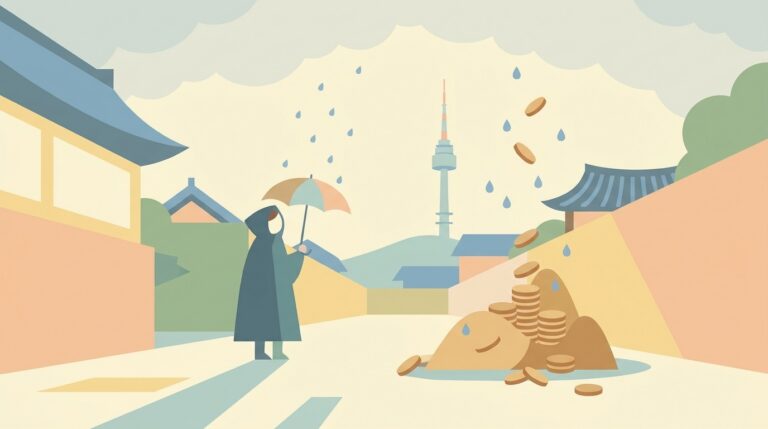
Phase 1: Why Tiny Drops Matter in Korea
안녕하세요! 매일한글 에디터입니다. (Hello! This is the Daily Hangul Editor.) Picture this: you’re curled up watching a gritty Korean office drama or a relatable “no-spend challenge” (무지출 챌린지, mujichul chaellinji) YouTube vlog from Seoul. The main character sighs over an empty bank account—not from one big splurge, but from daily 4,500 KRW iced Americanos and late-night delivery fees. At Level 6, you already grasp complex Korean grammar, yet native speakers constantly drop earthy, centuries-old proverbs laced with humor and social satire. Based on real coaching sessions with advanced learners, this guide unlocks the exact nuance behind two iconic Korean proverbs so you can read the room—and sound effortlessly native.
Phase 2: 3 Core Expressions Deep Dive
1. 가랑비에 옷 젖는 줄 모른다 (Garangbie ot jeotneun jul moreunda)
- Pronunciation: ga-rang-bi-e ot jeon-neun jul mo-reun-da (Imagine ot stopping abruptly like the “t” in “hat” before releasing any air, then flowing smoothly into jeon-neun like “juhn-neun”).
- Meaning: Literally “One doesn’t notice one’s clothes getting soaked in a drizzle.” In real life, it warns that seemingly trivial expenses, minor bad habits, or tiny compromises accumulate silently until the damage is irreversible.
- K-Culture Moment: You’ll hear this constantly in Korean financial variety shows or slice-of-life dramas whenever a character casually swipes their card for micro-luxuries and wonders where their paycheck went.
- Editor’s Insight: Unlike a sudden downpour (소나기, sonagi), a fine drizzle (garangbi) feels harmless in the moment. At an advanced level, notice how this proverb carries a quiet, slightly satirical critique of human complacency.
- Situation Spectrum: Casual ✅ | Semi-formal ✅ | Formal ⚠️ (Use cautiously with superiors unless reflecting on your own habits or discussing broad trends!)
- 🤔 Think About It: English uses sharper metaphors like “death by a thousand cuts.” Why do you think Korean turns to a soft, sensory weather image (drizzle) to warn against carelessness?
2. 티끌 모아 태산 (Tikkeul moa taesan)
- Pronunciation: ti-kkeul mo-a tae-san (The kk in tikkeul is a tense, un-aspirated “k”—like the “k” in “sky” with zero puff of air; taesan sounds close to “teh-sahn”).
- Meaning: Literally “Dust gathered together forms Mount Tai (a grand mountain).” Traditionally, it celebrates how persistent small savings or daily efforts yield monumental success.
- K-Culture Moment: It’s a staple in K-Pop idol documentary interviews (practicing 15 extra minutes every night for years) and Korean “frugal-tech” (짠테크, jjantech) vlogs.
- Editor’s Insight: Here’s the C2 cultural secret: modern young Koreans often twist this proverb with biting social satire—saying “티끌 모아 티끌” (Tikkeul moa tikkeul — “Dust gathered is still just dust”) when inflation outpaces tiny savings! Knowing both the classic earnest version and the ironic twist proves true fluency.
- Situation Spectrum: Casual ✅ | Semi-formal ✅ | Formal ✅
- 🤔 Think About It: English says “Rome wasn’t built in a day,” focusing on time and architecture. Korean contrasts microscopic tikkeul (dust) with cosmic taesan (a legendary peak). What does that extreme contrast reveal about Korean resilience?
3. 바늘 도둑이 소 도둑 된다 (Baneul dodugi so doduk doenda)
- Pronunciation: ba-neul do-du-gi so do-duk dwen-da (do-du-gi glides lightly like “doh-doo-gee” with a soft “g”; doenda sounds like “dwen-da”).
- Meaning: Literally “A needle thief becomes a cow thief.” It warns that excusing minor moral lapses or sloppy shortcuts inevitably snowballs into major ethical or personal ruin.
- K-Culture Moment: Frequently delivered by seasoned detectives or strict elders in Korean thriller and chaebol dramas when a tiny cover-up spirals into a massive corporate scandal.
- Editor’s Insight: Notice the difference: 가랑비 (garangbi) highlights unconscious accumulation, whereas 바늘 도둑 targets rationalized escalation. Pairing them gives you full mastery over how Koreans discuss human nature.
- Situation Spectrum: Casual ✅ | Semi-formal ✅ | Formal ⚠️ (Too blunt if aimed directly at a boss or client—keep it to third-person commentary.)
- 🤔 Think About It: Does your native language have a folkloric escalation proverb like “needle to cow,” and where do you draw the line between helpful warning and harsh judgment?
Phase 3: Textbook Korean vs. Real Korean
Situation 1: Calling out daily micro-spending
- 📖 교과서 한국어 (Textbook Korean): 매일 조금씩 돈을 쓰면 나중에는 큰 금액이 될 수 있으니 주의해야 합니다. (Maeil jogeumssik doneul sseumyeon najungeneun keun geumaegi doel su isseuni juuihaeya hamnida. — If you spend a little money every day, it can become a large sum later, so you must be careful.)
- 🗣️ 진짜 한국어 (Real Korean): 야, 너 그렇게 배달비 야금야금 쓰다간 가랑비에 옷 젖는 줄 모른다니까? (Ya, neo geureoke baedalbi yageumyageum sseudagan garangbie ot jeotneun jul moreundanikka? — Hey, if you keep nibbling away at your cash with delivery fees like that, you won’t even notice until you’re soaked!)
- 💡 왜 다를까? (Why is it different?): Real Koreans pair the proverb with vivid mimetic adverbs like 야금야금 (yageumyageum — nibbling bit by bit) and the conversational warning ending -다니까? to sound like a caring friend instead of a finance textbook.
Situation 2: Reacting to modern hustle & saving culture
- 📖 교과서 한국어 (Textbook Korean): 비록 지금은 성과가 작아 보이지만 꾸준히 노력하면 큰 결실을 맺을 것입니다. (Birok jigeumeun seonggwaga jaga boijiman kkujunhi noryeokamyeon keun gyeolsireul maejeul geosimnida. — Although results seem small now, steady effort will bear great fruit.)
- 🗣️ 진짜 한국어 (Real Korean): 요즘 다들 ‘티끌 모아 티끌’이라고 자조해도, 난 결국 티끌 모아 태산이라는 말을 믿어. (Yojeum dadeul ‘tikkeul moa tikkeul’irago jajohaedo, nan gyeolguk tikkeul moa taesaniraneun mareul mideo. — Even though everyone self-deprecatingly jokes “dust gathered is just dust” lately, I still believe tiny efforts build a mountain.)
- 💡 왜 다를까? (Why is it different?): Advanced speakers weave contemporary internet satire into classic proverbs, using verbs like 자조하다 (jajohada — to be self-deprecating) to show sharp awareness of Korea’s economic mood.
Phase 4: K-Culture Deep Dive & Non-Verbal Manners
4-1. 눈치 (Nunchi) & Gestures
Proverbs carry authority in Korea, which means delivery is everything if you want to avoid sounding like a 꼰대 (kkondae — a preachy, condescending elder). When teasing a friend with 가랑비에 옷 젖는 줄 모른다 (You don’t notice clothes getting soaked in a drizzle), soften your expression with a wry smile and a slight head tilt—never point a finger! When encouraging a junior colleague with 티끌 모아 태산 (Dust gathered makes a mountain), keep your voice warm and nod slowly to show genuine respect for their daily grind.
4-2. Cultural Code Analysis: From Confucian Thrift to “Beggar Chatrooms”
Modern Korea lives in a fascinating tug-of-war between traditional frugality (근검절약, geungeomjeoryak) and flashy consumerism. Recently, young Koreans popularized “거지방” (geojibang — “Beggar Chatrooms”), open group chats where strangers playfully scold each other out of buying a 4,500 KRW iced coffee by dropping satirical lines like 가랑비에 옷 젖는 줄 모른다. That playful communal accountability keeps centuries-old proverbs alive in smartphone culture.
Phase 5: Real-Life Roleplay Scenario
- Setting & Characters: A cozy, rain-streaked café in Seongsu-dong on Friday evening. You are chatting over coffee with Min-ji, your witty Korean colleague who swears she is on a strict budget yet orders dessert and limited-edition merch every week.
Min-ji: 🎭 (Staring dramatically at her banking app while stirring her iced latte) 어휴, 이번 달도 월급이 로그아웃했네. (Eohyu, ibeon daldo wolgeubi rogeuauthaenne. — Sigh, my paycheck logged right out again this month.)
You: 🎭 (Chuckles gently while glancing at the pastry receipt on the table) 아니, 어제도 큰돈 쓴 적 없다며? (Ani, eojedo keundon sseun jeok eopdamyeo? — Wait, didn’t you say yesterday you hadn’t spent any big money?)
Min-ji: 🎭 (Shrugs defensively, holding up four fingers) 진짜야! 그냥 커피 한 잔, 택시 한 번, 구독료 몇 개뿐이라니까? (Jinjjaya! Geunyang keopi han jan, taeksi han beon, gudokryo myeot gaeppuniranikka? — I’m serious! It’s literally just one coffee, one taxi, and a couple subscriptions!)
You: 🎭 (Smiles knowingly and leans forward slightly) 민지야, 그게 바로 가랑비에 옷 젖는 줄 모른다는 거야. (Minjiya, geuge baro garangbie ot jeotneun jul moreundaneun geoya. — Min-ji, that right there is not noticing your clothes getting soaked in a drizzle.)
Min-ji: 🎭 (Laughs and sighs in defeat) 아, 맞다… 요즘은 커피값 몇 푼 아낀다고 티끌 모아 티끌 아니냐며 그냥 막 썼더니 이 모양이네. (A, matda… yojeumeun keopikkap myeot pun akkindago tikkeul moa tikkeul aninyamyeo geunyang mak sseotdeoni i moyangine. — Ah, true… lately I joked “saving coffee money is just dust,” spent carelessly, and look at me now.)
You: 🎭 (Encouragingly taps your notebook) 그래도 오늘부터 쓸데없는 구독부터 끊어 봐. (Geuraedo oneulbuteo sseuldeeomneun gudokbuteo kkeuneo bwa. — Still, try canceling the useless subscriptions starting today.)
Min-ji: 🎭 (Eyes lighting up slightly as she picks up her phone) 오, 그래! 역시 티끌 모아 태산이지. 지금 바로 해지해야겠다! (O, geurae! Yeoksi tikkeul moa taesaniji. Jigeum baro haejihaeyagetda! — Oh, right! Little drops really do make a mountain. I’m canceling them right now!)
You: 🎭 (Raises your cup in a playful toast) 좋아, 이번 달은 우리 둘 다 흑자 가자! (Joha, ibeon dareun uri dul da heukja gaja! — Nice, let’s both finish this month in the black!)
🔀 Interactive Branching Point: What if your team leader (팀장님) complained about small budget leaks?
- A) “팀장님, 가랑비에 옷 젖는 줄 모른다잖아요.” (Team leader, they say you don’t notice clothes getting soaked in a drizzle.)
- B) “작은 지출들이 쌓이면 나중에 부담이 될 수 있으니, 이번 기회에 같이 점검해 볼까요?” (Since small expenses can add up to a burden later, shall we review them together this time?)
- C) “바늘 도둑이 소 도둑 된다고 하니까 조심하셔야죠.” (Since a needle thief becomes a cow thief, you’d better be careful.)
Feedback:
* Option A (Risk ⚠️): While the proverb itself is mild, tossing it casually at a superior with -잖아요 can sound subtly patronizing depending on your closeness.
* Option B (Best ✅): Politeness meets precision! You convey the exact logic of 가랑비 without sounding preachy, inviting collaboration with -볼까요?.
* Option C (Bad 🚫): Never link a superior’s casual habit to a proverb about stealing (도둑)—that crosses straight from helpful advice into an offensive accusation!
Phase 6: 10-Second Emotion Shadowing Drill
Read aloud, pausing briefly at / and matching the emotional cue:
[😒 Gently exasperated]야, / 그렇게 매일 야금야금 쓰다간 / 가랑비에 옷 젖는 줄 모른다니까? (Ya, / geureoke maeil yageumyageum sseudagan / garangbie ot jeotneun jul moreundanikka? — Hey, if you keep nibbling away like that every day, you won’t even notice till you’re soaked!)[😏 Wry, self-deprecating smirk]요즘 다들 / ‘티끌 모아 티끌’이라고 웃지만, / 나는 결국 태산이 된다고 믿어. (Yojeum dadeul / ‘tikkeul moa tikkeul’irago utjiman, / naneun gyeolguk taesani doendago mideo. — Everyone laughs saying “dust is just dust” lately, but I believe it eventually becomes a mountain.)[🧐 Serious, warning tone]사소한 타협도 / 그냥 넘기면 / 바늘 도둑이 소 도둑 되는 법이야. (Sasohan tahyeopdo / geunyang neomgimyeon / baneul dodugi so doduk doeneun beobiy-a. — If you brush off even tiny compromises, a needle thief becomes a cow thief.)
Phase 7: K-Culture Mini Dictionary
- 야금야금 (yageumyageum) | Little by little / bit by bit | Used vividly in everyday speech and business when costs, time, or market share erode gradually without notice.
- 짠테크 (jjantech) | Frugal-tech (from 짜다 “stingy” + 재테크 “financial tech”) | Widely used in media and casual conversation for clever daily micro-saving hacks, like app-rewards and transfer discounts.
- 거지방 (geojibang) | “Beggar Chatroom” | A playful Korean KakaoTalk trend where users share tempted purchases and talk each other out of unnecessary spending.
- 자조적 (jajojeok) | Self-deprecating / cynically humorous | An essential Level 6 adjective in essays, news, and reviews to describe satirical twists like 티끌 모아 티끌.
Phase 8: Survival Kit for Travelers
Top 3 Practical Expressions
- 이거 혹시 추가 요금 있나요? (Igeo hoksi chuga yogeum innayo? — Is there an extra charge for this?) — Pro Tip: Use this at cafés or taxis to avoid 가랑비-style hidden surcharges.
- 따로따로 계산해 주세요. (Ttarottaro gyesanhae juseyo. — Please ring these up separately.) — Pro Tip: Essential when traveling with friends so nobody loses track of small shared costs.
- 작지만 정성껏 준비했어요. (Jakjiman jeongseongkkeot junbihaesseoyo. — It’s small, but I prepared it with care.) — Pro Tip: A warm cultural staple when handing someone a thoughtful souvenir.
Editor’s Travel Note
In Seoul, 티끌 모아 태산 becomes literal magic on public transit! When you tap a T-money card between the subway and bus within 30 minutes, Korea’s transfer discount (환승 할인) saves you around 1,400 KRW per ride—adding up fast over a two-week trip. Before landing, check out the Naver Map App Official Download Guide to track exact bus/subway transfer fares in real time, and bookmark the Korea Transit T-money Fare Information page for seamless cashless budgeting.
Phase 9: One Step Deeper
Why do small-increment proverbs resonate so deeply in Korean culture? Korea’s rapid transformation from post-war hardship to a global powerhouse—often called the Miracle on the Han River—was literally built by millions of ordinary people practicing 티끌 모아 태산 day after day. Yet today’s younger generation faces skyrocketing housing prices, turning that earnest optimism into witty satire like 티끌 모아 티끌. Still, whether uttered with fierce hope or dry humor, these proverbs remind Koreans that tiny choices silently shape both personal character and society at large.
💬 Your Turn: Does your culture have a proverb like “drizzle” or “dust to a mountain”—and has social media given it a funny modern twist? Share yours in the comments!
Phase 10: FAQ & Common Mistakes
Q: Can I use “가랑비에 옷 젖는 줄 모른다” for positive habits too?
A: Usually no! 가랑비에 옷 젖는 줄 모른다 carries a cautionary or negative nuance—it warns about unnoticed loss, bad habits, or creeping problems. For positive small habits stacking up into success, stick to 티끌 모아 태산 (Dust gathered makes a mountain).
Q: Is “티끌 모아 티끌” rude to say to older Koreans?
A: Careful! Since 티끌 모아 티끌 is cynical internet humor, saying it seriously to elders or bosses who value traditional hard work might make you sound defeatist or disrespectful. Save the twist for peers and close friends.
Q: How do I introduce a proverb naturally in Level 6 Korean without sounding stiff?
A: Frame it with natural connectors like “옛말에 ~라고 하잖아요” (Yetmare ~rago hajanayo — As the old saying goes…) or “딱 ~ 꼴이네” (Ttak ~ kkorine — That’s a classic case of…).
🚨 Common Mistakes Alert
- Mistake: Saying 바늘 도둑이 소 도둑 된다 directly to a coworker over a tiny office mistake. Correct Action: Keep 바늘 도둑 for general commentary or serious ethical discussions; for minor oversights, use softer reminders like “조금씩 신경 쓰면 좋겠어요” (It’d be great to watch this bit by bit).
- Mistake: Mixing up 티끌 (dust) and 티클 in spelling or pronunciation. Correct Action: Remember the tense double-consonant ㄲ (티끌)—never pronounce it softly!
- Mistake: Using 가랑비 when someone lost a huge sum all at once. Correct Action: If the loss was sudden and massive, use “청천벽력” (Cheongcheonbyeongnyeok — a bolt from the blue) instead; 가랑비 strictly describes slow, sneaky accumulation.
Phase 11: Action Mission & Engagement
- 🥉 Bronze (Solo Practice): Record yourself shadowing all three sentences in Phase 6 and listen back to check your tense ㄲ in 티끌.
- 🥈 Silver (Share Online): Post one daily habit you’re building on social media with the Korean caption: “오늘도 티끌 모아 태산! (Oneudlo tikkeul moa taesan! — Gathering tiny efforts today too!)”
- 🥇 Gold (Real-Life Use): Next time a Korean friend complains about mysterious credit card bills, drop “가랑비에 옷 젖는 줄 모른다더니!” with a playful grin.
- 🎮 K-Culture Mission: Watch an episode of a Korean lifestyle show (like I Live Alone) or a Seoul budget vlog this week and spot one 가랑비 spending moment—write down the Korean phrase you’d use to tease the host!
Phase 12: Interactive Quiz Challenge
1. Situational Judgment: Your Korean friend finally bought a house after saving small bonuses and skipping pricey lunches for five years. Which response fits best?
A) 야, 가랑비에 옷 젖는 줄 모른다더니 대단하다!
B) 역시 티끌 모아 태산이라더니, 진짜 고생 많았어!
C) 바늘 도둑이 소 도둑 된다고 하더니 해냈구나!
👉 Click to reveal Answer & Explanation
Correct Answer: B!
Explanation: Option B warmly celebrates long-term accumulation (티끌 모아 태산). Option A wrongly uses a negative warning about unnoticed loss (가랑비), and Option C jokingly compares your friend’s hard work to stealing (도둑)—definite social chaos!
2. Fill-in-the-Blank: Complete this natural Level 6 sentence warning against tiny daily leaks:
“매일 커피 한 잔씩 사 마시다 보면 결국 ( ____ )에 옷 젖는 줄 모른다니까.”
👉 Click to reveal Answer & Explanation
Correct Answer: 가랑비 (garangbi)
Explanation: “가랑비에 옷 젖는 줄 모른다” captures how small, seemingly harmless daily habits add up before you notice.
3. True or False Cultural Quiz: Modern young Koreans sometimes joke “티끌 모아 티끌” to satirize how tiny savings barely keep up with modern living costs.
👉 Click to reveal Answer & Explanation
Correct Answer: True!
Explanation: Yes! “티끌 모아 티끌” (Dust gathered is still just dust) is a hugely popular self-deprecating twist among younger Koreans, contrasting sharply with the classic earnest proverb.
🎬 Watch Our Daily Videos! (Daily Hangul Official Instagram)
Review the expressions you learned in this article with our fun daily short videos! Check out native pronunciation and real-life nuances in action.
- Instagram @dailyhangul_en






