

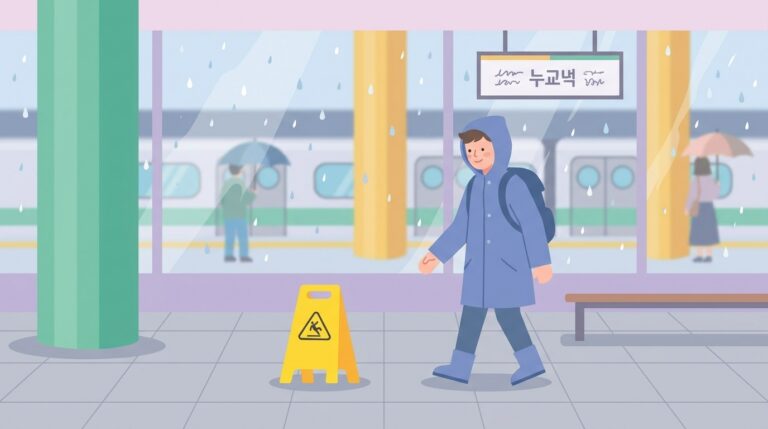
Phase 1: Empathy — Rainy Days and Shiny Floors in Seoul
안녕하세요! 매일한글 에디터입니다. (Annyeonghaseyo! Hello, this is your Daily Hangul editor!) Picture this: it is pouring rain in Seoul, just like a classic K-drama scene. You dash inside a cozy convenience store for a warm snack, only to see a bright yellow sign on the shiny tile floor. Suddenly, you freeze! What does that Korean sign say, and why is the staff member waving? Many beginner learners tell us that public warning signs in Korea feel intimidating at first. Understanding basic social signs is your secret shield for safe, stress-free travel. Based on real feedback from our students, this guide will help you spot floor warnings instantly and respond like a thoughtful local!
Phase 2: 3 Core Expressions You Need to Know
1. 바닥이 미끄러우니 주의하세요 (Badagi mikkeureouni juuihaseyo)
- Pronunciation: Ba-da-gi mi-kkeu-reo-u-ni ju-ui-ha-se-yo (Think of “bah-dah-gee mee-kuh-ruh-oo-nee joo-ee-hah-seh-yo” — the “kk” sounds like a tight, bouncy “k” in “sky”!)
- Meaning: Literal: “Because the floor is slippery, please pay attention.” / Real Nuance: “Caution: Wet/Slippery Floor.”
- K-Culture Moment: You will spot this exact phrase on bright yellow A-frame cones in Seoul Metro stations, department stores, and right outside freshly mopped K-drama hospital hallways.
- Editor’s Insight: This is the polite, official warning written on public signs. Even if you only recognize the first word 바닥 (badak, floor) and 주의 (juui, caution), you immediately know to watch your step!
- Situation Spectrum: Casual 🚫 | Semi-formal ⚠️ | Formal ✅
- 🤔 Think About It: In English, signs often say a blunt “Wet Floor!” Why do Korean signs add “-하세요” (haseyo, please do) even to a plastic cone? Notice how Korean public culture softens warnings with politeness!
2. 조심하세요! (Josimhaseyo!)
- Pronunciation: Jo-sim-ha-se-yo (Sounds like “joh-shim-hah-seh-yo” — smooth and friendly, like telling a friend “watch your step!”)
- Meaning: Literal: “Please be careful.” / Real Nuance: “Watch out!” or “Be careful!”
- K-Culture Moment: In Korean variety shows like Running Man, whenever cast members walk onto a soapy game mat, the staff and members yell “조심하세요! (Josimhaseyo!)” nonstop.
- Editor’s Insight: This is your everyday Swiss Army knife! You can say it when someone is carrying hot ramen, walking on wet stairs, or even saying goodbye when it is raining outside.
- Situation Spectrum: Casual ⚠️ | Semi-formal ✅ | Formal ✅
- 🤔 Think About It: In your native language, do you use the same phrase for “be careful right now” and “take care”? In Korean, 조심하세요 (josimhaseyo) covers both safety warnings and warm concern!
3. 미끄러워요! (Mikkeureowoyo!)
- Pronunciation: Mi-kkeu-reo-wo-yo (Think “mee-kuh-ruh-woh-yo” — push a little extra air-stop on the “kk” so it sounds crisp and urgent!)
- Meaning: Literal: “It is slippery.” / Real Nuance: “Careful, it’s super slippery here!”
- K-Culture Moment: When a K-pop idol walks onto an outdoor rainy stage during a concert rehearsal, they often tap their shoe on the floor and warn their groupmates: “여기가 미끄러워요! (Yeogiga mikkeureowoyo! It’s slippery here!)”
- Editor’s Insight: As a Level 1 beginner, short “-요 (-yo)” endings are your best friend. You do not need a long sentence—just pointing at a puddle and saying 미끄러워요 (mikkeureowoyo) instantly helps the person behind you!
- Situation Spectrum: Casual ⚠️ | Semi-formal ✅ | Formal ⚠️
- 🤔 Think About It: Notice how Korean often drops the subject “it” or “the floor” when everyone can see the puddle. How does sharing context without extra words feel compared to English?
Phase 3: Textbook Korean vs. Real Korean
Situation 1: Warning someone about a wet spot right in front of them
* 📖 Textbook Korean: 바닥이 미끄러우니 주의하세요. (Badagi mikkeureouni juuihaseyo. — Because the floor is slippery, please be cautious.)
* 🗣️ Real Korean: 어, 여기 미끄러워요! 조심하세요! (Eo, yeogi mikkeureowoyo! Josimhaseyo! — Oh, it’s slippery here! Watch out!)
* 💡 Why the difference? The textbook sentence is written for signs and subway announcements. In real life, speaking a long grammar pattern while someone is mid-step takes too long—Koreans react fast with short, punchy words!
Situation 2: Checking on someone who just slipped a little
* 📖 Textbook Korean: 넘어지셨습니까? 다치지 않으셨습니까? (Neomeojisyeotseumnikka? Dachiji aneushyeotseumnikka? — Did you fall? Were you not hurt?)
* 🗣️ Real Korean: 어머, 괜찮으세요? (Eomeo, gwaenchaneuseyo? — Oh my, are you okay?)
* 💡 Why the difference? Very formal “-습니까” endings sound like a news anchor! In daily cafes or streets, warm concern starts with a quick “어머 (eomeo, oh my)” and “괜찮으세요? (gwaenchaneuseyo?)”.
Phase 4: K-Culture Deep Dive & Non-Verbal Manners
4-1. Nunchi (눈치) & Gestures
In Korea, reading the room—called 눈치 (nunchi)—is huge in shared spaces. When you see a yellow wet-floor cone or someone holding a mop, slow down right away and walk around the dry edge instead of cutting straight across. If a cleaner or store clerk points at the floor and warns you, give a small head nod and say “네, 감사합니다! (Ne, gamsahamnida! Yes, thank you!)” with a warm smile. It shows respect for their hard work!
4-2. Cultural Code Analysis: K-Travel & K-Drama
Have you noticed how shiny marble and tile floors are everywhere in Korean subway stations, underground shopping malls, and trendy cafes? During the summer monsoon season (장마, jangma), rain gets tracked inside quickly. That is why Korea has an incredible system of umbrella plastic bag dispensers at entrances and yellow warning cones everywhere. In K-dramas, a sudden slip on a wet convenience store floor is a classic meet-cute trope—but in real-life K-travel, keeping your eyes peeled for 바닥 (badak, floor) signs keeps your ankles safe!
Phase 5: Real-Life Roleplay Scenario
Setting: A cozy GS25 convenience store in Hongdae on a rainy Friday evening. You just folded your umbrella and walked in. Min-ji, a cheerful part-time worker with an apron and a mop, spots you heading toward the ramen aisle.
- Min-ji: 저기요! 잠시만요! (Jeogiyo! Jamsimanyo! — Excuse me! Just a second!) 🎭 Waves one hand gently while holding the mop with the other
- You: 네? 무슨 일이세요? (Ne? Museun iriseyo? — Yes? What’s the matter?) 🎭 Stops at the entrance mat and tilts head politely
- Min-ji: 지금 청소했어요. 바닥이 미끄러우니 주의하세요! (Jigeum cheongsohaesseoyo. Badagi mikkeureouni juuihaseyo! — I just cleaned. Caution, the floor is slippery!)
- You: 아, 정말요? 알려주셔서 감사해요! (A, jeongmalyo? Allyeojusyeoseo gamsahaeyo! — Oh, really? Thank you for letting me know!) 🎭 Looks down at the shiny tiles and nods appreciatively
- Min-ji: 이쪽은 조금 미끄러워요. 오른쪽으로 가세요! (Ijjogeun jogeum mikkeureowoyo. Oreunjjogeuro gaseyo! — This side is a bit slippery. Please go to the right!) 🎭 Points toward the dry snack aisle
- You: 네, 조심할게요! (Ne, josimhalgeyo! — Yes, I’ll be careful!) 🎭 Steps carefully onto the dry right path
- Min-ji: 네, 천천히 보세요! (Ne, cheoncheonhi boseyo! — Yes, take your time browsing!)
- You: 감사합니다! (Gamsahamnida! — Thank you!)
🔀 Interactive Branching Point
Right after Min-ji warns you about the freshly mopped floor, how should you react?
* Choice A: Say “네, 감사합니다! (Ne, gamsahamnida!)” and walk along the dry right side.
* Feedback (Best!): 100/100 Nunchi points! You followed the staff’s advice, showed gratitude, and avoided ruining the freshly mopped floor.
* Choice B: Ignore the yellow cone and stomp across the wet spot with muddy shoes.
* Feedback (Bad!): Oops! Not only might you slip, but leaving footprints right after someone mopped is considered very inconsiderate in Korea.
* Choice C: Shout “왜요?! (Waeyo?! Why?!)” loudly in panic.
* Feedback (Risk!): A bit dramatic! Koreans might feel startled or think you are angry. A calm “네? (Ne? Yes?)” works much better.
Phase 6: 10-Second Emotion Shadowing Drill
Read these aloud twice! Use / as a quick breath pause.
1. [😲 Urgent and helpful] 어! / 여기 / 미끄러워요! (Eo! / Yeogi / mikkeureowoyo! — Oh! / Here / it’s slippery!)
2. [😊 Warm and polite] 바닥 / 조심하세요! (Badak / josimhaseyo! — Floor / please be careful!)
3. [🥺 Gentle and grateful] 알려주셔서 / 감사해요! (Allyeojusyeoseo / gamsahaeyo! — Thank you / for telling me!)
Phase 7: K-Culture Mini Dictionary (4 Core Keywords)
- 바닥 (badak) | Floor / Bottom | Used everywhere from subway signs to cafes—and even in foodie talk, like saying you ate a bowl of ramen down to the 바닥 (bottom)!
- 주의 (juui) | Caution / Attention | A formal word seen on public signs, medicine bottles, and subway doors across South Korea.
- 조심 (josim) | Carefulness / Watch out | Used in daily life with family and friends whenever safety matters, like crossing the street or carrying hot soup.
- 표지판 (pyojipan) | Sign / Signboard | Refers to street signs, warning cones, and directional boards in tourist spots and subway stations.
Phase 8: Traveler’s Survival Kit
Top 3 Survival Phrases
- 미끄러워요! (Mikkeureowoyo!) — Pro Tip: Say this fast if your travel buddy is about to step on wet stairs!
- 조심하세요! (Josimhaseyo!) — Pro Tip: Works for bikes, wet floors, and hot Korean BBQ grills!
- 괜찮으세요? (Gwaenchaneuseyo?) — Pro Tip: The kindest phrase to ask if someone stumbles near you.
Editor’s Travel Note
Rainy days in Seoul mean hopping between underground arcades and subway exits! Before your trip, Download the Naver Map App for Accurate Indoor Subway Exits and Check the Seoul Metro Official Travel Safety Guide so you can find covered walkways easily. Also, keep a small foldable umbrella in your bag and look for the free umbrella-bag stands right inside building doors—using them keeps the 바닥 (badak, floor) dry for everyone!
Phase 9: One Step Deeper — The Heart Behind Korean Signs
Have you ever noticed how Korean public signs feel strangely caring? Even a simple warning sign uses polite endings like -하세요 (-haseyo, please do), reflecting Korea’s deep-rooted value of 배려 (baeryeo)—thoughtful consideration for strangers sharing the same space. Rather than just giving an order, society gently reminds everyone to look out for one another. Learning to read these small signs connects you directly to that everyday warmth!
💬 Your Turn: Have you ever had a funny or surprising moment with a public sign while traveling? Tell us in the comments below!
Phase 10: FAQ & Myth-Busting
Q: Do I have to memorize the entire sentence “바닥이 미끄러우니 주의하세요” to understand signs in Korea?
A: Not at all! At Level 1, just recognizing the words 바닥 (badak, floor) and 주의 (juui, caution) plus the yellow cone icon is more than enough to keep you safe.
Q: Is “조심하세요 (josimhaseyo)” too formal to say to a friend?
A: To a close friend of the same age or younger, you can drop the “-세요 (-seyo)” and simply say “조심해! (Josimhae! Be careful!)”. For strangers or elders, always keep “조심하세요!”.
Q: What is the difference between “주의 (juui)” and “조심 (josim)”?
A: Both mean caution/care, but 주의 (juui) is mostly written on official signs and rules, while 조심 (josim) is what real people say out loud in everyday conversation.
🚨 Common Mistakes Alert
- Mistake: Saying “조심해! (Josimhae!)” to an elderly person or store clerk. -> Correct Action: Add “-세요” and say “조심하세요! (Josimhaseyo!)” to stay polite.
- Mistake: Stepping over a mopped area thinking “I’ll be quick.” -> Correct Action: Wait 10 seconds or take the dry path around the cone.
- Mistake: Confusing 바닥 (badak, floor) with 바다 (bada, sea). -> Correct Action: Remember the final “k” sound in 바닥 (ba-dak) means “floor”!
Phase 11: Action Mission & Engagement
- 🥉 Bronze Mission (Solo Practice): Look at a tile floor in your home right now and say “바닥이 미끄러워요! 조심하세요! (Badagi mikkeureowoyo! Josimhaseyo!)” out loud 3 times.
- 🥈 Silver Mission (Share It): Screenshot your favorite phrase from Phase 2 and share it on Instagram or with your study buddy!
- 🥇 Gold Mission (Real-Life Use): Next time it rains, warn a friend or family member in Korean: “조심하세요! (Josimhaseyo!)”
- 🎮 K-Culture Mission: Watch a rainy scene in your favorite K-drama or K-pop vlog and spot at least one yellow caution sign or umbrella stand!
Phase 12: Interactive Quiz Challenge
Quiz 1 (Situation Judgment): You are at a Korean cafe and see a staff member mopping near the restroom with a yellow cone. What should you say as you carefully walk around?
A) 바닥이 미끄러우니 주의하세요!
B) 네, 조심할게요! 감사합니다!
C) 바다 조심해!
👉 Click to reveal Answer & Explanation for Quiz 1
Correct Answer: B) 네, 조심할게요! 감사합니다! (Ne, josimhalgeyo! Gamsahamnida! — Yes, I’ll be careful! Thank you!)
Why not A? A is what the sign says to YOU, not what you say to the worker! Why not C? 바다 (bada) means “ocean/sea,” not “floor” (바닥), and “조심해” is too casual for a stranger.
Quiz 2 (Fill in the Blank): Fill in the missing word for “floor”: _______이 미끄러우니 주의하세요. (_______i mikkeureouni juuihaseyo.)
👉 Click to reveal Answer & Explanation for Quiz 2
Correct Answer: 바닥 (badak)
바닥 (badak) means “floor”! Putting it together gives you 바닥이 미끄러우니 주의하세요 (Caution: Wet/Slippery Floor).
Quiz 3 (True or False): In Korea, “조심하세요 (josimhaseyo)” is only used for wet floors and cannot be used in other situations.
👉 Click to reveal Answer & Explanation for Quiz 3
Correct Answer: False!
조심하세요 (josimhaseyo) means “Be careful!” in general—you can use it for hot food, traffic, stairs, or rainy weather!
🎬 Watch Our Daily Videos! (Daily Hangul Official Instagram)
Review the expressions you learned in this article with our fun daily short videos! Check out native pronunciation and real-life nuances in action.
- Instagram @dailyhangul_en






