

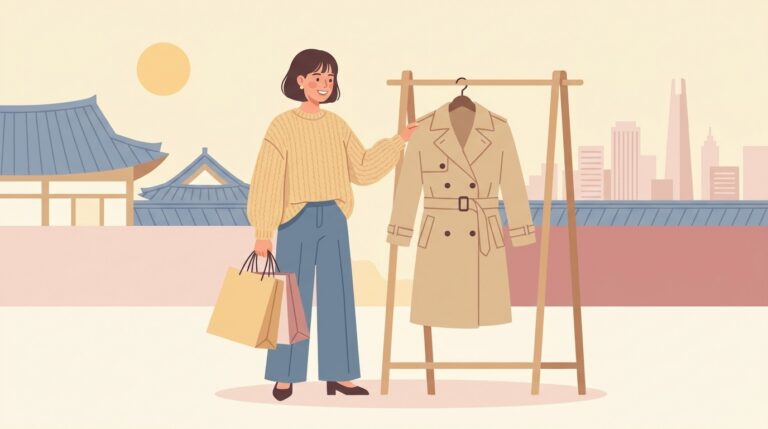
Phase 1: Empathy & Story Opening
안녕하세요! 매일한글 에디터입니다. (Annyeonghaseyo! Maeil Hangeul editeo-imnida. / Hello! I’m your Daily Hangul Editor.)
Picture this: it’s midnight, and you’re watching a Seoul fashion haul (하울 영상, haul yeongsang) on YouTube. Your favorite creator pulls out a sleek beige coat and calls it their ultimate forever staple—only for auto-subtitles to say “life-long template”! Wait, what?! Many of my Level 2 learners tell me this exact confusion happens whenever they watch K-fashion videos or browse Seongsu-dong boutiques. Learning these real buzzwords based on actual learner feedback will help you understand haul videos effortlessly and shop like a local. Ready to upgrade your wardrobe vocabulary? Let’s go!
Phase 2: Deep Dive into Top 3 Core Expressions
1. 평생템 (pyeongsaengtem)
- Pronunciation: pyeong-saeng-tem (“pyeong” sounds like “p-young” blended smoothly, “saeng” like “sang” in “I sang a song”, and “tem” like the end of “i-tem”)
- Meaning: Literally “lifetime” (평생, pyeongsaeng) + “item” (아이템, aitem). In real life, it means a “forever staple” or “holy grail” piece you’ll never throw away.
- K-Culture Moment: When a K-fashion YouTuber films a “What’s in My Closet” haul and holds up a classic black blazer or leather bag they’ve cherished for five years.
- Editor’s Insight: Koreans love mashing words together! Adding -템 (-tem) to words creates instant buzzwords, like 꿀템 (kkultem / sweet must-have item) or 인생템 (insaengtem / item of a lifetime).
- Situation Spectrum: Casual ✅ | Semi-formal ✅ | Formal ⚠️ (Great for friendly shopping chats, skip in stiff business reports!)
- 🤔 Think About It: In English, we say “staple piece” or “investment piece.” Why do you think Korean speakers use the dramatic word “평생 (pyeongsaeng / entire lifetime)” even for a simple coat or bag?
2. 유행을 안 타다 (yuhaeng-eul an tada)
- Pronunciation: yu-haeng-eul an ta-da (“yu” like “you”, “haeng” like “hang” with a soft ‘eh’, “eul” like “uh-l”, “an” like “ahn”, and “ta-da” like a magician’s “ta-da!”)
- Meaning: Literally “to not ride the trend.” The real nuance is “to be timeless” or “to never go out of style.”
- K-Culture Moment: Scrolling through Korean fashion apps like Musinsa or 29CM, or hearing a Hannam-dong boutique owner explain why a classic striped shirt is worth buying.
- Editor’s Insight: Notice the verb 타다 (tada / to ride)! In Korean, you “ride” trends (유행을 타다, yuhaeng-eul tada) and even “ride” seasonal moods. Saying 안 타다 (an tada) means this piece stands strong without chasing fast fads!
- Situation Spectrum: Casual ✅ | Semi-formal ✅ | Formal ✅ (Super versatile and classy!)
- 🤔 Think About It: English says clothes “stay in style” or are “timeless.” Korean imagines trends as a bus or wave you choose whether to “ride” (타다). How does that metaphor change how you picture fashion?
3. 매년 꺼내 입다 (maenyeon kkeonae ipda)
- Pronunciation: mae-nyeon kkeo-nae ip-da (“mae” like “meh”, “nyeon” like “nyun”, “kkeo” like a tense “kuh” in “cup”, “nae” like “neh”, “ip-da” like “eep-da”)
- Meaning: Literally “every year take out and wear.” It captures that cozy, reliable feeling of pulling your favorite classic piece from your closet every time the season returns.
- K-Culture Moment: Autumn and winter lookbook hauls on Instagram Reels where creators say, “유행 타지 않는 클래식한 디자인이라 매년 꺼내 입는 평생템이에요 (Yuhaeng taji anneun keullaesikhan dijain-ira maenyeon kkeonae inneun pyeongsaengtem-ieyo / It’s a classic timeless design, so it’s a forever item I pull out and wear every year).”
- Editor’s Insight: For Level 2 learners, notice how two simple verbs team up here: 꺼내다 (kkeonaeda / to take out) + 입다 (ipda / to wear) becomes 꺼내 입다. You do the first action, then the second!
- Situation Spectrum: Casual ✅ | Semi-formal ✅ | Formal ✅
- 🤔 Think About It: Does your native language highlight the physical action of “pulling clothes out of the closet” to express how durable and beloved an item is?
Phase 3: Textbook Korean vs. Real Korean
Situation 1: Describing a timeless coat
- 📖 Textbook Korean: 이 옷은 오래 입을 수 있는 디자인이에요. (I os-eun orae ibeul su inneun dijain-ieyo. / This outfit is a design you can wear for a long time.)
- 🗣️ Real Korean: 이거 완전 유행 안 타는 평생템이에요! (Igeo wanjeon yuhaeng an taneun pyeongsaengtem-ieyo! / This is totally a timeless forever item!)
- 💡 Why the difference?: Textbooks stick to neutral, plain descriptions. In real haul videos or shopping trips, Koreans add punchy words like 완전 (wanjeon / totally) and -템 (-tem) to share genuine excitement and great taste!
Situation 2: Complimenting a friend’s classic jacket
- 📖 Textbook Korean: 그 재킷은 아주 멋있고 깔끔합니다. (Geu jaekis-eun aju meositgo kkalkkeumhamnida. / That jacket is very stylish and neat.)
- 🗣️ Real Korean: 와, 그 재킷 진짜 꾸안꾸 클래식이다! (Wa, geu jaekit jinjja kkuankku keullaesig-ida! / Wow, that jacket is such an effortlessly stylish classic!)
- 💡 Why the difference?: Korean fashion culture adores 꾸안꾸 (kkuankku)—looking dressed up yet effortless. Dropping a buzzword shows your friend you have top-tier fashion sense (패션 센스, paesyeon senseu).
Phase 4: K-Culture Deep Dive & Non-Verbal Manners
4-1. Nunchi (눈치) & Gestures
When checking out a 평생템 (pyeongsaengtem) in a trendy Seoul boutique (like in Seongsu-dong), gently feel the sleeve fabric between two fingers (만져보다, manjeoboda) and nod slowly with a soft “음~ (eum~)” to show you appreciate the craftsmanship. Never yank or stretch clothes on racks—Korean indie shop owners treat their pieces like art! When a friend models a classic coat, tilt your head slightly with a warm smile or subtle thumbs-up rather than shouting loudly inside quiet shops.
4-2. Cultural Code Analysis: The Rise of “Old Money” & Value Hauls
While fast fashion thrives in hotspots like Hongdae, young Koreans have recently shifted toward 미니멀 룩 (minimeol luk / minimal look) and 올드머니 룩 (oldeumeoni luk / old money look). Today’s Korean YouTube haul videos aren’t just about buying ten cheap tees. Viewers celebrate 뽕 뽑는 템 (ppong pponneun tem)—classic pieces so versatile and well-made that you get 100% of your money’s worth by wearing them year after year!
Phase 5: Practical Roleplay Scenario
Setting: A sunlit, minimalist boutique in Seongsu-dong, Seoul, smelling faintly of cedarwood and fresh espresso. Soft indie pop plays in the background.
Characters: Minji (민지), a friendly boutique stylist with effortless style, and You (나, Na), browsing the autumn coat rack.
- Minji: 🎭 (Smiling warmly as she adjusts a hanger) 어서 오세요! 찾으시는 스타일 있으세요? (Eoseo oseyo! Chajeusineun seutail isseuseyo? / Welcome! Is there a style you’re looking for?)
- You: 🎭 (Pointing gently at a beige trench coat) 네, 오래 입을 수 있는 클래식한 코트를 찾고 있어요. (Ne, orae ibeul su inneun keullaesikhan koteureul chatgo isseoyo. / Yes, I’m looking for a classic coat I can wear for a long time.)
- Minji: 🎭 (Eyes lighting up as she takes down the coat) 아, 이 코트 정말 잘 고르셨어요! (A, i koteu jeongmal jal goreusyeosseoyo! / Oh, you picked a really great coat!)
- You: 🎭 (Touching the soft wool fabric) 디자인이 정말 깔끔하네요. 유행을 안 탈까요? (Dijain-i jeongmal kkalkkeumhaneyo. Yuhaeng-eul an talkkayo? / The design is really clean. Will it stay timeless?)
- Minji: 🎭 (Nodding enthusiastically) 네! 유행 타지 않는 클래식한 디자인이라 매년 꺼내 입는 평생템이에요. (Ne! Yuhaeng taji anneun keullaesikhan dijain-ira maenyeon kkeonae inneun pyeongsaengtem-ieyo. / Yes! It’s a classic timeless design, so it’s a forever item you’ll pull out and wear every year.)
- You: 🎭 (Trying it on in front of the mirror) 와, 핏도 너무 예쁘고 가벼워요! (Wa, pitdo neomu yeppeugo gabyeowoyo! / Wow, the fit is so pretty and it’s light!)
- Minji: 🎭 (Giving a gentle clap) 손님한테 찰떡이에요! 봄이랑 가을에 진짜 잘 입으실 거예요. (Sonnimhante chaltteog-ieyo! Bom-irang gaeur-e jinjja jal ibeusil geoyeyo. / It’s a total match for you! You’ll wear it really well in spring and fall.)
- You: 🎭 (Smiling happily at the mirror) 좋아요! 이걸로 할게요. (Joayo! Igeollo halgeyo. / Great! I’ll take this one.)
🔀 Interactive Branching Point
Minji asks how you feel about the coat! Which response do you choose?
* Choice A: 유행 안 타는 디자인이라 마음에 쏙 들어요! (Yuhaeng an taneun dijain-ira maeum-e ssok deureoyo! / I love it because it’s a timeless design!) -> Best! Natural, polite Level 2 Korean that warmly acknowledges the stylist’s recommendation.
* Choice B: 이거 평생템 맞아요? 너무 비싼 것 같아요. (Igeo pyeongsaengtem majayo? Neomu bissan geot gatayo. / Is this really a forever item? It seems too expensive.) -> Bad! Being overly blunt about price right after praising the coat feels awkward. Try saying 가격이 조금 고민되네요 (Gagyeog-i jogeum gomindoeneyo / I’m hesitating a bit about the price) gently instead.
* Choice C: 완전 내 스타일이야! (Wanjeon nae seutair-iya! / Totally my style!) -> Risk! Fun and trendy vocabulary, but ending in -야 (-ya) is casual speech (반말, banmal) meant for close friends, not shop staff. Switch to polite mode: 완전 제 스타일이에요! (Wanjeon je seutair-ieyo!).
Phase 6: 10-Second Emotional Shadowing Drill
Read aloud following the pause marks (/) and channel the emotion!
[😊 Happy and excited, eyes sparkling]이거 / 완전 / 평생템이에요! (Igeo / wanjeon / pyeongsaengtem-ieyo! / This is totally a forever item!)[😌 Calm, confident, and stylish]유행 타지 않는 / 클래식한 디자인이에요. (Yuhaeng taji anneun / keullaesikhan dijain-ieyo. / It’s a classic, timeless design.)[🥰 Warm and nostalgic, picturing crisp autumn air]매년 / 꺼내 입는 / 코트예요. (Maenyeon / kkeonae inneun / koteuyeyo. / It’s a coat I pull out and wear every year.)
Phase 7: K-Culture Mini Dictionary
- 하울 (haul) | Haul | Used in YouTube and TikTok shopping videos (패션 하울, paesyeon haul) and daily chats when showing off newly bought clothes or beauty products.
- 찰떡 (chaltteok) | Perfect match (literally “sticky rice cake”) | Everyday fashion and beauty slang when an outfit or color suits someone seamlessly (찰떡이에요, chaltteog-ieyo).
- 가성비 (gaseongbi) | Cost-effectiveness / bang for your buck | Widely used in both casual shopping and business meetings to evaluate if quality justifies the price.
- 꾸안꾸 (kkuankku) | Effortlessly stylish (“dressed up, yet not”) | Popular slang describing chic, natural style—perfect for complimenting a friend’s classic everyday outfit.
Phase 8: Survival Kit for Travelers
Top 3 Shopping Survival Phrases
- 입어 봐도 돼요? (Ibeo bwado dwaeyo? / Can I try this on?) — Pro Tip: Always ask before stepping into a fitting room! Some white tops or delicate knits aren’t allowed to be tried on due to makeup stains.
- 새 상품 있어요? (Sae sangpum isseoyo? / Do you have a brand-new one?) — Pro Tip: Display items on racks may have been tried on already. Staff happily grab a fresh piece from storage if available!
- 텍스 프리 돼요? (Tekseu peuri dwaeyo? / Is tax-free available?) — Pro Tip: Carry your physical passport when shopping in Seoul; many stores offer instant tax refunds right at the register!
Editor’s Travel Note
Before heading out to trendy Seoul shopping streets like Seongsu-dong or Hannam-dong, be sure to Download Naver Map App for Seoul Walking Directions, as Google Maps doesn’t provide full navigation in Korea. You can also Check the Korea Tourism Organization Tax Refund Guide to save money on your haul. Most boutiques accept international credit cards, and grabbing a T-money transit card at any convenience store makes hopping between subway shopping districts a breeze!
Phase 9: “One Step Deeper” (Thought Question)
In Korea, trends move at lightning speed (빨리빨리, ppalli-ppalli culture), from overnight dessert fads to viral K-pop aesthetics. Yet, paradoxically, Koreans deeply admire items that endure—things called 평생템 (pyeongsaengtem) that survive every trend wave. Why? Because in a fast-paced society where people often dress similarly to blend in, owning one classic, timeless piece shows quiet confidence and personal taste (취향, chwihyang). Choosing lasting quality over constant replacement is becoming a proud badge of maturity among young Koreans.
💬 Your Turn: What is one 평생템 (pyeongsaengtem) in your closet that you pull out every single year? Share it in the comments in English or try writing it in Korean!
Phase 10: FAQ & Myth-Busting
Q: Can I attach “-템 (-tem)” to any Korean word?
A: Almost! It sounds most natural with positive or practical nouns, like 꿀템 (kkultem / sweet must-have item), 애정템 (aejeongtem / favorite cherished item), or 필수템 (pilsutem / essential item). Just keep it out of formal business reports!
Q: What is the difference between “평생템 (pyeongsaengtem)” and “인생템 (insaengtem)”?
A: They’re best friends! 인생템 (“item of my life”) means the absolute best one you’ve ever tried (often used for skincare or food), while 평생템 (“lifetime item”) highlights durability and timelessness—something you’ll keep using for decades!
Q: Is “클래식하다 (keullaesikhada)” only used for classical music?
A: Not at all! Just like in English, Koreans use 클래식한 디자인 (keullaesikhan dijain) for timeless fashion, vintage cafes, and classic movie aesthetics.
🚨 Common Mistakes
- Saying 유행 타는 디자인 (yuhaeng taneun dijain) when you mean “timeless.” -> Without 안 (an), 타는 means it follows trends and will look dated next year! Correct Action: Always include the negative: 유행 안 타는 디자인 (yuhaeng an taneun dijain).
- Using 입다 (ipda / to wear) for shoes, hats, or bags. -> In Korean, clothes are 입다 (ipda), shoes are 신다 (sinda), hats are 쓰다 (sseuda), and bags are 들다 (deulda) or 메다 (meda)! Correct Action: For a timeless handbag, say 매년 꺼내 드는 평생템 (maenyeon kkeonae deuneun pyeongsaengtem).
- Dropping polite endings with shop staff. -> Saying just “평생템!” to a stranger sounds abrupt. Correct Action: Add -이에요 (-ieyo) politely: 평생템이에요! (pyeongsaengtem-ieyo!).
Phase 11: Action Mission & Engagement
- 🥉 Bronze (Solo Practice): Open your closet right now, hold up your favorite timeless item, and say aloud three times: “이건 유행 안 타는 내 평생템이에요! (Igeon yuhaeng an taneun nae pyeongsaengtem-ieyo!)”
- 🥈 Silver (Social Share): Post a quick photo of your classic outfit of the day on social media with the hashtags
#평생템and#DailyHangul. - 🥇 Gold (Real-Life Use): Leave an encouraging Korean comment on your favorite K-fashion YouTuber’s haul video: “유행 타지 않는 디자인이라 정말 평생템이에요! 👍”
- 🎮 K-Culture Mission: Search “가을 하울 (gaeul haul / autumn haul)” or “클래식 코트 (keullaesik koteu)” on YouTube and listen closely—see how many times you can spot the words 평생템 or 유행 안 타는 in the first three minutes!
Phase 12: Interactive Quiz Challenge
Quiz 1 (Situational Judgment): You want to tell a Korean friend that a crisp white shirt will never go out of style. Which sentence is right?
* A) 이거 완전 유행 타는 옷이에요! (Igeo wanjeon yuhaeng taneun os-ieyo!)
* B) 이거 유행 안 타는 클래식한 옷이에요! (Igeo yuhaeng an taneun keullaesikhan os-ieyo!)
* C) 이거 매년 넣는 옷이에요! (Igeo maenyeon neonneun os-ieyo!)
Check Answer & Explanation
Correct Answer: B! “유행 안 타는” means it doesn’t chase fleeting trends (timeless). Option A means it follows trends (will soon be outdated!), and Option C means you “put it away” every year (넣다 instead of 꺼내다).
Quiz 2 (Fill in the Blank): Complete the phrase for “pulling out and wearing every year”:
매년 ( ______ ) 입는 평생템이에요. (Maenyeon ______ inneun pyeongsaengtem-ieyo.)
Check Answer & Explanation
Correct Answer: 꺼내 (kkeonae)! From 꺼내다 (kkeonaeda / to take out). Combined, 꺼내 입다 means “to take out and wear.”
Quiz 3 (True or False):
“You can use 입다 (ipda) for every single fashion item, including classic leather handbags and ankle boots.” (True / False)
Check Answer & Explanation
Correct Answer: False! Korean uses specific wearing verbs: 입다 (ipda) is for clothes, 신다 (sinda) is for shoes, and 들다/메다 (deulda/meda) is for bags!
🎬 Watch Our Daily Videos! (Daily Hangul Official Instagram)
Review the expressions you learned in this article with our fun daily short videos! Check out native pronunciation and real-life nuances in action.
- Instagram @dailyhangul_en







