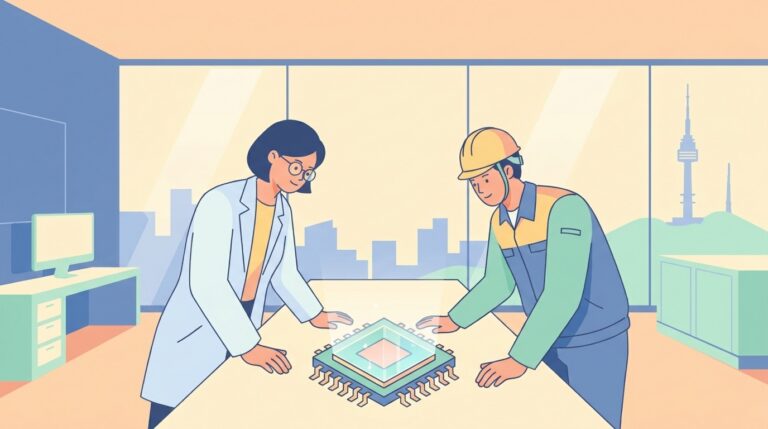
안녕하세요! 매일한글 에디터입니다. (Annyeonghaseyo! Maeil Hangeul Editeo-imnida — Hello! This is the Daily Hangul Editor.) Picture a scene straight out of the K-Drama Start-Up: you spent two years perfecting an AI algorithm or a K-Beauty skincare formula in a university lab, signed the technology transfer deal, and popped the champagne. Then Monday hits—the factory calls because the formula clogs their mass-production lines! In Korea, walking away after the handover breaks trust. Based on real feedback from advanced learners in Korean R&D hubs, mastering post-handover advisory phrases turns you from a vendor into an indispensable partner.
Phase 1: Why Post-Handover Responsibility Matters in Korea
In Western business culture, a signed technology transfer contract often marks the finish line for the R&D team. In South Korea, however, signing the agreement is merely the starting whistle. Whether you are collaborating with a university lab in Daejeon or a biotech manufacturer in Pangyo, your Korean partners evaluate your professionalism by how steadfastly you stand beside them during the rocky transition from lab prototype to mass production.
Phase 2: Top 3 Advanced Expressions Deep Dive
1. 기술 자문을 도맡아 양산 안착을 견인했습니다 (Gisul jamuneul domata yangsan anchageul gyeoninhaetseumnida)
- Pronunciation: [Gee-sool jah-moon-eul doh-mah-tah yahng-sahn ahn-chah-geul gyuh-nin-haet-seum-nee-dah] — Think of domata like ‘dough-mah-tah’ with a crisp ‘t’, and gyeoninhaetseumnida flowing smoothly like ‘gyuh-nin’ (towing a vehicle) + polite past ending.
- Meaning: Literally ‘Taking full charge of technical advisory, we towed/pulled the stable settlement of mass production.’ Nuance: It frames your team not as passive consultants, but as the driving engine behind the factory’s commercial success.
- K-Culture Moment: Picture an executive briefing scene in a corporate K-Drama like Misaeng or Agency, where a team leader presents project KPIs on a sleek glass wall and credits their R&D partner for pulling the production line out of crisis.
- Editor’s Insight: At Level 5, verbs like 도맡다 (domatda – to take full responsibility for) and 견인하다 (gyeoninhada – to drive/lead forward) instantly elevate your credibility over basic verbs like 돕다 (dopda – to help). Use 안착 (anchak – soft landing/stabilization) to show you understand manufacturing realities.
- Situation Spectrum: Casual 🚫 / Semi-formal ⚠️ / Formal ✅
- 🤔 Think About It: Why does Korean business language use heavy mechanical metaphors like ‘towing’ (견인하다) and ‘safe landing’ (안착하다) for teamwork? How does that compare to phrases like ‘driving results’ in your native language?
2. 상용화 초기 시행착오를 최소화하는 데 주력했습니다 (Sangyonghwa chogi sihaengchagoreul choesohwahaneun de juryeokhaetseumnida)
- Pronunciation: [Sahng-yong-hwah choh-gee shee-haeng-chah-goh-reul chweh-soh-hwah-hah-neun deh joo-ryeok-haet-seum-nee-dah] — Notice ‘chogi’ sounds like ‘choh-ghee’ (hard g), and ‘choesohwa’ starts softly like ‘chweh-soh-hwah’.
- Meaning: Literally ‘We concentrated our efforts on minimizing trial and error during early commercialization.’ Nuance: A diplomatic, face-saving way to acknowledge early factory hiccups while highlighting your proactive problem-solving.
- K-Culture Moment: In K-Beauty documentary features on brands booming globally, R&D directors often use this exact phrasing when discussing how they tweaked an emulsion formula so it wouldn’t separate on high-speed bottling lines.
- Editor’s Insight: Never say ‘there were many mistakes’ (실수가 많았습니다 – silsuga manatseumnida) in a Korean partner review—that invites blame. Instead, say 시행착오 (sihaengchago – trial and error), which frames glitches as an inevitable, constructive part of innovation.
- Situation Spectrum: Casual 🚫 / Semi-formal ✅ / Formal ✅
- 🤔 Think About It: In your culture, is admitting ‘trial and error’ seen as a sign of weakness or scientific rigor? Notice how Korean wraps it in 주력하다 (juryeokhada – focusing one’s main strength).
3. 기술이전 후에도 사후 지원까지 책임감 있게 이행했습니다 (Gisul ijeon huedo sahu jiwonkkaji chaegimgam itge ihaenghaetseumnida)
- Pronunciation: [Gee-sool ee-juhn hoo-eh-doh sah-hoo jee-won-kkah-jee chae-geem-gahm eet-geh ee-haeng-haet-seum-nee-dah] — Hold the double ‘kk’ in kkaji briefly like stopping your breath on ‘k’ before releasing ‘ah-jee’.
- Meaning: Literally ‘Even after technology transfer, we faithfully fulfilled up to post-handover support with a sense of responsibility.’ Nuance: Emphasizes unwavering loyalty and contractual integrity beyond bare minimum obligations.
- K-Culture Moment: Think of the loyal mentor characters in Start-Up who stay late in the sandbox office debugging code even after their official mentoring term ends.
- Editor’s Insight: Pairing 사후 지원 (sahu jiwon – post-support/aftercare) with 이행하다 (ihaenghada – to execute/fulfill an obligation) signals legal and moral reliability. In Korea’s tight-knit R&D ecosystem, your reputation for 사후 관리 (aftercare) determines whether you get invited to the next national R&D grant.
- Situation Spectrum: Casual 🚫 / Semi-formal ⚠️ / Formal ✅
- 🤔 Think About It: Koreans famously cherish ‘A/S’ (After Service) culture, from electronics to B2B tech. How deeply does post-sale care influence trust in your home country’s industry?
Phase 3: Textbook Korean vs. Real Korean
Even advanced learners sometimes sound like a translated legal PDF during factory check-ins. Here is how fluent Level 5 professionals actually bridge the gap.
Situation 1: Reassuring the factory partner when early mass production hits a snag
* 📖 Textbook Korean (교과서 한국어): 문제가 해결될 때까지 우리가 계속 도와드리겠습니다. (Munjega haegyeoldoel ttaekkaji uriga gyesok dowadeurigetseumnida — We will keep helping you until the problem is solved.)
* 🗣️ Real Korean (진짜 한국어): 양산 수율이 안정될 때까지 끝까지 발 맞춰 뛰겠습니다. (Yangsan suyuri anjeongdoel ttaekkaji kkeutkkaji bal matwo ttwigetseumnida — We will run in lockstep with you all the way until mass-production yield stabilizes.)
* 💡 Why is it different? Using ‘help’ (도와드리다) subtly creates a hierarchy where you are doing them a favor. Saying 발 맞춰 뛰다 (running in step together) conveys true partnership and grit—classic Korean teamwork energy.
Situation 2: Explaining why your advisory is needed during initial commercialization
* 📖 Textbook Korean (교과서 한국어): 연구실 기술과 공장 생산은 다르기 때문에 자문이 필요합니다. (Yeongusil gisulgwa gongjang saengsaneun dareugi ttaemune jamuni piryohamnida — Advisory is needed because lab tech and factory production are different.)
* 🗣️ Real Korean (진짜 한국어): 연구실 레시피를 양산 공정에 최적화하는 데는 현장 밀착형 자문이 필수입니다. (Yeongusil resipireul yangsan gongjeonge choejeokhwahaneun deneun hyeonjang milchakhyeong jamuni pilsuimnida — On-site, close-contact advisory is essential for optimizing a lab recipe to a mass-production process.)
* 💡 Why is it different? Expressions like 공정 최적화 (process optimization) and 현장 밀착형 (field-embedded/hands-on) are authentic buzzwords in Korean industry-academia (산학협력 – sanhakhyeomnyeok) reports and boardrooms.
Phase 4: K-Culture Deep Dive & Non-Verbal Manners
4-1. Nunchi (눈치) & Gestures on the Factory Floor
When you step into a Korean manufacturing facility for post-handover technical advisory, your body language speaks louder than your Korean vocabulary. First, respect the cleanroom dress code enthusiastically: put on the anti-static gown (방진복 – bangjinbok), hairnet, and shoe covers swiftly without sighing or joking about how they look. Second, when inspecting a defective prototype (불량품 – bullyangpum), pick it up with both hands rather than poking it with one finger—showing respect for the factory workers’ labor. Finally, practice Nunchi during silence: if the factory director stares at a machine and quietly says, ‘검토가 좀 필요하겠네요’ (Geomtogajom piryohagetneyo — It will need some review), do not rush to fill the silence with defensive data. Wait three seconds, nod slowly, and offer to check the parameters together.
4-2. Cultural Code Analysis: ‘Uiri’ (의리) Meets ‘Ppalli-ppalli’ (빨리빨리)
If you watch Korean workplace dramas like Misaeng or tech entrepreneurship shows like Start-Up, you will notice a fascinating cultural paradox: urgent speed (빨리빨리) paired with lifelong loyalty (의리 – uiri). Korean manufacturers face intense market pressure to launch products fast, especially in K-Beauty, semiconductors, and bio-health. When a university or R&D partner stays on-site after technology transfer to troubleshoot temperature curves or nozzle pressures, Koreans don’t just view it as good engineering—they view it as Uiri (honorable loyalty). Once you earn that badge of Uiri, doors open across the entire Korean corporate network.
Phase 5: Real-Life Roleplay Scenario
Setting: A sleek yet humid K-Beauty OEM manufacturing plant in Osong Bio Valley. The high-speed filling line has paused because a newly transferred fermented essence formula is foaming too much.
Characters:
* Dr. Alex Kim (You): University R&D Lead who developed the patented essence.
* Director Park (박 본부장님 – Park Bonbujangnim): Veteran Factory Production Director, stressed about tomorrow’s shipment deadline.
- Director Park: 박사님, 어제 이전받은 시료로 파일럿 양산을 돌렸는데 거품이 너무 심해서 충전이 안 됩니다. (Baksanim, eoje ijeonbadeun siryoro paillot yangsaneul dollyeotneunde geopumi neomu simhaeseo chungjeoni an doemnida.) — ‘Doctor, we ran a pilot mass-production batch with the sample transferred yesterday, and there’s so much foam that it won’t fill the bottles.’ 🎭 (Frowning slightly, holding a half-filled serum bottle under the fluorescent light.)
- Dr. Alex: 본부장님, 바로 연락 주셔서 감사합니다. 상용화 초기 단계에서 흔히 겪는 교반 속도 문제일 가능성이 높습니다. (Bonbujangnim, baro yeollak jusyeoseo gamsahamnida. Sangyonghwa chogi dangyeeseo heunhi gyeokneun gyoban sokdo munjeeil ganeungseongi nopseumnida.) — ‘Director, thank you for reaching out right away. It is likely an agitation-speed issue commonly encountered in early commercialization.’ 🎭 (Calmly stepping toward the mixing tank, accepting the sample bottle with both hands.)
- Director Park: 연구실 비커에서는 멀쩡했다면서요? 납기일이 코앞이라 현장이 비상이 걸렸습니다. (Yeongusil bikeoeseoneun meoljjeonghaetdamyeonseoyo? Napgiiri koapira hyeonjangi bisangi geollyeotseumnida.) — ‘Didn’t you say it was fine in the lab beaker? With the delivery deadline right around the corner, the floor is in emergency mode.’ 🎭 (Tapping his clipboard nervously, glancing at the idle conveyor belt.)
- Dr. Alex: 그 점 충분히 공감합니다. 저희가 기술 자문을 도맡은 만큼 양산 안착까지 끝까지 책임지고 함께 해결하겠습니다. (Geu jeom chungbunhi gonggamhamnida. Jeohuiga gisul jamuneul domateun mankeum yangsan anchakkkaji kkeutkkaji chaegimjigo hamkke haegyeolhagetseumnida.) — ‘I completely empathize with that. Since we took charge of the technical advisory, we will take full responsibility and solve this together until mass production settles smoothly.’ 🎭 (Making steady, reassuring eye contact and giving a crisp, confident nod.)
- Director Park: 그렇게 말씀해 주시니 한결 마음이 놓이네요. 당장 공정 변수를 어디부터 손봐야 할까요? (Geureoke malsseumhae jusini hangyeol maeumi noineyo. Dangjang gongjeong byeonsureul eodibuteo sonbwaya halkkayo?) — ‘Hearing you say that puts my mind much more at ease. Which process variables should we adjust right away?’ 🎭 (His shoulders visibly relax as he pulls up the tank telemetry on a tablet.)
- Dr. Alex: 먼저 냉각 온도 구배를 2도 낮추고, 충진 노즐 압력을 재조정해 시행착오를 최소화합시다. (Meonjeo naenggak ondo gubaereul ido natchugo, chungjin nojeul amnyeogeul jaejojeonghae sihaengchagoreul choesohwahapsida.) — ‘First, let’s lower the cooling temperature gradient by 2 degrees and recalibrate the filling nozzle pressure to minimize trial and error.’ 🎭 (Pointing gently at the temperature curve on the tablet with an open hand.)
- Director Park: 아, 점도 변화 때문에 노즐에 공기가 유입됐을 수도 있겠군요! 바로 현장 팀에 지시하겠습니다. (A, jeomdo byeonhwa ttaemune nojeure gonggiga yuipdwaesseul sudo itgetgunyo! Baro hyeonjang time jisihagetseumnida.) — ‘Ah, air might have been drawn into the nozzle due to viscosity changes! I will instruct the floor team immediately.’ 🎭 (Nodding enthusiastically, snapping into decisive action.)
- Dr. Alex: 테스트 배치가 나올 때까지 저도 라인 옆에서 대기하며 수치 모니터링을 지원하겠습니다. (Teseuteu baechiga naol ttaekkaji jeodo rain yeopeseo daegihamyeo suchi moniteoringeul jiwonhagetseumnida.) — ‘I will also wait right beside the line and support numerical monitoring until the test batch comes out.’ 🎭 (Pulling out a notebook to log the test parameters side-by-side with the engineers.)
🔀 Interactive Branching Point: What if Director Park asks about extra advisory fees right on the spot?
Director Park asks cautiously: ‘박사님, 계약상 기술이전은 끝났는데 이렇게 계속 와주시면 추가 자문료가 발생하나요? (Baksanim, gyeyaksang gisul ijeoneun kkeutnatneunde ireoke gyesok wajusimyeon chuga jamunnyoga balsaenghanayo? — Doctor, technically the handover is over; if you keep coming, will there be extra advisory fees?)’
- Option A: ‘이번 양산 안정화 지원은 저희 연구실의 기본 사후 지원 범위에 포함되니 걱정 마시고 공정 정상화부터 집중하시죠.’ (Ibeon yangsan anjeonghwa jiwoneun jeohui yeongusirui gibon sahu jiwon beomwie pohamdoeni geokjeong masigo gongjeong jeongsanghwabuteo jipjunghasijyo.) — ✅ BEST! You relieve his budget anxiety immediately, show tremendous Uiri, and keep the focus on solving the crisis. You can formally review scope boundaries later once the line is running.
- Option B: ‘계약서 제7조에 따라 현장 출장 시 시간당 자문료를 청구해야 합니다. 결재부터 올려 주세요.’ (Gyeyakseo jechiljoe ttara hyeonjang chuljang si sigandang jamunnyoreul cheongguhaeya hamnida. Gyeoljaebuteo ollyeo juseyo.) — 🚫 BAD! While legally accurate, throwing contract clauses at a stressed Korean factory director mid-crisis destroys trust and signals you lack partnership spirit.
- Option C: ‘글쎄요, 일단 급한 불부터 끄고 비용 문제는 추후 양 기관 산학협력단끼리 조율하는 게 어떨까요?’ (Geulsseyo, ildan geuphan bulbuteo kkeugo biyong munjeneun chuhu yang gigwan sanhakhyeomnyeokdankkiri joyulhaneun ge eotteolkkayo?) — ⚠️ RISK! Smartly defers money talk to the administrative offices (산학협력단 – Industry-Academia Cooperation Foundation) while prioritizing the emergency, though leaving fees vague might still make him slightly hesitant to call you next time.
Phase 6: 10-Second Emotion Shadowing Drill
Read these lines aloud, pausing briefly at / and matching the emotional cue!
- [😌 Reassuring & Steady] 기술이전이 끝이 아니라 / 상용화 안착까지 / 저희가 끝까지 함께합니다. (Gisul ijeoni kkeuchi anira / sangyonghwa anchakkkaji / jeohuiga kkeutkkaji hamkkehamnida. — Technology transfer isn’t the end; until commercialization settles smoothly, we are with you all the way.)
- [🤝 Empathetic & Collaborative] 초기 양산의 시행착오는 자연스러운 과정이니 / 현장 데이터부터 차분히 / 같이 살펴보시죠. (Chogi yangsanui sihaengchagoneun jayeonseureoun gwajeongini / hyeonjang deiteobuteo chabunhi / gachi salpyeobosijyo. — Trial and error in early mass production is a natural process, so let’s calmly examine the field data together first.)
- [🔥 Determined & Accountable] 수율이 안정될 때까지 / 기술 자문 역할을 도맡아 / 책임 있게 지원하겠습니다. (Suyuri anjeongdoel ttaekkaji / gisul jamun yeokhareul domata / chaegim itge jiwonhagetseumnida. — Until the yield stabilizes, we will take charge of the technical advisory role and support you responsibly.)
Phase 7: K-Culture Mini Dictionary (4 Key Terms)
- 기술이전 (Gisul ijeon) | Technology Transfer | The formal legal and technical process of transferring patents, know-how, or prototypes from a university/research institute to a private company for commercialization.
- 양산 (Yangsan) | Mass Production | Short for 대량 생산 (daeryang saengsan). The critical milestone where a product moves from small lab batches to high-volume factory lines.
- 상용화 (Sangyonghwa) | Commercialization | Turning an R&D innovation into a market-ready product or service that actually generates revenue.
- 산학협력단 (Sanhakhyeomnyeokdan) | Industry-Academia Cooperation Foundation (IACF) | Every major Korean university has this dedicated office! They manage R&D contracts, patent licensing, and technology transfer settlements between professors and corporations.
Phase 8: Survival Kit for Tech Travelers
Visiting Korean industrial complexes like Pangyo Techno Valley, Osong, or Daedeok Innopolis in Daejeon? Keep these three expressions in your pocket:
- 현장 방문객 등록은 어디서 하나요? (Hyeonjang bangmungaek deungnogeun eodiseo hanayo?) — ‘Where do I register as an on-site visitor?’ Pro Tip: Korean R&D plants have strict security; bring your passport or Alien Registration Card (ARC) to swap for a visitor badge.
- 보안 서약서에 서명하면 될까요? (Boan seoyakseoe seomyeonghamyeon doelkkayo?) — ‘Should I sign the NDA / security pledge?’ Pro Tip: Expect to sign a short security pledge and have camera stickers placed over your phone lenses before entering R&D floors.
- 시제품 테스트 일정 조율이 필요합니다. (Sijepum teseuteu iljeong joyuri piryohamnida.) — ‘We need to coordinate the prototype test schedule.’ Pro Tip: Always buffer extra days in your travel itinerary—Korean factory test slots shift dynamically!
Editor’s Travel Note: Google Maps struggles with walking and driving routes in Korea, especially inside sprawling industrial complexes. Before your trip, grab the Naver Map English Navigation App and set up the Kakao T Taxi Booking App so you aren’t stranded outside a remote Osong or Pangyo factory at 8 PM. Traveling from Seoul to Daejeon or Osong? Book KTX high-speed rail tickets via the Korail KTX Official Reservation Portal in advance, and keep a T-money card handy for subway transfers. Remember: if you pay with a corporate card, always ask for a paper receipt (영수증 – yeongsujeung) for university reimbursement!
Phase 9: One Step Deeper (Culture Essay)
In Korean society, a contract (계약서 – gyeyakseo) is often seen as the minimum floor of a relationship, never its ceiling. Rooted in centuries of communal Jeong (정 – deep mutual affection) and modern Uiri (의리 – principled loyalty), Korean partners judge true competence not by how brilliantly you write an agreement, but by how calmly you stay in the trenches when reality diverges from the blueprint. When you voluntarily remain at a partner’s side after technology transfer to shepherd a fragile formula into stable mass production, you transcend the label of ‘external researcher.’ You become part of Uri (우리 – ‘we/our’ collective circle), unlocking a level of trust that no legal clause could ever purchase.
💬 Your Turn: Have you ever stayed beyond your official scope to help a colleague or client succeed—or experienced a Korean partner going the extra mile for you? Share your story in the comments!
Phase 10: FAQ & Common Mistakes
Q: Is it rude to mention the end of the contract period during a post-handover troubleshooting call?
A: Yes, bringing up contractual expiration while a factory line is actively stalled can come across as cold or evasive. Focus on diagnosing the technical bottleneck first, and let your administrative team (산학협력단) handle contract extensions separately afterward.
Q: What is the difference between ‘시제품 제작’ (sijepum jejak) and ‘양산’ (yangsan)?
A: 시제품 제작 refers to fabricating small-scale prototypes or pilot batches to verify feasibility, whereas 양산 refers to full-scale, continuous mass production intended for commercial market supply with strict yield targets.
Q: Should I use ‘-습니다’ (-seumnida) or ‘-어요’ (-eoyo) when giving technical advice to a factory manager?
A: Always start with the formal deferential ending ‘-습니다’ (-seumnida) in R&D and manufacturing meetings, especially when reassuring stakeholders about accountability and yield stabilization. It projects executive poise and professionalism.
🚨 Common Mistakes Alert (TOP 3)
- Blaming the factory equipment directly: Saying ‘Your machines are too old for our tech’ (기계가 노후해서 그렇습니다) causes huge loss of face. Correct Action: Frame it neutrally as a calibration gap: ‘공정 조건과의 미세한 차이를 조율해야 합니다’ (We need to fine-tune subtle differences with the process conditions).
- Using casual verbs like ‘고치다’ (gochida – fix) for complex tech: Saying ‘제가 고쳐 드릴게요’ sounds amateurish, like fixing a broken toy. Correct Action: Use advanced terms like ‘보완하다’ (bowanhada – supplement/refine) or ‘최적화하다’ (choejeokhwahada – optimize).
- Skipping post-meeting written summaries: Assuming a verbal nod in the factory means everyone remembers the new parameters. Correct Action: Send a polite follow-up email titled ‘[기술 자문 회의록] 양산 공정 최적화 방안 공유’ (Technical Advisory Minutes: Sharing Mass-Production Optimization Plan) within 24 hours.
Phase 11: Action Mission & Engagement
- 🥉 Bronze Mission (Solo Practice): Record yourself reading the three Phase 6 Shadowing sentences aloud using your phone’s voice memo app. Check if your pause at
/sounds authoritative yet warm. - 🥈 Silver Mission (Social Share): Post one phrase you learned today—such as 양산 안착을 견인하다 (driving stable mass production)—on LinkedIn or Instagram with a short note on what cross-cultural B2B trust means to you.
- 🥇 Gold Mission (Real-World Use): Use at least one advanced phrase from Phase 2 or Phase 3 in your next Korean status report, Slack thread with Korean engineers, or mock business pitch!
- 🎮 K-Culture Mission: Rewatch an episode of Start-Up (Episodes 11–14) or a Korean tech documentary on YouTube and listen closely for words like 상용화 (commercialization), 양산 (mass production), and 시행착오 (trial and error).
Phase 12: Interactive Quiz Challenge
Test your Level 5 Korean R&D instincts! Click the toggle below each question to check your answer.
Quiz 1 (Situational Judgment): Your Korean manufacturing partner calls in a panic because the newly transferred battery coating formula is cracking during high-speed mass production. Which response builds the highest trust?
A) 계약서에 적힌 대로 저희 책임은 기술이전으로 끝났습니다.
B) 상용화 초기 시행착오를 줄일 수 있도록 저희가 기술 자문을 도맡아 공정 최적화를 돕겠습니다.
C) 연구실에서는 완벽했으니 공장 기계가 문제인 것 같습니다.
Click to reveal Quiz 1 Answer & Feedback
Answer: B! Option B uses ‘상용화 초기 시행착오’ (early commercialization trial and error) and ‘기술 자문을 도맡아’ (taking charge of technical advisory) to project calm ownership and partnership. Option A destroys B2B loyalty (*Uiri*), and Option C blames the partner’s equipment, causing severe loss of face.
Quiz 2 (Fill in the Blank): Complete this Level 5 sentence to express taking end-to-end accountability:
‘기술이전 후에도 ____ 지원까지 책임감 있게 이행하여 양산 ____을 견인했습니다.’
(Hint: Post-handover support + stable landing/settlement)
Click to reveal Quiz 2 Answer & Explanation
Answer: 사후 (sahu) / 안착 (anchak)! Full sentence: ‘기술이전 후에도 사후 지원까지 책임감 있게 이행하여 양산 안착을 견인했습니다.’ (Even after tech transfer, we faithfully fulfilled post-handover support to drive the stable settlement of mass production.)
Quiz 3 (True/False Cultural Quiz): In Korean industry-academia collaboration, once the university’s Industry-Academia Cooperation Foundation (산학협력단) signs off on the technology transfer fee, the R&D team is expected to cease all communication with the factory engineers unless a brand-new contract is drafted.
Click to reveal Quiz 3 Answer & Cultural Insight
Answer: False! While formal scope should be respected administratively, Korean B2B culture places enormous value on post-handover technical advisory and *Uiri* (loyalty). Supporting early commercialization hiccups cements long-term partnerships and future joint grants.
🎬 Watch Our Daily Videos! (Daily Hangul Official Instagram)
Review the expressions you learned in this article with our fun daily short videos! Check out native pronunciation and real-life nuances in action.
- Instagram @dailyhangul_en