

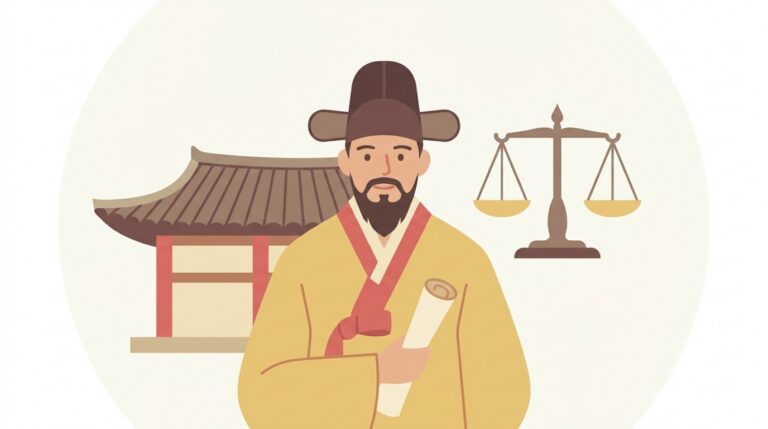
Phase 1: Empathy — When K-Drama History Meets Real Seoul Debates
안녕하세요! 매일한글 에디터입니다. (Annyeonghaseyo! Hello, this is your Daily Hangul Editor!) Picture this: you are in a lively Seoul café with Korean friends after watching a hit historical K-drama like Yi San. Everyone starts debating how modern Korean civic pride connects back to Late Joseon Silhak thinker Dasan Jeong Yak-yong. You know he wrote Gyeongseyupyo and Mokminsimseo, and even argued in Tangnon and Wonmok that rulers derive legitimacy from the people below—not heaven! Yet when you try to articulate bottom-up sovereignty in Level 6 Korean, your phrasing sounds like a stiff textbook. Based on real feedback from advanced learners, this guide equips you with authentic, nuanced Korean to debate Korean political philosophy like a true insider.
Phase 2: Deep Dive into 3 Core Expressions
1. 민심에서 비롯된 정당성 (minsimeseo birotdoen jeongdangseong)
- Pronunciation: min-sim-e-seo bi-rot-doen jeong-dang-seong (Think of min as in mint, sim like seem, bi-rot-doen as bee-rote-dwen with a crisp t stop, and jeong-dang-seong like jung-dahng-sung.)
- Meaning: Literally “legitimacy originating from the people’s heart/will.” In real usage, it captures the core thesis of Dasan’s Tangnon (탕론)—that political authority is never innate or guaranteed by birthright, but continuously earned from below.
- K-Culture Moment: You will hear anchorpersons on Korean current-affairs podcasts or intense courtroom-style political dramas (think Chief of Staff or The Whirlwind) drop this exact collocation when a leader’s approval rating collapses and commentators remind them where power actually comes from.
- Editor’s Insight: Notice the verb stem 비롯되다 (birotdoeda — to originate from). At Level 6, swapping basic 나오다 (naoda — to come out) for 비롯되다 instantly elevates your register from casual chatting to sharp editorial commentary.
- Situation Spectrum: Casual ⚠️ | Semi-formal ✅ | Formal ✅
- 🤔 Think About It: In English, we often speak of “consent of the governed” as a legal contract. In Korean, 민심 (minsim) fuses people with heart/mind (심 / 心). How does framing legitimacy as an emotional and moral alignment rather than just a ballot shift the way Koreans judge their leaders?
2. 아래에서 위로 추대하다 (araeeseo wiro chudaehada)
- Pronunciation: a-rae-e-seo wi-ro chu-dae-ha-da (Say a-rae like ah-reh, wi-ro like wee-roh, and chu-dae like choo-deh—imagine a crisp sneeze followed by “day.”)
- Meaning: Literally “to nominate/elevate from below to above.” In Tangnon (탕론), Dasan boldly compared a king to a village elder or a dance-troupe leader chosen by villagers: if the leader performs poorly, the people can replace them.
- K-Culture Moment: Fans of historical dramas (sageuk) like The Red Sleeve or Queen Woo recognize the tension between top-down royal decrees and bottom-up consensus. Today, Koreans also use 추대하다 (chudaehada) in boardrooms, university clubs, or civic committees when someone is nominated by popular acclaim rather than self-promotion.
- Editor’s Insight: Unlike 뽑다 (ppopda — to pick/vote) or 선출하다 (seonchulhada — to elect via formal ballot), 추대하다 implies moral reverence and collective backing. Using it with 아래에서 위로 (from bottom to top) highlights just how radical Dasan’s 18th-century argument was in a Confucian monarchy!
- Situation Spectrum: Casual ⚠️ | Semi-formal ✅ | Formal ✅
- 🤔 Think About It: In your native language, is there a difference between “electing” someone and “elevating” someone by community trust? Why do you think Dasan chose a bottom-up village metaphor to explain royal legitimacy?
3. 이용후생과 실사구시 (iyonghusaenggwa silsagusi)
- Pronunciation: i-yong-hu-saeng-gwa sil-sa-gu-si (Think ee-yong-hoo-seng-gwah, then sil-sah-goo-shee—watch out for 시, which sounds softer than English “she,” closer to a gentle breeze over “see.”)
- Meaning: 이용후생 (이용하다 + 후생) means using practical tools and institutions to enrich people’s everyday livelihood; 실사구시 means seeking truth through concrete facts rather than empty dogma. Together, they form the twin pillars of Late Joseon 실학 (Silhak — Practical Learning).
- K-Culture Moment: Whether it is an indie documentary about King Jeongjo’s Suwon Hwaseong Fortress—where Dasan’s pulley crane (거중기 / geojunggi) saved workers’ backs and slashed construction time—or a modern Korean tech CEO criticizing pointless red tape, these four-character idioms (사자성어 / saja seongeo) signal pragmatic wisdom.
- Editor’s Insight: Koreans love pairing four-character Sino-Korean idioms for rhetorical rhythm. Don’t memorize them as dusty museum labels! Drop 실사구시 정신 (silsagusi jeongsin — spirit of empirical pragmatism) in a Korean business meeting when arguing for data over gut feelings, and watch eyebrows rise in respect.
- Situation Spectrum: Casual 🚫 | Semi-formal ✅ | Formal ✅
- 🤔 Think About It: Western philosophy often separates “pure theory” from “applied engineering.” How does Dasan’s integration of moral governance (Wonmok) with practical engineering (Iyonghusaeng) challenge that divide?
Phase 3: Textbook Korean vs. Real Korean
Situation 1: Expressing that a ruler or leader exists for the people, not the other way around
- 📖 Textbook Korean: 통치자는 백성을 위해서 존재해야 합니다. (Tongchijaneun baekseongeul wihaeseo jonjaehaeya hamnida. — Rulers must exist for the people.)
- 🗣️ Real Korean: 결국 리더는 국민이 있어야 존재하는 거잖아요. (Gyeolguk lideoneun gungmini isseoya jonjaehaneun geojanayo. — At the end of the day, a leader only exists because the people are there, right?)
- 💡 Why the difference? While 백성 (baekseong) and 통치자 (tongchija) accurately reflect Joseon texts like Wonmok (원목), modern Koreans naturally shift to 국민 (gungmin — citizens) or 시민 (simin) and soften philosophical assertions with the shared-knowledge ending -잖아요 (-janayo) to invite agreement in spirited café debates.
Situation 2: Calling out empty theory vs. real-world problem solving (Silsagusi vibe)
- 📖 Textbook Korean: 공리공론을 피하고 실사구시의 태도를 가져야 합니다. (Gongnigongnoneul pihago silsagusii taedoreul gajyeoya hamnida. — We must avoid empty theorizing and adopt an empirical attitude.)
- 🗣️ Real Korean: 탁상공론만 하지 말고, 당장 현장에 쓸 수 있는 대안을 내놔야죠. (Taksanggongnonman haji malgo, dangjang hyeonjange sseul su inneun daeaneul naenwayajyo. — Stop with the armchair theorizing and let’s put forward solutions we can actually use on the ground.)
- 💡 Why the difference? Koreans swap the textbook 공리공론 for the punchier 탁상공론 (taksanggongnon — “desk-top empty debate”), contrasting it directly with 현장 (hyeonjang — the real field). It carries Dasan’s exact Silhak spirit in crisp 21st-century office Korean!
Phase 4: K-Culture Deep Dive & Non-Verbal Manners
4-1. Nunchi (눈치) & Gestures in Intellectual Debates
Talking about sovereignty, Tangnon, and governance in Korea requires sharp 눈치 (nunchi — social awareness). Even when passionately arguing a bottom-up idea like Dasan’s, notice how fluent speakers manage hierarchy and harmony:
* Posture & Gaze: Keep an open, slightly leaned-in posture to show engagement, rather than leaning back with crossed arms (which reads as dismissive in Korea).
* Hand Gestures: Avoid pointing a single index finger at someone across the table when saying “the leader” or “you”—use an open palm sweeping gently upward when describing 아래에서 위로 (from bottom to top).
* Vocal Cushioning: Even when disagreeing strongly with an older friend or professor, preface your point with “제 생각에는… (je saenggageneun — in my view…)” or “일리가 있지만 (illiga itjiman — that makes sense, however…)” before dropping your sharp Silhak critique.
4-2. Cultural Code Analysis: Sageuk Dramas & Modern Civic Pride
If you have watched Yi San (이산) or The Red Sleeve (옷소매 붉은 끝동), you already felt the electric tension of King Jeongjo’s court—where reform-minded Silhak scholars clashed with entrenched Noron elites. Jeongjo deeply cherished Jeong Yak-yong’s talent, famously commissioning him to design the bridge over the Han River and Suwon Hwaseong Fortress. Yet after Jeongjo’s sudden death, Dasan spent 18 years in exile in Gangjin, where he poured his grief into over 500 volumes, including Gyeongseyupyo (경세유표 — Design for Good Government) and Mokminsimseo (목민심서 — Admonitions on Governing the People). Why does this resonate so deeply in K-Culture today? Because Korea’s modern candlelight civic culture echoes Tangnon‘s radical claim: authority is a temporary stewardship, never a divine birthright.
Phase 5: Interactive Roleplay Scenario
Setting: A warm, wooden-beamed traditional tea house in Bukchon Hanok Village after visiting an exhibit on Late Joseon Silhak. Outside, autumn rain patters against tiled roofs.
Character: Jisu (지수), a witty 29-year-old Korean history PhD candidate and obsessive K-drama reviewer who loves testing her friends’ grasp of Korean nuance.
- Jisu: 🎭 pouring hot roasted barley tea into celadon cups 전시회 어땠어요? 정약용의 거중기 모형이 제일 인기 많던데. (Jeonsihoe eottaesseoyo? Jeong Yak-yongui geojunggi mohyeongi jeil ingi mandeonde. — How was the exhibition? Jeong Yak-yong’s crane model seemed the most popular.)
- You: 🎭 wrapping both hands around the warm cup 거중기도 대단했지만, 저는 사실 ‘탕론’과 ‘원목’ 설명이 제일 충격적이었어요. (Geojunggido daedanhaetjiman, jeoneun sasil ‘Tangnon’gwa ‘Wonmok’ seolmyeongi jeil chunggyeokjeogieosseoyo. — The crane was amazing, but honestly, the explanation of Tangnon and Wonmok shocked me the most.)
- Jisu: 🎭 eyes widening with delight 오, 거기까지 유심히 봤어요? 조선 시대에 그런 말을 했다는 게 믿기지 않죠? (O, geogikkaji yusimhi bwasseoyo? Joseon sidaee geureon mareul haetdaneun ge mitgiji anjyo? — Oh, you looked that closely? It’s hard to believe someone said that during the Joseon Dynasty, right?)
- You: 🎭 nodding earnestly 네! 통치자가 하늘에서 정해지는 게 아니라 백성이 아래에서 추대한다는 게 정말 파격적이잖아요. (Ne! Tongchijaga haneureseo jeonghaejineun ge anira baekseongi araeeseo chudaehandaneun ge jeongmal pagyeokjeogijanayo. — Yes! The idea that rulers aren’t ordained by heaven, but elevated by the people from below, is truly groundbreaking.)
- Jisu: 🎭 leaning forward over the low table 맞아요. ‘원목’에서는 아예 목민관이 백성을 위해 존재하는 거지, 백성이 목민관을 위해 사는 게 아니라고 못을 박았죠. (Majayo. ‘Wonmok’eseoneun aye mokmingwani baekseongeul wihae jonjaehaneun geoji, baekseongi mokmingwaneul wihae saneun ge anirago moseul bagatjyo. — Exactly. In Wonmok, he nailed it down explicitly: magistrates exist for the people, not the people for the magistrates.)
- You: 🎭 smiling thoughtfully 게다가 ‘경세유표’나 ‘목민심서’를 보면, 이상적인 철학뿐만 아니라 실제 행정 개혁까지 다뤘더군요. (Gedaga ‘Gyeongseyupyo’na ‘Mokminsimseo’reul bomyeon, isangjeogin cheolhakppunman anira silje haengjeong gaehyeokkkaji darwotdeogunyo. — On top of that, looking at Gyeongseyupyo and Mokminsimseo, he didn’t just write ideal philosophy—he tackled real administrative reform.)
- Jisu: 🎭 giving an approving nod 바로 그게 이용후생과 실사구시죠. 그런데 요즘 시대에 다산 선생님이 살아 계신다면, 우리 사회에 어떤 조언을 해 주실까요? (Baro geuge iyonghusaenggwa silsagusijyo. Geureonde yojeum sidaee Dasan seonsaengnimi sara gyesindamyeon, uri sahoee eotteon joeoneul hae jusilkkayo? — That right there is iyonghusaeng and silsagusi. By the way, if Master Dasan were alive today, what advice do you think he’d give our society?)
- You: (Your turn to respond!)
🔀 Interactive Branching Point: How do you answer Jisu?
- Choice A: “탁상공론 대신, 민심을 살피고 현장에 필요한 실용적인 정책부터 세우라고 하실 것 같아요.” (Taksanggongnon daesin, minsimeul salpigo hyeonjange piryohan siryongjeogin jeongchaekbuteo seurago hasil geot gatayo. — “Instead of armchair debate, I think he’d say to examine the people’s will and build practical policies needed on the ground first.”)
- Feedback (🌟 Best!): Absolute perfection! You seamlessly combined modern natural Korean (탁상공론, 현장) with Dasan’s core values (민심, 실용). Jisu would immediately ask if you want to co-host a Korean history podcast!
- Choice B: “다산 선생님은 모든 정치인을 당장 감옥에 보내라고 하실 거예요!” (Dasan seonsaengnimeun modeun jeongchiineul dangjang gamoge bonaerago hasil geoyeyo! — “Master Dasan would tell us to throw every politician in jail right away!”)
- Feedback (💥 Risk!): Too blunt and overly cynical for a nuanced philosophical chat. Even if Koreans joke about politics, reducing Dasan’s thoughtful institutional reform (경세유표) to “jail everyone” misses the constructive heart of Silhak.
- Choice C: “그냥 책을 많이 읽으라고 하시겠죠 뭐.” (Geunyang chaegeul mani ilgeurago hasigetjyo mwo. — “He’d probably just tell us to read lots of books, I guess.”)
- Feedback (❌ Bad / Missed Opportunity): While Dasan was a prodigious writer, shrugging off with 그냥… 뭐 sounds indifferent and misses the chance to show off your Level 6 command of Silhak vocabulary.
Phase 6: 10-Second Emotional Shadowing Drill
Read these aloud, pausing briefly at every / and matching the emotional cue!
- [🔥 Passionately & persuasively]
통치자는 / 하늘이 내린 것이 아니라 / 백성이 아래에서부터 / 추대하여 세운 존재입니다!
(Tongchijaneun / haneuri naerin geosi anira / baekseongi araeeseobuteo / chudaehayeo seun jonjaeimnida!)
— “A ruler is not sent down by heaven, but is someone elevated and established by the people from below!” -
[🤔 Thoughtfully & deeply]
백성이 / 통치자를 위해 존재하는 게 아니라, / 통치자가 / 백성을 위해 존재하는 거죠.
(Baekseongi / tongchijareul wihae jonjaehaneun ge anira, / tongchijaga / baekseongeul wihae jonjaehaneun geojyo.)
— “The people do not exist for the ruler; the ruler exists for the people, you see.” -
[😌 Calmly & firmly]
말뿐인 이론보다 / 백성의 삶을 실질적으로 바꾸는 / 실사구시의 자세가 필요합니다.
(Malppunin ironboda / baekseongui salmeul siljiljeogeuro bakkuneun / silsagusii jasega piryohamnida.)
— “More than mere words and theory, we need an empirical attitude that genuinely improves the people’s lives.”
Phase 7: K-Culture Mini Dictionary
- 실학 (Silhak) | Practical Learning | A Late Joseon reform movement prioritizing real-world livelihoods, science, and institutional reform over rigid Neo-Confucian metaphysics. In modern business, Koreans jokingly praise a no-nonsense teammate as having “실학 마인드 (Silhak mindset).”
- 민심 (Minsim) | Public Sentiment / Heart of the People | Literally “the people’s mind/heart.” Ubiquitous in Korean news headlines, K-drama boardroom coups, and even K-pop fandom discussions when public opinion turns.
- 목민관 (Mokmingwan) | Local Magistrate / Shepherd of the People | From Dasan’s Mokminsimseo (목민심서), referring to officials tasked with caring for citizens as a shepherd tends a flock. Modern Korean mayors and governors still reference 목민관의 자세 (the posture of a mokmingwan) in inauguration speeches.
- 실사구시 (Silsagusi) | Seeking Truth from Facts | An empirical, evidence-based approach to problem solving. Widely used in Korean journalism, tech startups, and policy debates to demand proof over ideology.
Phase 8: Survival Kit for Travelers
Planning to walk along King Jeongjo’s and Dasan’s footsteps at Suwon Hwaseong Fortress or the Dasan Heritage Site in Namyangju? Pack these three phrases!
- 다산 정약용 유적지로 가는 가장 빠른 길이 어디예요? (Dasan Jeong Yak-yong yujeokjiro ganeun gajang ppareun giri eodiyeyo? — What is the fastest way to the Dasan Jeong Yak-yong Historic Site?)
- Pro Tip: Even if a local isn’t sure about the exact bus, mentioning 다산 유적지 (Dasan Yujeokji) immediately clues them in.
- 거중기 관련 전시나 체험 프로그램도 있나요? (Geojunggi gwallyeon jeonsina cheheom peurogeuraemdo innayo? — Are there exhibitions or hands-on programs related to the geojunggi crane?)
- Pro Tip: At the Silhak Museum in Namyangju, interactive models bring Dasan’s Iyonghusaeng inventions to life!
- 영어 오디오 가이드를 대여할 수 있을까요? (Yeongeo odio gaideureul daeyeohal su isseulkkayo? — Could I rent an English audio guide?)
- Pro Tip: Asking politely with -을까요 (-eulkkayo) keeps museum staff smiling and eager to help.
Editor’s Travel Note: Navigating historic sites outside central Seoul is effortless if you Download the Naver Map App for English Transit Routes beforehand—Google Maps lacks reliable walking and bus routing in Korea. Before heading to Namyangju’s Dasan Heritage Site or Suwon Hwaseong, you can also Check Korail Train Schedules to Suwon and Yangsu Stations and load a T-money card at any convenience store (CU or GS25) with cash so bus transfers are seamless.
Phase 9: One Step Deeper — The Heart of Korean Accountability
In Western political thought, sovereignty is often framed as an abstract legal contract forged in the Enlightenment. Yet in Korea, Dasan Jeong Yak-yong’s Tangnon and Wonmok fused civic legitimacy with moral empathy: an official is a 목민관 (mokmingwan)—a shepherd accountable to the flock—and 민심 (minsim) is literally equated with 천심 (cheonsim — the will of heaven). Even though Korean daily life preserves intricate honorifics and age hierarchies, there exists an equally fierce cultural expectation that anyone holding higher status bears heavier duty toward those below. When power forgets its duty, Korean history shows that 아래에서 위로 (from bottom to top) ceases to be a philosophical essay and becomes a living force in the streets.
💬 Your Turn: Does your home culture have a historical thinker or proverb that expresses “rulers exist for the people, not the other way around”? Drop a comment below and tell us how it compares to Dasan’s Tangnon!
Phase 10: FAQ & Misconception Prevention
Q: Was Dasan Jeong Yak-yong’s Tangnon advocating for modern Western-style elections?
A: Not quite in the modern institutional sense—he wrote within an 18th-century Confucian framework—but his argument that rulers originate from bottom-up communal selection (추대) and can be replaced like a village leader if they fail was astonishingly close to popular sovereignty.
Q: What is the difference between Gyeongseyupyo (경세유표) and Mokminsimseo (목민심서)?
A: Think of Gyeongseyupyo as the structural blueprint for reforming central state institutions (taxes, ministries, national law), whereas Mokminsimseo is a practical ethical and administrative manual for local magistrates governing citizens directly on the ground.
Q: Can I actually use words like 백성 (baekseong) or 군주 (gunju) in modern Korean conversations?
A: Only when explicitly discussing history, sageuk dramas, or literary quotes! In everyday modern discussions about politics or leadership, switch to 국민 (gungmin — citizens), 시민 (simin), or 지도자 (jidoja — leader).
🚨 Common Mistakes Warning Board
- Mistake: Saying 왕을 뽑았어요 (picked a king) when summarizing Tangnon.
- Correct Action: Use 추대하다 (chudaehada — elevate by consensus) to preserve the classical dignity and philosophical weight of Dasan’s argument.
- Mistake: Confusing 실학 (Silhak) with just “science class.”
- Correct Action: Remember that Silhak encompasses economics, public administration (경세치용), daily technology (이용후생), and empirical truth-seeking (실사구시).
- Mistake: Pronouncing 실사구시 like “shil-sa-goo-shee” with heavy English “sh.”
- Correct Action: Keep 시 (si) light and airy—touch your tongue gently behind your lower teeth rather than rounding your lips.
Phase 11: Action Mission & Engagement
- 🥉 Bronze Mission (Solo Practice): Record yourself performing the 3 lines in Phase 6’s 10-Second Shadowing Drill and listen back to check your pauses at each
/. - 🥈 Silver Mission (Share Online): Post one sentence on your study journal or social feed using 실사구시 (silsagusi) or 민심 (minsim) to describe a real-life situation, tagging
#DailyHangul! - 🥇 Gold Mission (Real-World Use): Next time you talk with a Korean friend about a K-drama or current event, drop “결국 민심에서 비롯되는 거죠 (After all, it originates from the people’s will)” and watch their impressed reaction.
🎮 K-Culture Mission: Rewatch an episode of Yi San, The Red Sleeve, or Chief of Staff this week and try to spot at least one scene where a character challenges top-down authority with bottom-up accountability—that’s Tangnon and Wonmok alive on screen!
Phase 12: Interactive Quiz Challenge
1. Situational Judgment
Your Korean coworker suggests skipping customer field testing and rushing a launch based purely on a flashy slide deck. Which Silhak-inspired Level 6 response fits best?
* A) “탁상공론만 하지 말고 실사구시 정신으로 현장 데이터부터 확인합시다.” (Let’s stop armchair theorizing and check field data first with a silsagusi mindset.)
* B) “당신은 훌륭한 목민관이 아닙니다.” (You are not a good local magistrate.)
2. Fill in the Blank
In Tangnon (탕론), Dasan argued that rulers are not chosen by heaven from the start, but rather ____________________.
(통치자는 하늘이 처음부터 정한 것이 아니라, 백성이 _________ 추대하여 세운 존재다.)
* A) 위에서 아래로 (from top to bottom)
* B) 아래에서부터 (from below)
3. True or False Cultural Quiz
Statement: Dasan Jeong Yak-yong wrote Gyeongseyupyo and Mokminsimseo while serving comfortably as Prime Minister in Seoul’s royal palace.
* True / False
Click here to reveal the answers & editor’s explanations!
- Quiz 1 Answer: A! Using 탁상공론 and 실사구시 sounds razor-sharp and natural in a Korean office. Option B would make your coworker wonder why you’re calling them a Joseon magistrate!
- Quiz 2 Answer: B (아래에서부터 — from below)! Dasan famously argued in Tangnon that leadership flows upward from the people’s consensus, not downward from heaven.
- Quiz 3 Answer: False! After King Jeongjo’s death, Dasan endured 18 years of political exile in Gangjin, Jeollanam-do, where he transformed hardship into over 500 volumes of groundbreaking statecraft and Silhak scholarship.
🎬 Watch Our Daily Videos! (Daily Hangul Official Instagram)
Review the expressions you learned in this article with our fun daily short videos! Check out native pronunciation and real-life nuances in action.
- Instagram @dailyhangul_en







