

Don’t Panic at Seoul’s Giant Crosswalks! Master Korean Underground Walkway Directions
Phase 1: The Seoul Street Maze (Opening Story)
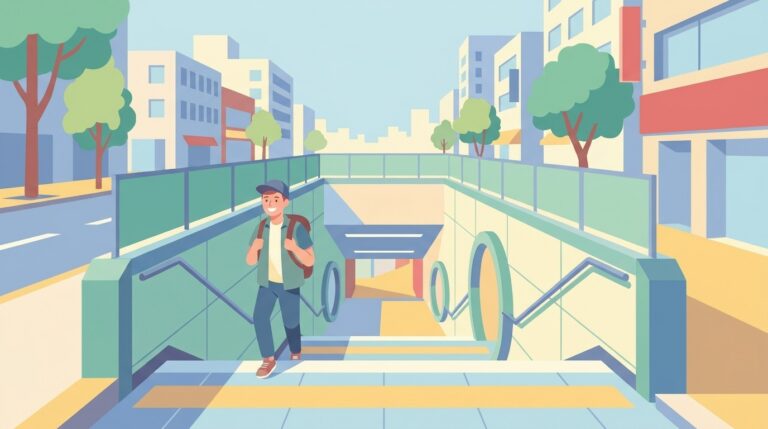
Annyeonghaseyo! Hello, I’m your Daily Hangul Editor. Imagine you are in Myeongdong, hunting for that limited-edition K-Pop album. You spot the store right across the street, but wait—there is an eight-lane road with zero crosswalks! Confused, you ask a friendly Korean student nearby, and she smiles, pointing down at some stairs: 지하보도로 내려가세요 (Jihabodo-ro naeryeogaseyo / Go down the underground walkway). Many of our beginner students tell us that Seoul’s underground walkways feel like a hidden maze at first. Based on real feedback from travelers and learners just like you, this Level 1 guide will help you understand walking directions and navigate Seoul’s underground paths like a pro!
Phase 2: Deep Dive into 3 Essential Expressions
1. 지하보도로 내려가세요 (Jihabodo-ro naeryeogaseyo)
- Pronunciation: Ji-ha-bo-do-ro nae-ryeo-ga-se-yo (Think of “ji-ha” like gee-ha, “bo-do” like bow-dough, and “nae-ryeo” like neh-ryuh without rolling the R too hard!)
- Meaning: Literally “By means of the underground walkway, please go down.” In real life, it simply means “Go down through the underpass.”
- K-Culture Moment: You will see this exact situation in K-Dramas set in bustling Seoul districts like Gangnam or Euljiro, where the main character rushes down the subway-like stairs to cross a busy boulevard and grab a street snack.
- Editor’s Insight: Notice the particle -(으)로 (-(eu)ro). In Korean, it marks the path or route you take! Using 내려가세요 (naeryeogaseyo) instead of 가세요 (gaseyo / go) immediately tells you that your destination starts downstairs.
- Situation Spectrum: Casual 🚫 | Semi-formal ✅ | Formal ✅
- 🤔 Think About It: In your country, do people usually cross big streets underground or on the surface? In Korea, big cities build underground walkways not just for safety, but to turn walking routes into lively indoor spaces!
2. 건너편으로 가고 싶어요 (Geonneopyeon-euro gago sipeoyo)
- Pronunciation: Geo-nneo-pyeon-eu-ro ga-go si-peo-yo (The double “nn” in “geo-nneo” sounds like saying “gun-nuh” with a slightly longer N hold, like in “pen-name.”)
- Meaning: Literally “I want to go toward the crossing side.” It is the easiest Level 1 phrase for “I want to get to the other side of the street.”
- K-Culture Moment: In Korean travel variety shows, cast members often stand at a huge intersection holding a mission map, squinting at a café on the opposite side, and asking locals how to cross using this exact phrase.
- Editor’s Insight: 건너편 (geonneopyeon) means “the opposite side.” Even if you forget the word for underground walkway, saying this while pointing across the road will instantly make any Korean local point you to the right stairs!
- Situation Spectrum: Casual 🚫 | Semi-formal ✅ | Formal ✅
- 🤔 Think About It: English speakers often ask “How do I cross?” focusing on the action. Korean beginners find it much easier to state their goal—”I want to go to the other side”—which naturally invites locals to give the best route!
3. 몇 번 출구로 나가요? (Myeot beon chulgu-ro nagayo?)
- Pronunciation: Myeot beon chul-gu-ro na-ga-yo (“Myeot” rhymes with “cut” with a soft T at the end, and “chul-gu” sounds like “chool-goo.”)
- Meaning: Literally “Through which number exit do I go out?” It means “Which exit should I take?”
- K-Culture Moment: When K-Pop fans meet up near a concert venue or trendy Seongsu-dong pop-up store, their KakaoTalk messages are always filled with exit numbers like “Exit 3” or “Exit 8.”
- Editor’s Insight: In Seoul, underground walkways and subway stations share numbered exits! Once you go underground using a 지하보도 (jihabodo), knowing the exit number saves you from popping back up on the wrong corner.
- Situation Spectrum: Casual 🚫 | Semi-formal ✅ | Formal ✅
- 🤔 Think About It: Why do Koreans rely so heavily on numbered exits instead of street names? Because underground passages connect huge areas, numbers act like universal GPS pins for everyone!
Phase 3: Textbook Korean vs. Real Korean
Situation 1: Asking how to cross the street
- 📖 Textbook Korean: 실례지만, 길을 어떻게 건넙니까? (Sillyejiman, gireul eotteoke geonneomnikka? / Excuse me, how does one cross the road?)
- 🗣️ Real Korean: 저기요, 여기 건너가려면 지하보도로 가야 돼요? (Jeogiyo, yeogi geonneogaryeomyeon jihabodo-ro gaya dwaeyo? / Excuse me, to cross here, do I have to take the underpass?)
- 💡 Why the difference? Textbooks love the stiff -ㅂ니까 (-mnikka) ending, which sounds like a news anchor! In daily street conversations, friendly -요 (-yo) endings and casual openers like 저기요 (Jeogiyo / Excuse me) feel warm and natural.
Situation 2: Confirming you are going the right way
- 📖 Textbook Korean: 이 계단을 통해 아래로 내려가십시오. (I gyedaneul tonghae araero naeryeogasipsio. / Please descend downward through these stairs.)
- 🗣️ Real Korean: 이쪽으로 내려가면 돼요! (Ijjog-euro naeryeogamyeon dwaeyo! / Just go down this way!)
- 💡 Why the difference? Real-life directions in Korea are short and action-focused. Locals love the pattern -(으)면 돼요 (-(eu)myeon dwaeyo / you just need to…) because it feels reassuring and easy for beginners to catch!
Phase 4: K-Culture Deep Dive & Non-Verbal Manners
4-1. Nunchi & Street Gestures
When you ask for directions on a busy Seoul sidewalk, Nunchi (눈치 / social awareness) matters! Avoid stopping someone who is wearing big headphones or speed-walking to catch a bus. Make gentle eye contact, give a slight head nod, and use an open palm—never point with a single index finger at people! When a Korean local guides you toward an underground walkway, they will often walk two or three steps with you and gesture downward with an open hand while saying 저기요 (Jeogiyo / Right over there). Returning a warm nod and saying 감사합니다 (Gamsahamnida / Thank you) creates instant good vibes.
4-2. Cultural Code: The Secret World of K-Travel Underground Shopping
In Korea, an underground walkway is rarely just an empty concrete tunnel! Especially in Myeongdong, Gangnam, and Express Bus Terminal (Goto Mall), a 지하보도 (jihabodo) transforms into a brightly lit 지하상가 (jihasangga / underground shopping arcade). You will walk past trendy K-Fashion boutiques, K-Beauty skincare shops, phone case stalls, and cozy snack corners selling hot fish cakes! In winter or during summer monsoon rain, Koreans intentionally use these underground walkways to stay comfortable while traveling across huge districts.
Phase 5: Real-Life Roleplay Scenario
- Setting: A sunny afternoon near City Hall in Seoul. Huge traffic flows in front of you, and you want to reach a famous bibimbap restaurant on the opposite side.
- NPC: Minji (민지), a cheerful Korean office worker holding an iced Americano.
Dialogue
- You: 저기요, 죄송한데 질문 하나만 해도 돼요? (Jeogiyo, joesonghande jilmun hanaman haedo dwaeyo? / Excuse me, sorry to bother you, can I ask one question?) 🎭 Step politely toward Minji with a small smile.
- Minji: 네, 말씀하세요! (Ne, malsseumhaseyo! / Yes, go ahead!) 🎭 Minji stops and smiles warmly.
- You: 저기 건너편으로 가고 싶어요. 횡단보도가 없어요? (Jeogi geonneopyeon-euro gago sipeoyo. Hoengdanbodo-ga eopseoyo? / I want to go to the other side over there. Is there no crosswalk?) 🎭 Point gently toward the restaurant across the wide road.
- Minji: 아, 여기는 차가 많아서 횡단보도가 없어요. (A, yeogineun cha-ga manaseo hoengdanbodo-ga eopseoyo. / Ah, there are so many cars here, so there is no crosswalk.) 🎭 Minji nods sympathetically.
- You: 그럼 어떻게 가요? (Geureom eotteoke gayo? / Then how do I go?) 🎭 Tilt your head slightly, looking curious.
- Minji: 저기 지하보도로 내려가세요. 3번 출구로 나가면 돼요. (Jeogi jihabodo-ro naeryeogaseyo. Sam-beon chulgu-ro nagamyeon dwaeyo. / Please go down that underground walkway over there. Just go out Exit 3.) 🎭 Minji gestures with an open palm toward the green stairs sign.
- You: 아! 3번 출구요? 감사합니다! (A! Sam-beon chulguyo? Gamsahamnida! / Ah! Exit 3? Thank you!) 🎭 Bow your head slightly in gratitude.
- Minji: 네, 조심히 가세요! (Ne, josimhi gaseyo! / Yes, get there safely!) 🎭 Minji waves lightly and walks away.
🔀 Interactive Branching Point: What do you do once you reach the underground walkway?
- Option A: Follow the yellow signs labeled 3번 출구 (Sam-beon chulgu / Exit 3) and check the street map board on the wall.
- Option B: Walk straight without checking signs because all underground tunnels lead to the same place.
- Option C: Ask a shopkeeper inside the underground arcade, “이쪽이 3번 출구예요?” (Ijjog-i sam-beon chulguyeyo? / Is this way Exit 3?) just to be sure.
Feedback:
* Option A (Best!): Smart traveler move! Korean underground walkways have super clear color-coded exit signs. Checking the wall map guarantees you pop up right near your bibimbap!
* Option B (Bad!): Danger of getting lost! Big Seoul underpasses connect to multiple subway lines and different street corners. Walking blindly might take you three blocks away!
* Option C (Risk, but Friendly!): Most shopkeepers are helpful, though some might be busy with customers. Still, your polite Korean question will usually earn you a quick nod and a smile!
Phase 6: 10-Second Emotion Shadowing Drill
Read aloud and follow the / pause marks and emotion cues!
- [😊 Cheerfully & politely]
저기요! / 저기 건너편으로 / 가고 싶어요. (Jeogiyo! / Jeogi geonneopyeon-euro / gago sipeoyo.) - [😲 Surprised & curious]
어? / 횡단보도가 / 없어요? (Eo? / Hoengdanbodo-ga / eopseoyo?) - [😌 Relieved & grateful]
아, / 지하보도로 / 내려가세요? / 감사합니다! (A, / jihabodo-ro / naeryeogaseyo? / Gamsahamnida!)
Phase 7: K-Culture Mini Dictionary
- 지하보도 (Jihabodo) | Underground walkway / Underpass | A pedestrian tunnel beneath busy roads. Often has signs showing street directions.
- 지하상가 (Jihasangga) | Underground shopping arcade | A lively shopping mall built inside a walkway or subway station—famous for affordable K-Fashion!
- 계단 (Gyedan) | Stairs | Crucial word! Signs often warn 계단 조심 (Gyedan josim / Watch your step on the stairs).
- 출구 (Chulgu) | Exit | You will see this on bright yellow signs everywhere underground, paired with numbers like 1, 2, 3.
Phase 8: Traveler’s Survival Kit
Top 3 Survival Phrases
- 지하보도가 어디예요? (Jihabodo-ga eodiyeyo?) — Where is the underground walkway?
- Pro Tip: Look for a small icon of a person walking down stairs on blue street signs!
- 어느 쪽으로 내려가요? (Eoneu jjog-euro naeryeogayo?) — Which way do I go down?
- Pro Tip: Great when you see two different staircases at an intersection.
- 여기 3번 출구 맞아요? (Yeogi sam-beon chulgu majayo?) — Is this Exit 3?
- Pro Tip: Swap “sam-beon” (3) with “il-beon” (1) or “i-beon” (2) whenever needed!
Editor’s Travel Note
Google Maps often struggles with walking routes in South Korea! Before your trip, make sure to complete your Naver Map app download for Seoul walking routes or KakaoMap guide for Korean pedestrian navigation. Both apps support English and will literally show you which underground walkway entrance to enter and which numbered exit to climb back up. Also, keep your T-money transit card handy—if an underground walkway passes inside a subway ticket gate area, do not tap your card unless you plan to ride the train; look for the free public walkway path marked 건너가는 곳 (Geonneoganeun got / Crossing area)!
Phase 9: One Step Deeper
Notice how Korean direction phrases like 내려가세요 (naeryeogaseyo / go down) and 올라가세요 (ollagaseyo / go up) always reflect your exact vertical movement. Rather than treating space as a flat 2D map, Korean naturally describes how your body moves through multi-layered cities. This reflects Korea’s fast-paced urban culture, where life flows smoothly both above and below the street. Even a quick trip through an underpass becomes a shared community space filled with tiny shops, warm lights, and helpful neighbors.
💬 Your Turn: Have you ever stumbled into a cool underground shopping street in Korea—or gotten hilariously lost looking for an exit? Share your story in the comments below!
Phase 10: FAQ & Myth-Busting
Q: Do I have to pay a subway fare to use an underground walkway?
A: No! A regular 지하보도 (jihabodo) is 100% free for pedestrians. Even when an underpass connects to a subway station, you stay outside the ticket gates to cross the street.
Q: Are Korean underground walkways safe to walk through at night?
A: Yes, most major underground walkways in Seoul are brightly lit, monitored by CCTV, and lined with shops until late evening. However, very late at night when shops close, stick to well-lit main exits.
Q: What is the difference between 지하보도 (jihabodo) and 지하철 (jihacheol)?
A: Great question! 지하 (jiha) means “underground.” 보도 (bodo) means “walkway/sidewalk,” while 철 (cheol) means “rail/train.” So 지하보도 is for walking, and 지하철 is the subway!
🚨 Common Mistakes Top 3
- Mistake: Saying 아래로 가요 (Araero gayo / Go to the bottom) instead of 내려가세요 (Naeryeogaseyo).
- Correct Action: Use 내려가다 (naeryeogada / to go down) for stairs and slopes—it sounds 10x more natural!
- Mistake: Tapping your T-money card at a subway gate just to cross the street.
- Correct Action: Look for signs saying 횡단 (Hoengdan / Crossing) or 반대편 (Bandaepyeon / Opposite side) that bypass the ticket gates for free.
- Mistake: Asking a local “Exit 3?” in English without the Korean word 출구 (chulgu).
- Correct Action: Simply say “삼 번 출구 어디예요?” (Sam-beon chulgu eodiyeyo? / Where is Exit 3?) for instant comprehension!
Phase 11: Action Mission & Engagement
- 🥉 Bronze Mission: Stand near your own stairs at home and say “지하보도로 내려가세요” (Jihabodo-ro naeryeogaseyo) aloud 3 times while walking down!
- 🥈 Silver Mission: Screenshot your favorite phrase from Phase 2 and share it on Instagram Stories or with a study buddy who wants to visit Seoul.
- 🥇 Gold Mission: Next time you are in Korea (or at a local Korean market/town!), practice asking “건너편으로 가고 싶어요” (Geonneopyeon-euro gago sipeoyo) or reading Hangul exit signs!
- 🎮 K-Culture Mission: Watch a Seoul walking vlog on YouTube and spot at least one yellow 출구 (chulgu) sign or 지하보도 (jihabodo) entrance!
Phase 12: Interactive Quiz Challenge
Quiz 1: Situation Judgment
You want to cross a giant 8-lane avenue in Gangnam, and a local points toward a staircase going down and says, “지하보도로 내려가세요.” What should you do?
* A) Wait on the curb for a green crosswalk light.
* B) Walk down the stairs into the underground walkway.
* C) Get into a taxi immediately.
👉 Click to reveal the answer & explanation!
Correct Answer: B!
지하보도로 내려가세요 (Jihabodo-ro naeryeogaseyo) means “Please go down through the underground walkway.” Wait on the curb (A) and you might wait forever because there is no crosswalk! Calling a taxi (C) just to cross the street isn’t necessary when the underpass is free and fast.
Quiz 2: Fill in the Blank
Complete the phrase for “Where is Exit 2?”:
2번 [ _____ ] 어디예요? (I-beon [ _____ ] eodiyeyo?)
* A) 계단 (gyedan)
* B) 출구 (chulgu)
* C) 건너편 (geonneopyeon)
👉 Click to reveal the answer & explanation!
Correct Answer: B (출구 / chulgu)!
출구 (chulgu) means “exit,” so 2번 출구 어디예요? means “Where is Exit 2?” 계단 (gyedan) means stairs, and 건너편 (geonneopyeon) means the opposite side.
Quiz 3: True or False Culture Quiz
Statement: In Korea, you always have to pay a subway ticket fee to walk through an underground walkway.
👉 Click to reveal the answer & explanation!
Correct Answer: False!
Pedestrian underground walkways (지하보도 / jihabodo) are completely free! Even when they connect to subway stations, you stay outside the ticket gates to cross to the other side.
🎬 Watch Our Daily Videos! (Daily Hangul Official Instagram)
Review the expressions you learned in this article with our fun daily short videos! Check out native pronunciation and real-life nuances in action.
- Instagram @dailyhangul_en







