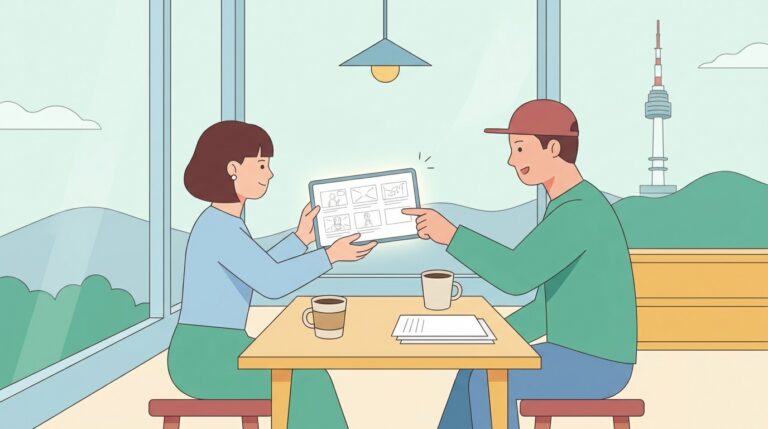
Phase 1: Empathy — Walking the Tightrope of K-Content Adaptation
안녕하세요! 매일한글 에디터입니다. (Annyeonghaseyo! Maeil Hangeul editeoimnida.) Hello! I’m your Daily Hangul editor. Picture a tense meeting room in Sangam-dong, Seoul. A mega-hit dark-fantasy webnovel is becoming a K-Drama, and a producer casually suggests erasing the hero’s tragic backstory for mass appeal. Instantly, the room freezes. As many advanced learners working in media have shared with us, pushing back on creative changes in Korean without sounding harsh is remarkably tough. Today, we will master Level 5 Korean to protect core lore, prevent fandom backlash, and collaborate smoothly with original creators!
Phase 2: Deep Dive into Top 3 Core Expressions
1. 원작의 결을 해치다 (wonjagui gyeoreul haechida)
- Pronunciation: won-jag-ui gyeo-reul hae-chi-da (Think of gyeol like saying “gyuh” + “l” smoothly, almost like the soft “girl” without the “r”, and hae-chi-da like “heh-chee-dah”)
- Meaning: Literal: “to damage the grain/texture of the original work” vs. Nuance: “to undermine the emotional tone, spirit, or core identity of the source material.”
- K-Culture Moment: When a K-Drama adaptation of a beloved Naver Webtoon turns a bittersweet thriller into a slapstick comedy, fans and critics lament that the show “원작의 결을 해쳤다 (wonjagui gyeoreul haecheotda).”
- Editor’s Insight: The word 결 (gyeol) refers to wood grain or water ripples. Using it instead of a blunt word like “망치다 (mangchida – to ruin)” makes you sound like an insightful Korean content insider who respects artistic nuance.
- Situation Spectrum: Casual ✅ / Semi-formal ✅ / Formal ✅ (Highly versatile in both fandom critiques and executive pitch rooms!)
- 🤔 Think About It: In English, people often debate whether an adaptation is “faithful” or “accurate” to the plot. Why do Koreans focus on 결 (texture/flow)? It reflects a cultural emphasis on atmosphere and emotional continuity over mere plot checklists.
2. 개연성이 떨어지다 (gaeyeonseongi tteoreojida)
- Pronunciation: gae-yeon-seong-i tteo-reo-ji-da (Think gae like “geh” in get, yeon like “yuhn”, seong like “sung”, and tteo as a tense, un-aspirated “tuh” like the “t” in stop)
- Meaning: Literal: “narrative probability drops” vs. Nuance: “the plot logic falls apart / the character’s motivation makes zero sense given the established lore.”
- K-Culture Moment: Whenever a transmedia drama kills off a key character or alters a superpower rule without setup, Korean online communities erupt with comments saying “개연성이 너무 떨어져요 (gaeyeonseongi neomu tteoreojyeoyo).”
- Editor’s Insight: You will hear this constantly in Korean script-reading sessions. It is the polite, analytical way to tell a writer, “This twist feels unearned.”
- Situation Spectrum: Casual ✅ / Semi-formal ✅ / Formal ✅ (Professional yet punchy—just soften it with “~것 같아요” in formal rooms.)
- 🤔 Think About It: English viewers might say “plot hole” or “bad writing.” Korean fans use 개연성 (causal plausibility), showing how deeply K-fandoms value tight emotional and logical cause-and-effect.
3. 원작자와의 긴밀한 조율 (wonjakjawaui ginmilhan joyul)
- Pronunciation: won-jak-ja-wa-ui gin-mil-han jo-yul (gin-mil sounds like “geen-meel”—meaning tight/intimate—and joyul is “joh-yool”, like tuning a musical instrument)
- Meaning: Literal: “close tuning with the original author” vs. Nuance: “ongoing, respectful alignment and negotiation with the creator so changes still fit their vision.”
- K-Culture Moment: Before announcing casting or script changes for a Super IP webnovel adaptation, major studios emphasize in press releases that everything went through “원작자와의 긴밀한 조율 (wonjakjawaui ginmilhan joyul).”
- Editor’s Insight: 조율 (joyul) literally means tuning a piano or violin. In Korean business culture, you don’t “overrule” or “force” a partner; you “tune” together until both sides resonate.
- Situation Spectrum: Casual ⚠️ (A bit stiff for texting friends) / Semi-formal ✅ / Formal ✅
- 🤔 Think About It: In Western studio contracts, IP rights often transfer total control away from the author. Why does Korean media culture increasingly highlight 조율 (mutual tuning)? Because in Korea’s hyper-connected fandom ecosystem, an unhappy creator signals instant trouble to millions of loyal readers.
Phase 3: Textbook Korean vs. Real Korean
Situation 1: Warning a producer that altering core lore will trigger backlash
- 📖 Textbook Korean: 원작의 핵심 설정을 이유 없이 바꾸면 팬들이 크게 화를 낼 것입니다. (Wonjagui haeksim seoljeongeul iyu eopsi bakkumyeon paendeuri keuge hwareul nael geosimnida.) — “If you change the original core settings without reason, fans will get very angry.”
- 🗣️ Real Korean: 맥락 없이 설정 붕괴 나면 팬덤에서 원성이 자자할 거예요. (Maengnak eopsi seoljeong bunggoe namyeon paendeomeseo wonseongi jajahal geoyeyo.) — “If there’s a lore breakdown without context, backlash across the fandom will be deafening.”
- 💡 Why the difference? Textbook Korean translates word-for-word and sounds stiff. Real Korean industry insiders use vivid idioms like 설정 붕괴 (seoljeong bunggoe – lore collapse) and 원성이 자자하다 (wonseongi jajahada – complaints spread far and wide) to convey urgent business risk.
Situation 2: Suggesting close alignment with the webtoon creator
- 📖 Textbook Korean: 원작 작가님과 자주 대화하면서 의견을 맞추는 것이 필수입니다. (Wonjak jakganimgwa jaju daehwahamyeonseo uigyeoneul matchuneun geosi pilsuimnida.) — “Talking often with the original author and matching opinions is essential.”
- 🗣️ Real Korean: 원작자분과 수시로 핏을 맞춰 가면서 방향성을 조율해야죠. (Wonjakjabungwa susiro piseul matchwo gamyeonseo banghyangseongeul joyulhaeyajyo.) — “We have to constantly align our ‘fit’ with the creator and fine-tune the direction.”
- 💡 Why the difference? Modern Korean creative teams borrow English loanwords like 핏을 맞추다 (piseul matchuda – matching the fit/vibe) combined with refined Sino-Korean nouns like 방향성 (banghyangseong – strategic direction) to sound collaborative and trendy.
Phase 4: K-Culture Deep Dive & Non-Verbal Manners
4-1. 눈치 (Nunchi) & Gestures in Creative Meetings
In Korean production meetings, directly telling a senior producer “그건 원작 훼손이에요 (Geugeon wonjak hwesonieyo – That’s ruining the original)” can shut down the conversation. Instead, watch how Koreans use 눈치 (nunchi – social intuition) and body language:
* Softening the Gaze: Before raising an objection about lore, slightly tilt your head, pause briefly, and glance down at the script rather than staring sharply across the table.
* The Cushion Breath: Start with a gentle nod and a soft “음… (Eum…)” or “확실히 흥미로운데요… (Hwaksilhi heungmiroundeyo… – That’s certainly intriguing, however…)” to show you respect their idea before pivoting to fandom concerns.
* Open-Palm Framing: When mentioning the original creator, gesture with an open palm rather than pointing, signaling partnership rather than accusation.
4-2. Culture Code Analysis: The Rise of “원작 고증 (Faithfulness to Original Lore)”
In Korea’s transmedia ecosystem—where hit webtoons and webnovels expand into K-Dramas, games, and global animations—fans treat the original work’s 세계관 (segyegwan – universe/lore) as sacred ground. Remember how Korean viewers praise adaptations that faithfully recreate signature character flaws, iconic panels, or world rules, while harshly criticizing shows that rewrite endings or erase pivotal side characters without narrative justification? Unlike passive viewers, Korean webtoon/webnovel fans actively mobilize on forums and social media, meaning 원작 고증 (wonjak gojeung) isn’t just fan service—it is risk management.
Phase 5: Real-Life Roleplay Scenario
Setting: A sleek, glass-walled meeting room in Sangam-dong, Seoul, smelling faintly of iced Americanos. Rain taps against the window. PD Kang (an ambitious drama producer) is pitching an adaptation change to Author Yoon (the fiercely protective creator of a 100-million-view webnovel) and You (the IP Strategy Lead).
- PD Kang: 작가님, 이번 드라마 각색에서 주인공의 트라우마 설정을 좀 덜어내면 어떨까요? 시청층을 넓히고 싶어서요.
(Jakganim, ibeon deurama gaksaegeseo juingongui teurauma seoljeongeul jom deoreonaemyeon eotteolkkayo? Sicheongcheungeul neolpigo sipeoseoyo.)
“Author Yoon, what if we trim down the protagonist’s trauma setting in this drama adaptation? I want to broaden our viewer demographic.”
🎭 Leaning forward eagerly, tapping his tablet stylus on the script. - Author Yoon: 음… 그 트라우마가 주인공이 각성하는 핵심 동기인데, 그걸 빼면 이야기 전체가 흔들리지 않을까요?
(Eum… geu teuraumaga juingongi gakseonghaneun haeksim donggiinde, geugeol ppaemyeon iyagi jeonchega heundeulliji aneulkkayo?)
“Hmm… that trauma is the core motivation behind the protagonist’s awakening. If we remove it, wouldn’t the whole story wobble?”
🎭 Frowning slightly, folding her hands tightly over her printed webnovel manuscript. - You: 피디님 취지는 충분히 공감해요. 대중성을 확보하려는 고민이 느껴집니다.
(Pidinim chwijineun chungbunhi gonggamhaeyo. Daejungseongeul hwakbohallyeoneun gomini neukkyeojimnida.)
“PD Kang, I completely empathize with your intent. I can tell you’re thinking hard about securing mass appeal.”
🎭 Nodding warmly toward PD Kang to ease the sudden tension. - You: 다만 원작 핵심 설정을 맥락 없이 훼손하면 기존 팬덤 반발이 클 수밖에 없어요.
(Daman wonjak haeksim seoljeongeul maengnak eopsi hwesonhamyeon gijon paendeom banbari keul subakke eopseoyo.)
“However, if we undermine core original lore without narrative context, backlash from the existing fandom is inevitable.”
🎭 Gesturing openly toward the story bible on the table with a calm, analytical tone. - PD Kang: 그럼 시청자들이 무거워하지 않으면서도 개연성을 살릴 절충안이 있을까요?
(Geureom sicheongjadeuri mugeowohaji aneumyeonseodo gaeyeonseongeul sallil jeolchungan-i isseulkkayo?)
“Then is there a compromise that keeps it from feeling too heavy for viewers while preserving narrative plausibility?”
🎭 Pausing, rubbing his chin thoughtfully. - Author Yoon: 트라우마 자체를 지우기보다, 초반 연출 톤을 조금 담백하게 조절하는 건 어떨까요?
(Teurauma jacheleul jiugiboda, choban yeonchul toneul jogeum dambaekhage jojeolhaneun geon eotteolkkayo?)
“Rather than erasing the trauma itself, how about adjusting the early directing tone to be a bit more understated?”
🎭 Relaxing her shoulders, offering a constructive look. - You: 좋은 아이디어네요! 원작의 결을 지키면서도 진입 장벽을 낮출 수 있겠어요.
(Joeun aidieoneyo! Wonjagui gyeoreul jikimyeonseodo jinip jangbyeogeul natchul su itgesseoyo.)
“That’s a great idea! We can lower the barrier to entry while preserving the essence of the original.”
🎭 Smiling brightly and jotting down notes to lock in the consensus. - PD Kang: 좋습니다. 앞으로도 작가님과 긴밀히 협의하면서 대본 작업을 이어가겠습니다.
(Joseumnida. Apeurodo jakganimgwa ginmilhi hyeobuihamyeonseo daebon jageobeul ieogagetseumnida.)
“Sounds good. Moving forward, I’ll continue script development in close consultation with you, Author Yoon.”
🎭 Offering a respectful nod and closing the tablet.
🔀 Interactive Branching Point: What would you say next as the IP Lead to wrap up the meeting?
- Option A: “그럼 오늘 논의된 방향성을 기준으로, 1~2화 수정본이 나올 때마다 작가님께 공유드리고 피드백을 조율하겠습니다.” (Geureom oneul nonuidoen banghyangseongeul gijuneuro, il-ihwa sujeongboni naol ttaemada jakganimkke gongyudeurigo pideubaegeul joyulhagetseumnida.) — “Based on today’s direction, we’ll share each revised draft of Episodes 1-2 with the author and coordinate feedback.”
- Feedback (🏆 Best!): Pro! You turn verbal goodwill into a concrete workflow using 방향성 (direction) and 조율하다 (coordinate), protecting both the lore and team harmony.
- Option B: “다행이네요! 솔직히 팬들이 무서워서 원작 건드리면 큰일 나거든요.” (Dahaengineyo! Soljikhi paendeuri museowoseo wonjak geondeurimyeon keunil nageodeunyo.) — “Phew! Honestly, fans are scary, so messing with the original would be a disaster.”
- Feedback (⚠️ Risk): While honest and casual, calling fans “scary” in front of a PD and author sounds unprofessional and frames fandom loyalty negatively.
- Option C: “피디님, 다음부터는 작가님 허락 없이 설정 바꾸지 마세요.” (Pidinim, daeumbuteoneun jakganim heorak eopsi seoljeong bakkuji maseyo.) — “PD Kang, from now on don’t change settings without the author’s permission.”
- Feedback (🚫 Bad): Way too confrontational! Using 허락 없이 (without permission) and ~지 마세요 breaks Korean meeting etiquette and will alienate the director.
Phase 6: 10-Second Emotion Shadowing Drill
Read these aloud at natural speed, pausing at / and channeling the emotion tag!
[😟 Concerned and empathetic]원작 설정을 / 맥락 없이 훼손하면 / 팬덤 반발이 클 거예요. (Wonjak seoljeongeul / maengnak eopsi hwesonhamyeon / paendeom banbari keul geoyeyo.) — “If we alter the original lore without context, the fandom backlash will be huge.”[😤 Firmly yet politely]캐릭터의 개연성이 / 여기서 끊기면 / 시청자도 납득하기 어렵죠. (Kaerikteoui gaeyeonseongi / yeogiseo kkeunkimyeon / sicheongjado napdeukhagi eoryeopjyo.) — “If the character’s plausibility breaks here, viewers won’t buy it either.”[🤝 Determined and collaborative]원작자와의 긴밀한 조율을 통해 / 완벽한 시너지를 내 봅시다! (Wonjakjawaui ginmilhan joyureul tonghae / wanbyeokhan sineojireul nae bopsida!) — “Let’s create perfect synergy through close alignment with the original creator!”
Phase 7: K-Culture Mini Dictionary
- 세계관 (segyegwan) | Lore / Universe / Worldview | Used in both business pitches and daily fan chatter to describe the rules, history, and interconnected universe of a webtoon, K-Pop group, or drama.
- 각색 (gaksaek) | Adaptation / Dramatization | The formal term for rewriting a webnovel or webtoon into a screenplay, often paired with “각색의 묘미 (the charm of a smart adaptation).”
- 원작 고증 (wonjak gojeung) | Faithfulness to the Original | Originally meaning historical accuracy (고증), fans now use it to praise costumes, props, and dialogue that honor the source material.
- 역풍 (yeokpung) | Backlash / Headwind | Literally a “reverse wind”; heavily used in Korean media news and PR meetings when a creative decision triggers severe public criticism.
Phase 8: Survival Kit for Visiting Seoul’s K-Content Hubs
Top 3 Survival Expressions (When Visiting Webtoon Pop-ups or Studios)
- 원작 팬이라서 꼭 와 보고 싶었어요. (Wonjak paeniraseo kkok wa bogo sipeosseoyo.) — “I’m a fan of the original work, so I really wanted to visit.” | Pro Tip: Say this at Seongsu-dong webtoon pop-up stores or book cafes; staff love hearing genuine fan enthusiasm!
- 이 굿즈는 원작 고증이 정말 잘 됐네요. (I gutjeuneun wonjak gojeungi jeongmal jal dwaenneyo.) — “This merch is super faithful to the original lore.” | Pro Tip: A great conversation starter with Korean fans browsing official IP shops.
- 혹시 작가님 사인회 일정이 따로 있나요? (Hoksi jakganim sainhoe iljeongi ttaro innayo?) — “By any chance, is there a separate schedule for the creator’s signing event?” | Pro Tip: Adding 혹시 (by any chance) softens any inquiry politely.
Editor’s Travel Note
Heading to Hongdae, Seongsu-dong, or Sangam Digital Media City (DMC) for K-Webtoon pop-ups and studio tours? First, install the Naver Map App for Real-Time Seoul Navigation since global map apps have limited walking directions in Korea. Before diving into Korean originals, check out the Naver Webtoon Platform for Official Lore to brush up on trending titles. For smooth transit between content hubs, load a T-money card at any convenience store (GS25 or CU) and link a foreign card inside the Kakao T App for Easy Taxi Hailing.
Phase 9: One Step Deeper — Respecting the Roots of a Story
In Korean culture, creative works aren’t treated merely as disposable intellectual property to be sliced and repackaged; they are seen as living worlds sustained by a shared covenant between the 원작자 (creator) and the 독자 (readers). Just as Korean honorifics encode mutual respect between people, Korea’s transmedia ecosystem thrives on 상생 (sangsaeng – mutual coexistence)—where studios elevate a creator’s vision without erasing its soul. When producers ignore that covenant, fans feel a personal breach of trust, proving that in K-Culture, emotional authenticity always outranks quick commercial shortcuts.
💬 Your Turn: Have you ever watched a K-Drama adaptation that changed a webtoon’s ending or core lore? Did it work, or did you feel the 배신감 (baesingam – sense of betrayal)? Drop your thoughts in the comments!
Phase 10: FAQ & Common Mistakes
Q: Is it rude to say “원작을 망쳤어요 (It ruined the original)” in a Korean business meeting?
A: Yes, 망치다 (mangchida – to ruin) is far too emotional and blunt for professional Korean settings. Use 원작의 결을 해치다 (damage the texture of the original) or 개연성이 아쉽다 (the plausibility is lacking) instead.
Q: Can I use the word “팬덤 (fandom)” in formal Korean reports and news articles?
A: Absolutely! While 팬덤 (paendeom) is a loanword, it is standard terminology across Korean entertainment business reports, academic papers, and press releases.
Q: What is the difference between “협의 (hyeobui)” and “조율 (joyul)”?
A: 협의 (consultation/discussion) focuses on formal negotiation and decision-making between parties, whereas 조율 (tuning/alignment) highlights smoothing out creative differences delicately until everyone is on the same wavelength.
🚨 Common Mistakes Warning Board
- Mistake: Saying “작가님하고 싸우지 않게 조심하세요” (Be careful not to fight with the author) in a meeting.
- Correct Action: Say “원작자분과 긴밀히 협의해 주세요” (Please consult closely with the creator) to keep the tone constructive.
- Mistake: Confusing 설정 (seoljeong – lore/setting) with 배경 (baegyeong – physical background/scenery).
- Correct Action: Use 핵심 설정 (core lore/rules) when discussing character powers, backstories, or world mechanics.
- Mistake: Using casual slang like “설정 붕괴 쩔어요” (The lore collapse is insane) with senior executives.
- Correct Action: Upgrade 쩔어요 to “개연성 문제가 우려됩니다” (Plausibility issues are a concern).
Phase 11: Action Mission & Engagement
- 🥉 Bronze Mission (Solo Practice): Pick a favorite webtoon-based K-Drama and record a 30-second voice memo in Korean explaining one change using “개연성이 떨어지다” or “원작의 결을 살리다.”
- 🥈 Silver Mission (Social Share): Post a short review on social media comparing a webtoon and its drama adaptation, tagging one key Korean keyword like #원작고증 or #세계관.
- 🥇 Gold Mission (Real-World Use): Join a Korean webtoon comment section or language exchange chat and politely share your opinion on an adaptation using “원작자와의 조율이 잘 된 것 같아요.”
- 🎮 K-Culture Mission: Watch a behind-the-scenes interview on YouTube with a K-Drama director and webtoon author—spot how many times they mention 원작 (original), 결 (tone/grain), or 세계관 (lore)!
Phase 12: Interactive Quiz Challenge
1. Situation Judgment: Your Korean teammate wants to change the main villain’s motive at the last minute without explaining why. Which response sounds most professional and natural?
* A) 그건 완전 설정 붕괴라서 팬들이 욕할 거예요.
* B) 맥락 없이 핵심 설정을 바꾸면 개연성이 떨어져서 팬덤 반발이 클 수 있어요.
* C) 원작자 허락 안 받았으니까 절대 바꾸지 마세요.
2. Fill in the Blank: 원작의 ____을/를 해치지 않기 위해 작가님과 긴밀히 조율하고 있습니다. (We are coordinating closely with the creator so as not to harm the essence/grain of the original.)
3. True or False: In Korean creative meetings, using 조율 (joyul) implies one side forcing the other to accept their edits.
Click to reveal answers & explanations
1. Answer: B
A uses harsh slang (“욕할 거예요”), and C is an abrupt command. Option B politely combines 맥락 없이 (without context), 개연성이 떨어지다 (lack plausibility), and 팬덤 반발 (fandom backlash) like a true Level 5 speaker.
2. Answer: 결 (gyeol)
원작의 결을 해치다 means damaging the inherent tone, texture, and spirit of the original work.
3. Answer: False
조율 literally means tuning a musical instrument—it emphasizes harmonious, mutual adjustment rather than one-sided coercion.
🎬 Watch Our Daily Videos! (Daily Hangul Official Instagram)
Review the expressions you learned in this article with our fun daily short videos! Check out native pronunciation and real-life nuances in action.
- Instagram @dailyhangul_en