

Phase 1: Empathy (Storytelling Opening)
안녕하세요! 매일한글 에디터입니다.
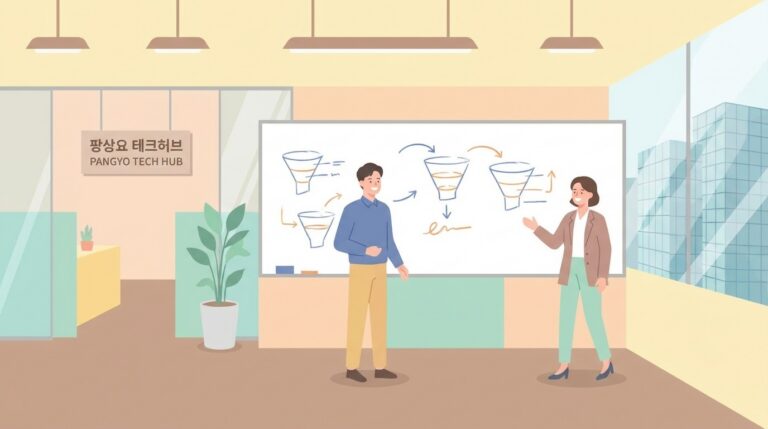
Imagine this: You are sitting in an ultra-sleek, glass-walled conference room in Pangyo Techno Valley—the Silicon Valley of South Korea. It is Friday afternoon sprint retro time. You just spent two weeks running an A/B test on your mobile app’s checkout funnel. The goal was simple: test whether a 15% discount coupon would spike conversion rates (CVR).
The result? A disaster. CVR dropped by 3.2%, and retention flatlined. In traditional corporate environments, this might feel like walking on eggshells. Your heart races as the Lead Product Manager opens the dashboard. But instead of scolding, she turns around, sips her iced Americano, and smiles warmly: “실패가 아니라 값진 학습 데이터네요! 우리 유저는 할인율보다 무료 배송에 더 민감하다는 걸 알아냈잖아요.” (It’s not a failure, but valuable learning data! We just discovered our users care far more about free shipping than percentage discounts.)
Instantly, the tension vanishes. In the Korean tech ecosystem, growth hacking isn’t about blaming individuals; it’s about building institutional knowledge (자산화). Learning how to reframe failed growth metrics into strategic gold is the ultimate superpower for anyone working in or with Korean tech teams. Based on real feedback from global professionals navigating Korean startups, this guide will give you the exact vocabulary, nuanced tone, and cultural nunchi to turn every red metric into a winning insight.
Phase 2: Core 3 Expressions Deep Dive
1. 실패가 아니라 유의미한 학습 데이터예요 (Silpaega anira yu-uimihan hapseup de-iteoyeyo)
- Pronunciation: [Sil-pae-ga a-ni-ra yu-ui-mi-han hak-seup de-i-teo-ye-yo] (Think of it like: “Seal-pay-gah ah-nee-rah you-wee-me-han hahk-seup day-ee-tuh-yay-yo”)
- Meaning: Literal: “It is not a failure, but meaningful learning data.” / Real-world nuance: “Let’s not dwell on the loss; we just gathered an actionable insight about user behavior.”
- K-Culture Moment: Seen in contemporary K-Dramas like Start-Up during heated post-demo day team debriefs at Sandbox when the team pivots after an algorithm test drops in accuracy.
- Editor’s Insight: The word ‘유의미한’ (statistically significant / meaningful) signals that you understand data literacy. Paired with ‘학습 데이터’ (learning data), it elevates the conversation from emotional disappointment to objective scientific iteration.
- Situation Spectrum: Casual ⚠️ | Semi-formal ✅ | Formal ✅
- 🤔 Think About It: In many Western companies, people openly say “We failed fast.” In Korean workplaces, however, the word ‘실패’ (failure) carries heavy emotional weight. Why do modern Korean startups prefer reframing it as ‘학습’ (learning) rather than celebrating failure directly?
2. 가격 할인보다 무료 배송에 더 민감하게 반응해요 (Gagyeok hal-inboda muryo baesong-e deo mingamhage baneunghaeyo)
- Pronunciation: [Ga-gyeok hal-in-bo-da mu-ryo bae-song-e deo min-gam-ha-ge ba-neung-hae-yo] (Phonetic rhythm: “Gah-gyuk hahl-een-bo-dah moo-ryo bay-song-ay duh meen-gahm-hah-gay bah-neung-hay-yo”)
- Meaning: Literal: “They react more sensitively to free shipping than price discounts.” / Real-world nuance: “Our target cohort prioritizes friction-free delivery fees over raw percentage discounts.”
- K-Culture Moment: Frequently heard during weekly growth standups at major Korean e-commerce giants like Coupang, Kurly, or Musinsa when analyzing purchase funnels.
- Editor’s Insight: ‘민감하게 반응하다’ is the gold standard for describing user elasticity and behavioral psychology in Korean. Avoid using simple verbs like ‘좋아하다’ (to like); intermediate business communication demands precise descriptors like ‘민감하다’ (sensitive/responsive).
- Situation Spectrum: Casual ⚠️ | Semi-formal ✅ | Formal ✅
- 🤔 Think About It: Korea is famous for ‘로켓배송’ (Rocket Delivery) and overnight arrival. How does Korea’s hyper-convenient logistical infrastructure make consumers value ‘free delivery’ psychologically higher than a modest price cut?
3. 이번 결과를 다음 스프린트 자산으로 삼죠 (Ibeon gyeolgwaleul da-eum seupeurinteu jasan-euro samjyo)
- Pronunciation: [I-beon gyeol-gwa-reul da-eum seu-peu-rin-teu ja-san-eu-ro sam-jyo] (Sounds like: “Ee-bun gyul-gwah-reul dah-eum s’peo-reen-teu jah-sahn-oo-ro sahm-jyo”)
- Meaning: Literal: “Let’s make this result an asset for our next sprint.” / Real-world nuance: “Let’s document this takeaway in Notion so we don’t repeat the same assumption in our upcoming development cycle.”
- K-Culture Moment: The classic closing statement by a seasoned Team Lead wrapping up a 30-minute retro meeting on Slack Huddle or Google Meet.
- Editor’s Insight: The grammatical structure ‘~으로 삼다’ means to take something and treat/regard it as a foundation. Calling data a ‘자산’ (asset) transforms what could have been wasted marketing budget into lasting intellectual capital.
- Situation Spectrum: Casual 🚫 | Semi-formal ✅ | Formal ✅
- 🤔 Think About It: How does phrasing a post-mortem outcome as a shared ‘asset’ foster psychological safety (심리적 안정감) in a team environment known for high-pressure deadlines?
Phase 3: Textbook Korean vs. Real-world Korean
Situation 1: Reporting an unverified hypothesis in a retro meeting
- 📖 교과서 한국어 (Textbook): 이번 실험은 실패했습니다. (Ibeon silheom-eun silpaehaessseumnida.) — “This experiment has failed.”
- 🗣️ 진짜 한국어 (Real-world): 이번 가설은 미검증으로 결론짓고 배운 점을 위키에 남기죠. (Ibeon gaseol-eun mi-geomjeung-euro gyeollonjitgo baeun jeom-eul wikie namgijyo.) — “Let’s conclude this hypothesis as unverified and log the learnings on our internal wiki.”
- 💡 왜 다를까? (Why the difference?): Declaring outright “failure” sounds fatalistic and points fingers. Modern Korean tech professionals prefer terms like ‘가설 미검증’ (unverified hypothesis) and focus immediately on documentation.
Situation 2: Highlighting user preference during funnel analysis
- 📖 교과서 한국어 (Textbook): 사용자들은 할인보다 무료 배송을 더 선호합니다. (Sayongjadeul-eun hal-inboda muryo baesong-eul deo seonhohamnida.) — “Users prefer free delivery over discounts.”
- 🗣️ 진짜 한국어 (Real-world): 유저들이 할인율보다 ‘무배’에 훨씬 즉각적으로 반응하더라고요. (Yujeodeul-i hal-in-yulboda ‘mubae’-e hwolssin jeukgakjeog-euro baneunghadeoragoyo.) — “Users responded far more instantly to ‘free delivery’ than nominal discount rates.”
- 💡 왜 다를까? (Why the difference?): In casual-pro startup jargon, Korean marketers almost always abbreviate 무료 배송 (free shipping) as ‘무배’ (Mubae), and express behavioral immediacy with ‘즉각적으로 반응하다’.
Phase 4: K-Culture Deep Dive & Non-verbal Manners
4-1. 눈치 (Nunchi) & Professional Gestures
When delivering disappointing AARRR funnel metrics (such as a drop in Activation or Revenue conversion), posture and nunchi dictate the atmosphere:
1. The Reflective Nod (끄덕임): While your colleague presents underperforming funnel graphs, maintain soft eye contact and nod slowly. Tilting your head slightly shows you are internalizing the data rather than judging the execution.
2. The Open-Hand Reframe: When proposing to document the lesson, keep your hands open on the table or gesture lightly toward the screen. Never point directly at the person who initiated the failed experiment.
3. Tone Softener: Precede data analysis with “오히려 이번 실험 덕분에…” (Rather, thanks to this experiment…). It proactively dismantles team anxiety.
4-2. Culture Code: The Pangyo Agile Synthesis
Korean tech hubs like Pangyo and Teheran-ro have developed a hybrid dialect known colloquially as Pangyo-mal (판교말). It blends English agile/growth terminology with Korean polite workplace grammar (Haeyo-che).
In this culture, team members use English first names (e.g., “Sarah-nim, 이번 스프린트 CVR 어때요?”) while maintaining honorific suffixes. Experiments are designed to be fast, but documentation is communal. When an experiment doesn’t yield positive ROI, the highest virtue is not perfection, but 회고의 투명성 (transparency in retrospection).
Phase 5: Real-world Roleplay Scenario
- Setting: 4:30 PM at a bustling D2C startup office in Seongsu-dong. Sticky notes cover the agile board, and monitors display Mixpanel retention curves. You are analyzing the checkout drop-off rate with Ji-ho (지호), the Growth Lead.
-
Ji-ho (지호): 이번 결제 퍼널 테스트 결과 나왔어요. 10% 할인 쿠폰 그룹의 전환율이 오히려 2% 떨어졌네요. (Ibeon gyeolje peoneol teseuteu gyeolgwa nawasseoyo. Sip-peosenteu hal-in kupon geurup-ui jeonhwan-yul-i ohiryeo i-peosenteu tteoreojyeotneyo.)
🎭 Looking somewhat deflated, pointing his stylus pen at the red drop-off graph on his tablet. -
You: 너무 실망하지 마세요, 지호 님. 실패가 아니라 진짜 유의미한 학습 데이터예요. (Neomu silmanghaji maseyo, Ji-ho nim. Silpaega anira jinjja yu-uimihan hapseup de-iteoyeyo.)
🎭 Leaning forward, offering a warm smile to ease the room’s tension. -
Ji-ho (지호): 그렇긴 한데, 쿠폰 마케팅 예산을 꽤 썼거든요. 팀장님께 어떻게 보고하죠? (Geureotgin hande, kupon maketing yesan-eul kkwae sseotgeodeunyo. Timjangnimkke eotteoke bogohajyo?)
🎭 Scratching the back of his neck with a nervous chuckle. -
You: 데이터 뜯어보니까, 우리 타깃 유저는 가격 할인보다 무료 배송에 훨씬 민감하게 반응하더라고요. (De-iteo tteudeobonikka, uri tagit yujeoneun gagyeok hal-inboda muryo baesong-e hwolssin mingamhage baneunghadeoragoyo.)
🎭 Switching the view to the cohort comparison tab with a confident gesture. -
Ji-ho (지호): 아! 배송비 3,000원 면제 그룹은 결제 완료율이 18%나 올랐네요? (A! Baesongbi samcheon-won myeonje geurup-eun gyeolje wanryoyul-i sip-pal-peosenteuna ollatneyo?)
🎭 Eyes widening as he zooms into the green metric line. -
You: 맞아요! 그러니까 이번 결과를 다음 스프린트 자산으로 삼고 배송비 프로모션으로 전환하죠. (Majayo! Geureonikka ibeon gyeolgwaleul da-eum seupeurinteu jasan-euro samgo baesongbi peuromosyeon-euro jeonhwanhajyo.)
🎭 Nodding firmly, tapping the table lightly to affirm the direction. -
Ji-ho (지호): 좋습니다! 단순 실패 보고가 아니라 ‘유저 인사이트 발굴’로 랩업 문서 작성할게요. (Jotseumnida! Dansun silpae bogoga anira ‘yujeo insa-iteu balgul’-ro raebeop munseo jakseonghalgeyo.)
🎭 Typing enthusiastically on his mechanical keyboard with renewed energy. -
You: 완벽해요. 제가 위키 템플릿에 가설 검증 결과 정리해 둘게요! (Wanbyeokhaeyo. Jega wiki tempeullit-e gaseol geomjeung gyeolgwa jeongrihae dulgeyo!)
🎭 Giving a gentle two-thumbs-up gesture.
🔀 Interactive Decision Point
Suppose the Product Owner abruptly enters and asks: “이번 할인 프로모션 망한 건가요?” (Did this discount promotion totally fail?) What is your best response?
- Option A: “네, 완전히 망했습니다. 예산만 낭비했어요.” (Yes, it totally failed. We just wasted budget.)
- Feedback (Bad): 🚫 Destroys team morale and frames your growth unit as reckless spenders without showing intellectual return.
- Option B: “아닙니다! 할인율보다 무배에 대한 유저 민감도가 월등히 높다는 걸 검증한 값진 데이터입니다.” (Not at all! It is invaluable data proving our users are significantly more responsive to free shipping than discounts.)
- Feedback (Best): ✅ Masterful reframe. Reassures executive leadership using clear metrics, strategic vocabulary, and immediate business value.
- Option C: “글쎄요, 데이터가 좀 이상하게 나와서 다시 돌려봐야 할 것 같아요.” (Well, the data came out weird, so I guess we have to re-run it.)
- Feedback (Risk): ⚠️ Evading accountability. Suggests you distrust your own testing infrastructure without offering analytical insight.
Phase 6: 10-Second Emotion Shadowing Drill
Practice these natural pacing pauses (/) and emotional cues to sound like an authentic Pangyo tech professional:
[😌 차분하고 다정하게 - Calmly & reassuringly]- 실패가 아니라 / 유의미한 / 학습 데이터예요. (Silpaega anira / yu-uimihan / hapseup de-iteoyeyo.)
[💡 번뜩이는 인사이트를 담아 - With an analytical spark]- 우리 유저는 / 가격 할인보다 / ‘무배’에 더 민감해요! (Uri yujeoneun / gagyeok hal-inboda / ‘mubae’-e deo mingamhaeyo!)
[🔥 확신에 차고 든든하게 - Resolute & solution-oriented]- 이번 결과를 / 다음 스프린트의 / 핵심 자산으로 삼죠. (Ibeon gyeolgwaleul / da-eum seupeurinteu-ui / haeksim jasan-euro samjyo.)
Phase 7: K-Culture Mini Dictionary
- 무배 (Mubae) | Short for 무료 배송 (Free Shipping) | The ultimate buzzword in Korean e-commerce. Often used colloquially in marketing meetings: “무배 혜택 붙이면 CVR 바로 뜁니다” (Add a free shipping perk and our CVR will jump instantly).
- 자산화 (Jasan-hwa) | Assetization / Institutionalization | Converting one-off marketing experiments or operational lessons into documented, reusable company intellectual property.
- 전환율 (Jeonhwan-yul) | Conversion Rate (CVR) | The cornerstone metric of Korean growth teams measuring visitors who complete a desired target action along the AARRR funnel.
- 오히려 좋아 (Ohiryeo joa) | “Even better! / A blessing in disguise!” | Originating from internet streaming culture, this ubiquitous phrase is now widely said in Korean agile teams when unexpected obstacles yield superior alternatives.
Phase 8: Expat & Tech Professional Survival Kit
Survival Expressions TOP 3
- 가설 검증 완료했습니다. (Gaseol geomjeung wanryohaessseumnida.)
- Romanization: [Ga-seol geom-jeung wan-ryo-haet-seum-ni-da]
- Pro Tip: Use this to conclude any A/B test cleanly during formal presentations.
- 다음 스프린트에 바로 반영할게요. (Da-eum seupeurinteue baro banyeonghalgeyo.)
- Romanization: [Da-eum seu-peu-rin-teu-e ba-ro ban-yeong-hal-ge-yo]
- Pro Tip: Demonstrates agility and readiness to iterate based on cross-functional feedback.
- 회고 문서 노션에 올려뒀습니다. (Hoego munseo Nosyeone ollyeodwossseumnida.)
- Romanization: [Hoe-go mun-seo No-syeon-e ol-lyeo-dwot-seum-ni-da]
- Pro Tip: The standard sign-off when closing a retrospective loop.
Editor’s Work & Travel Note
Navigating tech ecosystems in Seoul (Gangnam, Pangyo, Seongsu) requires more than just good grammar. Ensure your productivity stack is locally synced: download the official Naver Map app on mobile for punctual subway transfers to Pangyo Station. Furthermore, Korean tech teams live on Notion, Slack, and Channel.io. When communicating asynchronously on Slack, use clean bullet points with emoji indicators to respect colleagues’ fast processing speed.
Phase 9: “One Step Deeper” (Reflective Question)
Traditional Korean business hierarchy was historically characterized by top-down reporting, where mistakes incurred direct reprimand. However, the modern Korean startup revolution spearheaded by tech giants has completely rewritten this social contract. Today, teams champion 심리적 안정감 (psychological safety) and blameless retrospectives (무비난 회고). By mastering phrases that frame unexpected test results as collective assets rather than individual failures, you demonstrate not only high linguistic fluency, but deep cultural intelligence in modern Korea’s corporate evolution.
💬 Your Turn: Have you ever experienced a test or project where failure revealed an unexpected insight? How would you summarize that pivot using the phrase “오히려 좋아” in the comments below?
Phase 10: FAQ & Avoiding Misunderstandings
Q: Can I use the word “실패” (failure) if I am speaking to my C-level executive?
A: It is much safer to avoid saying “실패했습니다” directly regarding your own initiatives. Instead, state: “이번 가설은 기각되었으나 유의미한 행동 패턴을 발견했습니다” (This hypothesis was rejected, but we discovered a meaningful behavioral pattern). It demonstrates statistical maturity.
Q: Is the abbreviation ‘무배’ appropriate in written reports to senior management?
A: No. While ‘무배’ is universally accepted during verbal sprint standups and internal Slack discussions, always write out the full term 무료 배송 (Free Shipping) in formal slide decks and executive briefing memos.
Q: What is the subtle nuance between ‘학습’ (learning) and ‘공부’ (studying)?
A: Never say 공부 데이터. ‘공부’ refers to individual academic studying (like preparing for a test). ‘학습’ specifically denotes structured, institutional learning or machine learning data suitable for analytical contexts.
🚨 흔한 실수 (Common Mistakes) Warning Board
- Mistake: Saying “유저들이 할인을 좋아하지 않아요” (Users don’t like discounts).
- Correct Action: Say “할인율보다 무료 배송에 더 민감하게 반응합니다” (They react more sensitively to free shipping than discount rates). Professional marketers describe elasticity, not emotional preference.
- Mistake: Using aggressive blame language like “누구 아이디어였죠?” (Whose idea was this?).
- Correct Action: Keep it collective: “어떤 가설에서 출발했는지 다시 짚어볼까요?” (Shall we revisit which initial hypothesis this stemmed from?).
- Mistake: Apologizing profusely for an unsuccessful A/B test with “죄송합니다” (I am sorry).
- Correct Action: Do not apologize for statistically valid experiments! Say “데이터를 통해 확실한 유저 선호도를 파악했습니다” (Through data, we identified clear user preferences).
Phase 11: Action Missions
- 🥉 Bronze Mission (Solo Practice): Read the Phase 6 shadowing drill out loud three times while looking in the mirror, paying attention to the supportive facial expressions and intonation pauses.
- 🥈 Silver Mission (Social / Community): Leave a comment on your professional LinkedIn or language journal using the phrase: “실패가 아니라 유의미한 학습 데이터예요!”
- 🥇 Gold Mission (Real-world Execution): In your next standup, meeting, or Korean study group, frame a recent small setback as a 자산 (asset) using: “이번 경험을 다음 스프린트 자산으로 삼겠습니다.”
- 🎮 K-Culture Mission: Watch an episode of a modern office drama like Start-Up or Search: WWW. Count how many times team members say words like ‘가설’ (hypothesis), ‘지표’ (metrics), or ‘데이터’ (data)!
Phase 12: Interactive Quiz Challenge
Test your intermediate business Korean mastery!
1. Situational Judgment:
Your A/B test shows that users abandoned the payment page because of a 2,500 KRW shipping fee, despite a 20% discount coupon. How should you describe this finding to your team?
* A) 우리 유저들은 돈이 없습니다. (Our users have no money.)
* B) 유저들이 할인율보다 무료 배송에 훨씬 민감하게 반응합니다. (Our users react much more sensitively to free shipping than discount rates.)
* C) 실험이 완전히 망했으니 배송비를 숨깁시다. (The experiment completely failed, so let’s hide shipping fees.)
2. Fill-in-the-Blank:
이번 A/B 테스트 결과는 단순한 실패가 아니라 다음 분기를 위한 귀중한 ( )(으)로 삼아야 합니다.
* (a) 잔소리 (Nagging)
* (b) 자산 (Asset)
* (c) 낭비 (Waste)
3. True or False Cultural Quiz:
In contemporary Korean tech environments, saying “오히려 좋아” when an experiment disproves an assumption is considered an unprofessional insult to the founder.
* (True / False)
👉 Click to reveal answers & explanations!
- Question 1 Answer: B | Explaining conversion discrepancies through user behavioral sensitivity (민감도) demonstrates analytical competence.
- Question 2 Answer: (b) 자산 | “자산으로 삼다” is the quintessential Korean business expression for transforming lessons learned into long-term organizational capital.
- Question 3 Answer: False | “오히려 좋아” is frequently celebrated as an optimistic, resilient growth-hacking mindset that re-energizes team dynamics.
🎬 Watch Our Daily Videos! (Daily Hangul Official Instagram)
Review the expressions you learned in this article with our fun daily short videos! Check out native pronunciation and real-life nuances in action.
- Instagram @dailyhangul_en







