

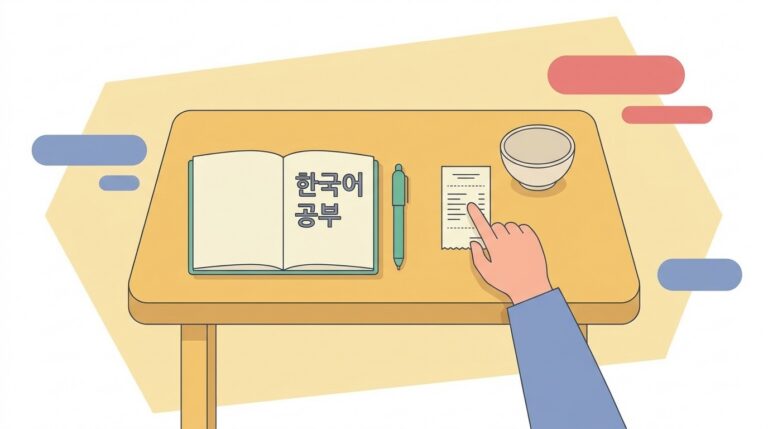
Speak Up Politely: How to Handle Overcharging and Hygiene Issues at Korean Restaurants
Phase 1: Empathy (Real-Life Opening)
안녕하세요! 매일한글 에디터입니다. (Hello! I’m your Daily Hangul editor.)
Picture this: You are having an unforgettable trip in Busan. You sit down at an energetic seafood stall near the harbor, smelling the savory grilled fish. You order a standard seafood soup. But when the bill arrives, the total is nearly 15,000 KRW higher than what was written on the menu. Or worse: midway through your meal, you spot a stray hair or a dirty utensil. Your stomach drops. You want to say something, but panic sets in: “Will they think I’m making a scene? What if they yell at me? How do I say this in Korean without sounding like a rude tourist?”
If you have ever swallowed your frustration and quietly paid for an incorrect bill just to avoid awkward conflict, you are definitely not alone. Many of our intermediate learners share this exact pain point. In Korean culture, conflict avoidance is real, but that does not mean you have to surrender your rightful consumer rights! Koreans also advocate for fair service—they just do it with calm precision, subtle deference, and zero emotional drama. Today, let’s master the art of being firm, respectful, and crystal-clear so you never leave a restaurant feeling taken advantage of again.
Phase 2: Core Expressions Deep Dive
1. 저기요, 계산서가 조금 잘못된 것 같아요. (Jeogiyo, gyesanseoga jogeum jalmotdoen geot gat-ayo.)
- Pronunciation: Jeo-gi-yo, gye-san-seo-ga jo-geum jal-mot-doen geot ga-ta-yo. (Sounds like “Jug-ee-yo, gyeh-san-saw-ga jo-gum jal-moht-dwen gut gah-tah-yo”)
- Meaning: Direct: “Excuse me, the bill seems a little wrong.” | Nuance: “Excuse me, I think there might be a slight mistake on this bill, could you check it?”
- K-Culture Moment: In modern K-Dramas like Hospital Playlist or Work Later, Drink Now, whenever friends review a shared dinner bill, they softly flag discrepancies using the “~것 같아요” (it seems like) softening pattern instead of directly declaring an error.
- Editor’s Insight: Notice the word 조금 (a little) and the ending ~ㄴ/은 것 같아요 (it seems like). Even if the bill is visibly double the correct amount, downplaying the error with “it seems slightly off” lets the server save face while immediately addressing the problem.
- Situation Spectrum: Casual ⚠️ | Semi-formal ✅ | Formal ✅
- 🤔 Think About It: Why do you think Korean uses indirect forms like “it seems like” even when an objective mathematical error is right on the paper?
2. 음식에 머리카락이 들어가 있는데, 새로 바꿔 주시겠어요? (Eumsige meorikaragi deureoga inneunde, saero bakkwo jusigesseoyo?)
- Pronunciation: Eum-sig-e meo-ri-ka-ra-gi deu-reo-ga in-neun-de, sae-ro bak-kwo ju-si-ges-seo-yo? (Rhymes loosely with “Oom-shig-eh muh-ree-kah-rah-gee doo-ruh-gah een-noon-deh…”)
- Meaning: Direct: “There is a hair in the food, so could you exchange it for a new one?” | Nuance: “Pardon me, there happens to be a hair in this dish. Could I please have a fresh replacement?”
- K-Culture Moment: Often seen in restaurant scenes when a calm character politely handles an awkward kitchen mistake without raising their voice.
- Editor’s Insight: Connect the factual observation with ~는데 (background/context), followed by the courteous request ~아/어 주시겠어요? (Would you please…?). It avoids accusatory verbs like “You gave me dirty food” and focuses purely on the solution.
- Situation Spectrum: Casual 🚫 | Semi-formal ✅ | Formal ✅
- 🤔 Think About It: In your home country, is it standard to ask for a refund or a replacement first? In Korea, asking for a fresh dish (새로 바꿔 주세요) is the standard, polite initial remedy.
3. 저희 이 메뉴는 안 시켰는데 확인 한번 해주시겠어요? (Jeohui i menyuneun an sikyeonneunde hwagin hanbeon haejusigesseoyo?)
- Pronunciation: Jeo-hui i me-nyu-neun an si-kyeon-neun-de hwa-gin han-beon hae-ju-si-ges-seo-yo?
- Meaning: Direct: “We didn’t order this menu, could you check once?” | Nuance: “We didn’t actually order this dish—would you mind double-checking our ticket?”
- K-Culture Moment: Seen when table service brings extra expensive side dishes or banchan that were assumed to be complimentary (service), only to discover they were charged.
- Editor’s Insight: The phrase 확인 한번 (a quick check) is the ultimate social lubricant in Korea. It frames your protest as a simple confirmation check rather than an accusation of dishonesty.
- Situation Spectrum: Casual ⚠️ | Semi-formal ✅ | Formal ✅
- 🤔 Think About It: How does asking someone to “check” make dispute resolution much faster than stating “You made a mistake”?
Phase 3: Textbook Korean vs. Real Korean
Situation 1: Suspecting an Overcharge / Extra Items on the Bill
- 📖 Textbook Korean: 이것은 바가지요금입니다! 환불해 주세요! (Igeoseun bagajiyogeumimnida! Hwanbulhae juseyo! – “This is an exorbitant ripoff! Refund it!”)
- 🗣️ Real Korean: 저기요, 저희가 주문한 내역이랑 조금 다른 것 같아서요. 영수증 다시 확인해 주시겠어요? (Jeogiyo, jeohuiga jumunhan naeyeogirang jogeum dareun geot gat-aseoyo. Yeongsujeung dasi hwaginhae jusigesseoyo? – “Excuse me, this looks a bit different from what we ordered. Could you double-check the receipt for us?”)
- 💡 왜 다를까? Calling someone’s establishment 바가지 (rip-off) directly to their face is an instant escalation that puts the owner on defensive high alert. Using 주문 내역 (order history) and 확인 (confirmation) resolves the issue quickly while keeping everyone dignified.
Situation 2: Finding Foreign Matter in Your Food or Cutlery
- 📖 Textbook Korean: 접시가 더럽습니다. 돈을 낼 수 없습니다. (Jeopsiga deoreopseumnida. Doneul nael su eopseumnida. – “The plate is dirty. I cannot pay money.”)
- 🗣️ Real Korean: 사장님, 죄송한데 여기 숟가락 좀 바꿔 주시겠어요? (Sajangnim, joesonghande yeogi sutgarak jom bakkwo jusigesseoyo? – “Boss, excuse me, but could you please swap out this spoon for another one?”)
- 💡 왜 다를까? Starting with a soft 죄송한데 (sorry to bother you, but…) softens the friction and makes the staff eager to apologize and replace the item immediately without tension.
Phase 4: K-Culture Deep Dive & Non-Verbal Manners
4-1. Nunchi (눈치) & Body Language Protocols
When resolving customer disputes in Korea, body language carries 70% of your message:
* Lower your vocal register and volume: When pointing out an issue, lean in slightly and speak at a low volume. If other diners overhear you loudly accusing the restaurant of poor hygiene, the owner may panic about public embarrassment, creating resistance.
* Discreet finger-pointing: Do not lift a dirty spoon or foreign object high in the air for the whole room to see. Keep it close to the table surface and point gently with an open palm or your index finger.
* The Soft “저기요”: Raise your hand to chest or shoulder level with fingers together, tilt your head slightly, and call out a gentle “저기요…” (Excuse me).
4-2. Cultural Code: The Border Between “Service (서비스)” and Overcharging
In Korean dining, complimentary side dishes or small perks are lovingly referred to as 서비스 (service). However, in high-traffic tourist areas (like certain seafood tent bars or street alleys), confusion sometimes occurs when extra chargeable platters are brought to the table without crystal-clear explanation. Remember: you have full legal and cultural rights as a consumer in Korea! Koreans value fairness (공정함) and clean business practices. Politely saying, “저희 이거 안 시켰는데 계산에 들어갔나요?” (We didn’t order this, was it included in the bill?) establishes firm personal boundaries without crossing into Gapjil (갑질 – abuse of consumer power).
Phase 5: Real-Life Roleplay Scenario
Setting: A bustling seafood restaurant in Sokcho. You ordered one basic Spicy Fish Stew (매운탕, 30,000 KRW), but the bill comes out to 50,000 KRW, including an expensive side dish you never requested.
- You: 저기요, 사장님. 바쁘신데 죄송해요. (Jeogiyo, sajangnim. Bappeusinde joesonghaeyo.)
🎭 Action: Hand raised politely at shoulder height, speaking in a quiet, friendly tone. - Owner (이모님): 네, 손님! 뭐 필요한 거 있으세요? (Ne, sonnim! Mwo pil-yohan geo isseuseyo?)
🎭 Action: Wiping hands on apron, smiling warmly. - You: 계산서를 봤는데, 저희가 생각한 금액이랑 조금 달라서요. (Gyesanseoreul bwanneunde, jeohuiga saenggak-han geumaegirang jogeum dallaseoyo.)
🎭 Action: Placing the paper receipt flat on the table, pointing softly with an index finger. - Owner (이모님): 어머, 그래요? 어디 한번 봅시다. (Eomeo, geuraeyo? Eodi hanbeon bopsida.)
🎭 Action: Leaning over table, squinting at the receipt. - You: 저희 매운탕 소(小)자 시켰는데, 영수증에는 대(大)자로 들어가 있고 이 생선구이는 안 시켰거든요. (Jeohui mae-untang so-ja sikyeonneunde, yeongsujeung-eneun dae-jaro deureoga itgo i saengseon-gu-ineun an sikyeotgeodeunyo.)
🎭 Action: Speaking calmly and clearly without showing signs of anger. - Owner (이모님): 아이고! 옆 테이블 주문이랑 영수증이 바뀌었네! 정말 미안해요. (Aigo! Yeop te-i-beul jumun-irang yeongsujeungi bakkwieonne! Jeongmal mianhaeyo.)
🎭 Action: Patting hands together apologetically. - You: 아, 그러셨군요! 다시 계산해 주시겠어요? (A, geureosyeotgunyo! Dasi gyesanhae jusigesseoyo?)
🎭 Action: Nodding with an understanding smile to relieve tension. - Owner (이모님): 그럼요! 바로 다시 뽑아드릴게요. 미안해서 음료수 하나 서비스로 줄게요! (Geureomyo! Baro dasi ppobadeurilgeyo. Mianhaeseo eumnyosu hana seobiseuro julgeyo!)
🎭 Action: Handing you a complimentary can of cider with a relieved grin.
🔀 Interactive Decision Fork
What should you do if the owner dismissively says, “외국인이라 잘 몰라서 그래. 원래 다 나오는 거야.” (“You don’t understand because you’re a foreigner. It normally comes out like this”)?
* Choice A: Shout “경찰 부를 거예요!” (I’m going to call the police!) and slap the table.
👉 Feedback (Bad): Escalates instantly into an aggressive public disturbance. Police may treat it as a civil disagreement rather than a crime.
* Choice B: Quietly point to the printed menu and say: “메뉴판 가격이랑 달라요. 영수증 상세 내역서 뽑아주세요.” (It differs from the menu price. Please print me an itemized receipt).
👉 Feedback (Best): Calm, objective, and legally bulletproof. Asking for an itemized receipt (상세 내역서) signals that you know your consumer rights.
* Choice C: Give up, pay the extra 20,000 KRW, and leave an angry one-star review later.
👉 Feedback (Risk): You lose your money, feel regret, and your one-star review might get challenged under Korean online defamation regulations.
Phase 6: 10-Second Emotion Shadowing Drill
Practice matching the cadence, emotion markers, and rhythm slashes (/):
[😌 Calm & Respectful]
저기요, / 계산서가 / 조금 잘못된 것 같아요.
(Jeogiyo, / gyesanseoga / jogeum jalmotdoen geot gat-ayo.)-
[🧐 Clarifying & Friendly]
저희 이 메뉴는 / 안 시켰는데 / 확인 한번 / 해주시겠어요?
(Jeohui i menyuneun / an sikyeonneunde / hwagin hanbeon / haejusigesseoyo?) -
[🤝 Polite & Solution-Oriented]
음식에 / 뭐가 들어가 있어서요, / 새로 바꿔 주시겠어요?
(Eumsige / mwoga deureoga isseoseoyo, / saero bakkwo jusigesseoyo?)
Phase 7: K-Culture Mini Dictionary
- 바가지 (Bagaji): Literally a wooden gourd ladle, but colloquially means a massive rip-off or overcharge. Used in phrases like “바가지 썼어요” (I got ripped off).
- 영수증 (Yeongsujeung): Itemized sales receipt. Always ask for this by saying “영수증 주세요” (Please give me the receipt) if total amounts seem suspicious.
- 위생 (Wisaeng): Hygiene / Sanitation. Crucial keyword when addressing dining standards or clean utensils (위생 상태).
- 정당한 항의 (Jeongdanghan Hang-ui): Legitimate and rightful protest/complaint. Differentiated strictly from 진상 (Jinsang – an irrational, abusive customer).
Phase 8: Traveler’s Survival Kit
Survival Expressions TOP 3
- 새 숟가락으로 바꿔 주세요. (Sae sutgarageuro bakkwo juseyo.) – “Please exchange this for a clean spoon.”
Pro Tip: Use whenever cutlery in the communal table drawer shows smudges. - 메뉴판 가격이랑 다른데요. (Menyupan gageogirang dareundeyo.) – “It differs from the price on the menu.”
Pro Tip: Take a quick smartphone photo of the wall menu before sitting down in traditional markets. - 상세 영수증 출력해 주세요. (Sangse yeongsujeung chullyeok-hae juseyo.) – “Please print an itemized detailed receipt.”
Pro Tip: Ensures you have solid proof if you need to file an official report.
Editor’s Travel Note
- Useful Hotline: If you suspect severe commercial exploitation or malicious overcharging, you can call the 1330 Korea Travel Helpline (free, multi-language support 24/7). They can mediate restaurant misunderstandings directly over the speakerphone!
- Payment Verification: Keep your card payment alert active on your banking app to verify that the swipe matches the authorized bill amount immediately.
Phase 9: “One Step Deeper” (Cultural Reflection)
In South Korea, social harmony is guarded through Che-myeon (체면 – saving face and social dignity). Publicly shouting at a store owner strips them of their face, making them react defensively rather than reasonably. However, using soft modal grammar like “~인 것 같아요” (it appears so) provides a dignified conversational bridge. You are not sacrificing your rights; you are employing refined emotional intelligence (눈치) to get exactly what you want without collateral damage.
💬 Your Turn: Have you ever experienced an awkward dining error while traveling? How do people in your culture handle overcharging compared to Korea? Share your story in the comments below!
Phase 10: FAQ & Avoiding Misunderstandings
Q: Will Korean restaurant staff get angry if I point out a hair in my food?
A: Not at all, provided you do it privately! Korean restaurants take hygiene reviews very seriously. If you call the server softly and show them discreetly, 99% of servers will apologize immediately and replace your dish or offer a beverage on the house.
Q: What should I do if an owner insists that side dishes (banchan) cost extra money after I ate them?
A: In standard Korean dining, basic banchan refills are 100% free. If an exotic side dish costs money, it must be stated on the menu. Firmly state: “메뉴판에 안내가 없었어요. 미리 말씀해 주셨어야죠.” (It wasn’t on the menu; you should have informed us beforehand).
Q: Can I refuse to pay if the food hygiene was totally unacceptable?
A: Legally, walking out without settling the bill can trigger a police call for dining theft (무전취식). Instead, immediately photograph the contaminated food, ask to speak to the head manager (책임자), and resolve the invoice reduction on site.
🚨 Common Mistakes Alert
| Mistake | Why it hurts | Correct Action |
|---|---|---|
| Calling the owner a 도둑 (thief) or shouting 바가지! | Considered criminal slander/insult under Korean penal law. | State facts calmly: “주문한 내용과 다릅니다.” (This differs from what was ordered). |
| Waving dirty chopsticks in the air | Disgusts neighboring diners and humiliates the staff. | Leave it on a napkin and point down discreetly. |
| Leaving without asking for a printed receipt | Zero proof for card disputes or official consumer reports. | Always demand: “영수증 꼭 주세요.” |
Phase 11: Action Mission & Engagement
- 🥉 Bronze Level: Stand in front of the mirror and practice saying: “저기요, 계산서가 조금 이상한 것 같아요.” three times with a calm, relaxed smile.
- 🥈 Silver Level: Next time you order takeout or coffee, practice verifying your order ticket in Korean: “아이스 아메리카노 맞나요?” (Is this iced Americano correct?).
- 🥇 Gold Level: During your trip to Korea, if an extra item or sauce is brought out, confirm politely: “이거 서비스인가요?” (Is this on the house?).
- 🎮 K-Culture Mission: Watch an episode of a Korean street-food documentary or variety show (like Baek Jong-won’s Alley Restaurant) and listen for how owners and customers clarify menu orders!
Phase 12: Interactive Quiz Challenge
Q1. Situational Judgment:
You notice that a 5,000 KRW beer was added to your bill, but you only drank water. What is the most natural B1-level phrase to resolve this?
A) 야! 돈 내놓으세요! (Hey! Give me money!)
B) 저희 맥주 안 마셨는데, 영수증 확인 한번 해주시겠어요? (We didn’t drink beer, could you check the receipt once?)
C) 경찰 부를 거예요! (I will call the police!)
Q2. Fill in the Blank:
“음식에 머리카락이 나왔어요. 새로 ______ 주시겠어요?” (There’s a hair in the food. Could you please exchange it with a fresh one?)
* Clue: Root verb is 바꾸다 (to exchange/swap).
Q3. True or False:
True or False: In Korea, shouting loudly across the room about bad hygiene is admired as confident consumer bravery.
👉 Click to reveal answers & explanations!
- A1 Answer: B (Using 저희 ~ 안 했는데, 확인 한번 해주시겠어요? handles the issue with dignity and maximum efficacy).
- A2 Answer: 바꿔 (바꿔 주시겠어요? is the polite intermediate causative request pattern).
- A3 Answer: False (Public shaming triggers unnecessary friction. Quiet, confident, and direct conversations lead to much faster solutions!).
🎬 Watch Our Daily Videos! (Daily Hangul Official Instagram)
Review the expressions you learned in this article with our fun daily short videos! Check out native pronunciation and real-life nuances in action.
- Instagram @dailyhangul_en







