

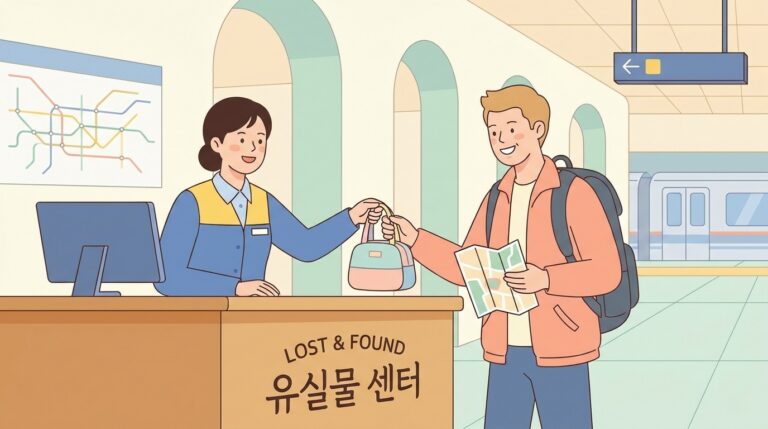
Don’t Panic! How to Ask Seoul Subway Staff About Lost Items Like a Local
Phase 1: 공감 (Storytelling Opening)
안녕하세요! (Annyeonghaseyo!) It is your editor from Daily Hangul, your trusted local culture navigator. Picture this: you just stepped off the iconic green Line 2 train at Hongdae Station after a wonderful day of shopping. The train doors beep, the safety gates slide shut, and as the train accelerates into the dark tunnel, a cold shock freezes your spine. Your backpack—carrying your favorite souvenirs, your portable charger, and your hotel key—is sitting peacefully on the overhead rack of car 4-2.
In a classic K-drama, this is where dramatic piano music swells while the main character drops to their knees in slow motion. But take a deep breath! Korea’s subway system boasts an astounding return rate of over 85% for lost belongings. When you hurry to the station office, a calm and polite subway official will likely say:
“유실물 센터에 접수되었는지 전산으로 확인해 볼게요.”
(Yusilmul senteoe jeopsu-doeeonneunji jeonsaneuro hwaginhae bolgeyo.)
(I will check the system to see if it has been logged at the Lost and Found.)
Knowing how to decode this sentence and describe your situation in simple A2 Korean transforms sheer panic into immediate relief. Let us walk through the exact steps and words to get your treasured belongings back!
Phase 2: 핵심 표현 3선 심층 분석 (Top 3 Core Expressions)
1. 유실물 센터에 접수되었는지 전산으로 확인해 볼게요. (한글)
- Pronunciation: Yusilmul senteoe jeopsu-doeeonneunji jeonsaneuro hwaginhae bolgeyo. (Pronounce like: Yoo-sheel-mool sen-tuh-eh jup-soo-dway-un-jee jun-sahn-oo-ro hwa-geen-hae bohl-geh-yoh)
- Meaning:
- Literal: “I will check via computer system whether it has been officially received at the lost items center.”
- Nuance: “Don’t worry, let me search our real-time transit database to see if someone turned it in!”
- K-Culture Moment: You hear this line in workplace dramas like Misaeng or Live, where public service workers handle frantic citizen inquiries with calm technological efficiency.
- Editor’s Insight: The word 전산 (jeonsan) refers to the centralized computerized network. In Korea’s hyper-connected bureaucracy, everything from subway losses to lost pet reports syncs instantly to centralized servers.
- Situation Spectrum:
- Casual: 🚫 (Too formal and wordy for close friends)
- Semi-formal (해요체): ✅ (Standard helpful employee tone)
- Formal (하십시오체): ✅ (Can be phrased as 확인해 드리겠습니다)
- 🤔 Think About It: In your home country, do station workers check a central database right away, or do you have to wait days to call a physical warehouse? How does this reflect Korea’s “Palli-palli” (quick-quick) service mindset?
2. 어디에 두고 내리셨어요? (한글)
- Pronunciation: Eodie dugo naerisyeosseoyo? (Pronounce like: Uh-dee-eh doo-goh neh-ree-shuh-ssuh-yoh?)
- Meaning:
- Literal: “Where did you leave it and disembark?”
- Nuance: “Where exactly did you leave your item on the train or platform?”
- K-Culture Moment: The standard question every station master asks when someone runs panting to the customer counter.
- Editor’s Insight: The honorific ending -셨어요 (-syeosseoyo) shows respectful consideration from the staff toward you, even though you made the mistake of forgetting your belongings!
- Situation Spectrum:
- Casual: ⚠️ (Only with close friends: 어디 두고 내렸어?)
- Semi-formal: ✅ (Polite inquiry by service staff)
- Formal: ✅
- 🤔 Think About It: Why does Korean differentiate between simply “leaving an item” (두다) and “leaving it while getting off” (두고 내리다)?
3. 잃어버린 물건의 특징을 말씀해 주세요. (한글)
- Pronunciation: Ireobeorin mulgeonui teukjingeul malsseumhae juseyo. (Pronounce like: Ee-ruh-buh-reen mool-guhn-eui teuk-jeeng-eul mahl-ssum-hae joo-seh-yoh)
- Meaning:
- Literal: “Please state the special characteristics of the lost object.”
- Nuance: “Could you describe what your lost item looks like?”
- K-Culture Moment: The moment where the protagonist sheepishly confesses that their lost bag has an oversized plushie keychain dangling from it!
- Editor’s Insight: 말씀 (malsseum) is the polite honorific word for “speech/words”. When requesting information from a customer, polite speakers use 말씀해 주세요 instead of the blunt 말해 주세요.
- Situation Spectrum:
- Casual: 🚫
- Semi-formal: ✅
- Formal: ✅
- 🤔 Think About It: How does honoring the listener’s speech create a comforting atmosphere during an emergency?
Phase 3: 교과서 한국어 vs 진짜 한국어 (Textbook vs. Real Korean)
Situation 1: Explaining you left your bag on the train
- 📖 교과서 한국어: 제 가방을 분실하였습니다. 찾아 주십시오.
(Je gabangeul bunsilhayeotseumnida. Chaja jusipsio. / I have lost my bag. Please locate it.) - 🗣️ 진짜 한국어: 저기요, 지하철에 가방을 두고 내렸어요!
(Jeogiyo, jihachore gabangeul dugo naeryeosseoyo! / Excuse me, I left my bag on the subway!) - 💡 왜 다를까? 분실하였습니다 is overly rigid military-style Korean. Native speakers simply say 두고 내렸어요 (I left it behind when getting off), which immediately tells the staff you know it is still on that specific train line.
Situation 2: Asking if anyone handed it in
- 📖 교과서 한국어: 유실물이 여기에 도착했는지 질문이 있습니다.
(Yusilmuri yeogie dochakhaenneunji jilmuni itseumnida. / I have a question regarding whether the lost item has arrived here.) - 🗣️ 진짜 한국어: 혹시 가방 들어온 거 있나요?
(Hoksi gabang deureoon geo innayo? / By any chance, has a bag been turned in?) - 💡 왜 다를까? Real Koreans use 혹시 (hoksi – by any chance) to soften requests, and say 들어온 거 있나요? (has anything come in?) rather than stiff verbs like “arrive”.
Phase 4: K-Culture 딥다이브 & 비언어적 매너 (Deep Dive & Body Language)
4-1. 눈치(Nunchi) & 제스처 (Gestures & Etiquette)
- Two-Handed Phone Presentation: If you have photos of your lost item or your digital transit card transaction history showing the exact time you boarded, show your screen while holding the phone with both hands. It demonstrates respect and helps the agent identify the exact train run number.
- Respecting the Screen Barrier: When the staff says they are checking the computer system (전산으로 확인해 볼게요), step back half a step. Do not lean your head over the counter to peek at their desktop monitor; in Korean office culture, leaning into a worker’s desk is considered intrusive.
4-2. 문화 코드 분석 (The Korean “CCTV & Conscience” Culture)
Have you noticed cafes in Seoul where people leave their laptops and wallets unattended on tables to visit the restroom? That same cultural trust applies to the subway. Seoul Metro stations are blanketed with high-definition CCTV, and the police run an integrated portal called LOST112. When someone finds a forgotten item on a seat, fellow passengers almost always bring it directly to the nearest station office or hand it to the subway operator.
Phase 5: 실전 롤플레이 시나리오 (Real-Life Roleplay)
- Background: Station Office (역무실) at City Hall Station (Line 2).
- Characters:
- Alex: A foreign tourist who left a canvas bag on the train.
- Min-su (민수): A kind, efficient Seoul Metro customer service agent.
— Dialogue —
- Alex: 🎭 (Approaching counter with a worried face and slight bow)
저기요, 지하철에 가방을 두고 내렸어요!
(Jeogiyo, jihachore gabangeul dugo naeryeosseoyo!)
“Excuse me, I left my bag on the subway!” -
Min-su: 🎭 (Nods reassuringly, opening the workstation computer)
아이구, 놀라셨겠어요. 어디에 두고 내리셨어요?
(Aigu, nollasyeotgesseoyo. Eodie dugo naerisyeosseoyo?)
“Oh dear, you must be startled. Where did you leave it when getting off?” -
Alex: 🎭 (Pointing toward the platform)
2호선 시청역에서 방금 내렸어요. 4번 칸 선반 위예요.
(Ihoseon Sicheongyeogeseo banggeum naeryeosseoyo. Sabeon kan seonban wieyo.)
“I just got off Line 2 at City Hall Station. It was on the overhead rack in car number 4.” -
Min-su: 🎭 (Typing quickly on the keyboard)
잃어버린 물건의 특징을 말씀해 주세요.
(Ireobeorin mulgeonui teukjingeul malsseumhae juseyo.)
“Please describe the features of the lost item.” -
Alex: 🎭 (Showing a photo on the phone with both hands)
하얀색 에코백이고, 귀여운 고양이 키링이 달려 있어요.
(Hayansaek ekobaegigo, gwiyeoun goyangi kiring-i dallyeo isseoyo.)
“It’s a white canvas tote bag with a cute cat keychain attached to it.” -
Min-su: 🎭 (Staring closely at the internal terminal)
네, 유실물 센터에 접수되었는지 전산으로 확인해 볼게요.
(Ne, yusilmul senteoe jeopsu-doeeonneunji jeonsaneuro hwaginhae bolgeyo.)
“Understood, I will check the system to see if it has been logged at the Lost and Found.” -
Alex: 🎭 (Clasping hands together in anticipation)
네, 꼭 좀 찾아 주세요! 감사합니다.
(Ne, kkok jom chaja juseyo! Gamsahamnida.)
“Yes, please find it if possible! Thank you so much.” -
Min-su: 🎭 (Smiling warmly and picking up the landline phone)
아, 종점인 성수역 역무실에 지금 막 비슷한 가방이 접수되었네요!
(A, jongjeomin Seongsu-yeok yeongmusire jigeum mak biseuhan gabang-i jeopsudoeeonneyo!)
“Ah! A similar bag was just logged at the last stop, Seongsu Station office!”
🔀 인터랙티브 분기점 (Interactive Branching)
What should Alex do next to confirm and claim the bag?
- Choice A: Run straight onto the next train to Seongsu Station without asking for an official receipt or reference number.
- Feedback (Risk): The item might still be in the process of cataloging by the train conductor, meaning you could arrive before the staff can officially release it to you.
- Choice B: Ask Min-su: “확인증이나 접수 번호 같은 게 있나요?” (Do you have a confirmation slip or registration number?) and show your passport upon arrival at Seongsu Station.
- Feedback (Best!): Spot on! In Korea, station staff give you a system claim code. Matching this code with your ID card or passport ensures instant verification.
- Choice C: Tell Min-su to deliver the bag to your hotel immediately via quick service courier at the station’s expense.
- Feedback (Bad): Metro staff cannot pay for private couriers for personal forgotten items; lost items must be claimed in person or shipped via cash-on-delivery courier with prior consent.
Phase 6: 10초 감정 섀도잉 드릴 (10-Second Shadowing Drill)
Practice these lines out loud, mimicking native rhythm and pausing at each slash (/)!
[😰 초조하고 다급하게 / Anxiously & Urgently]
저기요! / 2호선 열차에 / 가반을 두고 내렸어요!
(Jeogiyo! / Ihoseon yeolchae / gabangeul dugo naeryeosseoyo!)-
[🧑💼 차분하고 친절하게 / Calmly & Professionally]
유실물 센터에 / 접수되었는지 / 전산으로 확인해 볼게요.
(Yusilmul senteoe / jeopsu-doeeonneunji / jeonsaneuro hwaginhae bolgeyo.) -
[😌 안도하며 감사하게 / Relieved & Grateful]
정말 다행이에요! / 도와주셔서 / 정말 감사합니다!
(Jeongmal dahang-ieyo! / Dowajusyeoseo / jeongmal gamsahamnida!)
Phase 7: K-Culture 미니 사전 (Mini Dictionary)
-
유실물 (Yusilmul) / 분실물 (Bunsilmul)
- Meaning: Lost property / Misplaced article.
- Daily Usage: While 분실물 is commonly spoken by travelers (“잃어버린 물건”), 유실물 is the legal and formal term used on government and subway signage (e.g., 유실물 센터 – Lost and Found Center).
- 전산 (Jeonsan)
- Meaning: Electronic data processing system / Computer network.
- Daily Usage: Commonly used in customer service phrases like “전산 조회” (database search) or “전산 오류” (system glitch).
- 접수 (Jeopsu)
- Meaning: Receipt, registration, logging.
- Daily Usage: Used when filing reports, submitting documents, or logging lost belongings into an official queue.
- 보관소 (Bogwanso)
- Meaning: Storage facility / Custody office.
- Daily Usage: Items found on subway trains stay at the station office for several days before being moved to a regional central 유실물 보관소 (storage center).
Phase 8: 여행자를 위한 생존 키트 (Traveler’s Survival Kit)
Top 3 Survival Expressions
- 지하철 몇 번 칸이었는지 잘 모르겠어요.
(Jihacheol myeot beon kanieonneunji jal moreugesseoyo.)
“I am not sure which train car number it was.”
Pro Tip: Tell them the exact time you tapped out; staff can calculate the exact train you rode! - 외국인 등록증(여권) 여기 있습니다.
(Oegugin deungnokjeung / yeogwon yeogi itseumnida.)
“Here is my Alien Registration Card (Passport).”
Pro Tip: To claim any item from Korean lost and found centers, official photo ID is mandatory. - 물건을 찾으면 연락 주실 수 있나요?
(Mulgeoneul chajeumyeon yeollak jusil su innayo?)
“Could you please contact me if you find the item?”
Pro Tip: Provide a local Korean phone number or the contact number of your hotel concierge.
Editor’s Travel Note
- Check the Platform Floor Numbers: When waiting for the train, look down at the platform screen doors. You will see numbers like 4-3 or 7-1. Remembering this number allows staff to check that exact car’s overhead rack within minutes!
- Digital Tool Recommendation: Bookmark the official National Police Lost and Found portal on your browser via the LOST112 Police Portal website. It updates daily with photos and descriptions of every registered item across Korean subway lines, buses, and taxis.
Phase 9: “한 발 더 깊이” (Cultural Reflection)
In many international megacities, leaving an expensive smartphone or laptop on public transit means saying goodbye to it forever. In Korea, however, a unique blend of Confucian communal ethics, high legal accountability through ubiquitous CCTVs, and pride in civic safety makes returning lost items second nature. When an attendant says 전산으로 확인해 볼게요, they are tapping into a system built on collective trust.
💬 Your Turn: Have you ever lost an item while traveling abroad? How would you feel walking into a foreign subway office knowing there is an 80%+ chance your item is waiting safely for you? Share your experience in the comments below!
Phase 10: FAQ & 흔한 실수 경고판 (FAQ & Common Mistakes)
Q: Can I retrieve my item on the same day if the subway has already passed my station?
A: Yes! If the train is still in operation, the station master will call the depot or the conductor at an upcoming station, who will physically walk onto the train car, grab the item, and leave it at that station’s office for you to pick up.
Q: What if I don’t speak any Korean when I arrive at the Lost and Found counter?
A: Most major transfer hubs (such as Seoul Station, City Hall, or Express Bus Terminal) have staff familiar with translation apps. You can also utilize the free 1330 Korea Travel Helpline to get instant three-way interpretation.
Q: How long does the subway keep unclaimed lost items?
A: Items are kept at the subway station office for about 7 days. After that, they are transferred to the local police department storage facility for up to 9 months before being auctioned or discarded according to Korean civil law.
🚨 외국인 학습자 흔한 실수 TOP 3 (Common Mistakes)
| Mistake | Why it Causes Confusion | Correct Action |
|---|---|---|
| Saying “가방을 잃었어요” | 잃다 is for abstract loss (losing courage, losing a person). | Say “가방을 잃어버렸어요” or “두고 내렸어요”. |
| Forgetting your train direction | Seoul Line 2 is a circle line. Saying just “Line 2” is not enough. | Specify the direction by naming the upcoming station (e.g., 강남역 방면 / toward Gangnam Station). |
| Forgetting to bring photo ID | Lost items cannot be released without legal proof of identity. | Always bring your physical passport or ARC card to the station office. |
Phase 11: 액션 미션 & 참여 유도 (Action Missions)
- 🥉 Bronze Mission (Solo Shadowing): Stand in front of your mirror and practice saying: “저기요, 지하철에 물건을 두고 내렸어요!” three times with urgent, expressive body language.
- 🥈 Silver Mission (Observation Check): Next time you watch a Seoul travel vlog or K-drama, listen for words like 분실물 or 접수 when characters visit public offices.
- 🥇 Gold Mission (Real Action): The next time you take the metro anywhere, make a habit of noting down the train car door number (e.g., 2-4) before stepping on board!
🎮 K-Culture Mission: Search the Korean hashtag #유실물 or #분실물센터 on social media. You will see photos of lost AirPods, plushies, and umbrellas being lovingly cared for until their owners return!
Phase 12: 인터랙티브 퀴즈 챌린지 (Interactive Quiz)
Test your knowledge with these three quick questions!
- [Situation Judgment] You left your camera on Subway Line 3 five minutes ago. What is the most effective piece of information to tell the station agent immediately?
- A) The brand of the camera lens.
- B) The exact door number where you boarded and the direction of the train.
- C) How much money the camera cost.
- [Fill-in-the-Blank] Complete the sentence with the correct polite phrase:
- “유실물 센터에 접수되었는지 ________ 확인해 볼게요.” (I will check via the computer system…)
- A) 전산으로 (jeonsaneuro)
- B) 버스로 (beoseuro)
- C) 편의점으로 (pyeon-uijeomeuro)
- [True / False] In Korea, if you leave your bag on a subway train, it is immediately thrown away if no one claims it within 24 hours. (T / F)
👉 Click to view answers and explanations!
- Answer: B
Explanation: Subway staff can intercept the train in real time if you provide the train direction and car door number (such as 3-2). -
Answer: A (전산으로)
Explanation: 전산으로 means “via the electronic database/system”. 버스로 means by bus, and 편의점으로 means by convenience store. -
Answer: False
Explanation: Unclaimed items are safely logged in the computerized system and stored in station offices for about a week before being transferred to official police storage facilities.
🎬 Watch Our Daily Videos! (Daily Hangul Official Instagram)
Review the expressions you learned in this article with our fun daily short videos! Check out native pronunciation and real-life nuances in action.
- Instagram @dailyhangul_en







