

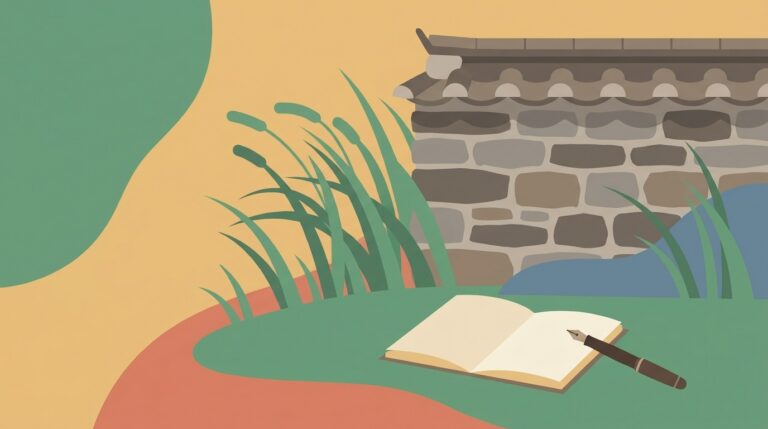
Phase 1: Stepping Beyond the Palace Walls
안녕하세요! (Annyeonghaseyo! / Hello!) I am the Daily Hangul Editor. Have you ever stood outside Seoul’s Gyeongbokgung Palace, stepped into a cozy Seochon book cafe, and frozen when local friends started debating Kim Su-young’s poetry? Even at Level 6, shifting from polite textbook Korean to raw post-war literary discourse feels daunting. While Kim Sowol and Yun Dong-ju sang of lyrical sorrow, post-war Kim Su-young forged modernism and civic resistance after Liberation, the Korean War, and the April 19 Revolution in works like ‘Grass’ and ‘Exiting the Old Palace One Day.’ Built from real advanced learner feedback, this guide equips you to unpack self-reflection and freedom like a native intellectual.
Phase 2: 3 Key Expressions Deep Dive
1. 온몸으로 밀고 나가다 (Onmomeuro milgo nagada)
- Pronunciation: Onmomeuro milgo nagada (Sounds like ohn-moh-meu-roh meal-goh nah-gah-dah; keep the eu in meu flat like an unrounded uh, and let the g in milgo voice softly into a smooth glide).
- Meaning: Literally “to push forward with the whole body.” In actual Korean intellectual and everyday usage, it means committing your entire existence, actions, and integrity—not just hollow words—to overcome resistance or create art.
- K-Culture Moment: You will hear this exact nuance in acclaimed Korean films like 1987: When the Day Comes or literary variety shows like Alssul Sinjap when critics praise Kim Su-young’s belief that poetry cannot merely describe liberty from a safe armchair—it must propel reality forward with physical urgency.
- Editor’s Insight: Kim Su-young famously revolutionized Korean poetics by demanding literature written with one’s “whole body” rather than detached cleverness. Today, Koreans use this phrase both in literary criticism and when admiring someone who stakes their career or comfort on a moral principle.
- Situation Spectrum:
- Casual: ✅ (Used passionately among close friends discussing art, politics, or life choices)
- Semi-formal: ✅ (Ideal in university seminars, book clubs, and editorial meetings)
- Formal: ✅ (Respected in speeches, essays, and cultural broadcasts)
- 🤔 Think About It: In English, we often separate “mind” and “body” (putting your heart into it vs. putting your back into it). Why do you think post-war Korean literature specifically fused thought and physicality into 온몸 (the whole body) after experiencing war and authoritarianism?
2. 소시민적 비겁함을 자성하다 (Sosiminjeok bigeophameul jaseonghada)
- Pronunciation: Sosiminjeok bigeophameul jaseonghada (Sounds like soh-shee-meen-juhk bee-guh-pah-meul jah-sung-hah-dah; notice how p + h in bigeopham aspirates crisply like pahm).
- Meaning: Literally “to self-reflect upon petit-bourgeois cowardice.” In real usage, it describes agonizingly honest self-examination when you realize you stayed silent against major injustice only to protect your tiny daily comforts.
- K-Culture Moment: Think of the quiet, gut-wrenching monologues in K-dramas like Youth of May or My Mister, where an ordinary office worker gets angry at a powerless vendor or stays mute in front of a corrupt boss, then walks home hating their own meekness—the exact emotional core of Kim Su-young’s poem Exiting the Old Palace One Day.
- Editor’s Insight: While 반성하다 (banseonghada / to reflect on a mistake) is taught in early intermediate classes, 자성하다 (jaseonghada) carries a razor-sharp philosophical weight. Pairing it with 소시민 (sosimin / ordinary comfort-seeking citizen) instantly signals C2 mastery of modern Korean social discourse.
- Situation Spectrum:
- Casual: ⚠️ (Sounds overly academic in casual banter unless used with wry self-irony)
- Semi-formal: ✅ (Spot-on in serious discussions, film reviews, and cultural commentary)
- Formal: ✅ (Standard in essays, op-eds, and academic critiques)
- 🤔 Think About It: Does your native language have a single word like 소시민 (sosimin) that simultaneously captures middle-class ordinariness, political timidity, and quiet guilt? How do writers in your culture critique everyday complicity?
3. 역사의 모순을 직시하다 (Yeoksaui mosuneul jiksihada)
- Pronunciation: Yeoksaui mosuneul jiksihada (Sounds like yuhk-sah-eh moh-soo-neul jeek-shee-hah-dah; in natural speech, possessive 의 / ui softens smoothly to eh, and ks in jiksi stays crisp).
- Meaning: Literally “to look straight at the contradictions of history.” In practice, it means refusing comforting illusions and staring unflinchingly at painful social truths—from war trauma to post-revolution disillusionment.
- K-Culture Moment: Frequently heard in Korean documentary narrations, BIFF (Busan International Film Festival) director Q&As, and podcasts analyzing how Kim Su-young blended Western-inspired modernism with fierce post-war historical realism.
- Editor’s Insight: 보다 (boda / to look) is passive, whereas 직시하다 (jiksihada) implies bravery—keeping your eyes wide open even when the truth stings. Using 모순 (mosun / contradiction—originating from the classic tale of an invincible spear and impenetrable shield) elevates your Korean argument effortlessly.
- Situation Spectrum:
- Casual: ⚠️ (Heavy for small talk; save for deep late-night conversations)
- Semi-formal: ✅ (Great for museum discussions, book clubs, and interviews)
- Formal: ✅ (Highly persuasive in formal presentations and journalism)
- 🤔 Think About It: Early Korean modernists like Kim Sowol channeled grief into traditional folk rhythm, while Kim Su-young stared directly at gritty urban contradictions. When society undergoes sudden turmoil, do you prefer art that comforts or art that confronts?
Phase 3: Textbook Korean vs. Real Korean
Situation 1: Admitting you were too timid to speak up in a tough moment
- 📖 Textbook Korean: 저는 어제 그 상황에서 용기가 부족해서 아무 말도 못 하고 조용히 있었습니다. (Jeoneun eoje geu sanghwangeseo yonggiga bujokhaeseo amu maldo mot hago joyonghi isseotseumnida. / Yesterday in that situation, I lacked courage, couldn’t say anything, and stayed quiet.)
- 🗣️ Real Korean: 결국 또 눈치만 보다가 꼬리 내린 내 자신이 너무 소시민 같아서 현타 왔어. (Gyeolguk tto nunchiman bodaga kkori naerin nae jasini neomu sosimin gataseo hyeonta wasseo. / Honestly, watching myself read the room and back down again felt so petty-bourgeois that I got a massive reality check.)
- 💡 Why the difference? Level 6 speakers rarely narrate emotional cowardice with stiff textbook nouns like 용기가 부족해서 (lacking courage). Instead, Koreans weave sharp idioms like 꼬리를 내리다 (lower one’s tail) and 현타 오다 (sudden disillusionment) alongside literary concepts like 소시민 (sosimin) to express self-directed irony.
Situation 2: Describing the resilience of ordinary citizens in Korean history
- 📖 Textbook Korean: 한국 국민들은 힘든 시기를 겪고도 포기하지 않고 다시 일어났습니다. (Hanguk gungmindeureun himdeun sigireul gyeokgodo pogihaji anko dasi ireonatseumnida. / Korean citizens went through hard times without giving up and stood back up.)
- 🗣️ Real Korean: 거센 바람에 밟히고 꺾여도 끝내 다시 고개를 드는 민초들의 생명력이 대단하지 않아요? (Geosen barame balphigo kkeokkyeodo kkeutnae dasi gogaereul deuneun minchodeurui saengmyeongnyeogi daedanahaji anayo? / Isn’t the vitality of ordinary grass-roots people—who lift their heads again even after being trampled and bent by fierce winds—truly remarkable?)
- 💡 Why the difference? Drawing directly from the imagery of Kim Su-young’s Grass, educated speakers use 민초 (mincho / common people compared to resilient grass) and 생명력 (vitality) to evoke shared historical memory without sounding like a flat history textbook.
Phase 4: K-Culture Deep Dive & Non-Verbal Manners
4-1. Nunchi & Gestures in Literary and Historical Conversations
When discussing weighty modern Korean history—such as the scars of the Korean War, the April 19 Revolution, or Kim Su-young’s self-critical poetry—in a Seoul book club or cafe, verbal precision must match calm physical composure:
* Measured Pacing & Pauses: Avoid overly theatrical hand-waving when using words like 자성하다 (self-reflect) or 비겁함 (cowardice). Koreans signal sincerity by slightly lowering their vocal pitch and pausing briefly before delivering a reflective point.
* Shared Nodding (고개 끄덕임): Maintaining steady, gentle eye contact while nodding slowly validates the emotional weight of historical topics. Jumping in too fast to debate aggressively breaks 눈치 (nunchi / social attunement).
* Self-Inclusive Framing: Notice how Kim Su-young criticized himself rather than lecturing others. In Korean discussions, gesturing softly toward yourself when saying 우리 자신 (ourselves) or 제 이야기 (my own story) earns immense respect.
4-2. Cultural Code Analysis: From Seochon Alleyways to 1987
If you stroll through Seochon (west of Gyeongbokgung Palace), you are walking through the living geography of modern Korean poetry. Yun Dong-ju’s boarding house ruins sit just uphill, while the old palace walls where Kim Su-young stepped out in frustration—confronting his smallness against power—stand right beside modern cafes. This same lineage of ordinary people rising despite fear powers contemporary Korean cinema like 1987: When the Day Comes and A Taxi Driver, where small, hesitant citizens transform into history’s resilient 풀 (grass).
Phase 5: Interactive Roleplay Scenario
Setting & Characters
- Location: A warm, rain-streaked independent bookstore in Seochon, Seoul, five minutes from Gyeongbokgung Palace.
- NPC: Min-seo (민서), a witty 34-year-old literary podcast producer wearing round tortoise-shell glasses and sipping black Americano.
Dialogue
- Min-seo: 비 오는 날 고궁 담벼락을 걸으니까 괜히 김수영 시인이 떠오르지 않아요? (Bi oneun nal gogung dambyeorageul georeunikka gwaenhi Kim Su-young siini tteooreuji anayo? / Walking along the old palace wall on a rainy day, doesn’t poet Kim Su-young just come to mind?)
🎭 Stage Direction: Min-seo glances out the rain-speckled window toward Gyeongbokgung’s stone wall and swirls her coffee. - You: 맞아요. 윤동주 시인의 순결한 부끄러움과는 또 다른, 아주 날카로운 자성이 느껴져요. (Majayo. Yun Dong-ju siinui sungyeolhan bukkeureoumgwaneun tto dareun, aju nalkaroun jaseongi neukkyeojyeoyo. / Exactly. Unlike Yun Dong-ju’s pure sense of shame, you feel a razor-sharp self-reflection in Kim Su-young.)
🎭 Stage Direction: You set down a slim poetry anthology on the wooden table and lean in thoughtfully. - Min-seo: 오, 정확한데요? 소시민적 비겁함을 숨기지 않고 날것 그대로 꺼내 놓잖아요. (O, jeonghwakhandeyo? Sosiminjeok bigeophameul sumgiji anko nalgeot geudaero kkeonae nochanayo. / Oh, spot on! He doesn’t hide his petit-bourgeois cowardice; he lays it out completely raw.)
🎭 Stage Direction: Min-seo’s eyes light up with genuine surprise, tilting her head appreciatively. - You: 일상에서는 사소한 일에 분노하면서 정작 큰 불의 앞에서는 침묵하는 모순을 직시한 거죠. (Ilsangeseoneun sasohan ire bunnohamyeonseo jeongjak keun burui apeseoneun chimmukhaneun mosuneul jiksihan geojyo. / He stared straight at the contradiction of raging over trivial annoyances while staying silent before great injustice.)
🎭 Stage Direction: You tap the table lightly once to emphasize the contrast between trivial anger and silence. - Min-seo: 그렇죠. 4·19 혁명 이후에 그 치열한 모더니즘이 결국 ‘풀’의 생명력으로 이어진 셈이에요. (Geureochyo. Sailgu hyeongmyeong ihue geu chiyeolhan modeonijeumi gyeolguk ‘Pul’ui saengmyeongnyeogeuro ieojin semieyo. / Right. After the April 19 Revolution, that fierce modernism ultimately led into the vitality of ‘Grass’.)
🎭 Stage Direction: Min-seo nods slowly, resting her chin lightly on her hand. - You: 단순히 시류에 편승한 구호가 아니라 온몸으로 밀고 나간 시학이라서 오늘날에도 울림이 큰 것 같아요. (Dansunhi siryue pyeonseunghan guhoga anira onmomeuro milgo nagan sihakiraseo oneullaredo ullimi keun geot gatayo. / Because it was a poetics pushed forward with his whole being rather than a trendy slogan, it still resonates deeply today.)
🎭 Stage Direction: You speak with calm conviction, matching the quiet hum of jazz in the bookshop. - Min-seo: 와, 한국 문학을 이렇게 깊이 이해하시다니요! 혹시 이번 주말 북토크 패널로 오실 생각 없어요? (Wa, Hanguk munhageul ireoke gipi ihaehasidaniyo! Hoksi ibeon jumal buktokeu paeneollo osil saenggak eopseoyo? / Wow, to understand Korean literature this deeply! By any chance, would you consider joining our weekend book talk panel?)
🎭 Stage Direction: Min-seo laughs warmly and pulls out her smartphone calendar. - You: (Now it’s your turn to respond smoothly!)
🔀 Interactive Branching Point: How will you reply to Min-seo?
- Choice A: “과찬이세요. 저야말로 소시민적인 안일함에서 벗어나 직접 부딪쳐 보고 싶었거든요. 기꺼이 참여할게요!” (Gwachaniseyo. Jeoyamallo sosiminjeogin anilhameseo beoseona jikjeop buditchyeo bogo sipeotgeodeunyo. Gikkeoi chamyeohalgeyo! / You flatter me. I actually wanted to break out of petit-bourgeois complacency and dive right in. I’d gladly join!)
- Feedback (Best!): Brilliant Level 6 wit! You gracefully deflect the compliment (과찬이세요), playfully echo the unit’s theme (소시민적 안일함), and accept enthusiastically without sounding arrogant.
- Choice B: “네, 제가 한국 시를 누구보다 잘 아니까 강연비만 맞으면 갈게요.” (Ne, jega Hanguk sireul nuguboda jal anikka gangyeonbiman majeumyeon galgeyo. / Yes, since I know Korean poetry better than anyone, I’ll go as long as the speaker fee is right.)
- Feedback (Bad!): Ouch—huge nunchi misfire! Boasting and immediately bringing up money in a warm indie literary conversation shatters the cultural rapport.
- Choice C: “아니요, 저는 외국인이니까 절대 못 해요. 한국 사람들이 비웃을 거예요.” (Aniyo, jeoneun oegugininikka jeoldae mot haeyo. Hanguk saramdeuri biuseul geoyeyo. / No, I’m a foreigner so I definitely can’t. Koreans will laugh at me.)
- Feedback (Risk!): Too harsh on yourself! While Korean modesty is appreciated, assuming Koreans will mock you shuts down a genuine cultural bridge. A gentle, humble acceptance or polite rain check works much better.
Phase 6: 10-Second Emotion Shadowing Drill
Read these lines aloud, pausing briefly at each / to mirror native literary cadence:
- [😔 Self-reproachful & Bitter]
왜 나는 / 작고 사소한 일에만 / 분노하는가. / (Wae naneun / jakgo sasohan ireman / bunnohaneunga. / Why do I rage / only at small, trivial things?) -
[🔥 Resolute & Unyielding]
바람보다 / 더 빨리 눕더라도 / 끝내 / 먼저 일어나리라. / (Baramboda / deo ppalli nupdeorado / kkeutnae / meonjeo ireonarira. / Even if laid low / faster than the wind / in the end / we shall rise first.) -
[🧐 Thoughtfully Intense]
시는 / 머리가 아니라 / 온몸으로 / 밀고 나가는 것이다. / (Sineun / meoriga anira / onmomeuro / milgo naganeun geosida. / Poetry / is not pushed by the head / but forward / with the whole body.)
Phase 7: K-Culture Mini Dictionary
- 참여시 (Chamyeosi) | Engaged / socially committed poetry | Used in literature, journalism, and cultural criticism to describe poetry that confronts political reality rather than escaping into pure aestheticism.
- 소시민 (Sosimin) | Petit-bourgeois / cautious ordinary citizen | Common in everyday essays, dramas, and social debates when critiquing self-protective complacency or narrow self-interest.
- 온몸 시학 (Onmom sihak) | Poetics of the whole body | Kim Su-young’s signature aesthetic theory; invoked in arts, design, and business talks to praise work backed by total authenticity and action.
- 자조 (Jajo) | Bitter self-mockery | Essential C2 emotional vocabulary used when someone laughs darkly at their own helplessness or compromises.
Phase 8: Survival Kit for Travelers
Top 3 Survival Expressions for Seoul’s Literary Districts
- 김수영 시집이 어느 서가에 있나요? (Kim Su-young sijibi eoneu seogae innayo? / Which bookshelf has Kim Su-young’s poetry collections?) — Pro Tip: Indie bookshops in Seochon arrange modern poets chronologically rather than alphabetically; staff love sharing recommendations if you mention 현대시 (hyeondaesi / modern poetry).
- 여기서 4·19 혁명 기념관까지 걸어갈 만한가요? (Yeogiseo Sailgu Hyeongmyeong Ginyeomgwankkaji georeogal manhangayo? / Is it walkable from here to the April 19 Revolution memorial?) — Pro Tip: 걸어갈 만하다 indicates reasonable walking distance, avoiding vague yes/no answers.
- 근현대 문학 관련 독립출판물도 취급하시나요? (Geunhyeondae munhak gwallyeon dongnipchulpanmuldo chwigeuphasinayo? / Do you also carry independent zines on modern literature?) — Pro Tip: Using 취급하다 (to carry/stock) makes you sound like an insider at Seoul art bookshops.
Editor’s Travel Note
To trace Kim Su-young’s footsteps from Gyeongbokgung Palace to Seochon’s indie bookstores and the Kim Su-young Literature Museum in Dobong-gu, skip global maps and Download the Naver Map app for pinpoint walking routes in Seoul. Before heading out, Check Gyeongbokgung Palace visitor hours since the palace closes on Tuesdays. Pick up a T-money card (or Seoul’s Climate Card for unlimited rides) at any convenience store; almost all indie cafes and bookstores accept credit cards or tap-to-pay seamlessly.
Phase 9: One Step Deeper
Modern Korean poetry evolved like a relay torch across the twentieth century’s darkest storms. Under Japanese colonial rule, Kim Sowol distilled collective grief into folk song, Baek Seok preserved endangered northern dialects and memory, and Yun Dong-ju turned inward with agonizing moral purity. Yet after Liberation, the 1950–1953 Korean War, and the 1960 April 19 Revolution, Kim Su-young refused to let language remain a nostalgic shelter—he fused jagged urban modernism with uncompromising civic engagement, insisting that genuine freedom demands confronting our own everyday cowardice. In Korean society today, that transition explains why poetry is never treated as mere decoration, but as a living conscience that whispers whenever citizens gather in public squares.
💬 Your Turn: Which side of Korean poetics resonates with you more—Yun Dong-ju’s quiet inward reflection or Kim Su-young’s fierce, messy confrontation with everyday reality? Share your thoughts in the comments!
Phase 10: FAQ & Myth-Busting
Q: Why did Kim Su-young fuse modernism with political engagement (참여시) when Western modernism often avoided politics?
A: In post-war South Korea, everyday urban survival, American consumer culture, war trauma, and authoritarian censorship collided simultaneously. Kim Su-young believed pure formal experimentation (모더니즘) became hollow if it ignored reality, and political slogans became propaganda without modernist self-awareness—so he merged both to keep language radically alive.
Q: Is Kim Su-young’s Korean too archaic for Level 6 learners to read?
A: Actually, his vocabulary is surprisingly modern and conversational compared to earlier colonial poets! Instead of ornate traditional phrasing, he deliberately mixed colloquial Seoul speech, newspaper terms, and biting repetition to capture raw urban life.
Q: What is the core contrast between Exiting the Old Palace One Day and Grass?
A: In Exiting the Old Palace One Day, the speaker brutally mocks his own petit-bourgeois cowardice—yelling at powerless people while staying silent toward power. In Grass, he shifts from individual guilt to collective resilience, portraying ordinary people like wild grass that bends before fierce wind yet rises again with unstoppable vitality.
🚨 Common Mistakes Warning Board
- Mistake: Using 반성하다 (banseonghada) for deep existential or literary self-critique.
- Correct Action: Use 자성하다 (jaseonghada) or 자기비판하다 (jagibipanhada) for philosophical, artistic, or civic reflection.
- Mistake: Translating “grass” literally as 잔디 (jandi) when discussing Kim Su-young’s poem.
- Correct Action: 잔디 refers to manicured lawn grass! Kim Su-young’s iconic title and metaphor use 풀 (pul)—untamed wild grass that survives anywhere.
- Mistake: Treating 소시민 (sosimin) as a neutral synonym for “city resident.”
- Correct Action: Remember that 소시민 carries a critical nuance of cautious, comfort-obsessed smallness; use 시민 (simin) for neutral “citizen.”
Phase 11: Action Mission & Engagement
- 🥉 Bronze Mission (Solo Practice): Record yourself shadowing Phase 6 three times, exaggerating the pause slashes (
/) until your pacing sounds calm yet resolute. - 🥈 Silver Mission (Social Share): Post one sentence in Korean about breaking out of daily comfort (소시민적 안일함) on your study blog or SNS, tagging
#DailyHanguland#ModernKoreanPoetry. - 🥇 Gold Mission (Real-World Use): Use either 온몸으로 밀고 나가다 or 역사의 모순을 직시하다 naturally with a Korean friend, tutor, or language partner when reviewing a film or book.
- 🎮 K-Culture Mission: Watch a historical Korean film set between 1960 and 1987 (such as 1987: When the Day Comes or The Attorney) and spot at least one scene where ordinary, hesitant citizens embody the resilient 풀 (grass) spirit.
Phase 12: Interactive Quiz Challenge
1. Situational Judgment
At a Seoul literary meetup, a friend praises a young filmmaker who risked funding cuts to expose social hypocrisy instead of chasing safe commercial trends. Which expression fits best?
A) 그 감독은 소시민적 비겁함에 안주했네요.
B) 그 감독은 정말 온몸으로 밀고 나갔네요.
C) 그 감독은 잔디처럼 꺾였네요.
Click to reveal answer & feedback
Correct Answer: B) 그 감독은 정말 온몸으로 밀고 나갔네요. (That director truly pushed forward with their whole being.)
* Why A is wrong: 소시민적 비겁함에 안주하다 means settling into petit-bourgeois cowardice—the exact opposite of the filmmaker’s courage!
* Why C is wrong: 잔디 means manicured lawn grass rather than wild resilient grass (풀), and ending at “broken” misses the point of survival.
2. Fill in the Blank
Complete the sentence with the most accurate Level 6 noun:
“김수영은 권력 앞에서는 침묵하고 약자에게만 화를 내는 자신의 ( ______ )인 태도를 부끄러워하며 치열하게 자성했습니다.”
(Kim Su-young felt ashamed of his ( ______ ) attitude of staying silent before power while getting angry only at the weak, and fiercely reflected on himself.)
Click to reveal answer & explanation
Correct Answer: 소시민적 (sosiminjeok)
* Explanation: Forming the modifier 소시민적인 (petit-bourgeois / timidly self-protective) accurately captures the central self-critique in Exiting the Old Palace One Day.
3. True or False Cultural Quiz
Statement: Unlike Yun Dong-ju’s quiet colonial-era introspection, Kim Su-young rejected modernism entirely in order to write pure political slogans.
Click to reveal answer & explanation
Correct Answer: False!
* Explanation: Kim Su-young never abandoned modernism. Instead, he famously fused modernist experimentation and urban irony with post-war political engagement (참여시), demanding poetry written with one’s whole body.
🎬 Watch Our Daily Videos! (Daily Hangul Official Instagram)
Review the expressions you learned in this article with our fun daily short videos! Check out native pronunciation and real-life nuances in action.
- Instagram @dailyhangul_en







