

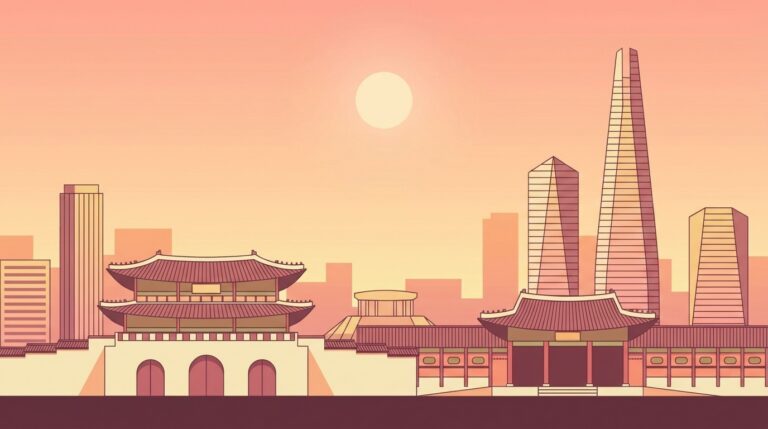
Phase 1: Empathy (Story-Driven Opening)
안녕하세요! 매일한글 에디터입니다. (Hello! It’s your Daily Hangul editor.)
Picture this scene from a sleek K-Drama like Reborn Rich or Queen of Tears: A veteran executive stands on the top floor of a gleaming glass skyscraper in Teheran-ro, Gangnam. Holding a cup of black coffee, he gazes down at the sea of autonomous delivery pods, AI tech headquarters, and electric vehicles humming below. He pulls out a faded black-and-white photograph of the exact same spot from 1974—nothing but muddy dirt paths, cabbage patches, and thatched huts. He takes a slow sip, lets out a quiet sigh, and murmurs just four syllables to his young protege.
Have you ever stood in modern Seoul, perhaps amidst the industrial-chic cafes of Seongsu-dong or the digital towers of Pangyo, wondering how an entire civilization evolved from war ruins to a hyper-digital frontier in mere decades? Or perhaps you’ve sat in a corporate board meeting where your Korean colleagues discussed how an overnight tech shift wiped out a century-old market leader. When Koreans reflect on these tectonic industrial revolutions, the rise and fall of corporate empires, and the bittersweet passage of time, standard textbook phrases like “시간이 참 빠르네요” (Time flies) simply fall flat.
To truly connect with native Korean speakers at a C1 executive and intellectual level, you need the weight, poetry, and historical depth of classical four-character idioms (사자성어, sajaseong-eo). Based on feedback from our advanced learners working across Seoul’s tech and finance hubs, mastering these three idioms instantly shifts how native colleagues perceive your cultural fluency—from an outsider speaking textbook Korean to a trusted peer who understands the poignant rhythm of Korean history.
Phase 2: Core Idiom Deep-Dive
1. 상전벽해 (桑田碧海)
- Pronunciation: [Sang-jeon-byeok-hae] (Pronounced like “sahng-jun-byuk-heh”—think of rhyming ‘sahng’ with ‘song’, ‘jun’ like ‘done’, ‘byuk’ like ‘book’ with a quick ‘y’, and ‘heh’ like ‘hey’)
- Meaning: Mulberry fields turn into the deep blue ocean. Literally describing radical ecological metamorphosis; practically used to describe staggering, unrecognizable structural transformation in an industry, city, or society.
- K-Culture Moment: Seen frequently in business documentaries or historical retrospectives on Gangnam’s development from a rural swamp into Korea’s economic powerhouse, as well as in interviews with legacy electronics tycoons facing the generative AI surge.
- Editor’s Insight: Mulberry trees (상, sang) were planted to feed silkworms—the very foundation of traditional agriculture. Seeing a mulberry grove turn into a vast ocean (벽해, byeokhae) implies an overhaul so complete that not a single trace of the original landscape remains. Use this when the shift is structural and awe-inspiring, not just a minor seasonal update.
- Situation Spectrum: Casual ⚠️ | Semi-formal ✅ | Formal ✅
- 🤔 Think About It: In English, we say “The only constant is change” or “A whole new world.” How does the visual contrast of “mulberry fields becoming an ocean” evoke a different emotional permanence than Western metaphors?
2. 격세지감 (隔世之感)
- Pronunciation: [Gyeok-se-ji-gam] (Pronounced like “gyuk-seh-jee-gahm”—’gyuk’ rhymes with ‘yuck’, ‘seh’ like ‘say’, ‘jee’ like ‘jeep’, ‘gahm’ like ‘calm’)
- Meaning: The feeling of being separated by an entire generation or historical epoch. Literally feeling as if decades or centuries have passed, even if only a brief time has elapsed.
- K-Culture Moment: A senior manager watches a junior developer write an entire enterprise application in 15 minutes using an AI coding agent, shakes their head reminiscing about debugging punch cards or floppy disks, and utters this phrase with a bittersweet smile.
- Editor’s Insight: Unlike 상전벽해, which focuses on the objective transformation of the environment, 격세지감 focuses on the subjective emotional shock and alienation inside the observer. The key character here is 감 (感, feeling). It is a poignant confession that you feel like a visitor from another century.
- Situation Spectrum: Casual ⚠️ | Semi-formal ✅ | Formal ✅
- 🤔 Think About It: Does your native culture view generation gaps primarily as conflict, or as nostalgic wonder? Notice how Korean frames this gap as an internal sentiment (감) rather than an interpersonal clash.
3. 화무십일홍 (花無十日紅)
- Pronunciation: [Hwa-mu-si-bil-hong] (Pronounced like “hwah-moo-shee-beel-hohng”—’hwah’ like ‘water’ in Spanish ‘agua’, ‘moo’ like a cow sound, ‘shee’ like ‘she’, ‘beel’ like ‘bill’, ‘hohng’ like ‘hong kong’)
- Meaning: No blossom stays bright red for ten consecutive days. Practically meaning that absolute power, trending fame, and corporate supremacy are inherently ephemeral; no peak lasts forever.
- K-Culture Moment: The iconic dramatic line uttered when an untouchable chaebol family falls into crisis, or when an infallible market monopoly collapses due to disruptive startup innovations in dramas like Search: WWW.
- Editor’s Insight: Be careful not to use this with gloating delight (schadenfreude). In refined Korean discourse, 화무십일홍 carries aristocratic melancholy and cautionary wisdom. It reminds the listener to practice humility at the height of success, because the autumn wind arrives for every blooming flower.
- Situation Spectrum: Casual 🚫 | Semi-formal ✅ | Formal ✅
- 🤔 Think About It: Western corporate culture frequently celebrates “infinite growth.” How does a culture grounded in botanical impermanence perceive cyclical corporate downturns?
Phase 3: Textbook Korean vs. Real Native Korean
Situation 1: Remarking on how an old industrial district completely transformed into a futuristic tech cluster
- 📖 교과서 한국어 (Textbook Korean):
세월이 많이 흘러서 환경이 아주 많이 바뀌었습니다.
(Sewori mani heulleoseo hwangyeongi aju mani bakkwieotseumnida.)
“A lot of time has passed, so the environment has changed very much.” - 🗣️ 진짜 한국어 (Real Native Korean):
와, 옛날 공장 지대가 다 사라졌네요. 이 정도면 정말 상전벽해입니다.
(Wa, yennal gongjang jidaega da sarajyeonneyo. I jeongdomyeon jeongmal sangjeonbyeokhae-imnida.)
“Wow, the old factory district is completely gone. At this point, it’s truly a mulberry-field-to-blue-ocean transformation.” - 💡 왜 다를까? (Why is it different?):
Textbook Korean relies on bland descriptive adjectives (많이 바뀌었다). Native Korean intellectuals and executives encapsulate spatial shock and historical gravity in four concise syllables, lending elegance and authority to the observation.
Situation 2: Reflecting on how rapidly AI replaced conventional legacy workflows
- 📖 교과서 한국어 (Textbook Korean):
기술 발전 때문에 시대가 빠르게 변하는 것을 느낍니다.
(Gisul baljeon ttaemune sidaega ppareuge byeonhaneun geoseul neukkimnida.)
“I feel that eras are changing fast because of technological development.” - 🗣️ 진짜 한국어 (Real Native Korean):
스마트폰 나온 지가 엊그제 같은데 벌써 생성형 AI라니, 격세지감이 드네요.
(Seumateupon naon jiga eotgeuje gateunde beolsseo saengseonghyeong AIrani, gyeokse-jigami deuneyo.)
“It feels like smartphones came out just yesterday, but now it’s already generative AI—I genuinely feel the passage of an epoch.” - 💡 왜 다를까? (Why is it different?):
Real native speech contrasts a vivid recent milestone (스마트폰 나온 지가 엊그제 같은데) with the psychological sentiment marker 격세지감이 들다 (to feel the weight of an epoch), transforming a dry analytical statement into shared emotional camaraderie.
Phase 4: K-Culture Deep-Dive & Non-Verbal Manners
4-1. 눈치 (Nunchi) & Non-Verbal Gravitas
When delivering classical idioms about epochal shifts, your body language must match the dignity of the idiom:
* The Reflective Distance Gaze: When uttering 상전벽해 or 격세지감, do not stare aggressively into your counterpart’s eyes. Briefly shift your gaze slightly upward or toward the window as if picturing the bygone era, then return your eyes to the listener with a subtle, slow nod.
* The Modest Sigh (회한의 호흡): Softly exhale through your nose before delivering the phrase. This signals contemplative maturity rather than rushed small talk.
* Tone Control for Impermanence: When saying 화무십일홍, maintain a level, calm baritone. Avoid smiling or smirking, which could make you sound like you are celebrating someone’s downfall.
4-2. Cultural Code: The Paradox of Compressed Growth (압축성장)
Korea experienced in roughly 40 years what took Western industrial nations nearly two centuries: the transition from an agrarian society to a war-torn ruin, to manufacturing titan, to hyper-connected digital leader. This phenomenon, known historically as 압축성장 (compressed economic growth), created a unique collective consciousness.
In Seoul, you can walk through Euljiro—where 60-year-old metal lathing workshops stand directly beneath hyper-modern banking conglomerates—or witness Seongsu-dong, where shoe factory warehouses have morphed into luxury brand pop-ups. Because the physical reality of Korea changes at breakneck speed, idioms like 상전벽해 and 격세지감 are not dusty museum artifacts; they are daily existential descriptions of living in modern Korea.
Phase 5: Real-World Roleplay Scenario
Setting: A quiet private dining room (룸식당) in Yeouido, Seoul. Director Alex (an expat tech director) is having dinner with Senior Managing Director Park (박 전무), a 35-year corporate veteran, following the shutdown of a legacy retail chain acquired by an AI-driven digital platform.
- 박 전무 (Managing Director Park): (소주잔을 천천히 돌리며 창밖 빌딩 숲을 응시한다) 알렉스 디렉터, 저기 보이는 백화점 자리 말이에요. 내가 신입사원 때 첫 기획안 들고 뛰어다니던 곳인데, 다음 달에 철거되고 AI 물류 센터가 들어선다더군요.
(Sojujaneul cheoncheonhi dollimyeo changbak bilding supeul eungsihanda) Alex direkteo, jeogi boineun baekhwajeom jari marieyo. Naega sinipsawon ttae cheot gihoegan deulgo ttwieodanideon gosin-de, daeum dare cheolgeodoego AI mullyu senteoga deureoseondadeogunyo.
🎭 (Slowly swirling his soju glass, staring out at the forest of office buildings) Director Alex, that department store site over there… that was where I ran around with my very first project proposal as a rookie employee. They say it’s being demolished next month to make way for an automated AI logistics center. -
알렉스 디렉터 (Director Alex): (공감하듯 천천히 고개를 끄덕이며) 전무님 청춘이 깃든 곳인데 감회가 참 남다르시겠습니다.
(Gonggamhadeut cheoncheonhi gogaereul kkeodeogimyeo) Jeonmunim cheongchuni gitdeun gosin-de gamhoega cham namdareusigetseumnida.
🎭 (Nodding slowly with deep empathy) Your youth and sweat were poured into that place; your feelings must be truly profound, sir. -
박 전무 (Managing Director Park): (씁쓸한 미소를 지으며) 30년 동안 천하를 호령하던 유통 공룡이었는데… 기술이 바뀌니 한순간이네요.
(Sseupsseulhan misoreul jieumyeo) Samsimnyeon dongan cheonhareul horyeonghadeon yutong gongnyong-ieonneunde… Gisuri bakkwini hansung-anineyo.
🎭 (With a bittersweet smile) It was a retail dinosaur that commanded the entire country for thirty years… but with the technology shift, it vanished in a heartbeat. -
알렉스 디렉터 (Director Alex): (신중하고 무게감 있는 목소리로) 네, 전무님. 정말 화무십일홍이라는 말이 뼈저리게 와닿습니다. 영원한 1등은 없다는 걸 다시금 실감합니다.
(Sinjunghago mugegam inneun moksoriro) Ne, Jeonmunim. Jeongmal hwamuk-sibilhong-iraneun mari ppyeojeorige wadatsumnida. Yeongwonhan ildeungeun eopdaneun geol dasigeum silgamhamnida.
🎭 (In a thoughtful, poised voice) Indeed, Managing Director. The proverb “No flower stays red for ten days” hits home deeply. It truly reminds us that no market leader stays on top forever. -
박 전무 (Managing Director Park): (알렉스의 눈을 마주치며 잔을 채워준다) 그래요. 시장의 흐름을 못 읽으면 도태되는 법이지. 하지만 알렉스 디렉터가 이끄는 새 프로젝트를 보면 격세지감이 들면서도 가슴이 뜁니다.
(Alex-ui nuneul majuchimyeo janeul chaewojunda) Geuraeyo. Sijang-ui heureumeul mot ilgeumyeon dotaedoeneun beobiji. Hajiman Alex direkteoga ikkeuneun sae peurojekteureul bomyeon gyeokse-jigami deulmyeonseodo gaseumi ttwimnida.
🎭 (Meeting Alex’s eyes, pouring him a refill) Exactly. If you fail to read the market currents, obsolescence is inevitable. Yet, seeing this new project you are leading, while I feel a true generation gap, my heart still races with excitement. -
알렉스 디렉터 (Director Alex): (두 손으로 공손히 잔을 받으며) 전무님께서 닦아놓으신 토대 덕분입니다. 과거의 역사를 거울삼아 더 탄탄한 플랫폼을 만들겠습니다.
(Du soneuro gongsonhi janeul badeumyeo) Jeonmunimkkeseo dakkkano-usin todae deokbunimnida. Gwagoeo-ui yeoksareul geoulsama deo tantanhan peullaetpomeul mandeulgetseumnida.
🎭 (Receiving the cup respectfully with both hands) It is all thanks to the foundation you laid down, sir. Taking past history as our mirror, we will build an even more resilient platform. -
박 전무 (Managing Director Park): (흐뭇하게 잔을 부딪히며) 하하, 이 골목도 곧 상전벽해가 되겠구려. 우리 미래를 위해 듭시다!
(Heumuthage janeul budichimyeo) Haha, i golmokdo got sangjeonbyeokhaega doegetguryeo. Uri miraereul wihae deupsida!
🎭 (Clinking glasses warmly) Haha, this very alley will soon see mulberry fields turn to blue ocean too. Let’s drink to our future! -
알렉스 디렉터 (Director Alex): 네, 전무님! 위기를 기회로 만들겠습니다. 건배!
(Ne, Jeonmunim! Wigireul gihoero mandeulgetseumnida. Geonbae!)
🎭 (With crisp confidence) Yes, Managing Director! We will turn this crisis into opportunity. Cheers!
🔀 Interactive Decision Point
Imagine you are Alex right after Managing Director Park sighs: “It was a retail dinosaur that commanded the entire country for thirty years… but with the technology shift, it vanished in a heartbeat.” How do you respond?
- Option A: “그러게 말입니다! 요즘 세상에 혁신 안 하면 망하는 건 당연하죠. 저희 솔루션으로 싹 바꿔야 합니다!”
(Geureoge marimnida! Yojeum sesang-e hyeoksin an hamyeon manghaneun geon dang-yeonhajyo. Jeohui sollusyeoneuro ssak bakkwoya hamnida!)
“Tell me about it! In this day and age, going bankrupt is obvious if you don’t innovate. We need to replace everything with our solution!” - Option B: “네, 전무님. 정말 화무십일홍이라는 옛말처럼, 산업의 흥망성쇠를 마주하니 만감이 교차합니다.”
(Ne, Jeonmunim. Jeongmal hwamuk-sibilhong-iraneun yennalcheoreom, saneop-ui heungmangseongsoereul majuhani man-gami gyocha-hamnida.)
“Yes, Managing Director. Just like the old saying ‘no flower blooms red for ten days,’ witnessing the rise and fall of this industry brings up a kaleidoscope of complex emotions.” - Option C: “시대가 변했으니 슬퍼하실 필요 전혀 없습니다. 잊어버리시고 소주나 한잔하시죠!”
(Sidaega byeonhaesseuni seulpeohasil piryo jeonhyeo eopseumnida. Ijeobeorisigo sojuna hanjanhasijyo!)
“Times have changed, so there’s no need to be sad at all. Forget about it and let’s just have some soju!”
Feedback & Analysis:
* Option A (Bad – Nunchi Disaster): Calling the failure “obvious” (망하는 건 당연하죠) directly insults the veteran’s life work. You sound arrogant and emotionally tone-deaf.
* Option B (Best – C1 Master): Employs 화무십일홍 to philosophically validate his sorrow while acknowledging 흥망성쇠 (rise and fall). It builds massive executive rapport and proves high-level cultural emotional intelligence.
* Option C (Risk – Superficial): Dismissing his lifelong memories with a casual “don’t be sad, just drink” invalidates his emotional vulnerability.
Phase 6: 10-Second Emotion Shadowing Drill
Read these three cadence-marked lines out loud. Respect the pause marks (/) and embody the emotional stage direction.
[😮 경이로움과 격세지감 / Awe and astonishment at technological disruption]
불과 몇 년 사이에 / 산업 지형도가 이렇게 뒤바뀌다니 / 정말 격세지감이 듭니다.
(Bulgwa myeot nyeon saie / saneop jihyeongdoga ireoke dwibakkwidani / jeongmal gyeokse-jigami deumnida.)
“For the industrial topography to flip like this / in just a few short years / I truly feel an entire epoch has passed.”-
[🥀 무상함과 겸허함 / Poignant melancholy and philosophical humility]
한때 시장을 지배했던 대기업도 / 기술 혁신 앞에서는 / 화무십일홍일 뿐이군요.
(Hanttae sijangeul jibaehaetdeon daegieopdo / gisul hyeoksin apeseoneun / hwamuk-sibilhong-il ppunigunyo.)
“Even the conglomerate that once dominated the entire market / before the wave of technological innovation / is nothing more than a flower fading within ten days.” -
[🏙️ 감탄과 성찰 / Reflective wonder looking at urban change]
허허벌판이던 연구 단지가 / 글로벌 테크 허브가 된 것을 보니 / 그야말로 상전벽해입니다.
(Heoheobeolpan-ideon yeon-gu danjiga / geulleobeol tekeu heobeoga doen geoseul boni / geuyamallo sangjeonbyeokhae-imnida.)
“Looking at how an empty wasteland / turned into a global tech hub / it is quite literally mulberry fields turned into the ocean.”
Phase 7: K-Culture Mini Dictionary
-
상전벽해 (桑田碧海, Sangjeonbyeokhae)
Translation: Mulberry fields become blue sea.
Real-World Usage: Frequently deployed in financial press and urban planning presentations to describe radical physical or systemic disruptions, such as the digital transition of traditional brick-and-mortar retail. -
격세지감 (隔世之感, Gyeokse-jigam)
Translation: Sensation of a generational/epochal separation.
Real-World Usage: Used in business meetings when recalling past analog tools (fax machines, physical chops/stamps) compared to modern automated SaaS solutions. -
화무십일홍 (花無十日紅, Hwamuk-sibilhong)
Translation: No flower stays red for ten days.
Real-World Usage: A sobering corporate idiom used when advising executives to avoid complacency during record-breaking quarterly profits. -
권불십년 (權不十年, Gwonbulsimnyeon)
Translation: Political or institutional power does not last ten years.
Real-World Usage: Often paired with 화무십일홍 in political analysis or dramatic power struggles inside corporate chaebol boardrooms.
Phase 8: Traveler and Expat Survival Kit
Survival Expressions TOP 3
-
“예전 모습이 하나도 안 남아있네요!”
(Yejeon moseubi hanado an namainneyeo!)
“Not a single trace of the old days remains!”
Pro Tip: Use this when visiting places like Seoul Station or Seongsu-dong alongside an older Korean guide. -
“상전벽해라는 말이 딱 어울립니다.”
(Sangjeonbyeokhae-raneun mari ttak eoullimnida.)
“The phrase ‘mulberry fields turned to sea’ fits this perfectly.”
Pro Tip: A stellar compliment when a Korean municipal officer or company host showcases their newly constructed R&D center. -
“격세지감이 절로 드네요.”
(Gyeokse-jigami jeollo deuneyo.)
“A sense of epochal change arises completely on its own.”
Editor’s Travel Note: Exploring Seoul’s Layers of Time
Want to witness 상전벽해 in the flesh? Search for historical timeline exhibits or download the Naver Map street view feature to toggle between 2008 and present-day satellite views of Euljiro and Gangnam. While wandering the labyrinthine tool alleys of Cheonggyecheon right across from the shimmering Cheonggyecheon stream restoration, you will physically touch 1960s mechanical lathe grease while catching reflections of ultra-modern cloud architecture towers in the puddles.
Phase 9: “One Step Deeper” (Cultural Reflection)
To understand why Koreans are uniquely moved by idioms describing epochal change, one must understand that modern Korea has lived in a perpetual state of accelerated reinvention. Because the Korean Peninsula witnessed unimaginable devastation during the mid-20th century followed by blinding economic ascension, Koreans harbor an acute, dual-edged psychology: fierce pride in rapid modernization, coupled with a deep, unspoken anxiety that everything built could vanish just as swiftly.
Thus, when an educated Korean utters 화무십일홍 or 상전벽해, they are not merely reciting classical poetry; they are tapping into a national survival ethos that honors transience, preaches relentless innovation, and cautions against hubris.
💬 Your Turn: Has your home country experienced an industrial disruption that made you feel 격세지감? How do people in your culture articulate the bittersweet rise and fall of legendary companies? Share your thoughts below!
Phase 10: FAQ & Common Mistakes
Q: Can I use 화무십일홍 when an annoying competitor company goes bankrupt?
A: Avoid doing so in professional settings! While it might feel tempting, 화무십일홍 carries solemn, philosophical contemplation. Using it to gloat (고소하다, gosohada) makes you appear spiteful and unrefined. Instead, use it in a cautionary manner: “우리도 자만하면 안 됩니다. 화무십일홍이니까요.” (We must not become arrogant either, for no flower blooms red for ten days).
Q: Is 상전벽해 only used for positive development?
A: Primarily, it conveys positive awe at advanced development or monumental scale, but it can also be neutral. However, if an area deteriorated into ruins, Koreans usually prefer 폐허 (ruins) or 격세지감 rather than 상전벽해, which traditionally points toward grand, oceanic shifts.
Q: Can I use 격세지감 to describe my personal aging, like getting wrinkles?
A: No. 격세지감 requires an epochal or generational contrast in environment, culture, or technology. If you are just talking about your personal age or gray hair, use phrases like “나이 든 게 실감 나네요” (I really feel my age) or “세월 참 빠르네요” (Time flies).
🚨 Common Mistakes (흔한 실수) Warning Board
- Mistake: Using 상전벽해 for short-term trivial changes (e.g., your friend dyed their hair blonde).
Correct Action: Use 이미지 변신 (image makeover). Reserve 상전벽해 for monumental, structural transformations. - Mistake: Pronouncing 화무십일홍 as individual isolated syllables without natural liaison (Hwa-mu-sip-il-hong instead of natural Hwamuk-sibilhong).
Correct Action: Link the final consonantㅂto the vowel이to pronounce it smoothly: [화무시빌홍]. - Mistake: Combining 격세지감 with casual banmal to a corporate senior without honorifics.
Correct Action: Always anchor it with dignified endings like 격세지감이 듭니다 or 격세지감을 느낍니다.
Phase 11: Action Missions & K-Culture Discovery
- 🥉 Bronze Mission (Solo Shadowing): Stand in front of a mirror and recite the sentence: “스마트폰이 나온 지 엊그제 같은데, 벌써 AI 시대라니 격세지감이 듭니다.” Focus on maintaining the reflective distance gaze and controlled sigh.
- 🥈 Silver Mission (SNS Community): Share a photo on social media of an old childhood gadget (like an MP3 player or wired headphones) and caption it: “벌써 추억의 물건… 격세지감! 🎧”
- 🥇 Gold Mission (Live Corporate Application): In your next Korean business meeting or coffee chat with a Korean colleague, use 상전벽해 or 격세지감 when discussing market industry changes or the rise of new tech platforms.
- 🎮 K-Culture Mission: Watch an episode of a business-oriented K-drama (such as Misaeng, Reborn Rich, or Start-Up). Listen for when veteran board members or department heads use classical idioms to caution younger characters.
Phase 12: Interactive Quiz Challenge
Test your mastery of epochal idioms! Formulate your answers before opening the details toggle.
Question 1 (Situational Judgment)
You are attending an international tech forum in Seoul. The keynote speaker displays a 1980 photograph of a tranquil rice paddy, followed by a drone shot of the current bustling Songdo International Smart City. What is the most refined phrase to murmur to the CEO seated beside you?
* A) 와, 건물이 엄청 많아져서 참 축하할 일이네요.
* B) 허허벌판이 국제도시로 탈바꿈하다니, 그야말로 상전벽해입니다.
* C) 꽃이 열흘 붉지 못하더니 완전히 망했군요.
Question 2 (Fill in the Blank)
과거 20년 동안 업계 부동의 1위였던 필름 카메라 기업이 디지털 전환에 실패하여 결국 문을 닫았다. 이를 지켜보며 동료가 말했다:
“영원한 승자는 없다는 옛말이 맞네요. 권력도 성공도 영원하지 않다더니, 참 ( ________ )을 실감합니다.”
* A) 화무십일홍 (花無十日紅)
* B) 동문서답 (東問西答)
* C) 작심삼일 (作心三日)
Question 3 (True or False Cultural Insight)
True or False: You can use 격세지감 to describe the feeling of waking up late on Sunday morning after a long sleep.
👉 Click to reveal answers & explanations
- Question 1 Answer: B
Explanation: Songdo’s transformation from ocean/reclaimed mudflats into a high-tech metropolis is the textbook definition of 상전벽해 (mulberry fields turning to sea). Option A is far too juvenile for a C1 conversation, and Option C is an improper application of 화무십일홍. -
Question 2 Answer: A (화무십일홍)
Explanation: 화무십일홍 reflects the impermanence of corporate supremacy and commercial peaks. 동문서답 means giving an irrelevant answer, and 작심삼일 means giving up after three days. -
Question 3 Answer: False
Explanation: 격세지감 requires a sense of an entire historical era or cultural epoch shifting. Simply waking up groggy after oversleeping cannot trigger 격세지감!
🎬 Watch Our Daily Videos! (Daily Hangul Official Instagram)
Review the expressions you learned in this article with our fun daily short videos! Check out native pronunciation and real-life nuances in action.
- Instagram @dailyhangul_en







