

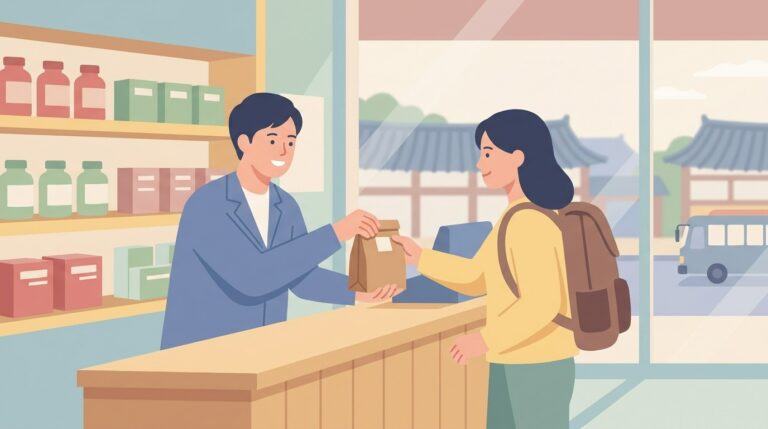
Phase 1: Why Korean Pharmacies Feel Like a K-Drama Maze
안녕하세요! 매일한글 에디터입니다. (Annyeonghaseyo! Hello! This is your Daily Hangul Editor.) Have you ever watched a K-Drama where the main character catches a cold after walking in the rain and rushes to a tiny neighborhood pharmacy? In real life, visiting a Korean pharmacy can feel super scary! You hand over your paper prescription, and suddenly the pharmacist starts speaking fast while handing you a bright paper bag covered in tiny Hangul. Wait—how many pills do I take, and will they make me sleepy? Based on real feedback from our beginner learners in Seoul, this guide solves that exact panic. Master these simple expressions, and you will calmly understand your medicine bag like a local!
Phase 2: Deep Dive into 3 Essential Pharmacy Expressions
1. 처방전 여기 있어요. (Cheobangjeon yeogi isseoyo.)
- Pronunciation: Cheo-bang-jeon yeo-gi i-sseo-yo. (Think of chuh-bahng-juhn + yuh-gee ee-suh-yo, with a soft ch like in church and eo like the u in cup.)
- Meaning: Literally “Prescription here exists.” In real life, it is the warm, polite way to say, “Here is my prescription.”
- K-Culture Moment: Just like in the hit medical K-Drama Hospital Playlist, right after seeing a doctor, Koreans walk across the street to a pharmacy with the big green or red 약 (yak, pharmacy) sign and hand over this exact paper.
- Editor’s Insight: Adding 여기 있어요 (yeogi isseoyo) softens your tone so you don’t sound like you are barking orders. Never just toss the paper on the counter silently—saying this phrase instantly earns you a friendly smile!
- Situation Spectrum:
- Casual (with friends): 🚫 (Too polite for friends, and you wouldn’t give them a prescription!)
- Semi-formal (standard polite
-요ending): ✅ (Perfect for all pharmacy staff!)- Formal (
-습니다ending, 처방전 여기 있습니다): ✅ (Great if you want to sound extra respectful to an older pharmacist.)- 🤔 Think About It: In English, we often start with “I’d like to drop this off” or “Can I fill this?” Korean skips the verb “to fill” and focuses on simply presenting what is here (여기 있어요). How does your native language hand things over politely?
2. 약 봉투 겉면을 참고하세요. (Yak bongtu geotmyeoneul chamgohaseyo.)
- Pronunciation: Yak bong-tu geot-myeo-neul cham-go-ha-se-yo. (Say yahk short and crisp like yuck without the uh, bong-too, guht-myuh-nuhl, and chahm-go-ha-seh-yo.)
- Meaning: Literally “Medicine bag outside-surface please refer to.” Real nuance: “The dosage instructions are written in detail on the medicine bag for your reference.”
- K-Culture Moment: When a K-Pop idol gets sick during a busy comeback and visits a clinic, their manager gets handed a paper pouch with printed boxes showing morning, lunch, and dinner icons. The pharmacist will point to the bag and say this exact line!
- Editor’s Insight: This is the #1 sentence pharmacists say to foreigners! Even if you don’t catch every word, hearing 약 봉투 (yak bongtu, medicine bag) and 참고하세요 (chamgohaseyo, please check/refer to) tells you: “Don’t worry, everything you need is printed right on this bag!”
- Situation Spectrum:
- Casual: 🚫 (Using -세요 is polite; you wouldn’t use this with close friends.)
- Semi-formal (Pharmacist to Customer): ✅ (The standard polite service phrase you will hear.)
- Formal: ✅ (Very natural and respectful in any clinic or pharmacy setting.)
- 🤔 Think About It: In many Western countries, medicine comes in orange plastic bottles with tiny sticky labels. In Korea, pharmacies pack your exact dose per meal into little sealed packets inside a detailed paper 약 봉투 (yak bongtu). Why do you think Korea prefers meal-by-meal packets?
3. 먹으면 졸릴 수 있어요? (Meogeumyeon jollil su isseoyo?)
- Pronunciation: Meo-geu-myeon jol-lil su i-sseo-yo? (Say muh-guh-myuhn + johl-leel soo ee-suh-yo, raising your pitch at the end like a curious question!)
- Meaning: Literally “If I eat it, can it be sleepy?” Real nuance: “Will this make me drowsy?”
- K-Culture Moment: Picture an exhausted office worker in a K-Drama like Misaeng or Business Proposal sneezing at their desk. They ask the pharmacist this question because they cannot afford to fall asleep in front of their boss!
- Editor’s Insight: Notice Koreans say “eat” medicine (약을 먹다, yageul meokda) instead of “take” medicine! For beginners, ~ㄹ/을 수 있어요? (~l/eul su isseoyo?, Could it happen?) is a magic pattern for checking any side effect.
- Situation Spectrum:
- Casual (먹으면 졸려?, Meogeumyeon jollyeo?): ✅ (When asking a friend who took the same cold pill.)
- Semi-formal (먹으면 졸릴 수 있어요?): ✅ (The best, easiest way to ask a pharmacist!)
- Formal (복용 시 졸릴 수 있습니까?, Bogyong si jollil su itseumnikka?): ⚠️ (A bit too robotic for a beginner—stick to Semi-formal!)
- 🤔 Think About It: English separates “eating food” and “taking medicine,” while Korean uses 먹다 (meokda, to eat) for food, water, and pills! What verb does your native language use for medicine?
Phase 3: Textbook Korean vs. Real Korean
Situation 1: Asking “How do I take this?”
- 📖 Textbook Korean: 이 약의 복용 방법을 설명해 주십시오. (I yagui bogyong bangbeobeul seolmyeonghae jusipsio. — Please explain the method of ingestion for this medicine.)
- 🗣️ Real Korean: 이거 어떻게 먹어요? (Igeo eotteoke meogeoyo? — How do I take this?)
- 💡 Why the difference? Textbooks love formal Chinese-origin nouns like 복용 방법 (bogyong bangbeop), which sound like reading a legal contract! In real neighborhood pharmacies, Koreans keep it warm, short, and conversational using 어떻게 먹어요? (eotteoke meogeoyo?).
Situation 2: Hearing “Take it 30 minutes after eating.”
- 📖 Textbook Korean: 식사를 하신 후에 삼십 분 뒤에 복용하시기 바랍니다. (Siksareul hasin hue samsip bun dwie bogyonghasigi baramnida. — Please take it 30 minutes after having a meal.)
- 🗣️ Real Korean: 밥 먹고 30분 뒤에 드세요. (Bap meokgo samsipbun dwie deuseyo. — Eat a meal and take it 30 minutes later.)
- 💡 Why the difference? In Korean daily life, 밥 (bap, cooked rice/meal) means any meal—even if you ate toast or pasta! Pharmacists use 밥 먹고 (bap meokgo) because it feels friendly, caring, and crystal clear.
Phase 4: K-Culture Deep Dive & Non-Verbal Manners
4-1. Nunchi (눈치) & Gestures at the Pharmacy
- The Two-Handed Rule: When handing over your 처방전 (cheobangjeon, prescription) or credit card, use both hands—or support your right forearm lightly with your left hand. In Korean culture, this small gesture instantly shows respect and warmth.
- Eye Contact & Micro-Bow: Give a gentle 15-degree head nod while saying 안녕하세요 (annyeonghaseyo) as you step up to the counter. Keep your gaze polite (around chin/eye level without staring intensely).
- Waiting with Nunchi: Korean pharmacies are compact. If the pharmacist is printing labels or counting pills behind the glass, step half a step back and wait quietly until they call your name with “~님! (~nim!)”.
4-2. Cultural Code: Why Korean Medicine Bags Are Genius
If you travel to Korea (K-Travel) or watch slice-of-life K-Dramas, you will notice clinics and pharmacies are almost always separated by law—doctors write the prescription, and nearby 약국 (yakguk, pharmacies) fill it. Even better? Instead of shaking pills out of three different bottles, Korean pharmacies put your morning, lunch, and dinner pills into neat individual tear-open plastic sachets (약 포장, yak pojang). And on the outside of the main paper 약 봉투 (yak bongtu), you will see exact times, meal instructions, and warning icons printed clearly. It is Korea’s famous ppalli-ppalli (빨리빨리, fast-and-efficient) convenience mixed with genuine care!
Phase 5: Real-Life Roleplay Scenario
Setting: A bright, cozy neighborhood pharmacy in Hongdae. Rain taps gently against the glass door. Behind the counter stands Pharmacist Ji-hoon, wearing a crisp white coat and a reassuring smile. You just walked over from the ENT clinic next door with a scratchy throat.
- Pharmacist Ji-hoon: 어서 오세요! 어디가 불편하세요? (Eoseo oseyo! Eodiga bulpyeonhaseyo? — Welcome! Where are you feeling uncomfortable?)
🎭 Hands poised neatly on the counter, smiling warmly. - You: 안녕하세요. 처방전 여기 있어요. (Annyeonghaseyo. Cheobangjeon yeogi isseoyo. — Hello. Here is my prescription.)
🎭 Handing over the paper prescription with both hands and a slight nod. - Pharmacist Ji-hoon: 네, 잠깐만 기다려 주세요. (Ne, jamkkanman gidaryeo juseyo. — Yes, please wait just a moment.)
🎭 Scanning the barcode and walking to the pill-packing machine. - (3 minutes later) Pharmacist Ji-hoon: 손님, 약 나왔습니다! (Sonnim, yak nawatseumnida! — Customer, your medicine is ready!)
🎭 Placing a colorful paper medicine bag on the counter. - You: 감사합니다! 이거 어떻게 먹어요? (Gamsahamnida! Igeo eotteoke meogeoyo? — Thank you! How do I take this?)
🎭 Pointing politely at the paper bag. - Pharmacist Ji-hoon: 하루에 세 번, 밥 먹고 30분 뒤에 드세요. 약 봉투 겉면에 복용 방법이 자세하게 적혀 있으니 참고하세요. (Harue se beon, bap meokgo samsipbun dwie deuseyo. Yak bongtu geotmyeone bogyong bangbeobi jasehage jeokhyeo isseuni chamgohaseyo. — Three times a day, please take it 30 minutes after eating. The dosage instructions are written in detail on the medicine bag for your reference.)
🎭 Tapping a pen gently on the printed chart on the bag. - You: 아, 네! 혹시 먹으면 졸릴 수 있어요? (A, ne! Hoksi meogeumyeon jollil su isseoyo? — Oh, okay! By any chance, can it make me sleepy?)
🎭 Leaning in slightly with a curious expression. - Pharmacist Ji-hoon: 네, 감기약이라서 조금 졸릴 수 있어요. 물 많이 드세요! (Ne, gamgiyagiraseo jogeum jollil su isseoyo. Mul mani deuseyo! — Yes, since it is cold medicine, it can make you a little sleepy. Drink lots of water!)
🎭 Handing you your receipt with a caring smile.
🔀 Interactive Branching Point: What Do You Do Next?
The pharmacist also mentions one extra warning about stomach aches if you skip meals, and you realize you haven’t eaten lunch yet! How do you respond?
- Option A: “알겠어요! 지금 밥 먹고 바로 먹을게요. 감사합니다!” (Algesseoyo! Jigeum bap meokgo baro meogeulgeyo. Gamsahamnida! — Got it! I will eat a meal right now and take it right away. Thank you!)
- Option B: “야! 물 줘!” (Ya! Mul jwo! — Hey! Give me water!)
- Option C: Say nothing, grab the bag, and immediately swallow the pills dry right in front of the pharmacist.
Feedback:
* Option A (Best! ✅): Natural, polite Level-2 Korean! You showed you understood the instruction (밥 먹고, after eating) and thanked them warmly.
* Option B (Bad! 🚫): Using 야! (Ya!) and 줘 (jwo) is super rude casual speech (반말, banmal) to a stranger and makes you sound angry!
* Option C (Risk! ⚠️): Taking cold medicine on an empty stomach without water can upset your stomach—always check the 약 봉투 (yak bongtu) or grab a warm drink first!
Phase 6: 10-Second Emotional Shadowing Drill
Read these lines out loud! Pause briefly at every / and match the emotion tag.
[😊 Warm and polite]안녕하세요! / 처방전 / 여기 있어요. (Annyeonghaseyo! / Cheobangjeon / yeogi isseoyo. — Hello! Here is my prescription.)[🤔 Curious and careful]이거 / 어떻게 / 먹어요? (Igeo / eotteoke / meogeoyo? — How do I take this?)[😟 A little worried]혹시 / 먹으면 / 졸릴 수 있어요? (Hoksi / meogeumyeon / jollil su isseoyo? — Could it make me sleepy?)[😌 Relieved and grateful]아, 네! / 잘 알겠습니다. / 감사합니다! (A, ne! / Jal algesseumnida. / Gamsahamnida! — Oh, yes! I understand well. Thank you!)
Phase 7: K-Culture Mini Dictionary
- 처방전 (cheobangjeon) | Prescription | A paper (or QR) document from a Korean doctor. You cannot buy strong antibiotics or custom cold sets without handing this to a pharmacist.
- 약 봉투 (yak bongtu) | Medicine bag | The iconic Korean paper envelope holding your pill sachets. The front always shows 식후 30분 (sikhu samsipbun, 30 mins after meals) and 1일 3회 (il-il samhoe, 3 times a day).
- 복용법 (bogyongbeop) | Dosage instructions | Literally “how to take medicine.” You will see this printed as a header box on almost every 약 봉투 (yak bongtu).
- 부작용 (bujagyong) | Side effect | Important medical word for allergies, dizziness, or drowsiness. In everyday slang, Koreans even joke about the “side effect” of binge-watching K-Dramas all night!
Phase 8: Survival Kit for Travelers
Top 3 Pharmacy Survival Phrases
- 여기에 알레르기 있어요. (Yeogie allereugi isseoyo. — I have an allergy to this.)
- Pro Tip: Show a saved photo or translated note of the ingredient name on your phone while pointing to it and saying 여기에 (yeogie, to this).
- 식후에 먹어요? (Sikhue meogeoyo? — Do I take it after eating?)
- Pro Tip: 식후 (sikhu) = after meal, 식전 (sikjeon) = before meal. Super easy to spot on the bag!
- 영수증 주세요. (Yeongsujeung juseyo. — Please give me a receipt.)
- Pro Tip: Essential if you plan to claim travel insurance back home!
Editor’s Travel Note
- Find Open Pharmacies Fast: Not all pharmacies open on Sundays! Download and use the Naver Map App for Finding Open Korean Pharmacies and search 약국 (yakguk) or 휴일 지킴이 약국 (hyuil jikimi yakguk, holiday-duty pharmacy).
- Scan Your Bag Instantly: Need to double-check every tiny Hangul note on your 약 봉투 (yak bongtu)? Use the camera mode in the Papago Translator App for Reading Korean Medicine Labels for fast, accurate translations.
- Payment & Transit: Korean pharmacies accept international Visa/Mastercard, cash, and even T-money cards at some locations. Just tap your card on the terminal right beside the counter!
Phase 9: One Step Deeper — The Warmth Inside a Paper Bag
When you first see a Korean 약 봉투 (yak bongtu) packed with neat little tear-open pouches, it might feel like a tiny miracle of efficiency. Behind that efficiency is 정 (jeong)—a deep Korean cultural feeling of unspoken care and looking out for one another. Pharmacists don’t just hand you pills; they organize your morning, lunch, and dinner doses so your tired, sick self doesn’t have to think. Even a polite reminder like “물 많이 드세요! (Mul mani deuseyo!, Drink lots of water!)” carries the warmth of a caring neighbor.
💬 Your Turn: Have you ever visited a pharmacy abroad where everything felt confusing—or tried reading a Korean medicine bag? Tell us your story in the comments below!
Phase 10: FAQ & Common Mistakes
Q: Can I buy prescription medicine at a Korean convenience store (편의점, pyeonuijeom)?
A: No! Convenience stores only sell basic over-the-counter items like mild painkillers (Tylenol), digestive aids, and bandages. For prescription medicine, you must visit a clinic and take your 처방전 (cheobangjeon) to a 약국 (yakguk, pharmacy).
Q: What do the numbers like “1일 3회” and “3일분” mean on my 약 봉투 (yak bongtu)?
A: 1일 3회 (il-il samhoe) means “3 times a day,” and 3일분 (samilbun) means “a 3-day supply.” Look for the sun, spoon, or moon icons printed right next to those numbers!
Q: How much does a prescription usually cost in Korea if I am a tourist?
A: Even without Korean National Health Insurance, basic cold or allergy prescriptions at a neighborhood pharmacy are very affordable—often between 5,000 KRW and 15,000 KRW (about $4–$11 USD), though specialized medicine can cost more.
🚨 Common Mistakes to Avoid
- Mistake: Saying “약을 마셔요” (yageul masyeoyo — I drink medicine) for pills.
- Correct Action: Always use 먹어요 (meogeoyo — eat)! Even for liquid syrup, Koreans say 약을 먹어요 (yageul meogeoyo).
- Mistake: Asking “부작용 없어요?” in an accusing tone while staring silently.
- Correct Action: Soften it with 혹시 (hoksi, by any chance) and a polite smile: “혹시 부작용 있어요? (Hoksi bujagyong isseoyo?)”
- Mistake: Throwing away the paper 약 봉투 (yak bongtu) and keeping only the plastic pill sachets.
- Correct Action: Snap a photo of the 약 봉투 (yak bongtu) first! All the dosage times and warning notes are printed on the outer bag.
Phase 11: Action Mission & Engagement
- 🥉 Bronze Mission (Solo Practice): Stand in front of a mirror and say “안녕하세요, 처방전 여기 있어요” (Annyeonghaseyo, cheobangjeon yeogi isseoyo) 5 times while practicing the two-handed card/paper gesture!
- 🥈 Silver Mission (Share & Shine): Post a quick story or note on your study account explaining what 약 봉투 (yak bongtu) means and tag a friend who loves K-Travel!
- 🥇 Gold Mission (Real-Life Action): Next time you visit a Korean pharmacy (or roleplay with your tutor!), ask “혹시 먹으면 졸릴 수 있어요? (Hoksi meogeumyeon jollil su isseoyo?)” and check the printed instructions on the bag.
- 🎮 K-Culture Mission: Watch a hospital or cold-scene clip in your favorite K-Drama (like Hospital Playlist or Doctor Slump) and spot the green or red 약 (yak) sign or a paper 약 봉투 (yak bongtu)!
Phase 12: Interactive Quiz Challenge
Quiz 1: Situational Judgment
You walk into a Korean pharmacy with your paper prescription. Which phrase is the warmest, most natural Level-2 way to hand it over?
A) 약 주세요! (Yak juseyo!)
B) 처방전 여기 있어요. (Cheobangjeon yeogi isseoyo.)
C) 이 종이 봐. (I jongi bwa.)
👉 Click to check Answer & Explanation for Quiz 1
Answer: B) 처방전 여기 있어요. (Cheobangjeon yeogi isseoyo.)
* Why A is wrong: “Give me medicine!” doesn’t mention your prescription and sounds too abrupt without a greeting.
* Why C is wrong: “Look at this paper” is casual speech (반말, banmal) and very rude to a pharmacist!
Quiz 2: Fill in the Blank
Complete the pharmacist’s helpful sentence about checking your medicine bag:
“______ 겉면을 참고하세요.” (Please refer to the outside of the medicine bag.)
👉 Click to check Answer & Explanation for Quiz 2
Answer: 약 봉투 (Yak bongtu)
Full sentence: 약 봉투 겉면을 참고하세요. (Yak bongtu geotmyeoneul chamgohaseyo.) — Remember, 약 (yak) means medicine, and 봉투 (bongtu) means bag/envelope!
Quiz 3: True or False Culture Quiz
Statement: In Korea, doctors always sell you the prescription pills directly inside the doctor’s office, so you never need to visit a separate 약국 (yakguk).
👉 Click to check Answer & Explanation for Quiz 3
Answer: False!
Korea separates prescribing and dispensing by law. You get your 처방전 (cheobangjeon, prescription) from the clinic, then walk to a nearby 약국 (yakguk, pharmacy) to receive your 약 봉투 (yak bongtu)!
🎬 Watch Our Daily Videos! (Daily Hangul Official Instagram)
Review the expressions you learned in this article with our fun daily short videos! Check out native pronunciation and real-life nuances in action.
- Instagram @dailyhangul_en







