

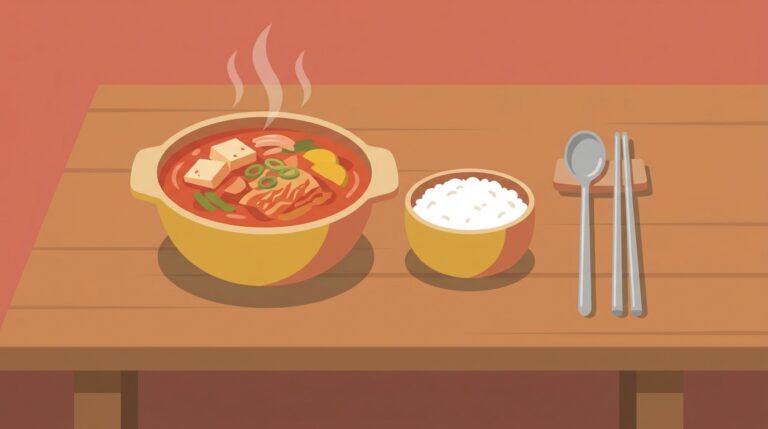
Phase 1: Why Korean Dining Tables Have Different Rules
안녕하세요! (Annyeonghaseyo!) I’m your Daily Hangul Editor. Picture this: you finally land in Seoul, sit down at a cozy local diner, and order piping hot kimchi stew (김치찌개, kimchi jjigae). You happily lift the bowl to sip the broth—just like you might at home or see in Japanese anime—and suddenly your Korean friend whispers, “Wait, put the bowl down!” Awkward, right? Many of our Level 1 learners tell us they felt nervous at Korean dinner tables simply because nobody taught them spoon etiquette. Today, based on real student feedback, you’ll master essential Korean mealtime greetings and learn why soup and stew belong strictly on a spoon. Eat confidently and impress your Korean friends from day one!
Phase 2: 3 Essential Expressions Deep Dive
1. 잘 먹겠습니다! (Jal meokgetseumnida!)
- Pronunciation: Jal meok-get-sseum-ni-da (Sounds like “Jahl muhk-get-suhm-nee-dah” — keep the ‘k’ soft and unreleased before ‘get’.)
- Meaning: Literally “I will eat well,” but actually means “Thank you for the meal!” before you start eating.
- K-Culture Moment: In Reply 1988 or Hospital Playlist, whenever the friends gather around a table packed with food, everyone folds their hands or smiles and shouts this together before picking up their spoons.
- Editor’s Insight: You say this even if you paid for the food yourself! You are thanking the chef, the host, or even the ingredients for the meal in front of you.
- Situation Spectrum: Casual ⚠️ (Use 잘 먹을게! instead) | Semi-formal ✅ | Formal ✅
- 🤔 Think About It: In English, we usually say “Enjoy your meal” to someone else, or “Thanks for cooking” to a host. Why do you think Koreans announce “I will eat well” out loud before taking a single bite?
2. 숟가락으로 떠먹어요. (Sutgarageuro tteomeogeoyo.)
- Pronunciation: Sut-ga-ra-geu-ro tteo-meo-geo-yo (Sounds like “Soot-gah-rah-goo-roh ttuh-muh-guh-yoh” — ‘tt’ is a crisp, firm ‘t’ with no puff of air.)
- Meaning: Literally “Scoop and eat with a spoon,” used to explain or remind someone how to eat soup, stew, and rice properly.
- K-Culture Moment: On Korean food variety shows like Youn’s Kitchen, hosts kindly show foreign guests how to scoop hot broth with a spoon instead of lifting the heavy earthenware pot.
- Editor’s Insight: The verb 떠먹다 (tteomeokda) combines 뜨다 (tteuda, to scoop) and 먹다 (meokda, to eat). Knowing this single verb instantly makes your Korean sound natural whenever soup or ice cream is on the table!
- Situation Spectrum: Casual ⚠️ (Drop ‘yo’ for friends) | Semi-formal ✅ | Formal ✅
- 🤔 Think About It: In some cultures, lifting a soup bowl to your mouth shows you are enjoying the meal. In Korea, keeping the bowl flat on the table is polite. How do table manners in your country show respect to the food and company?
3. 잘 먹었습니다! (Jal meogeotseumnida!)
- Pronunciation: Jal meo-geot-sseum-ni-da (Sounds like “Jahl muh-guht-suhm-nee-dah” — just change ‘get’ from Phrase 1 to ‘geot’ for past tense!)
- Meaning: Literally “I ate well,” meaning “Thank you for the wonderful meal!” when you finish eating.
- K-Culture Moment: Watch any K-drama office lunch scene—as employees walk out of a restaurant, they always bow slightly toward the counter and say this to the owner.
- Editor’s Insight: Saying this to restaurant staff as you leave is one of the warmest, easiest ways to earn a huge smile in Korea. It shows genuine appreciation!
- Situation Spectrum: Casual ⚠️ (Use 잘 먹었어! instead) | Semi-formal ✅ | Formal ✅
- 🤔 Think About It: Comparing Phrase 1 (future intention: -겠-) and Phrase 3 (past gratitude: -었-), notice how Korean frames a meal as a complete social ritual with a clear start and end. Does your language have matching start-and-end meal phrases?
Phase 3: Textbook Korean vs. Real Korean
Situation 1: Starting a meal with your Korean best friend
- 📖 Textbook Korean: 잘 먹겠습니다. (Jal meokgetseumnida.)
- 🗣️ Real Korean: 잘 먹을게! (Jal meogeulge!) or 맛있게 먹을게! (Masitge meogeulge!)
- 💡 Why is it different? Textbooks teach polite formal endings (-습니다) first for safety, but using them with a close friend sounds like you’re talking to your boss! Switching to -을게 (-eulge) creates instant warmth and friendship.
Situation 2: Asking for a spoon at a busy restaurant
- 📖 Textbook Korean: 저기요, 여기에 숟가락이 없습니다. 숟가락을 주십시오. (Jeogiyo, yeogie sutgaragi eopseumnida. Sutgarageul jusipsio.)
- 🗣️ Real Korean: 여기 수저 하나만 주세요! (Yeogi sujeo hanaman juseyo!)
- 💡 Why is it different? In daily life, Koreans rarely separate “spoon” and “chopsticks” when asking staff—they use the combo word 수저 (sujeo, spoon and chopsticks). Adding 하나만 (hanaman, just one) sounds friendly, fast, and natural.
Phase 4: K-Culture Deep Dive & Non-Verbal Manners
4-1. Nunchi (눈치) & Gestures at the Table
Good Nunchi (reading the room) at a Korean table starts with your hands and posture:
* Never lift your bowl: Keep both your rice bowl (밥그릇, bapgeureut) and soup bowl (국그릇, gukgeureut) resting firmly on the table. Lean slightly forward and bring the spoon up to your mouth instead.
* Spoon vs. Chopsticks rule: Use your spoon (숟가락, sutgarak) for rice, soup (국, guk), and stew (찌개, jjigae). Use your chopsticks (젓가락, jeotgarak) for side dishes (반찬, banchan). Never hold both in the same hand at once—set one down before picking up the other!
* The Elder First Rule: Wait until the oldest person or host picks up their spoon before you touch yours. Taking the first bite together shows deep respect.
4-2. Cultural Code Analysis: K-Food & K-Drama
In K-Dramas like Extraordinary Attorney Woo or Hospital Playlist, meals are rarely quiet, solo events. Notice how characters share a single bubbling pot of stew right in the center of the table! Because everyone dips their spoon into the shared stew—or uses a separate serving ladle—keeping your spoon clean and never shaking broth off it onto the table is a big sign of good manners. Sharing food from one pot reflects Korea’s Jeong (정, deep affection and community bond).
Phase 5: Real-Life Roleplay Scenario
Setting: A bustling, cozy kimchi stew restaurant in Hongdae, Seoul. Steam rises from a bubbling red clay pot between you and your Korean friend, Minji.
Dialogue:
1. Minji: 와, 김치찌개 나왔다! 🎭 (Places the spoon and chopsticks neatly on a napkin beside your bowl)
Wa, kimchi jjigae nawatda!
(Wow, the kimchi stew is here!)
2. You: 우와, 맛있겠다! 잘 먹겠습니다! 🎭 (Put your hands together happily before grabbing your spoon)
Uwa, masitgetda! Jal meokgetseumnida!
(Whoa, that looks delicious! Thank you for the meal!)
3. Minji: 응, 맛있게 먹어! 🎭 (Picks up her spoon and scoops a little broth first)
Eung, masitge meogeo!
(Yeah, enjoy your meal!)
4. You: 어, 잠깐만요. 숟가락이 없어요! 🎭 (Looks around your side of the table)
Eo, jamkkanmanyo. Sutgaragi eopseoyo!
(Oh, wait a second. I don’t have a spoon!)
5. Minji: 아, 테이블 아래 서랍에 있어. 여기! 🎭 (Opens the secret drawer built into the side of the table and hands you one)
A, teibeul arae seorabe isseo. Yeogi!
(Ah, it’s in the drawer under the table. Here!)
6. You: 고마워요! 국은 숟가락으로 떠먹어요, 맞죠? 🎭 (Holds the spoon carefully over the steaming bowl)
Gomawoyo! Gugeun sutgarageuro tteomeogeoyo, matjyo?
(Thank you! We eat soup with a spoon, right?)
7. Minji: 응, 맞아! 뜨거우니까 호호 불어서 먹어. 🎭 (Smiles warmly and points at the hot stew)
Eung, maja! Tteugeounikka hoho bureoseo meogeo.
(Yes, that’s right! It’s hot, so blow on it and eat.)
8. You: 아, 국물 진짜 맛있어요! 🎭 (Takes a careful sip from the spoon and gives a thumbs up)
A, gungmul jinjja masisseoyo!
(Ah, the broth is really delicious!)
🔀 Interactive Branching Point
Dinner is over and the stew pot is completely empty! As you stand up to walk past the smiling restaurant auntie (이모님, imonim) at the counter, what do you say?
* A) “잘 먹었습니다! 안녕히 계세요.” (Jal meogeotseumnida! Annyeonghi gyeseyo.)
* Feedback (Best!): 10/10! You used the polite past-tense meal greeting and said goodbye properly to someone staying behind. The owner will love you!
* B) “잘 먹겠습니다!” (Jal meokgetseumnida!)
* Feedback (Bad): Oops! That means “I will eat well.” Saying it after finishing an empty pot might confuse the owner—they might wonder if you want to order round two!
* C) “잘 먹었어!” (Jal meogeosseo!)
* Feedback (Risk): Uh-oh! That’s casual speech (Banmal) meant only for close friends or younger kids. Using it with an older restaurant owner sounds rude.
Phase 6: 10-Second Emotion Shadowing Drill
Read these out loud! Pause briefly at each / and match the emotion tag:
- [😊 Happy & Excited]
우와! / 잘 먹겠습니다! (Uwa! / Jal meokgetseumnida!)
(Whoa! / Thank you for the meal!) - [💡 Curious & Polite]
국물은 / 숟가락으로 / 떠먹어요? (Gungmureun / sutgarageuro / tteomeogeoyo?)
(Do we scoop / the broth / with a spoon?) - [😋 Savoury & Delighted]
와, / 국물이 / 진짜 맛있어요! (Wa, / gungmuri / jinjja masisseoyo!)
(Wow, / the broth is / really delicious!) - [🙏 Warm & Grateful]
사장님, / 잘 먹었습니다! (Sajangnim, / jal meogeotseumnida!)
(Owner, / thank you for the meal!)
Phase 7: K-Culture Mini Dictionary
- 수저 (Sujeo) | Spoon and chopsticks set | Used everywhere in daily life when setting the table or asking restaurant staff for utensils.
- 찌개 (Jjigae) | Thick Korean stew | A staple comfort food (like kimchi jjigae or doenjang jjigae) usually shared or served bubbling hot; always eaten with a spoon.
- 국물 (Gungmul) | Broth or soup liquid | Koreans love praising great broth! Saying “국물이 끝내줘요! (Gungmuri kkeutnaejwoyo! – The broth is amazing!)” is a top-tier compliment.
- 반찬 (Banchan) | Side dishes | Small shared plates like kimchi or pickled radish that sit around the main rice and soup; eaten with chopsticks, never a spoon.
Phase 8: Survival Kit for Travelers
Top 3 Survival Phrases
- 수저 어디 있어요? (Sujeo eodi isseoyo?) — Where are the spoons and chopsticks? | Pro Tip: Check the pull-out drawer built right under the edge of your restaurant table before asking!
- 숟가락 하나 더 주세요. (Sutgarak hana deo juseyo.) — Please give me one more spoon. | Pro Tip: Great if you accidentally drop your spoon on the floor or want a clean serving spoon.
- 앞접시 주세요. (Apjeopsi juseyo.) — Please give me a small personal plate. | Pro Tip: Essential when sharing hot stew so you can scoop a portion into your own small bowl to cool it down.
Editor’s Travel Note
- Navigation & Reviews: Before heading out for dinner, Download the Naver Map App for Accurate Korean Restaurant Navigation because Google Maps walking directions don’t work smoothly in Korea.
- Local Culture Tip: Most casual Korean stew spots have self-service water (물 셀프, mul selpeu) and napkins tucked inside the table drawer alongside the spoons. Also, tapping your T-money card works for buses and subways, while almost every restaurant accepts credit cards right at the counter when you say “잘 먹었습니다!”
Phase 9: One Step Deeper
Why do Koreans care so much about keeping bowls on the table and saying “잘 먹겠습니다 (Jal meokgetseumnida)”? In traditional Korean philosophy, a meal isn’t just fuel—it’s a moment of shared gratitude between nature, the cook, and everyone around the table. Keeping your bowl resting peacefully on the table shows calm dignity, while using a spoon for rice and soup honors the effort behind every grain and drop of broth. Even today in fast-paced Seoul, those two simple greetings frame every meal with warmth and connection.
💬 Your Turn: What surprised you the most about Korean spoon etiquette, or what is your favorite Korean soup or stew to eat? Drop a comment below and tell us!
Phase 10: FAQ & Common Mistakes
Q: Is it rude to blow on hot Korean soup on my spoon?
A: Not at all! Blowing gently on hot soup on your spoon is completely fine and very common, especially with bubbling stews. Just try not to blow loudly directly into a shared pot.
Q: Can I eat rice with chopsticks in Korea?
A: Technically you can, and nobody will scold a beginner, but Koreans eat rice primarily with a spoon! Korean metal chopsticks are flat and slippery, making a spoon much easier and more natural for both rice and soup.
Q: Should I say 잘 먹겠습니다 (Jal meokgetseumnida) when eating alone?
A: When eating alone at home, you don’t have to say it out loud. However, at a restaurant when the staff sets down your food, saying a quick “감사합니다 (Gamsahamnida – Thank you)” or “잘 먹겠습니다” is super polite.
🚨 Common Mistakes
- Lifting the soup bowl to drink broth: Correct Action: Keep the bowl on the table and use your spoon for every sip—even the last drops (tilting the bowl slightly away from you is okay only at the very end!).
- Sticking chopsticks or a spoon upright into rice: Correct Action: Always rest your spoon and chopsticks flat on the table, on a napkin, or on the edge of a side dish—standing them upright in rice resembles funeral incense rituals.
- Using a spoon to pick up flat kimchi or side dishes: Correct Action: Switch to chopsticks for banchan, and set your chopsticks down when picking up your spoon.
Phase 11: Action Mission & Engagement
- 🥉 Bronze Mission (Solo Practice): Tonight, before your own dinner—even if it’s just instant ramen or cereal—say “잘 먹겠습니다! (Jal meokgetseumnida!)” out loud and practice eating your soup purely with a spoon.
- 🥈 Silver Mission (Share It): Snap a photo of your favorite soup or Korean dish, post it on social media with the caption “잘 먹겠습니다! #DailyHangul”, and tag a friend you want to eat kimchi stew with!
- 🥇 Gold Mission (Real-World Challenge): Next time you visit a Korean restaurant, look for the table drawer, use your spoon for rice and soup, and say “잘 먹었습니다! (Jal meogeotseumnida!)” to the staff on your way out.
🎮 K-Culture Mission: Watch a dining scene in any K-Drama or Korean mukbang video this week. Count how many times the actors say “잘 먹겠습니다” and notice how they place their spoon and chopsticks side by side!
Phase 12: Interactive Quiz Challenge
Quiz 1 (Situation): You just finished a delicious bowl of beef radish soup (소고기뭇국) at a Korean restaurant and are walking out the door. What should you say to the owner?
* A) 잘 먹겠습니다! (Jal meokgetseumnida!)
* B) 잘 먹었습니다! (Jal meogeotseumnida!)
* C) 숟가락 주세요! (Sutgarak juseyo!)
Click to reveal Answer & Explanation for Quiz 1
Correct Answer: B) 잘 먹었습니다! (Jal meogeotseumnida!)
* Why? -었- marks the past tense, meaning “I ate well / Thank you for the meal!” Option A (-겠-) is for before eating, and Option C asks for a spoon.
Quiz 2 (Fill in the Blank): Complete the sentence: “국과 찌개는 _____으로 떠먹어요.” (Eat soup and stew with a _____.)
* A) 젓가락 (jeotgarak)
* B) 숟가락 (sutgarak)
* C) 반찬 (banchan)
Click to reveal Answer & Explanation for Quiz 2
Correct Answer: B) 숟가락 (sutgarak – spoon)
* Why? In Korea, rice, soup, and stew are eaten with a spoon (숟가락), while side dishes (반찬) are eaten with chopsticks (젓가락).
Quiz 3 (True or False): In Korea, it is polite to pick up your soup bowl with both hands and drink the broth directly from the rim.
Click to reveal Answer & Explanation for Quiz 3
Correct Answer: False!
* Why? Lifting your rice or soup bowl off the table is considered poor table manners in Korea. Always leave the bowl on the table and scoop your soup with a spoon!
🎬 Watch Our Daily Videos! (Daily Hangul Official Instagram)
Review the expressions you learned in this article with our fun daily short videos! Check out native pronunciation and real-life nuances in action.
- Instagram @dailyhangul_en







