

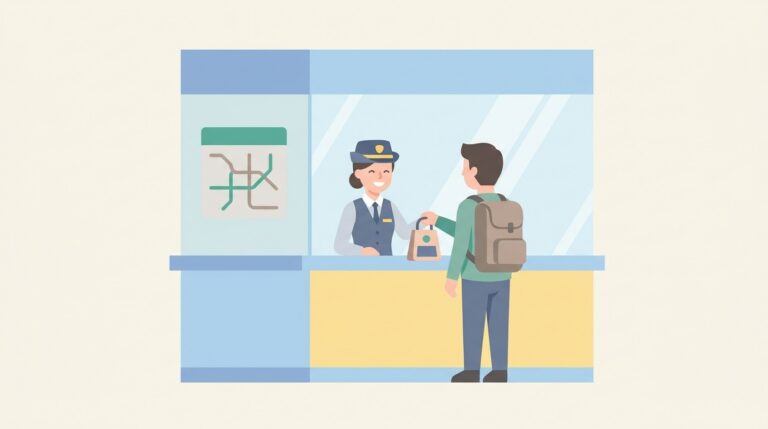
I Left My Bag on Line 2! How to Inquire at the Seoul Subway Lost and Found
Phase 1: Empathy (Real-Life Subway Panic)
안녕하세요! 매일한글 에디터입니다. (Hello! This is your Daily Hangul editor.)
Picture this: You just spent an exhilarating afternoon shopping in Hongdae and hopping between trendy cafes in Seongsu. You ride the bustling Seoul Subway Line 2 back toward your hotel, listening to your favorite K-pop playlist. As the chime rings for your stop and the automated melody announces the arrival, you step out onto the platform. Five seconds later, your stomach drops into an icy pit.
Your canvas tote bag—complete with your passport, favorite lip tint, and limited-edition concert photocard—is still sitting on the overhead luggage rack of car 4-3, speeding away toward Gangnam!
In many global cities, leaving a valuable item on public transit feels like saying goodbye forever. But here is the miracle of Seoul transit: Korea has one of the world’s most meticulous, connected lost-and-found systems. Over 80% of lost electronics and personal belongings are safely cataloged and returned! However, when you rush into the station office in a panic, waving your arms and stammering in English, it can feel daunting.
That is why knowing this magical response from the station attendant changes everything: “유실물 센터에 접수되었는지 전산으로 확인해 볼게요 (I will check the system to see if it has been logged at the Lost and Found).” When you hear these reassuring words, take a deep breath. Today, we will walk through the exact phrases, cultural habits, and insider tips you need so you can talk to subway staff smoothly and reclaim your belongings like a seasoned local.
Phase 2: Top 3 Core Expressions Deep Dive
Here are the three foundational expressions you need when tracking down your item.
1. 유실물 센터에 접수되었는지 전산으로 확인해 볼게요
- Pronunciation: [Yoo-sil-mul sen-teo-e jeop-su-doe-eon-neun-ji jeon-san-eu-ro hwag-in-hae bol-ge-yo] (Think: “Yoo-sheel-mool” rhyming with ‘cool’, and “jeon-san” sounding like ‘jun-sahn’)
- Meaning: Literal: “I will check via computer network whether it has been registered at the lost property center.” / Real Nuance: “Let me pull up the transit database right now to see if a station agent or passenger has turned it in.”
- K-Culture Moment: You see this in countless K-dramas (like Extraordinary Attorney Woo or My Mister) where a station attendant or police officer immediately starts clacking away at their keyboard, reassuring a distressed citizen.
- Editor’s Insight: Notice the word 전산 (jeonsan). It refers to computerized, networked data. Koreans take pride in instant digital administration. When an official says they will check ‘전산으로’, it means they are launching a real-time, cross-station search, not just peeking into a back closet!
- Situation Spectrum: Casual 🚫 | Semi-formal ✅ | Formal ✅
- 🤔 Think About It: In your home country, do lost transit items get logged into a centralized citywide system instantly, or do you have to call individual stations? How does digital centralization affect your trust in public services?
2. 지하철 몇 호선에 두고 내리셨어요?
- Pronunciation: [Ji-ha-cheol myeot ho-seon-e du-go nae-ri-syeoss-eo-yo?] (Think: “Jee-hah-chul myut ho-sun-eh doo-go neh-ree-syut-uh-yoh”)
- Meaning: Literal: “Which subway line did you leave it and get off?” / Real Nuance: “Which subway line were you riding when you left it behind?”
- K-Culture Moment: When you approach the information desk (고객안내센터), the staff member will immediately point toward the colorful line map and ask this exact phrase.
- Editor’s Insight: The phrase 두고 내리다 (dugo naerida) is a compound action: 두다 (to leave behind) + 내리다 (to alight/get off). At the A2 level, learning how Koreans link physical movement verbs together will make your Korean sound ten times more natural!
- Situation Spectrum: Casual ⚠️ | Semi-formal ✅ | Formal ✅
- 🤔 Think About It: English says “I left my bag on the train,” but Korean specifically emphasizes the moment of disembarking (leaving it AND getting off). Why do you think Korean grammar pays so much attention to chronological action?
3. 특징이나 색깔을 말씀해 주시겠어요?
- Pronunciation: [Teuk-jing-i-na saek-kkal-eul mal-sseum-hae ju-si-gess-eo-yo?] (Think: “Teuk-jeeng-ee-nah sek-kkahl-eul mahl-sseum-heh joo-shee-get-suh-yoh”)
- Meaning: Literal: “Could you tell me the features or color?” / Real Nuance: “Can you describe what it looks like or what brand and color it is?”
- K-Culture Moment: Subway clerks deal with dozens of identical black umbrellas and black wireless earbuds every single day. They need specific identifiers like keychains or stickers to confirm it’s yours.
- Editor’s Insight: Notice the word 말씀 (malsseum). Instead of saying the plain word 말 (mal – words/speech), the staff uses the honorific noun 말씀 out of respect for you, the customer. Always listen for this polite pattern when someone asks you for information in Korea.
- Situation Spectrum: Casual 🚫 | Semi-formal ✅ | Formal ✅
- 🤔 Think About It: In Korean service culture, staff use honorifics even when helping flustered strangers. How does language politeness de-escalate stressful situations?
Phase 3: Textbook Korean vs. Real Korean
Let’s compare what typical beginner textbooks print versus how native Koreans speak in real life.
Scenario 1: Asking if anyone found your wallet
- 📖 교과서 한국어 (Textbook Korean):
제 분실물이 여기에 도착했습니까?
(Je bunsilmul-i yeogi-e dochakhaessseumnikka? / Has my lost property arrived here?) - 🗣️ 진짜 한국어 (Real Korean):
혹시 검은색 지갑 습득된 거 있나요?
(Hoksi geomeunsaek jigap seupdeukdoen geo innayo? / Did anyone happen to turn in a black wallet?) - 💡 왜 다를까? (Why is it different?):
Nobody in Seoul says “분실물이 도착했습니까?” in conversational settings; it sounds like an automated legal announcement. Native speakers use 혹시 (hoksi – by any chance) to soften the question, and refer to found items as 습득된 거 (things picked up/found).
Scenario 2: Asking the agent to run a system check
- 📖 교과서 한국어 (Textbook Korean):
컴퓨터 데이터베이스를 검색해 주십시오.
(Keompyuteo deiteobeiseureul geomsaekae jusipsio. / Please search the computer database.) - 🗣️ 진짜 한국어 (Real Korean):
전산 한 번만 조회해 주실 수 있어요?
(Jeonsan han beonman johwaehae jusil su isseoyo? / Could you please check the computer records for me?) - 💡 왜 다를까? (Why is it different?):
Koreans rarely say “computer database” in conversation. They simply say 전산 (jeonsan) and pair it with 조회하다 (to look up/inquire records). Adding 한 번만 (just once) adds a polite, conversational softening tone.
Phase 4: K-Culture Deep Dive & Non-Verbal Manners
4-1. Nunchi (눈치) & Body Language at the Station Window
When approaching the subway 고객안내센터 (Customer Service Center), station workers are often managing train schedules, announcements, and fare gates simultaneously. Here is how to show perfect Nunchi:
1. The Phone Screen Preparation: Before speaking, open your transit card history or banking app showing your card tap time. Handing over or showing your screen with two hands while saying “저기요… (Excuse me…)” instantly signals that you have concrete time data, which station agents love!
2. The Two-Handed Gesture: If the staff hands you a lost item claim sheet or a phone to speak to the central office, always receive it with both hands or with your left hand lightly touching your right forearm. This subtle non-verbal sign of respect instantly wins cooperative goodwill.
4-2. The “Korean Cafe Honesty” Phenomenon on Transit
You have probably seen viral TikToks and YouTube Shorts where tourists leave their MacBooks and iPhones on a table in a Gangnam cafe to go use the restroom for twenty minutes, and nobody touches them. This civic ethic extends directly to the subway. Korea operates under a strong community surveillance and digital tracking ecosystem:
* CCTV Everywhere: Every subway platform and train cabin is monitored by high-definition cameras.
* The Law of Misappropriation: In Korea, taking an unattended item isn’t just “finders keepers”; keeping it is a serious criminal offense known as 점유이탈물횡령죄 (embezzlement of lost property). As a result, citizens almost always hand lost items directly to station masters or police booths. The system works because people expect it to work!
Phase 5: Real-World Roleplay Scenario
Setting: Alex (an exchange student) left a black tote bag on Line 2 ten minutes ago. Alex runs into the City Hall Station Customer Information Office and meets Station Agent Park (박 역무원), a helpful veteran subway employee.
- Turn 1 (Alex):
저기요, 제가 방금 2호선에 가방을 두고 내렸어요!
(Jeogiyo, jega banggeum i-hoseon-e gabang-eul dugo naeryeoss-eo-yo!)
“Excuse me, I just left my bag on Line 2!”
🎭[Hands slightly trembling, pointing toward the platform] -
Turn 2 (Agent Park):
아이구, 놀라셨겠어요. 침착하시고, 몇 시쯤 내리셨어요?
(Aigu, nollasyeotgess-eo-yo. Chimchakhasi-go, myeot si-jjeum naerisyeoss-eo-yo?)
“Oh dear, you must be startled. Stay calm, around what time did you get off?”
🎭[Pulls up keyboard and clicks open the Seoul Metro transit portal] -
Turn 3 (Alex):
방금 2시 15분에 내렸어요! 성수역 방향이었어요.
(Banggeum du-si sip-o-bun-e naeryeoss-eo-yo! Seongsu-yeok banghyang-i-eoss-eo-yo.)
“Just now at 2:15 PM! It was bound for Seongsu Station.”
🎭[Shows mobile phone clock to confirm the exact minute] -
Turn 4 (Agent Park):
혹시 몇 번 칸에 타셨는지 기억나세요?
(Hoksi myeot beon kan-e tasyeotneunji gieongnaseyo?)
“By any chance, do you remember which car compartment you were riding in?”
🎭[Glances up attentively over glasses] -
Turn 5 (Alex):
바닥에 4-3이라고 쓰여 있었어요!
(Badag-e sa-dasi-sam-i-rago sseu-yeo iss-eoss-eo-yo!)
“It was written 4-3 on the platform floor!”
🎭[Circles fingers to illustrate the floor door markings] -
Turn 6 (Agent Park):
유실물 센터에 접수되었는지 전산으로 확인해 볼게요.
(Yusilmul centeo-e jeopsu-doe-eotneunji jeonsan-euro hwag-in-hae bolgeyo.)
“I will check the system to see if it has been logged at the Lost and Found.”
🎭[Types vehicle number into the database with rapid clicks] -
Turn 7 (Agent Park):
아, 다음 역 역무원분이 방금 수거하셨네요! 보관 중입니다.
(A, da-eum yeok yeokmuwon-bun-i banggeum sugeohasyeotneyo! Bogwan jung-imnida.)
“Ah! The agent at the next station just retrieved it! It is safely in custody.”
🎭[Nods with a warm smile and prints out a confirmation slip] -
Turn 8 (Alex):
정말 감사합니다! 바로 찾으러 갈게요!
(Jeongmal gamsahamnida! Baro chajeureo galgeyo!)
“Thank you so much! I will go pick it up right away!”
🎭[Bows respectfully at 45 degrees with two hands together]
🔀 Interactive Branching Decision Point
Imagine the agent asks: “가방 안에 어떤 물건이 들어 있나요? (What items are inside the bag?)” How do you respond?
- Choice A: “노트북이랑 파란색 필통, 그리고 제 외국인등록증이 있어요.” (A laptop, a blue pencil case, and my Alien Registration Card.)
Feedback: Best! Specifying an official ID or unique personal item allows the agent to immediately verify ownership against the database description. - Choice B: “그냥 이것저것 많이 들어 있어요. 빨리 찾아주세요!” (Just a lot of this and that. Find it quickly please!)
Feedback: Bad. Vague answers prevent staff from distinguishing your bag from other black totes and might make you sound impatient or dismissive. - Choice C: “비밀인데, 그냥 CCTV 보여주시면 제가 직접 찾을게요.” (It’s a secret, just show me the CCTV and I will look myself.)
Feedback: Risk! Due to Korea’s strict Personal Information Protection Act (개인정보보호법), public CCTV cannot be shown directly to private citizens without official police procedure. This will only cause delay and confusion.
Phase 6: 10-Second Emotion Shadowing Drill
Practice these three lines aloud with the emotional rhythm markers. The slash / indicates a micro-pause for natural cadence!
[😰 Anxious & Urgent]
저기요, / 지하철에 가방을 / 두고 내렸어요!
(Jeogiyo, / jihacheore gabangeul / dugo naeryeosseoyo!)
“Excuse me, / I left my bag / on the subway!”-
[🙏 Earnest & Polite]
혹시 / 유실물 센터에 접수되었는지 / 전산으로 확인해 주실 수 있나요?
(Hoksi / yusilmul centeo-e jeopsudoe-eotneunji / jeonsaneuro hwaginhae jusil su innayo?)
“By any chance, / could you check the system / to see if it has been logged at the Lost and Found?” -
[😮💨 Relieved & Full of Gratitude]
정말 다행이에요! / 바로 찾으러 / 갈게요.
(Jeongmal dahaeng-ieyo! / baro chajeureo / galgeyo.)
“What a relief! / I will go pick it up / right away.”
Phase 7: K-Culture Mini Dictionary
Expand your Korean subway vocabulary with these four must-know terms:
- 유실물 (Yusilmul) | Lost property / item
The formal, administrative term for lost items. In daily life, people also use 분실물 (bunsilmul) interchangeably. When you see signs in large stations pointing to 유실물 센터, that is your destination! -
습득물 (Seupdeukmul) | Found / retrieved item
The counterpart to 유실물. When a good Samaritan or cleaner picks up your phone, it is officially classified as a 습득물 in the system. -
탑승 위치 (Tapseung wichi) / 칸 번호 (Kan beonho) | Boarding door location / Car number
Look down at the glass safety screen doors on any Korean subway platform. You will see numbers like 3-2 or 7-4. The first digit is the train car (칸), and the second is the exact door. Telling an agent this number narrows their search down from an 8-car train to a single 15-meter zone! -
경찰청 유실물 포털 (LOST112) | National Police Lost and Found Portal
If an item isn’t claimed at a subway station within 7 days, it gets transferred to the national police registry known nationwide as LOST112. It is a searchable online database for the entire country.
Phase 8: Survival Kit for Travelers
Top 3 Subway Survival Phrases
- 1. 몇 번 칸인지 기억이 안 나요.
(Myeot beon kan-inji gieog-i an nayo.)
Meaning: I don’t remember which train car number it was.
Pro Tip: Don’t worry if you forgot! Just tell them your boarding station and exit station. - 2. 카드 태그 시간 보여드릴게요.
(Kadeu tae-geu sigan boyeodeurilgeyo.)
Meaning: Let me show you my transit card tap-out time.
Pro Tip: The exact time you swiped your T-money card lets the station master calculate the exact train number that passed through! - 3. 보관증 써야 하나요?
(Bogwanjeung sseoya hanayo?)
Meaning: Do I need to fill out a receipt / release form?
Pro Tip: When collecting valuable electronics, you will sign a short receipt and show an ID or passport.
Editor’s Travel Note
- Digital Tool: You can track registered lost items in real time without calling. Bookmark the [Seoul Metro Lost and Found Center Guide] or search directly on the [LOST112 National Police Portal] where photos of found items are uploaded daily.
- Physical Office Hours: Centralized subway lost and found centers (like those at City Hall, Wangsimni, and Taereung Stations) are generally open on weekdays from 09:00 to 18:00. If you lose something on a weekend evening, station staff can secure it in the local station safe until Monday morning!
Phase 9: A Step Deeper (한 발 더 깊이)
In Korean society, the concept of 전산 (computerized database) represents more than just software—it reflects a deep-rooted cultural value: 신속·정확 (Promptness and Accuracy). Korea transitioned into an ultra-connected, high-speed digital society within a single generation.
When public servants say they will check the system, they are leaning into a collective contract of civic accountability. Strangers turn in lost wallets with cash intact not because they expect a reward, but because the shared social norm assumes: “If I lose something tomorrow, someone will do the same for me.” Participating in this system—even as an international traveler—welcomes you into this unspoken circle of mutual trust.
💬 Your Turn: Have you ever lost an item while traveling abroad? How was the recovery process different from Korea’s digital system? Share your stories in the comments below!
Phase 10: FAQ & Common Mistakes
Q: Can I retrieve an item if I am already at the airport heading home?
A: Yes! If your item is confirmed logged in the system, you can authorize a friend or hotel concierge to pick it up by providing a copy of your passport and a written authorization note (위임장, wi-im-jang). In some cases, stations can arrange Cash-on-Delivery domestic courier service (착불 택배) to a local friend’s address.
Q: What is the difference between 잃어버리다 and 잊어버리다?
A: They sound very similar, but have completely different meanings! 잃어버리다 (ilheobeorida) means to physically lose an object (e.g., wallet, bag). 잊어버리다 (ijeobeorida) means to forget information or a memory (e.g., forgetting a password or someone’s name). Don’t tell the station agent “지갑을 잊어버렸어요” (I forgot my wallet from my memory)!
Q: Do I need to pay a fee to reclaim my item at the subway office?
A: No, the subway lost and found service is completely free! However, Korean law allows a finder’s reward (보상금) of 5% to 20% if an individual citizen turned it in directly to the police, though ordinary passengers who turn things into station staff rarely request this.
🚨 흔한 실수 (Common Mistakes) Warning Board
- Mistake 1: Not noting the train destination (행선지): Saying “I was on Line 2” isn’t enough because Line 2 is a giant circle loop! Always notice whether it was bound for City Hall (시청 방면) or Seongsu (성수 방면).
- Mistake 2: Leaving the station before notifying staff: If you realize your item is missing within minutes, alert the nearest station office immediately! They can phone the next station ahead to dispatch an attendant onto your train car before passengers exit.
- Mistake 3: Throwing away your paper single-journey ticket: If you used a single-use orange transit card, keep it! The card serial number helps staff pinpoint the exact train you exited.
Phase 11: Action Mission & Challenge
Action Mission 3 Levels
- 🥉 Bronze Level (Solo Drill): Stand in front of your mirror and practice saying the sentence: “유실물 센터에 접수되었는지 전산으로 확인해 볼게요” three times smoothly without looking at the romanization.
- 🥈 Silver Level (Social Practice): Take a photo of the subway platform floor numbers (e.g., 5-3) during your next commute or Korean study session. Post it to your Instagram story with the caption: “오늘의 탑승 위치는 5-3! (Today’s boarding door is 5-3!)” and tag @DailyHangul.
- 🥇 Gold Level (Real-World Test): Next time you ride the Seoul subway, locate the exact sign that says 고객안내센터 (Customer Service) or 유실물 (Lost & Found) at your destination station and read it aloud with natural pronunciation!
🎮 K-Culture Mission
Watch any transit scene in a slice-of-life K-drama (like My Liberation Notes or Run On). Spot the electronic signs displaying the car number, or listen for platform announcements using the word 유실물 (lost property). Write down the moment you hear it!
Phase 12: Interactive Quiz Challenge
Test your knowledge before you hit the rails!
1. Situation Judgment
You left your backpack on Subway Line 3 just two minutes ago. What is the fastest, most effective step?
* (A) Wait at the bench until the train circles back 2 hours later.
* (B) Run to the 고객안내센터 (Customer Service Center), state your exit time, and tell them your platform door number.
* (C) Post a notice on social media and wait for a reply.
2. Fill-in-the-Blank
Complete the sentence using the vocabulary learned today:
“제 가방이 분실물 센터에 등록되었는지 ___________으로 확인해 주실 수 있나요?”
(Hint: The word for computerized network / database)
3. True / False Cultural Check
- Q: In Korea, if you leave your laptop on a subway seat, it will automatically be auctioned off after 24 hours. (True / False)
👉 Click to reveal answers & explanations!
Answers:
1. (B) Running immediately to the station office with your time and door number allows staff to call the upcoming station to intercept your car!
2. 전산 (jeonsan). The full sentence: “제 가방이 분실물 센터에 등록되었는지 전산으로 확인해 주실 수 있나요?”
3. False! Lost items are securely kept at station customer offices for several days, transferred to the regional subway lost and found center, and then kept in the police LOST112 system for up to 9 months before any public handling occurs!
🎬 Watch Our Daily Videos! (Daily Hangul Official Instagram)
Review the expressions you learned in this article with our fun daily short videos! Check out native pronunciation and real-life nuances in action.
- Instagram @dailyhangul_en







