

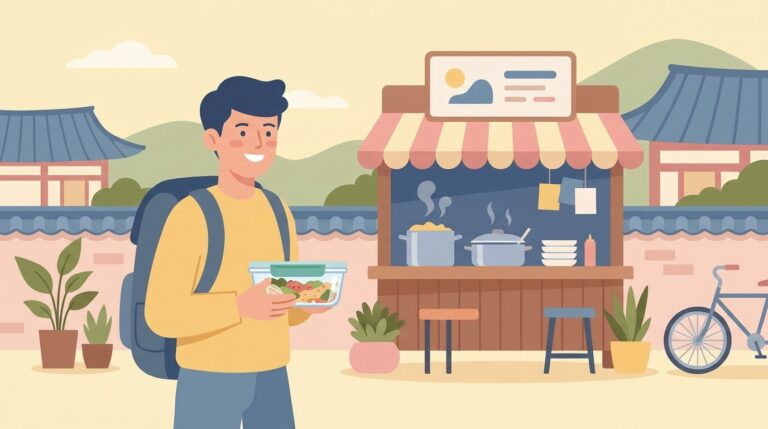
Phase 1: Empathy — Stepping Up to the Tteokbokki Counter
안녕하세요! 매일한글 에디터입니다. (Annyeonghaseyo! Hello, I’m your Daily Hangul editor!) Picture this: you’re standing in front of a cozy bunsik stall in Seoul, lured by the spicy aroma of steaming tteokbokki. Inside your tote bag sits a clean glass container from home. Your heart beats faster—will the busy shop owner get annoyed if you ask her to pack your food in it? Many of our intermediate students confess they freeze right here! Based on real learner feedback, this guide equips you for Korea’s ‘Yongginae Challenge’ (용기내 챌린지). Learn these natural phrases today and turn an eco-friendly habit into a heartwarming local moment.
Phase 2: Deep Dive into 3 Core Expressions
1. 여기에 담아 주실 수 있나요? (Yeogie dama jusil su innayo?)
- Pronunciation: [Yeogie dama jusil su innayo?] (Sounds like: “yuh-gi-eh dah-mah joo-shil soo een-nah-yo” — keep the ‘d’ in dama soft, and blend innayo smoothly like “in-eye-oh”).
- Meaning: Literal: “Can you put it in here for me?” / Real Nuance: A polite, gentle favor request asking the staff to place food directly into your personal container.
- K-Culture Moment: Think of eco-themed episodes on Korean variety shows like I Live Alone (나 혼자 산다), where celebrities shyly hold out their own glass bowls at a traditional market and smile hopefully at the merchant.
- Editor’s Insight: At an intermediate level, moving beyond basic 주세요 (juseyo — please give me) to the auxiliary pattern
-아/어 주실 수 있나요?(-a/eo jusil su innayo? — could you do this for me?) signals real politeness. It acknowledges that filling a customer’s container takes a little extra care.- Situation Spectrum: Casual 🚫 / Semi-formal ✅ / Formal ✅
- 🤔 Think About It: In Korean, asking a favor literally frames the action as the other person “giving” (
주다) their kindness to you. How does that differ from the more direct English question, “Can you put it in here?”2. 일회용품은 안 주셔도 돼요. (Ilhoeyongpumeun an jusyeodo dwaeyo.)
- Pronunciation: [Ilhoeyongpumeun an jusyeodo dwaeyo.] (Sounds like: “eel-hweh-yong-poom-eun ahn joo-shyuh-do dweh-yo” — hweh rhymes with “way” with a soft ‘h’ breath at the start).
- Meaning: Literal: “You don’t have to give me disposable items.” / Real Nuance: A warm, considerate way to decline plastic bags, wooden chopsticks, and plastic spoons.
- K-Culture Moment: Picture a fast-paced banchan (side dish) shop scene in a K-Drama. The owner automatically reaches for a classic black plastic bag (geomeun bongji), and our eco-savvy protagonist gracefully waves a hand to stop them.
- Editor’s Insight: Saying 필요 없어요 (pillyo eopseoyo — I don’t need it) can sound surprisingly blunt in Korean! Using
-아/어도 되다(you don’t have to…) softens the refusal by letting the clerk off the hook.- Situation Spectrum: Casual ⚠️ / Semi-formal ✅ / Formal ✅
- 🤔 Think About It: Korean speakers often avoid flatly saying “I don’t want that” and instead say “you don’t need to trouble yourself.” What does this reveal about everyday Korean hospitality?
3. 환경을 위해서 다회용기를 챙겨 왔어요. (Hwangyeongeul wihaeseo dahwoeyonggireul chaenggyeo wasseoyo.)
- Pronunciation: [Hwangyeongeul wihaeseo dahwoeyonggireul chaenggyeo wasseoyo.] (Sounds like: “hwahn-gyung-eul wee-heh-suh dah-hweh-yong-gee-reul cheng-gyuh wah-ssuh-yo” — chaeng sounds like “chang” in “change” ending with an ‘ng’).
- Meaning: Literal: “I packed a reusable container for the environment.” / Real Nuance: A friendly conversation starter that explains your zero-waste motivation and often earns proud smiles.
- K-Culture Moment: In popular Korean “Zero-Waste in Seoul” YouTube vlogs, creators say this exact line to break the ice when a curious shop owner asks why they brought a giant glass box.
- Editor’s Insight: Notice the verb 챙기다 (chaenggida — to pack/look after thoughtfully) instead of simple 가져오다 (gajyeooda — to bring). Using 챙겨 오다 implies preparation and personal care, making your commitment to the planet feel genuine.
- Situation Spectrum: Casual ⚠️ / Semi-formal ✅ / Formal ✅
- 🤔 Think About It: In Korea, briefly explaining why you are making an unusual request (
-을/를 위해서) builds instant rapport. Do people in your culture expect an explanation when bringing reusable containers?
Phase 3: Textbook Korean vs. Real Korean
Situation 1: Turning Down a Plastic Bag
- 📖 교과서 한국어: 비닐봉지는 필요하지 않습니다. (Binilbongjineun pillyohaji anseumnida. — A plastic bag is not necessary.)
- 🗣️ 진짜 한국어: 봉투는 괜찮아요, 제 가방에 넣을게요! (Bongtuneun gwaenchanayo, je gabange neoeulgeyo! — I’m good without a bag, I’ll just put it in mine!)
- 💡 왜 다를까? Textbook negatives like
-지 않습니다sound robotic at a neighborhood shop. In real life, 괜찮아요 (gwaenchanayo — it’s okay) is Korea’s all-purpose polite refusal, and adding what you will do next reassures busy staff that you won’t spill anything.
Situation 2: Asking for Extra Sauce in Your Container
- 📖 교과서 한국어: 여기에 국물을 많이 넣어 주십시오. (Yeogie gungmureul mani neoeo jusipsio. — Please put a lot of broth in here.)
- 🗣️ 진짜 한국어: 이모님, 여기 통에 국물 좀 넉넉히 담아 주세요~ (Imonim, yeogi tonge gungmul jom neongneoki dama juseyo~ — Auntie, please put plenty of broth in this tub~)
- 💡 왜 다를까? Calling a warm, older female bunsik owner 이모님 (imonim — Auntie) and choosing the rich adverb 넉넉히 (neongneoki — generously) instead of 많이 (mani — a lot) triggers Korean jeong (affection) and often scores you a bonus fried dumpling!
Phase 4: K-Culture Deep Dive & Non-Verbal Manners
4-1. Nunchi (눈치) & Gestures
Good Korean is 50% words and 50% nunchi (reading the room)! Before stepping up to the counter, take the lid off your container so the owner doesn’t have to wrestle with Snap-Lock clasps while wearing cooking gloves. Hold your open container with both hands (or support your right wrist with your left hand), tilt your head slightly, and smile brightly. Most importantly, practice timing-based nunchi: avoid doing your first Yongginae Challenge during the chaotic 12:00 PM–1:00 PM lunch rush when ten office workers are waiting in line!
4-2. Cultural Code: K-Food & The ‘Yongginae Challenge’
Why is it called the 용기내 챌린지 (Yongginae Chaellinjji)? It is one of the cleverest puns in modern Korean! The word 용기 (yonggi) has two completely different Sino-Korean meanings: “container” (容器) and “courage” (勇氣). Adding 내다 (naeda — to muster up) makes 용기 내다 mean “to gather your courage”—or playfully, “hand over your container!” Sparked by Greenpeace Korea and embraced by eco-conscious Korean celebrities like actor Ryu Jun-yeol and K-Pop fans worldwide, bringing airtight tubs for tteokbokki, sundae, and market banchan has turned a once-shy eco-action into a proud cultural trend.
Phase 5: Real-Life Roleplay Scenario
Setting: It is 3:30 PM on a sunny afternoon at Mangwon Market in Seoul. Steam rises from a giant red pan of simmering tteokbokki, smelling fiercely of sweet gochujang and green onions.
Characters: You (holding a sparkling clean 1L glass container) and 이모님 (Imonim) (a brisk, big-hearted market vendor in a floral apron).
- 이모님: 어서 와요! 뭐 드릴까요? (Eoseo wayo! Mwo deurilkkayo? — Welcome! What can I get for you?)
🎭 (Stirring the bubbling red rice cakes with a huge metal ladle) - You: 안녕하세요! 떡볶이 1인분 포장하고 싶은데, 혹시 여기에 담아 주실 수 있나요? (Annyeonghaseyo! Tteokbokki ilinbun pojanghago sipeunde, hoksi yeogie dama jusil su innayo? — Hello! I’d like one serving of tteokbokki to go; by any chance, could you put it in here?)
🎭 (Smiling warmly and holding out the open glass container with both hands) - 이모님: 아이고, 요즘 젊은 사람들이 이렇게 착하네! 당연히 담아 주죠! (Aigo, yojeum jeolmeun saramdeuri ireoke chakhane! Dangyeonhi dama jujyo! — Oh my, young people these days are so thoughtful! Of course I’ll pack it for you!)
🎭 (Beaming broadly and carefully scooping tteokbokki into your glass tub) - You: 감사합니다! 환경을 위해서 다회용기를 챙겨 왔어요. (Gamsahamnida! Hwangyeongeul wihaeseo dahwoeyonggireul chaenggyeo wasseoyo. — Thank you! I packed a reusable container for the environment.)
🎭 (Resting the lid neatly on your forearm while watching) - 이모님: 기특하네~ 일회용품도 다 빼 드릴까요? (Giteukhane~ Ilhoeyongpumdo da ppae deurilkkayo? — How admirable~ Should I leave out all the disposables too?)
🎭 (Pausing with one hand hovering over the wooden chopsticks) - You: 네, 젓가락이랑 봉투는 안 주셔도 돼요! 제 가방에 넣을게요. (Ne, jeotgaragirang bongtuneun an jusyeodo dwaeyo! Je gabange neoeulgeyo. — Yes, you don’t need to give me chopsticks or a bag! I’ll put it in my bag.)
🎭 (Pointing to your canvas tote bag with a cheerful nod) - 이모님: 자, 여기요! 용기 가져왔으니까 튀김 하나 서비스로 얹어 줬어요. (Ja, yeogiyo! Yonggi gajyeowasseunikka twigim hana seobiseuro eonjeo jwosseoyo. — Here you go! Since you brought a container, I threw in a fried snack on the house.)
🎭 (Handing back the warm container topped with a crispy fried sweet potato) - You: 와, 정말 감사해요! 맛있게 잘 먹겠습니다! (Wa, jeongmal gamsahaeyo! Masitge jal meokgesseumnida! — Wow, thank you so much! I’ll enjoy this deliciously!)
🎭 (Snapping the airtight lid shut securely and bowing slightly)
🔀 Interactive Branching Point
Imagine right before scooping, 이모님 squints at your container and says: “어머, 통이 좀 작은 것 같은데 1인분이 다 들어갈까?” (Oh dear, the tub looks a bit small—will one whole serving fit?)
How do you reply?
* A: “조금 넘칠 것 같으면 들어가는 만큼만 담아 주셔도 돼요!” (Jogeum neomchil geot gateumyeon deureoganeun mankeumman dama jusyeodo dwaeyo! — If it looks like it’ll overflow, just put in as much as fits!)
* Feedback (Best ✅): Brilliant nunchi! You keep the interaction stress-free, stay 100% zero-waste, and show great flexibility in natural intermediate Korean.
* B: “아뇨, 무조건 다 꾹꾹 눌러 담아 주세요!” (Anyo, mujogeon da kkukkuk nulleo dama juseyo! — No, push it all down and fit it in no matter what!)
* Feedback (Bad 🚫): Way too pushy! If spicy hot sauce overflows, it could burn the owner’s hands or stain your bag.
* C: “그럼 남는 건 비닐봉지에 따로 담아 주세요.” (Geureom namneun geon binilbongjie ttaro dama juseyo. — Then please put the rest separately in a plastic bag.)
* Feedback (Risk ⚠️): Polite and grammatical, but it completely defeats the point of your zero-waste challenge—plus washing half a bag and half a box is twice the mess!
Phase 6: 10-Second Emotional Shadowing Drill
Read these out loud, pausing briefly at each / and matching the emotional cue!
- [😊 Bright & Courageous]
저기요, / 혹시 여기에 / 담아 주실 수 있나요? (Jeogiyo, / hoksi yeogie / dama jusil su innayo? — Excuse me, / by any chance, / could you put it in here?) - [🙏 Polite & Considerate]
봉투랑 수저는 / 안 주셔도 돼요. / 제가 챙겨 왔어요! (Bongturang sujeoneun / an jusyeodo dwaeyo. / Jega chaenggyeo wasseoyo! — Bag and utensils / you don’t need to give me. / I brought my own!) - [🥰 Grateful & Warm]
환경을 위해서 / 용기 내 봤어요. / 감사히 잘 먹겠습니다! (Hwangyeongeul wihaeseo / yonggi nae bwasseoyo. / Gamsahi jal meokgesseumnida! — For the environment / I gave it a try. / Thank you, I’ll enjoy it!)
Phase 7: K-Culture Mini Dictionary (4 Keywords)
- 용기내 챌린지 (Yongginae Chaellinjji) | Courage Container Challenge | A viral Korean eco-movement using the pun on yonggi (container/courage) where people bring reusable tubs to markets, restaurants, and bakeries to eliminate takeout plastic.
- 다회용기 (Dahwoeyonggi) | Reusable container | Used across city eco-campaigns, delivery apps, and café posters. Unlike simple 통 (tong — tub), this formal-friendly term signals sustainability.
- 일회용품 (Ilhoeyongpum) | Single-use / disposable items | Covers plastic forks, takeout cups, wet wipes, and plastic bags. You will see signs saying 일회용품 줄이기 (reducing disposables) everywhere in Seoul.
- 제로웨이스트 (Jeroweiseuteu) | Zero-waste | Widely used in Korean lifestyle blogs, pop-up stores, and neighborhood refill stations (제로웨이스트 샵 — zero-waste shops).
Phase 8: Survival Kit for Travelers
Top 3 Survival Phrases
- 포장돼요? (Pojangdwaeyo?) — “Is takeout available?”
- Pro Tip: Always check this first before pulling out your container at small traditional sit-down spots.
- 수저는 빼 주세요. (Sujeoneun ppae juseyo.) — “Please leave out the spoon and chopsticks.”
- Pro Tip: Short, snappy, and super common in both shops and Korean delivery app memos.
- 뚜껑은 제가 닫을게요. (Ttukkeongeun jega dadeulgeyo.) — “I’ll close the lid myself.”
- Pro Tip: Saves the staff from struggling with unfamiliar rubber-sealed lids while wearing kitchen gloves.
Editor’s Travel Note
Ready to explore eco-friendly Seoul? Search “제로웨이스트샵” (zero-waste shop) on the Naver Map Official Portal to locate refill stations and package-free groceries near Hongdae, Mangwon, and Seongsu. Ordering food to your Airbnb? Look for the checkbox saying “일회용 수저, 포크 안 받기” (Skip disposable spoon & fork) on the Baemin Food Delivery Platform. Also, carry a foldable silicone container or tumbler—most Korean cafés like Ediya, Mega Coffee, and Starbucks offer a 300–500 KRW “personal cup discount” (개인컵 할인)! Lastly, never toss leftover tteokbokki into regular trash; Korea strictly separates food waste (음식물 쓰레기) from recyclable containers.
Phase 9: “One Step Deeper” (Thought Question)
South Korea is famous worldwide for its hyper-convenient ppalli-ppalli (빨리빨리 — hurry-hurry) culture, where food arrives sealed in three layers of plastic in under twenty minutes. Yet beneath that fast-paced exterior lies jeong (정)—a deep, unspoken warmth toward neighbors and guests. When you step outside the convenience-first norm by bringing your own container, you briefly slow down the transaction and create a human moment. More often than not, a Korean shop owner won’t see it as a bother; they’ll see your sincerity and respond with a smile or a little extra deom (bonus food).
💬 Your Turn: Which Korean dish would you love to bring home in your own container first—spicy tteokbokki, crispy fried chicken, or colorful banchan? Drop a comment below and try writing a short Korean sentence using today’s phrases!
Phase 10: FAQ & Myth-Busting
Q: Do Korean restaurant owners get annoyed if I ask to use my own container?
A: Mostly, no! In fact, younger café workers are completely used to tumblers, and older market imonim are often delighted and impressed to see foreigners practicing the Yongginae Challenge. Just avoid peak lunch hours and bring a container big enough for the portion.
Q: What size container should I pack for one serving (1인분) of tteokbokki or banchan?
A: For 1인분 of tteokbokki, a 700ml to 1L container is ideal because the rice cakes, fish cakes, and thick sauce take up more room than you expect! For banchan (side dishes), small 300ml–500ml airtight containers work great.
Q: Can I do the Yongginae Challenge at Korean bakeries and cafés too?
A: Absolutely! Bakeries like Paris Baguette or local neighborhood bread shops happily let you place tongs-picked pastries straight into your own container or cotton bread bag. Just tell the cashier: 개인 용기에 담아 왔어요 (Gaein yonggie dama wasseoyo — I packed them in my personal container).
🚨 Common Mistakes Warning Board
- Handing over a sealed or damp container: Making a busy cook pop open four stubborn latches slows down the line. Correct Action: Remove the lid beforehand and make sure the inside is dry and spotless.
- Saying “일회용품 싫어요” (I hate disposables): It sounds childish and awkward in a service setting. Correct Action: Say 일회용품은 안 주셔도 돼요 (Ilhoeyongpumeun an jusyeodo dwaeyo).
- Using thin, non-heat-safe plastic for hot soup: Steaming odeng (fish cake) broth or tteokbokki can warp cheap plastic and leak in your bag. Correct Action: Bring tempered glass, stainless steel, or heat-resistant BPA-free airtight containers.
Phase 11: Action Mission & Engagement
- 🥉 Bronze Mission (Solo Practice): Stand in front of your kitchen mirror holding a real airtight container, open the lid, and say “여기에 담아 주실 수 있나요?” (Yeogie dama jusil su innayo?) three times with a friendly smile.
- 🥈 Silver Mission (SNS Share): Snap a photo of your favorite reusable food container or tumbler and post it on Instagram or TikTok with the hashtags #용기내챌린지 and #DailyHangul.
- 🥇 Gold Mission (Real-World Action): This week, take your container to a local Korean restaurant, bakery, or deli near you—and if the staff speaks Korean, try using at least two of today’s phrases!
🎮 K-Culture Mission: Watch an eco-themed episode of I Live Alone (나 혼자 산다) or a Korean zero-waste vlog on YouTube. Keep your ears peeled for words like 다회용기 (reusable container), 봉투 (bag), or 텀블러 (tumbler) and jot down one new phrase!
Phase 12: Interactive Quiz Challenge
Quiz 1: Situational Judgment
You are at a busy gimbap shop in Seoul. The staff wraps your gimbap in foil and reaches for a plastic bag and chopsticks. You already have a tote bag and reusable chopsticks. What is the most natural and polite response?
* A) 비닐봉지하고 젓가락 싫어요.
* B) 봉투랑 젓가락은 안 주셔도 돼요! 제 가방에 넣을게요.
* C) 환경 오염되니까 일회용품 주지 마세요.
Click to Reveal Answer & Explanation
Answer: B) 봉투랑 젓가락은 안 주셔도 돼요! 제 가방에 넣을게요.
Why? Option A sounds blunt (“I hate bags and chopsticks”), and Option C sounds like you are scolding the worker (“It pollutes the environment, so don’t give me disposables!”). Option B politely declines while reassuring them you have your own bag.
Quiz 2: Fill in the Blank
Complete the sentence to explain why you brought a reusable container:
“환경을 ( _____ ) 다회용기를 챙겨 왔어요.”
* A) 때문에
* B) 위해서
* C) 덕분에
Click to Reveal Answer & Explanation
Answer: B) 위해서 (wihaeseo — for / for the sake of)
Why? N + -을/를 위해서 means “for the sake of N” (for the environment). 때문에 means “because of” (often negative), and 덕분에 means “thanks to.”
Quiz 3: True or False Cultural Quiz
Statement: The “Yongginae Challenge” (용기내 챌린지) gets its name solely from the English word “young” and has nothing to do with Korean wordplay.
* True / False
Click to Reveal Answer & Explanation
Answer: False!
Why? It is a clever Korean pun on 용기 (yonggi), which means both “container” (容器) and “courage” (勇氣)! So 용기내 means both “hand over your container” and “muster up your courage.”
🎬 Watch Our Daily Videos! (Daily Hangul Official Instagram)
Review the expressions you learned in this article with our fun daily short videos! Check out native pronunciation and real-life nuances in action.
- Instagram @dailyhangul_en







