

Phase 1: Empathy
안녕하세요! 매일한글 에디터입니다. (Hello! This is your Daily Hangul editor.)
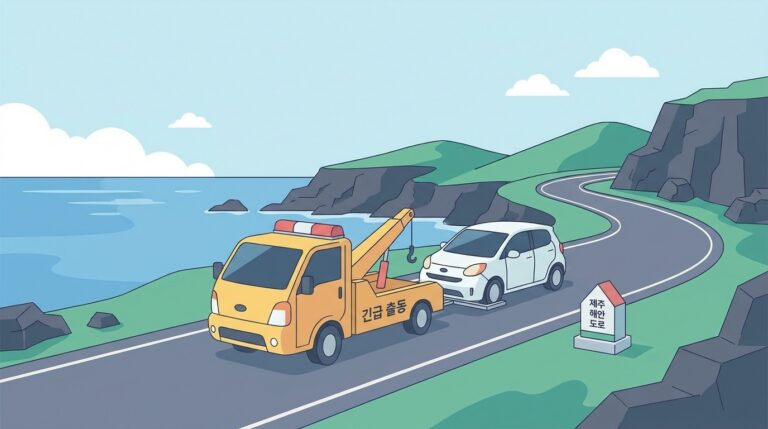
Picture this: You are cruising along a dreamy, wind-swept coastal highway in Jeju Island or winding through the picturesque mountain passes of Gangwon Province. The K-drama playlist is playing, the autumn breeze feels crisp, and suddenly—thump-thump-thump. The steering wheel pulls hard to the right. You pull over onto the shoulder, step outside, and see every driver’s nightmare: your rental car has a completely flat tire in the middle of nowhere.
Panic kicks in: How do I call for help? Does anyone speak English here? Am I stranded for the night? Take a deep breath! Korea possesses one of the fastest, most efficient emergency dispatch infrastructures in the world. Even on remote mountain paths, an insurance technician typically arrives within 15 to 20 minutes with a floor jack and plug kit. Based on real feedback from dozens of our international students navigating Korean roads, this guide provides the exact phrases, cultural etiquette, and roadside procedures you need to turn a stressful breakdown into a seamless cultural adventure. Let’s master these essential skills together!
Phase 2: Core Expressions Deep Dive
1. 타이어가 펑크 났어요 (Taieoga peongkeu nasseoyo)
- Pronunciation: [Ta-i-eo-ga peong-keu nas-seo-yo] (Sounds like: “Tie-ear-gah punk nah-ssuh-yo”)
- Meaning: Literal: “A puncture occurred in the tire.” | Actual Nuance: “I got a flat tire / My tire went flat.”
- K-Culture Moment: Seen in road-trip variety shows like 2 Days & 1 Night, when a cast member’s car hits a rock on a rural road and they groan into the walkie-talkie.
- Editor’s Insight: Notice the Konglish word 펑크 (peongkeu), adapted from “puncture.” Koreans often spell or pronounce it like “punk.” You don’t need a complex sentence; this simple phrase instantly tells the rental company or insurance operator what happened.
- Situation Spectrum: Casual: ⚠️ (타이어 펑크 났어) | Semi-formal: ✅ (타이어가 펑크 났어요) | Formal: ✅ (타이어가 펑크 났습니다)
- 🤔 Think About It: In English, we say “I got a flat tire” (subject-centered). In Korean, the tire and the puncture are the grammatical subjects (타이어가 펑크 났어요). Notice how Korean often highlights the situational state rather than personal ownership!
2. 긴급출동 서비스 좀 불러주세요 (Gingeupchuldong seobiseu jom bulleojuseyo)
- Pronunciation: [Gin-geup-chul-dong seo-bi-seu jom bul-leo-ju-se-yo] (Sounds like: “Geen-goop-chool-dong sir-bee-soo johm bool-luh-joo-say-yo”)
- Meaning: Literal: “Please call emergency dispatch service a little.” | Actual Nuance: “Could you please dispatch roadside assistance for me?”
- K-Culture Moment: Frequently heard in crime thrillers and dramas when a character calls their auto insurance provider after a sudden vehicle issue on a desolate highway.
- Editor’s Insight: 긴급 (gingeup) means urgent, and 출동 (chuldong) means dispatch. Adding the soft word 좀 (jom) softens the request, making you sound courteous and natural without sounding overly demanding.
- Situation Spectrum: Casual: 🚫 | Semi-formal: ✅ | Formal: ✅
- 🤔 Think About It: The word 좀 (jom) literally means “a little,” but functionally acts as an emotional lubricant in polite requests. Does your language have a similar softening word?
3. 얼마나 걸릴까요? (Eolmana geollilkkayo?)
- Pronunciation: [Eol-ma-na geol-ril-kka-yo] (Sounds like: “Uhl-mah-nah gull-leel-kkah-yo”)
- Meaning: Literal: “About how much will it take?” | Actual Nuance: “About how long will it take to get here?”
- K-Culture Moment: Used everywhere in daily Korean life, from asking delivery riders on food apps to asking a taxi driver stuck in Gangnam traffic.
- Editor’s Insight: The verb 걸리다 (geollida) refers to duration of time. By ending with -ㄹ까요? (-lkkayo?), you invite the listener’s polite estimate, which is standard etiquette when speaking with customer service reps.
- Situation Spectrum: Casual: ⚠️ (얼마나 걸려?) | Semi-formal: ✅ | Formal: ✅ (얼마나 걸립니까?)
- 🤔 Think About It: Asking for arrival estimates is natural in Korea’s fast-paced society, where service providers pride themselves on exact minute-based ETAs.
Phase 3: Textbook Korean vs. Real Korean
Scenario 1: Explaining your car is broken down on the roadside
- 📖 교과서 한국어 (Textbook Korean): 저의 자동차 타이어에 구멍이 생겨서 운전할 수 없습니다. (Jeoui jadongcha taieoe gumeong-i saenggyeoseo unjeonhal su eopseumnida. / “A hole has formed in my automobile’s tire, so I cannot drive.”)
- 🗣️ 진짜 한국어 (Real Korean): 주행 중에 타이어가 터졌어요. 갓길에 세워 뒀어요. (Juhaeng jung-e taieoga teojyeosseoyo. Gatgire seowo dwosseoyo. / “A tire blew out while driving. I’ve parked it on the shoulder.”)
- 💡 왜 다를까? (Why the difference?): Real Koreans rarely use formal noun compounds like 구멍이 생기다 (a hole formed) for tires. They prefer vivid active verbs like 터지다 (to burst/blow out) or 펑크 나다 (to get flat), immediately mentioning 갓길 (shoulder) to confirm safety.
Scenario 2: Asking if roadside assistance is free under the rental contract
- 📖 교과서 한국어 (Textbook Korean): 이것은 보험 계약 조건상 무료 서비스에 해당합니까? (Igeoseun boheom gyeyak jogeonsang muryo seobiseue haedanghamnikka? / “Does this correspond to free service under insurance contract terms?”)
- 🗣️ 진짜 한국어 (Real Korean): 이거 완전자차 보험으로 무료 처리되나요? (Igeo wanjeonjacha boheomeuro muryo cheoridoenayo? / “Is this covered for free under my Full CDW insurance?”)
- 💡 왜 다를까? (Why the difference?): Rental drivers always refer specifically to 완전자차 (Full Collision Damage Waiver) rather than vague terms. Asking 무료 처리되나요? (Can this be processed for free?) is direct, practical, and conversational.
Phase 4: K-Culture Deep Dive & Non-Verbal Manners
4-1. 눈치 (Nunchi) & Roadside Etiquette
If your tire gives out on an isolated road, immediate safety and clear communication are everything:
1. The Double-Blinker Courtesy (비상깜빡이): Turn on your hazard flashers instantly. In Korea, hazard flashers are more than an emergency beacon—they are a sign of situational courtesy notifying oncoming traffic that you are in distress.
2. Safe Positioning: Place your warning triangle 100 meters behind the car if on an expressway, then step behind the guardrail. Never stay inside the vehicle if parked along blind curves.
3. Mechanic Greeting: When the service truck (출동차량) pulls up, greet the technician with a slight 30-degree bow and a warm “안녕하세요! 고생 많으십니다!” (Hello! Thank you for your hard work!). Acknowledging their effort creates an instant positive connection.
4-2. The Magic of Korea’s “Palli-Palli” Insurance Ecosystem
Foreign travelers are often astounded by the speed of Korean roadside assistance (긴급출동). Thanks to nationwide GPS dispatch algorithms and network partnerships with local garages, tow trucks often arrive in rural valleys within 15 to 25 minutes. Most standard rental agreements include 3 to 5 complimentary emergency calls covering tire inflation, puncture plugging (지렁이 수리), battery jumps, and emergency towing. Understanding this gives you peace of mind: you are never truly stranded in Korea!
Phase 5: Real-Life Roleplay Scenario
Setting: You are on an empty rural road near Seogwipo, Jeju Island. Your rental sedan’s rear tire is flat. You call the rental company’s 24-hour insurance dispatch line.
Character: Insurance Agent Kim Min-su (친절하고 신속한 상담원 / Courteous and fast dispatch coordinator).
- Turn 1 (Agent Kim): 네, 롯데렌터카 긴급출동 센터 김민수입니다. 어떤 문제이신가요? (Ne, Lotte Renteoka gingeupchuldong senteo Kim Min-su-imnida. Eotteon munje-isingayo? / “Yes, this is Kim Min-su at Lotte Rent-a-Car Emergency Dispatch. What seems to be the issue?”)
- Turn 2 (You): 🎭 [Politely but urgently holding the phone to your ear] 안녕하세요. 운전 중에 타이어가 펑크 났어요. (Annyeonghaseyo. Unjeon jung-e taieoga peongkeu nasseoyo. / “Hello. While driving, I got a flat tire.”)
- Turn 3 (Agent Kim): 다치신 곳은 없으신가요? 현재 차량 위치가 어디쯤이신가요? (Dachisin goseun eopseusingayo? Hyeonjae charyang wichiga eodijjeum-isingayo? / “Are you uninjured? Around where is the vehicle located right now?”)
- Turn 4 (You): 🎭 [Checking your navigation screen] 네, 안 다쳤어요. 서귀포 중산간 도로 갓길에 세웠어요. (Ne, an dachyeosseoyo. Seogwipo jungsangan doro gatgire seowosseoyo. / “Yes, I’m unhurt. I parked on the shoulder of the Seogwipo Mid-Mountain Road.”)
- Turn 5 (Agent Kim): 알겠습니다. 카카오톡으로 위치 공유 메시지를 보내드릴게요. 링크 눌러주시겠어요? (Algetseumnida. Kakaotogeuro wichi gong-yu mesijireul bonaedeurilgeyo. Ringkeu nulleojusigesseoyo? / “Understood. I will send a location-sharing message via KakaoTalk. Could you click the link?”)
- Turn 6 (You): 🎭 [Checking your smartphone notifications] 네, 위치 전송 완료했어요. 기사님 오시는 데 얼마나 걸릴까요? (Ne, wichi jeonsong wanryeohaesseoyo. Gisanim osineun de eolmana geollilkkayo? / “Yes, I finished sending the location. How long will it take for the technician to arrive?”)
- Turn 7 (Agent Kim): 확인되었습니다. 근처 기사님이 배정되어 20분 내로 도착 예정입니다. 비상등 켜고 안전한 곳에서 대기해 주세요. (Hwagindoeeotseumnida. Geuncheo gisanimi baejeongdoeeo isip-bun naero dochak yeojeong-imnida. Bisangdeung kyeogo anjeonhan goseseo daegihae juseyo. / “Confirmed. A nearby technician has been assigned and is scheduled to arrive within 20 minutes. Please keep your hazard lights on and wait in a safe spot.”)
- Turn 8 (You): 🎭 [Sighing in relief and nodding] 네, 정말 감사합니다. 안전한 곳에 서서 기다릴게요. (Ne, jeongmal gamsahamnida. Anjeonhan gose seoseo gidarilgeyo. / “Yes, thank you so much. I will wait standing in a safe place.”)
🔀 Interactive Branch Point: How do you confirm cost before the technician repairs the tire?
- Choice A: “이거 공짜죠? 빨리 해줘요!” (Igeo gongjjajo? Pballi haejwoyo! / “This is free, right? Do it fast!”)
- Choice B: “완전자차 보험 가입되어 있는데, 출동 비용 추가로 드나요?” (Wanjeonjacha boheom ga-ipdoeeo inneunde, chuldong biyong chugaro deunayo? / “I have Full CDW insurance; will there be an additional charge for the dispatch?”)
- Choice C: Silently hand over your credit card without saying a single word.
Feedback:
* Choice A (Bad): Using blunt casual forms (공짜, 빨리 해줘요) sounds rude and demanding to service workers.
* Choice B (Best): Accurate, respectful, and sets exact expectations regarding policy coverage. Most Full CDW packages include flat-tire plugging (지렁이 패치) for free.
* Choice C (Risk): Technicians may assume you don’t know your policy and process it as paid roadside assistance or face miscommunication.
Phase 6: 10-Second Emotion Shadowing Drill
Practice these natural pacing rhythms out loud. Pay attention to the pauses marked with /!
[😰 Anxious & Flustered]
타이어가 / 갑자기 펑크 났어요! / 갓길에 세워 뒀어요.
(Taieoga / gapjagi peongkeu nasseoyo! / Gatgire seowo dwosseoyo.)
“My tire / suddenly went flat! / I parked it on the shoulder.”-
[🙏 Polite & Inquiring]
기사님 오시는 데 / 시간 얼마나 걸릴까요?
(Gisanim osineun de / sigan eolmana geollilkkayo?)
“For the technician to arrive / about how much time will it take?” -
[😊 Relieved & Reassured]
20분 만에 / 와 주셔서 / 정말 다행이에요!
(Isip-bun mane / wa jusyeoseo / jeongmal dahaeng-ieyo!)
“That you came / in just 20 minutes / is such a relief!”
Phase 7: K-Culture Mini Dictionary
- 긴급출동 (Gingeupchuldong) | Emergency roadside assistance dispatch.
Usage: The nationwide hotline system used by all Korean auto insurance firms (Samsung Fire, Hyundai Marine, DB, etc.) to handle dead batteries, lockouts, fuel delivery, and flat tires. - 견인차 / 렉카 (Gyeon-incha / Rekka) | Tow truck / Wrecker.
Usage: While official tow trucks are 견인차, Koreans casually refer to them as 렉카 (from “wrecker”). Private wreckers on highways can be aggressive; always insist on your official insurance dispatch. - 비상깜빡이 (Bisangkkambbaki) | Hazard warning flashers.
Usage: Also called 비상등 (bisangdeung). In Korea, flashing these twice is also universal body language for saying “Thank you!” or “I’m sorry!” in dense traffic. - 갓길 (Gatgil) | Road shoulder / Breakdown lane.
Usage: The outer strip of the road reserved for emergencies. Never park in the main lane; always steer the vehicle into the 갓길.
Phase 8: Traveler’s Survival Kit
Top 3 Survival Phrases
- 바퀴에 바람이 빠졌어요. (Bakwie barami ppajyeosseoyo. / “The air leaked out of the wheel.”)
Pro Tip: Use this if you have a slow leak rather than a complete blowout. - 위치를 카카오맵으로 찍어드릴게요. (Wichireul Kakaomaebeuro jjigeodeurilgeyo. / “I will drop and send you my pin via KakaoMap.”)
Pro Tip: Stating the road name in Korean can be difficult; sending a map pin solves the language barrier instantly. - 보험 접수 번호 나왔나요? (Boheom jeopsu beonho nawannayo? / “Has the insurance claim ticket number been issued?”)
Pro Tip: Asking for the claim ticket number (접수 번호) ensures your case is officially logged in the system.
Editor’s Travel Note
Before driving in Korea, check your smartphone: install the 네이버 지도 앱 다운로드 to copy exact Korean road addresses, or set your rental navigation to English via the settings menu. If you experience a blowout on an expressway (고속도로), dial Korea Expressway Corporation’s free emergency towing service at 1588-2504; they will tow your car to the nearest rest stop or safe zone free of charge!
Phase 9: Going One Step Deeper
In many Western countries, calling roadside support on a remote road means mentally preparing for a two-hour wait while sitting under a tree. In South Korea, however, you will discover the power of 빨리빨리 (palli-palli, “quick-quick”) operational culture. Korean corporate services operate under high mutual accountability: insurance companies compete aggressively on arrival speeds, aiming for under 20 minutes even along mountain trails. When the technician arrives, you will witness precision, speed, and quiet professional pride. Experiencing this service reveals how Korean society weaves collective efficiency and technological connectivity into everyday hospitality.
💬 Your Turn: Have you ever experienced a flat tire or car breakdown while traveling abroad? How long did you wait, and how does Korea’s 20-minute roadside dispatch compare to your home country? Share your stories below!
Phase 10: FAQ & Misconceptions
Q: What should I do if the insurance call center doesn’t speak English?
A: Dial the 24/7 Korea Travel Helpline at 1330 on your phone. Their staff provides free three-way phone interpretation between you and your rental car insurance dispatcher in English, Japanese, and Chinese.
Q: Can I accept help from a private tow truck that shows up before my insurance dispatch?
A: No, decline politely! Private tow trucks (사설 렉카) monitor police radios and frequently arrive first. If you allow them to hook up your vehicle without an agreement, they may charge exorbitant fees. Say clearly: “보험사 불렀어요. 손대지 마세요.” (Boheomsa bulleosseoyo. Sondaegi maseyo. / “I already called my insurance. Please do not touch it.”)
Q: Does a patched tire ruin my rental deposit?
A: If you purchased 완전자차 (Full CDW) or 슈퍼자차 (Super CDW), standard tire puncture repair (지렁이 패치) is almost always covered at zero out-of-pocket cost. Just keep the receipt or dispatch confirmation provided by the technician.
🚨 Common Mistakes (흔한 실수)
- Mistake 1: Staying inside the car on a highway shoulder.
Correct Action: Turn on hazard lights, set up the emergency marker behind the car, and wait behind the roadside barrier or guardrail. - Mistake 2: Trying to change the spare tire yourself without notifying the company.
Correct Action: Modern Korean rentals often do not carry a heavy spare tire; they carry an inflation kit. Always call dispatch so the event is officially logged. - Mistake 3: Giving vague landmark descriptions in English.
Correct Action: Share your live GPS pin via KakaoTalk or read the number printed on the green kilometer marker pole (기점표주) alongside the highway.
Phase 11: Action Missions & Engagement
- 🥉 Bronze Mission (Solo Practice): Stand in front of a mirror and say “타이어가 펑크 났어요. 긴급출동 서비스 좀 불러주세요” 5 times smoothly without reading notes.
- 🥈 Silver Mission (Voice Memo): Record your voice doing the Phase 6 Shadowing Drill. Listen back to check if your pauses sound natural.
- 🥇 Gold Mission (Simulation): Open your map app, find a secluded spot on Jeju Island, and simulate explaining your exact coordinates in Korean as if calling an agent.
- 🎮 K-Culture Mission: Watch an episode of a Korean travel show (such as House on Wheels or Camping Club). Spot whenever the cast checks their tire pressure or mentions vehicle conditions before setting off!
Phase 12: Interactive Quiz Challenge
Question 1 (Situational Judgment):
You are stranded on a country road with a flat tire. A private tow truck suddenly arrives and offers to haul your car. What is the most appropriate Korean response?
a) 고마워요, 지금 당장 차를 끌고 가주세요.
b) 이미 렌터카 보험사 긴급출동 불렀으니 괜찮습니다.
c) 돈이 없으니까 그냥 가세요.
Question 2 (Fill-in-the-Blank):
기사님이 도착하시는 데 시간이 얼마나 ________? (Asking how long it will take politely)
a) 갈까요?
b) 걸릴까요?
c) 만날까요?
Question 3 (True or False Cultural Quiz):
In Korea, turning on your hazard lights (비상깜빡이) is used only when an engine explodes, and using them during minor tire issues is illegal. (True / False)
🔍 Click here to reveal Answers & Explanations!
- Question 1 Answer: b) 이미 렌터카 보험사 긴급출동 불렀으니 괜찮습니다. (I already called my rental car insurance dispatch, so I am fine.) Never let private wreckers tow your rental car without authorization.
- Question 2 Answer: b) 걸릴까요? The Korean verb for time consumption is 걸리다, so 얼마나 걸릴까요? is the accurate and natural expression.
- Question 3 Answer: False! Turning on your hazard lights is the recommended first safety action whenever pulling over on any Korean road.
🎬 Watch Our Daily Videos! (Daily Hangul Official Instagram)
Review the expressions you learned in this article with our fun daily short videos! Check out native pronunciation and real-life nuances in action.
- Instagram @dailyhangul_en







