

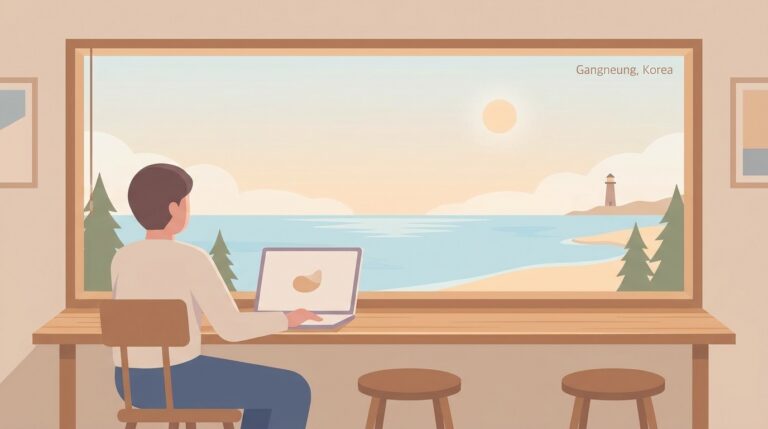
Escape the Seoul Grid: Your Essential Korean Guide to Coastal Workations
Phase 1: Empathy (A Story-Driven Opening)
안녕하세요! 매일한글 에디터입니다. (Hello! I’m your Daily Hangul editor.)
Have you ever found yourself squished like a fresh kimbap roll on Seoul Subway Line 2 at 8:30 AM? Your laptop bag is digging into your ribs, fluorescent lights buzz overhead, and you catch yourself daydreaming: There must be more to working in Korea than skyscrapers and endless commutes.
You are definitely not alone. Lately, the buzz across Korea is all about escaping metropolitan saturation. Remote professionals, creatives, and digital nomads are heading out toward Gangneung’s pine-fringed beaches, Jeju’s volcanic shores, and Namhae’s quiet coves for a ‘워케이션’ (Workation). It is a win-win lifestyle where you get your tasks done while injecting fresh economic life into charming provincial towns.
Yet, when our intermediate learners pack their bags for a seaside village, they often hit an unexpected communication wall. Standard textbooks teach ultra-formal Seoul business Korean or stiff tourist phrases for Myeongdong shopping. But how do you politely ask a coastal cafe owner if it is okay to work on your laptop for three hours? How do you ask for reliable Wi-Fi without sounding like a robotic auditor?
Drawing on hundreds of real coaching conversations with foreign remote workers across Korea, this practical guide gives you the exact phrases, acoustic manners, and cultural nuances you need to work, live, and connect seamlessly outside the Seoul bubble.
Phase 2: Core Expressions in Depth
1. 워케이션 왔어요 (Wokeisyeon wasseoyo)
- Pronunciation: [Wokeisyeon wasseoyo] (Sounds like: wah-kay-shyun wah-ssuh-yo)
- Meaning: Literal: “I came for a workation.” / Nuance: “I’m staying in town to work remotely and relax!”
- K-Culture Moment: Reminiscent of healing dramas like Summer Strike (아무것도 하고 싶지 않아) or Welcome to Samdal-ri (웰컴투 삼달리), where exhausted city professionals arrive at coastal towns with backpacks and laptops seeking a healthier work-life rhythm.
- Editor’s Insight: Rural Korean towns are used to seeing weekend tourists who rush between photo spots. Saying you are here on a workation instantly changes their perception: you are a respectful temporary resident contributing to the local community.
- Situation Spectrum: Casual: ⚠️ (with close peers) | Semi-formal: ✅ (ideal with hosts/baristas) | Formal: ✅ (워케이션으로 방문했습니다)
- 🤔 Think About It: In many Western cultures, “working on vacation” sounds like poor boundary-setting. Why do you think Korea created a positive, revitalizing cultural identity around “workations”?
2. 콘센트 있는 자리 있을까요? (Konsenteu inneun jari isseulkkayo?)
- Pronunciation: [Konsenteu inneun jari isseulkkayo?] (Sounds like: cone-sen-teu een-neun jah-ree ee-ssul-kkah-yo?)
- Meaning: Literal: “Could there be a seat with a concentric plug?” / Nuance: “Could I sit somewhere near a power outlet to plug in my device?”
- K-Culture Moment: Walking into a stylish red-brick cafe overlooking the East Sea, scoping out the seating layout before placing your coffee order so your battery does not die midway through an afternoon Zoom sprint.
- Editor’s Insight: The word 콘센트 (konsenteu) is a classic piece of Konglish derived from “concentric plug.” If you use the English word “outlet” or “socket,” locals might misunderstand and direct you to an outdoor shopping outlet!
- Situation Spectrum: Casual: 🚫 | Semi-formal: ✅ | Formal: ✅
- 🤔 Think About It: How does asking before taking up a powered table display the uniquely Korean practice of nunchi (social intuition) in shared hospitality spaces?
3. 여기 로컬 맛집 추천해 주실 수 있나요? (Yeogi rokeol matjip chucheonhae jusil su innayo?)
- Pronunciation: [Yeogi rokeol matjip chucheonhae jusil su innayo?] (Sounds like: yuh-gee lo-kuhl maht-jeep choo-chuhn-hae joo-sheel soo een-nah-yo?)
- Meaning: Literal: “Could you recommend a local delicious house here?” / Nuance: “Could you tell me about the hidden, authentic neighborhood spots that tourists usually miss?”
- K-Culture Moment: Asking the owner of a boutique coastal guesthouse for their personal dinner recommendation instead of trusting sponsored Naver blog posts.
- Editor’s Insight: Pairing “로컬” (local) with “맛집” (matjip) flatters provincial residents. It shows you genuinely value their regional heritage over flashy, cookie-cutter franchises.
- Situation Spectrum: Casual: ⚠️ | Semi-formal: ✅ | Formal: ✅
- 🤔 Think About It: Food is deeply tied to regional identity across Korea’s provinces (지방). How does asking for local food help dismantle Seoul-centric stereotypes?
Phase 3: Textbook Korean vs. Real Korean
Situation 1: Inquiring about internet speed for high-bandwidth work calls
- 📖 교과서 한국어 (Textbook): 인터넷 연결 상태가 양호합니까? (Inteonet yeongyeol sangtaega yanghohamnikka? – “Is the state of the internet connection favorable?”)
- 🗣️ 진짜 한국어 (Real-world): 와이파이 안 끊기고 잘 터져요? (Waipai an kkeunkkigo jal teojyeoyo? – “Does the Wi-Fi work stably without dropping out?”)
- 💡 왜 다를까? (Why the shift?): In everyday spoken Korean, signal strength and connectivity are expressed through the vivid verb 터지다 (teojida, literally “to burst/pop open”). The textbook phrase sounds like an engineer conducting a state telecommunications audit!
Situation 2: Explaining a multi-week stay in a regional town
- 📖 교과서 한국어 (Textbook): 저는 이곳에서 장기 체류를 계획하고 있습니다. (Jeoneun igoseseo janggi cheryureul gye-hoekhago itseumnida. – “I am planning a long-term residence in this location.”)
- 🗣️ 진짜 한국어 (Real-world): 여기서 2주 살기(혹은 한 달 살기) 하려고요. (Yeogiseo i-ju salgi [hogeun han dal salgi] haryeogoyo. – “I’m planning on doing a two-week [or one-month] stay here.”)
- 💡 왜 다를까? (Why the shift?): The cultural phrase “~달 살기” (~month living) has become the golden standard among Koreans to describe temporary, mindful immersion outside big metropolitan zones.
Phase 4: K-Culture Deep Dive & Non-Verbal Manners
4-1. Nunchi & Workation Cafe Etiquette
While Korean cafes are famous for welcoming laptop workers, provincial workations require a delicate touch of nunchi (눈치):
* The Table Rule: Never claim a four-person table with ocean views if you are working alone during lunch rush (12:00 PM – 1:30 PM). Seek out dedicated bar tables or quiet wall corners.
* The Fair-Use Policy: If you plan on working through your laptop for more than three hours, it is customary courtesy to order a second item—such as an iced tea, a local pastry, or a piece of regional cake.
* Two-Handed Respect: When handing your payment card or receiving your coffee tray, support your right forearm or wrist lightly with your left hand. This subtle gesture signals genuine humility toward local business owners.
4-2. Cultural Code: Regional Depopulation & The Rise of Local Revitalization
Over 50% of South Korea’s entire population resides within the Greater Seoul Area. This intense geographic funneling has caused severe provincial decline, known locally as 지방 소멸 (ji-bang so-myeol). To counteract this, provincial cities like Gangneung, Sokcho, and Yeosu partner with tech enterprises and creative collectives to launch specialized workation centers. When you spend your working days in these regional hubs, you are not just a sightseer; you are participating in a creative economic movement that keeps local schools, bakeries, and heritage spaces alive.
Phase 5: Real-Life Roleplay Scenario
Setting: A sunlit, timber-framed oceanfront cafe in Gangneung with views of the crashing waves.
Character: Min-jun (민준), a thoughtful cafe owner in his mid-30s who moved down from Seoul two years ago to launch his seaside business.
- Turn 1 (Learner): 안녕하세요! 혹시 콘센트 있는 자리 있을까요? (Annyeonghaseyo! Hoksi konsenteu inneun jari isseulkkayo?)
🎭 Looking around politely with a gentle, questioning smile while holding your laptop bag.
(Hello! Excuse me, might there be a seat with a power outlet?) -
Turn 2 (Min-jun): 어서 오세요! 네, 저기 창가 끝 쪽 테이블 아래에 콘센트 있어요. (Eoseo oseyo! Ne, jeogi changga kkeut jjok teibeul araee konsenteu isseoyo.)
🎭 Smiling warmly and guiding your gaze toward a wooden desk with two open palms.
(Welcome! Yes, there is a power socket right under the table at the far end of the window.) -
Turn 3 (Learner): 감사합니다! 실은 서울에서 워케이션 왔거든요. (Gamsahamnida! Sireun seoureseo wokeisyeon watgeodeunyo.)
🎭 Bowing slightly and placing your belongings down neatly.
(Thank you! Actually, I came down from Seoul on a workation.) -
Turn 4 (Min-jun): 아, 워케이션이요? 환영합니다! 오래 계셔도 편하게 일하세요. (A, wokeisyeoni-yo? Hwanyeonghamnida! Orae gyesyeodo pyeonhage ilhaseyo.)
🎭 Handing over the beverage menu with an encouraging nod.
(Ah, a workation? Welcome! Feel completely free to work comfortably even if you stay a while.) -
Turn 5 (Learner): 배려해 주셔서 감사해요. 와이파이 안 끊기고 잘 터지죠? (Baeryeohae jusyeoseo gamsahaeyo. Waipai an kkeunkkigo jal teojijyo?)
🎭 Tilting head slightly, pointing toward your smartphone screen.
(Thank you for your consideration. The Wi-Fi doesn’t disconnect and runs smoothly, right?) -
Turn 6 (Min-jun): 네, 기가 와이파이라 화상 회의도 끄떡없어요! 비밀번호는 영수증 아래에 있습니다. (Ne, giga waipaira hwasang hoe-uido kkeutteogeopseoyo! Bimilbeonhoneun yeongsujeung araee itseumnida.)
🎭 Giving a light thumbs-up gesture and pointing to the bottom of the printed receipt.
(Yes, it’s gigabit internet, so video conference calls are a breeze! The password is on the receipt slip.) -
Turn 7 (Learner): 다행이네요. 아이스 아메리카노 한 잔이랑 강릉 감자빵 하나 주세요. (Dahaeng-ineyo. Aiseu americano han jan-irang gangneung gamjappang hana juseyo.)
🎭 Passing your credit card across the counter with both hands.
(What a relief. Please give me an iced Americano and one Gangneung potato bread.) -
Turn 8 (Min-jun): 좋은 조합이네요! 정성껏 준비해서 진동벨로 알려드릴게요. (Joeun johab-ineyo! Jeongseongkkeot junbihaeseo jindongbello allyeodeurilgeyo.)
🎭 Accepting the payment card with both hands and handing over an electronic buzzer.
(Great combination! I’ll prepare it fresh and buzz your pager when it’s ready.)
🔀 Interactive Decision Point
You finish your work session after three hours. What do you do next?
* Option A: Pack up immediately, leave dirty napkins and paper cups on the table, and walk out silently.
* Option B: Order a cup of local herbal tea to support the shop, then clear your table completely before thanking the owner.
* Option C: Take a loud 30-minute conference phone call on speakerphone without putting on your earbuds.
Feedback:
* Option A (Risk): Leaving your mess behind violates clean table manners in Korean self-service cafes. Always return trays to the 반납대 (return station).
* Option B (Best Choice): Impeccable workation manners! It proves you are a considerate remote professional who supports regional entrepreneurs.
* Option C (Bad): Disastrous etiquette! Speaking loudly without headphones will draw sharp stares (눈총) from everyone working in the room.
Phase 6: 10-Second Emotional Shadowing Drill
Read these aloud, timing your breath to the pauses indicated by /.
[😊 설레고 밝게 - Excited & Bright]
서울 떠나서 / 바다 보며 / 워케이션 왔어요!
(Seoul tteonaseo / bada bomyeo / wokeisyeon wasseoyo!)
Leaving Seoul / looking at the sea / I came on a workation!-
[🤝 공손하고 조심스럽게 - Polite & Considerate]
혹시 노트북 충전할 / 콘센트 자리 / 있을까요?
(Hoksi notebuk chungjeonhal / konsenteu jari / isseulkkayo?)
By any chance / for charging my laptop / is there an outlet seat? -
[🤩 기대감 가득하게 - Full of Eager Curiosity]
사장님, / 여기 현지인들만 아는 / 찐 로컬 맛집 알려주세요!
(Sajangnim, / yeogi hyeonjiindeulman aneun / jjin rokeol matjip allyeojuseyo!)
Boss, / known only to locals here / please tell me an authentic local spot!
Phase 7: K-Culture Mini Dictionary
- 워케이션 (Wokeisyeon): The portmanteau of “Work” and “Vacation.” In Korea, it refers to structured remote working in scenic regional hubs aimed at relieving Seoul burnout.
- 카공족 (Kagongjok): A compound of 카페 (cafe), 공부 (study), and 족 (tribe). It describes people who use coffee houses to study or work on laptops.
- 한 달 살기 (Han dal salgi): Literally “living for a month.” A major trend where busy Koreans rent temporary rural housing to slow down and reconnect with nature.
- 찐 맛집 (Jjin matjip): 찐 (real/authentic slang) + 맛집 (famous eatery). Refers to unpretentious restaurants cherished by neighborhood seniors rather than social media influencers.
Phase 8: Traveler’s Survival Kit
Top 3 Survival Phrases for Regional Workations
- 와이파이 비밀번호가 뭐예요? (Waipai bimilbeonhoga mwoyeyo?)
What is the Wi-Fi password?
Pro Tip: Before waiting in line to ask, check the bottom of your printed register receipt or look for a small acrylic plaque mounted beside the counter. - 여기 몇 시에 닫아요? (Yeogi myeot sie dadayo?)
What time do you close here?
Pro Tip: Unlike Seoul, where cafes operate until midnight, many seaside spots close around 6:00 PM or 7:00 PM on weekdays. - 영수증 버려주세요. (Yeongsujeung beoryeojuseyo.)
Please discard the receipt for me.
Pro Tip: Handy when you do not need paper waste, but remember to verify whether the Wi-Fi code is printed on it first!
Editor’s Travel Note
- Navigation: Never rely exclusively on Google Maps outside Seoul; it does not accurately track regional bus lines or alleys. Always download the Naver Map Application or KakaoMap before leaving the capital.
- Payments: Foreign credit cards work smoothly in 99% of regional shops, but it is wise to maintain at least 30,000 KRW in physical cash or a preloaded transit card for smaller rural community shuttles.
Phase 9: “One Step Deeper” (Cultural Reflection)
South Korea’s modern story is built upon hyper-fast industrialization centered heavily on the Seoul Capital Area. While this concentration spurred incredible technological advancement, it also generated fierce competition, soaring housing pressures, and quiet depopulation in historical agricultural and seaside areas.
The rise of the Korean workation is far more than a fun weekend perk: it is a modern reconciliation. It represents young people seeking balance, human warmth, and tranquility, alongside rural communities welcoming new creative energy. By stepping outside the capital and speaking respectfully with regional citizens, you participate in balancing this dynamic peninsula.
💬 Your Turn: If you were gifted a two-week remote work grant in South Korea tomorrow, would you set up your desk overlooking the waves of Jeju Island or the quiet pine mountains of Gangwon Province? Share your dream destination in the comments below!
Phase 10: FAQ & Common Mistakes
Q: Can foreign tourists or digital nomads access regional workation centers in Korea?
A: Yes! Municipalities such as Gangwon Province, Busan, and Jeju operate welcoming workation initiatives. Many municipal co-working spaces allow international visitors to sign up online or at the reception desk simply by showing a passport or registration card.
Q: Is internet connection stable in smaller, traditional fishing villages?
A: South Korea boasts near-universal fiber-optic and 5G internet nationwide. Even in secluded cliffside cafes or rural hanok estates, high-speed Wi-Fi speeds comfortably handle file uploads and international video calls.
Q: How long is it socially acceptable to stay inside a cafe with a laptop?
A: In medium-to-large cafes, two to three hours per purchased drink is considered standard polite behavior. If you plan to settle in for a full six-hour workday, order an additional drink or dessert midway through your session.
🚨 Common Mistakes Warning Board
- Mistake: Calling an electrical outlet an “아울렛” (Aullet).
Correct Action: Always say 콘센트 (Konsenteu). In Korea, an “아울렛” refers exclusively to a shopping mall outlet. - Mistake: Assuming provincial cafes remain open late into the evening.
Correct Action: Double-check business hours on your map app. Many countryside and seaside venues close promptly at dusk. - Mistake: Speaking on phone conferences over external laptop speakers in open seating.
Correct Action: Use headphones at all times and keep your spoken tone soft to respect the shared quiet atmosphere.
Phase 11: Action Mission & Engagement
- 🥉 Bronze Level: Practice saying “콘센트 있는 자리 있을까요?” aloud three times in front of the mirror until it rolls off your tongue in under five seconds.
- 🥈 Silver Level: Snap a photo of your current home work setup, post it to your social feed with the Korean caption “#워케이션 가고 싶어요!” (I want to go on a workation!), and tag your study buddy.
- 🥇 Gold Level: During your next visit to a Korean-run cafe or during your trip in Korea, greet the counter staff politely and order while asking for the Wi-Fi password using real-world Korean phrasing!
- 🎮 K-Culture Mission: Watch an episode of a healing provincial K-Drama like Hometown Cha-Cha-Cha (갯마을 차차차) or Summer Strike (아무것도 하고 싶지 않아). Identify two scenes where city characters adjust their communication style to match provincial shop owners!
Phase 12: Interactive Quiz Challenge
Question 1: Scenario Judgment
You walk into a quiet oceanfront cafe in Sokcho with your laptop at 1:00 PM. The cafe has only five small tables. What is the most respectful nunchi action?
(A) Spread out your laptop, charger cables, and files across the largest table.
(B) Take a smaller corner desk, order a drink, and ask if working on a laptop is okay.
(C) Play your Zoom call without headphones because the sound of the ocean is noisy.
Question 2: Fill in the Blank
Complete the sentence to politely ask for an outlet seat:
“혹시 ________ 있는 자리 있을까요?”
(Hint: Remember the Korean term for power socket!)
Question 3: True or False
True or False: Using the textbook expression “인터넷 연결 상태가 양호합니까?” is the most natural way to ask a cafe barista about Wi-Fi stability.
Click to reveal answers & explanations!
- Answer 1: (B) In smaller spaces, choosing a discreet table and demonstrating basic courtesy ensures cafe owners remain happy to host remote workers.
- Answer 2: 콘센트 (Konsenteu). The full sentence is “혹시 콘센트 있는 자리 있을까요?”
- Answer 3: False! While grammatically correct, native speakers will find it unnaturally stiff. Instead, say “와이파이 안 끊기고 잘 터져요?” (Does the Wi-Fi run well without dropping?).
🎬 Watch Our Daily Videos! (Daily Hangul Official Instagram)
Review the expressions you learned in this article with our fun daily short videos! Check out native pronunciation and real-life nuances in action.
- Instagram @dailyhangul_en







