

Phase 1: Empathy & Immersion
안녕하세요! 매일한글 에디터입니다.
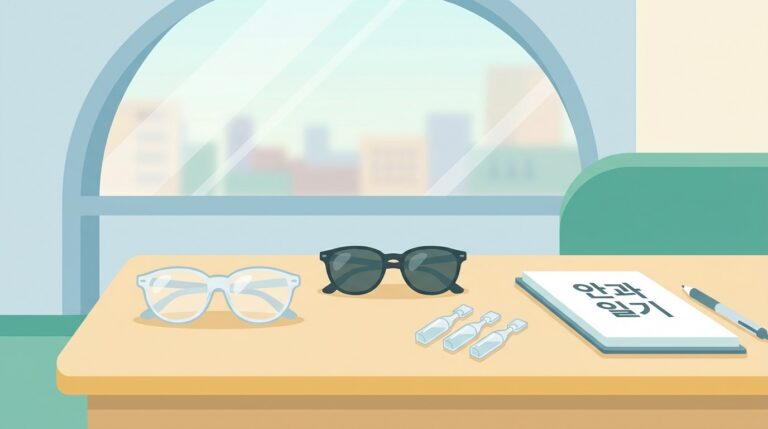
Picture this: You just stepped out of a sleek, state-of-the-art eye clinic in the heart of Gangnam. Your SMILE LASIK surgery took barely ten minutes—efficient, painless, and almost futuristic. But as soon as you step toward the pharmacy counter, reality hits you like high-noon sunlight. The clinic coordinator hands you a pouch containing several mystery bottles: antibiotic drops, anti-inflammatory solutions, and boxes of preservative-free artificial tears that look like tiny plastic ampoules. Then comes the rapid-fire Korean aftercare briefing: “자외선 차단을 위해 보안경을 착용하시고, 시간 맞춰 점안하셔야 해요.” Your eyes are already tearing up slightly, your vision is hazy like a soft-focus K-drama dream sequence, and your brain freezes trying to decipher which drop goes where and when.
Getting vision correction surgery in Korea is world-renowned for its speed and precision, but post-operative care (사후 관리) is where the real success of the procedure happens. Navigating medical instructions at an intermediate (B2) level means moving beyond basic textbook vocabulary like “약 먹어요” (I take medicine) into specialized everyday medical Korean like 점안하다 (to instill eye drops), 자외선 차단 (UV protection), and 시간 맞춰 (on schedule). As your trusty Korean cultural navigator, I have gathered real feedback from foreign residents and medical tourists who felt overwhelmed by post-op instructions. Master these terms, and you will not only protect your vision with flawless confidence, but you will also communicate with medical staff like a savvy local insider!
Phase 2: Core Expressions Deep Dive
1. 시간 맞춰 점안하셔야 해요 (Sigan matchwo jeomanhasyeoya haeyo)
- Pronunciation: [Si-gan mat-chwo jeo-man-ha-syeo-ya hae-yo] (Pronunciation tip: “Jeo-man” sounds like “jumper” without the ‘p’, gliding into ‘man’—think of gentle raindrops falling evenly into place).
- Meaning: Literal: “You must instill [the drops] fitting the time.” / Nuance: “Make sure to put in your eye drops strictly on schedule.”
- K-Culture Moment: Seen frequently in medical K-dramas like Hospital Playlist or Doctor Romantic, where caring nurses firmly lecture stubborn patients who forgot to follow their strict recovery timetable.
- Editor’s Insight: 점안하다 is the formal medical verb for “putting drops into the eye” (from Hanja 點眼). While casual speech often uses 안약 넣다 (put in eye drops), medical coordinators and pharmacists will almost always say 점안하다 or 점안하세요. Pairing it with 시간 맞춰 highlights the non-negotiable importance of routine intervals.
- Situation Spectrum: Casual 🚫 | Semi-formal ⚠️ | Formal ✅
- 🤔 Think About It: In English, we casually say “Take your drops regularly.” Why do Korean doctors emphasize 시간 맞춰 (matching the exact hour)? Reflect on how Korean healthcare prioritizes precise, proactive patient diligence.
2. 자외선 차단을 위해 보안경을 꼭 쓰세요 (Jawaeseon chadaneul wihae boan-gyeong-eul kkok sseuseyo)
- Pronunciation: [Ja-wae-seon cha-da-neul wi-hae bo-an-gyeong-eul kkok sseu-se-yo] (Pronunciation tip: Emphasize the double consonant ‘kkok’ with a crisp, popping tension like snapping on a pair of sleek glasses).
- Meaning: Literal: “For blocking ultraviolet rays, be sure to wear protective safety glasses.” / Nuance: “You must wear UV-blocking or protective glasses without fail to shield your eyes.”
- K-Culture Moment: You will spot K-pop idols exiting Incheon Airport wearing stylish tinted shades or clear-frame blue-light/UV glasses after private cosmetic or laser eye appointments to shield their sensitive corneas from flash photography and sunlight.
- Editor’s Insight: 보안경 refers to non-prescription protective safety glasses (often clear UV or blue-light blocking specs given right after surgery), whereas 선글라스 specifically means tinted sunglasses. Note the indispensable adverb 꼭 (without fail)—it signals that this instruction is vital for preventing corneal haze (각막 혼탁).
- Situation Spectrum: Casual ⚠️ | Semi-formal ✅ | Formal ✅
- 🤔 Think About It: Why does Korean medical culture categorize protective eyewear so specifically (보안경 vs 보호안경 vs 선글라스)? Consider how modern Korea combines medical protection with daily aesthetic fashion.
3. 무방부제 인공눈물을 수시로 넣어주세요 (Mubangbuje in-gongnunmureul susiro neoeojuseyo)
- Pronunciation: [Mu-bang-bu-je in-gong-nun-mu-reul su-si-ro neo-eo-ju-se-yo] (Pronunciation tip: “Mu” means ‘without’ or ‘zero’—pronounce it smoothly like “moo”, followed by a bouncy “bang-bu-je”).
- Meaning: Literal: “Please put in preservative-free artificial tears frequently.” / Nuance: “Use preservative-free artificial tears as often as needed throughout the day.”
- K-Culture Moment: Office workers in Seoul deskside vlogs clicking open tiny single-use plastic tear ampoules every hour while working long shifts under dry air conditioning.
- Editor’s Insight: Notice the contrast between 시간 맞춰 (used for medicated antibiotic drops that have strict dosage limits) and 수시로 (used for lubricating tears whenever dry). 무방부제 (preservative-free) single-use drops are standard in Korea post-surgery because bottled drops with preservatives can irritate recovering epithelial cells.
- Situation Spectrum: Casual ⚠️ | Semi-formal ✅ | Formal ✅
- 🤔 Think About It: How does the frequent usage adverb 수시로 empower the patient to monitor their own bodily signals compared to rigid, hour-bound prescriptions?
Phase 3: Textbook Korean vs. Real Korean
Situation 1: Asking the Pharmacist How to Administer Drops
- 📖 교과서 한국어 (Textbook):
“처방받은 약물을 규칙적인 시간에 점적투여하십시오.”
(Please administer the prescribed medication by instillation at regular times.) - 🗣️ 진짜 한국어 (Real-Life B2):
“항생제 안약은 하루 네 번 시간 맞춰 점안하시고, 인공눈물은 건조할 때마다 틈틈이 넣어주세요.”
(Instill the antibiotic drops four times a day on schedule, and put in artificial tears every now and then whenever it feels dry.) - 💡 왜 다를까?
Textbook Korean uses dry clinical jargon (점적투여, 약물). In real clinic counseling rooms, Korean healthcare workers speak with warm, active phrasing (시간 맞춰 점안하시고, 틈틈이 넣어주세요), balancing professional authority with comforting maternal care (정성).
Situation 2: Inquiring About Wearing Sunglasses Indoors
- 📖 교과서 한국어 (Textbook):
“수술 후 자외선 노출을 엄격히 차단하기 위해 차광 안경을 항시 착용 바랍니다.”
(Please wear shaded glasses at all times to strictly block UV exposure post-surgery.) - 🗣️ 진짜 한국어 (Real-Life B2):
“실내에서는 보안경 쓰시고, 외출하실 땐 자외선 차단되게 선글라스 꼭 챙겨 쓰세요.”
(Wear protective glasses indoors, and be sure to put on sunglasses whenever you head outside to block UV rays.) - 💡 왜 다를까?
Rather than using formal legalistic phrasing like 차광 안경 항시 착용, real Korean separates your daily life into 실내 (indoors) and 외출 (stepping outside), instructing you with practical, lifestyle-based verbs like 챙겨 쓰세요 (make sure to pack and wear them).
Phase 4: K-Culture Deep Dive & Non-Verbal Manners
4-1. Nunchi & Clinic Body Language
When receiving post-op instructions in a Korean ophthalmology consultation booth (상담실), listening actively is an art form. Keep your head angled slightly forward with continuous mini-nods (끄덕임) and responsive verbal cues like “네, 알겠습니다” (Yes, understood) or “아, 시간 간격을 둬야 하는군요” (Ah, so I need to leave time intervals between them).
Crucial physical etiquette: Never touch your face or rub your eyes while talking to the coordinator. Even touching the rim of your eye will cause the nurse to gasp in alarm and reach for the hand sanitizer (손 소독제). If your eyes sting from tearing up, use a clean tissue to dab the cheekbone area below your lower eyelid—never touch the eye itself. When the pharmacist hands you your divided eye drop pouches, receive them with both hands (두 손으로 받기) as a sign of mutual respect for your treatment regimen.
4-2. Cultural Code: The Korean “Aftercare System” and Gangnam Medical Care
Korea’s vision correction clinics in Gangnam and Apgujeong operate with world-class efficiency, often performing hundreds of laser procedures weekly. However, Korean patients judge the true quality of a clinic not by the 10-minute surgery, but by the thoroughness of its 사후 관리 (post-operative aftercare system).
Clinics actively compete over who provides the most detailed recovery kit: personalized KakaoTalk alarm services reminding you when to drop your antibiotics, high-tech UV-tester cards to check your sunglasses, and custom clear eye-shields (플라스틱 안대) taped to your face at bedtime so you do not accidentally rub your eyes while sleeping. Embracing this culture means taking pride in your aftercare homework. Diligently wearing your clear 보안경 inside a trendy Seoul cafe is not seen as awkward or nerdy—it is respected as a smart badge of modern self-care (자기관리).
Phase 5: Real-World Roleplay Scenario
Setting: The post-op recovery consultation room at a top-tier eye clinic near Gangnam Station.
Characters:
* 실장님 (Counseling Director Min): Professional, brisk, caring, and detail-oriented.
* 학습자 (You): An international resident recovering right after a SMILE procedure, wearing oversized protective glasses.
Turn 1
* 실장님: 🎭 (안약 파우치를 가리키며 꼼꼼하게 설명한다)
“수술 잘 끝나셨어요! 자, 여기 처방된 항생제 안약은 하루 네 번, 시간 맞춰 점안하셔야 해요.”
(Susul jal kkeutnasyeosseoyo! Ja, yeogi cheobangdoen hangsaengje anyageun haru ne beon, sigan matchwo jeomanhasyeoya haeyo.)
“Your surgery went great! Now, you must instill these prescribed antibiotic drops four times a day, strictly on schedule.”
Turn 2
* 학습자: 🎭 (메모하듯 고개를 끄덕이며)
“네, 알겠습니다. 혹시 인공눈물도 항생제랑 같은 시간에 바로 넣어도 되나요?”
(Ne, algesseumnida. Hoksi in-gongnunmuldo hangsaengjerang gateun sigane baro neoeodo doenayo?)
“Understood. By any chance, can I put in the artificial tears at the exact same time as the antibiotic?”
Turn 3
* 실장님: 🎭 (손으로 5분 간격을 표시하며)
“아니요! 약효가 씻겨 나갈 수 있어서, 최소 5분 간격을 두고 점안하셔야 효과가 있어요.”
(Aniyo! Yakhyoga ssitgyeo nagal su isseoseo, choeso obun gan-gyeogeul dugo jeomanhasyeoya hyogwaga isseoyo.)
“No! The medicine could wash away, so you must leave at least a 5-minute interval between drops for it to be effective.”
Turn 4
* 학습자: 🎭 (눈을 깜빡이며 조심스럽게)
“아, 5분 간격이군요. 인공눈물은 얼마나 자주 넣어야 할까요?”
(A, obun gan-gyeogigunyo. In-gongnunmureun eolmana jaju neoeoya halkkayo?)
“Ah, a 5-minute interval. How often should I put in the artificial tears?”
Turn 5
* 실장님: 🎭 (일회용 인공눈물 팩을 보여주며)
“무방부제 인공눈물은 뻑뻑하거나 건조할 때마다 수시로 듬뿍 넣어주세요. 개봉 후 하루 지난 건 버리시고요.”
(Mubangbuje in-gongnunmureun ppeokppeokhageona geonjohal ttaemada susiro deumpuk neoeojuseyo. Gaebong hu haru jinan geon beorisigoyo.)
“Put in the preservative-free tears generously whenever it feels stiff or dry. Discard any opened ampoule after one day.”
Turn 6
* 학습자: 🎭 (가방 속 선글라스를 꺼내 만지작거리며)
“실내에서도 계속 선글라스를 끼고 있어야 하나요?”
(Silnaeeseodo gyesok seon-geullaseureul kkigo isseoya hanayo?)
“Do I need to keep wearing sunglasses indoors as well?”
Turn 7
* 실장님: 🎭 (미소를 지으며 보안경을 가리킨다)
“실내에서는 병원에서 드린 투명 보안경만 쓰셔도 충분해요. 하지만 낮에 외출하실 땐 자외선 차단을 위해 선글라스를 꼭 착용해 주세요.”
(Silnaeeseoneun byeongwoneseo deurin tumyeong boan-gyeongman sseusyeodo chungbunhaeyo. Hajiman naje oechulhasil ttaen jawaeseon chadaneul wihae seon-geullaseureul kkok chagyonghae juseyo.)
“Indoors, wearing the clear protective glasses we gave you is plenty. But when you step outside during the day, make sure to wear sunglasses for UV protection.”
Turn 8
* 학습자: 🎭 (양손으로 파우치를 챙겨 들고 안도하며 인사한다)
“다행이네요! 알려주신 대로 시간 맞춰서 꼼꼼히 관리할게요. 감사합니다!”
(Dahaeng-ineyoyo! Allyeojusin daero sigan matchwoseo kkomkkomhi gwanlihalkkeyo. Gamsahamnida!)
“What a relief! I will take meticulous care on schedule just as you instructed. Thank you!”
🔀 Interactive Choice Point!
What should you do if your eye suddenly feels intensely dry just 1 minute after putting in your antibiotic drops?
- Option A: “항생제 넣자마자 너무 건조해서 바로 인공눈물을 넣었어요.” (Put artificial tears in right away.)
Feedback: ❌ Bad. The artificial tears will immediately dilute and flush away the antibiotic solution before your cornea can absorb it! - Option B: “약효가 흡수될 수 있게 5분 기다린 뒤에 인공눈물을 점안할게요.” (Wait 5 minutes so the drug can absorb, then instill tears.)
Feedback: 🌟 Best! You remembered the golden 5-minute rule (5분 간격). Your recovery will be smooth and textbook-perfect! - Option C: “안약 성분이 씻겨 나갈까 봐 오늘은 인공눈물을 아예 안 넣을래요.” (Refuse to put in any artificial tears all day.)
Feedback: ⚠️ Risk. Severe dry eye (안구건조증) can delay epithelial healing and cause sharp corneal pain. Never skip lubrication altogether!
Phase 6: 10-Second Emotion Shadowing Drill
Sharpen your intonation and pauses (/) while channeling authentic Korean clinic emotions!
- [🧐 진지하고 꼼꼼하게 / Inquiring & Attentive]
“인공눈물은 / 건조할 때마다 / 수시로 넣으면 되나요?”
(In-gongnunmureun / geonjohal ttaemada / susiro neoeomyeon doenayo?)
(Do I just put in artificial tears / whenever it feels dry / as often as needed?) -
[🚨 단호하고 주의를 주며 / Firm & Cautionary]
“안약 두 종류를 넣으실 땐 / 반드시 / 5분 간격을 두셔야 해요!”
(Anyak du jongnyureul neoeusil ttaen / bandeusi / obun gan-gyeogeul dusyeoya haeyo!)
(When instilling two types of drops / without fail / you must keep a 5-minute interval!) -
[😎 당당하고 안심시키며 / Reassuring & Confident]
“외출할 땐 / 자외선 차단을 위해 / 선글라스를 꼭 챙겨 쓸게요.”
(Oechulhal ttaen / jawaeseon chadaneul wihae / seon-geullaseureul kkok chaeng-gyeo sseulgeyo.)
(When going outside / to block UV rays / I will definitely make sure to wear sunglasses.)
Phase 7: K-Culture Mini Dictionary
-
스마일라식 (Seuma-il-la-sik) | SMILE LASIK (Small Incision Lenticule Extraction)
Usage: The most popular modern vision correction surgery in Korea, famed for minimal corneal incision (around 2mm), near-zero downtime, and rapid return to daily life within 24 hours. -
무방부제 인공눈물 (Mu-bang-bu-je in-gong-nun-mul) | Preservative-Free Artificial Tears
Usage: Sold in boxes containing strips of 30 disposable plastic vials. A daily staple in Korea for contact lens wearers, post-op patients, and computer screen marathoners alike. -
보안경 (Bo-an-gyeong) | Protective Safety Glasses
Usage: Non-prescription clear glasses designed to shield eyes from wind, physical friction, fine dust (미세먼지), and harmful UV/blue light rays during initial healing. -
점안 (Jeom-an) | Ocular Instillation (Dropping liquid into the eye)
Usage: The formal Sino-Korean term seen on Korean medicine envelopes, clinic whiteboards, and dosage reminder sheets (하루 4회 점안 = Instill 4 times a day).
Phase 8: Traveler’s Survival Kit
Top 3 Survival Phrases
- Expression 1: “안약 넣는 순서와 시간 간격 다시 설명해 주시겠어요?”
(Anyak neoneun sunseowa sigan gan-gyeok dasi seolmyeonghae jusigesseoyo?)
Pro Tip: Use this at the clinic checkout counter if the verbal briefing felt too fast. Staff will gladly circle the instructions on your instruction chart. - Expression 2: “수술 후에 빛 번짐이나 건조증이 얼마나 오래 가나요?”
(Susul hue bit beonjimina geonjojeung-i eolmana orae ganayo?)
Pro Tip: Perfect B2 sentence for inquiring about side effects like light halos (빛 번짐) and dry eyes (건조증). - Expression 3: “처방전 가지고 바로 앞 약국으로 가면 되나요?”
(Cheobangjeon gajigo baro ap yakgugeuro gamyeon doenayo?)
Pro Tip: Eye clinics in Gangnam usually have partner pharmacies directly on the first floor or right across the corridor.
Editor’s Travel Note
- Essential Navigation: Do not attempt to walk back to your hotel in bright daylight right after surgery. Open your map and hail a taxi from inside the building lobby using the 카카오 T 앱 다운로드 (Download Kakao T App) or search clinic pharmacy hours via the 네이버 지도 앱 다운로드 (Download Naver Map App).
- Local Payment Tip: Eye drops prescribed after cosmetic vision correction are categorized as non-reimbursable (비급여), so they cost significantly more than standard prescription drops. Keep your foreign credit card handy, and remember to ask the clinic for an English medical receipt (영문 진단서 및 진료비 세부내역서) if you plan to claim international travel insurance!
Phase 9: One Step Deeper (Thought Questions)
In Korean medical culture, recovery is viewed as a collective partnership rather than an isolated patient burden. When medical staff repeatedly emphasize 시간 맞춰 (on schedule) and hand you meticulously categorized schedules, they are invoking the Korean ethos of 정성 (wholehearted dedication) and 자기관리 (diligent self-governance). In Korea, following instructions to the minute is not considered rigid fussiness—it is seen as active respect for your own body and the doctor’s craft. How does this compare to aftercare in your home culture, where directions might be looser or more self-guided?
💬 Your Turn: Have you ever experienced medical care or received prescriptions in Korea? How did the speed, detail, and aftercare compare to your expectations? Share your story in the comments below!
Phase 10: FAQ & Common Mistakes
Q: Can I wear regular fashion sunglasses instead of the protective glasses provided by the clinic?
A: Yes, but with one condition: verify that they have 99% or 100% UV protection (자외선 차단 100%). Dark lenses without certified UV filters can actually cause your pupils to dilate, allowing more harmful UV rays to hit your healing cornea. Indoors, stick to the clear 보안경 provided by the clinic to prevent accidental bumping.
Q: What should I do if an eye drop misses my eye and rolls down my cheek?
A: Do not immediately squeeze three more drops into your eye in a panic! Simply blink, tilt your head back gently, pull down your lower lid to create a small pocket, and instill one fresh drop. Then close your eye softly for 30 seconds without hard squeezing.
Q: Can I reuse a single-use preservative-free artificial tear vial the next day if there is liquid left over?
A: Absolutely not. Since they contain zero chemical preservatives (무방부제), opened vials are vulnerable to bacterial growth in warm room temperatures. Korean ophthalmologists strongly recommend throwing them away 12 to 24 hours after opening, even if liquid remains.
🚨 Common Mistakes Alert
- Mistake: Instilling antibiotic drops and artificial tears back-to-back in the same minute.
Correct Action: Always wait at least 5 minutes (최소 5분 간격) so the medicated drops absorb properly. - Mistake: Rubbing your eyes with knuckles when experiencing the “eyelash-in-the-eye” gritty sensation (이물감).
Correct Action: That sensation is normal epithelial swelling. Flood the eye with preservative-free artificial tears instead of rubbing! - Mistake: Storing all eye drops together on a hot, sunny windowsill.
Correct Action: Keep them at cool room temperature or refrigerated if specifically designated (냉장 보관).
Phase 11: Action Missions
- 🥉 Bronze Mission (Solo Practice): Read the Phase 6 shadowing drill aloud 3 times in front of a mirror while practicing proper head tilt posture.
- 🥈 Silver Mission (Social Sharing): Take a selfie wearing your favorite protective glasses or sunglasses and post it to Instagram Stories with the caption: “자외선 차단 완료! 눈 건강 챙기세요 👓✨”
- 🥇 Gold Mission (Real Application): Visit a Korean pharmacy (약국) or clinic counter and order lubricating drops using only Korean: “무방부제 인공눈물 하나 주세요!”
- 🎮 K-Culture Mission: Watch an episode of a Korean medical drama (such as Hospital Playlist) and listen for when nurses instruct patients using verbs ending in -셔야 해요 (복용하셔야 해요, 쉬셔야 해요).
Phase 12: Interactive Quiz Challenge
1. Situational Judgment:
You had SMILE LASIK yesterday morning. Today is sunny, and you need to walk to the convenience store at 2:00 PM. What should you wear and take?
* A) Just head out with bare eyes to get fresh air.
* B) Wear UV-protective sunglasses (선글라스) and carry single-use artificial tears.
* C) Wear non-UV blue-light glasses only and leave your drops at home.
2. Fill-in-the-Blank:
“안약의 효과가 떨어지지 않도록 두 가지 안약은 최소 5분 ________ 점안하셔야 해요.”
(Hint: “leaving an interval”)
3. True or False Culture Quiz:
True or False: In Korea, wearing clear protective glasses (보안경) indoors after eye surgery is considered rude or socially awkward in public spaces.
🔍 Click here to reveal the Answers & Explanations!
- Answer: B — Sunlight reflects intensely off Seoul concrete and glass buildings. Always shield your cornea with certified UV-blocking sunglasses (선글라스) and keep artificial tears on hand for sudden dryness.
- Answer: 간격을 두고 (leaving an interval / with a gap) — Full sentence: “안약의 효과가 떨어지지 않도록 두 가지 안약은 최소 5분 간격을 두고 점안하셔야 해요.”
- Answer: False! — Public self-care (자기관리) is deeply respected in Korea. People will immediately recognize that you recently underwent eye surgery and may even open doors for you or give you extra space on the subway!
🎬 Watch Our Daily Videos! (Daily Hangul Official Instagram)
Review the expressions you learned in this article with our fun daily short videos! Check out native pronunciation and real-life nuances in action.
- Instagram @dailyhangul_en







