

Phase 1: Empathy & Story Opening
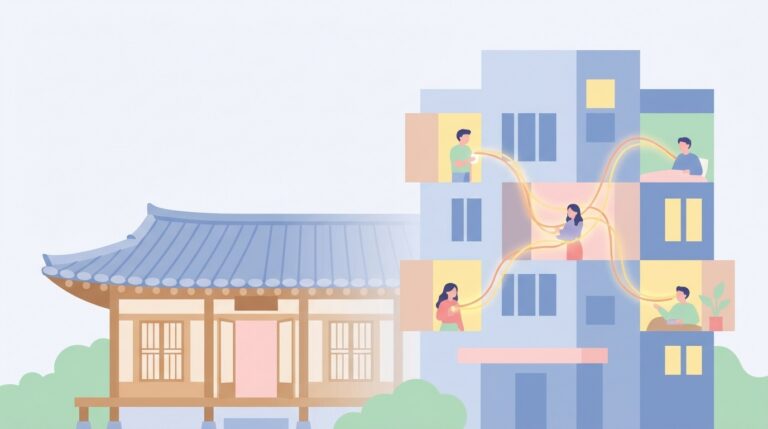
안녕하세요! 매일한글 에디터입니다. (Hello, this is your Daily Hangul Editor!) If you have ever watched Reply 1988 right after an episode of I Live Alone, you have witnessed Korea’s dramatic social shift firsthand. Traditionally, the Korean family was not just a home—it was the primary welfare safety net for care and livelihood. Yet, many advanced learners tell me they freeze when discussing this transition in Korean, struggling to capture the emotional weight behind changing family duties. Built from real Level 5 learner feedback, today’s guide equips you with nuanced vocabulary to discuss familism, solo households, and modern solidarity effortlessly.
Phase 2: Top 3 Core Expressions Deep Dive
1. 가족이 울타리가 되어 주다 (Gajogi ultariga doeeo juda — Family Becomes a Protective Fence)
- Pronunciation: [Ga-jo-gi ul-ta-ri-ga doe-eo ju-da] (Think gah-joh-ghee ool-tah-ree-gah dweh-uh joo-dah, letting doeeo glide smoothly like “dweh-uh”)
- Meaning: Literal: “Family becomes a fence for you.” Actual Nuance: Family acts as a warm, reliable buffer and primary welfare net shielding you from financial crises, illness, and social isolation.
- K-Culture Moment: Think of classic weekend family dramas like My Father is Strange or Reply 1988, where parents quietly absorb economic blows and share everything so their children can keep standing tall.
- Editor’s Insight: In English, a “fence” can sound cold or restrictive. In Korean, ultari (울타리) feels cozy and protective—an emotional and practical shield built when state support was scarce.
- Situation Spectrum: Casual ✅ / Semi-formal ✅ / Formal ✅ (Simply adjust the verb ending, such as
-줘요or-줍니다)- 🤔 Think About It: In your native culture, is family viewed as a protective “fence” responsible for livelihood, or is individual self-sufficiency prioritized the moment you hit adulthood?
2. 각자도생하다 (Gakjadosaenghada — Every Person Fends for Themselves)
- Pronunciation: [Gak-ja-do-saeng-ha-da] (Sounds like gahk-jah-doh-seng-hah-dah, keeping the first k unreleased like the “ck” in “clock” before moving to ja)
- Meaning: Literal: “Each person plans their own survival.” Actual Nuance: Everyone must secure their own livelihood and care because traditional safety nets—family or lifetime jobs—can no longer be counted on.
- K-Culture Moment: Frequently heard in realistic modern K-Dramas like Misaeng and My Liberation Notes, as well as Korean current-affairs podcasts analyzing solo-household (il-in gagu) anxiety.
- Editor’s Insight: As a four-character idiom (sajaseongeo), this phrase carries a bittersweet, slightly weary edge. Koreans rarely say it to celebrate independence; they say it to critique a hyper-competitive world where communal safety nets have thinned.
- Situation Spectrum: Casual ⚠️ (Feels heavy or overly journalistic over casual coffee unless used with dark humor) / Semi-formal ✅ / Formal ✅
- 🤔 Think About It: Does your language have an expression that captures the melancholy of “everyone for themselves,” or does self-reliance carry a purely empowering vibe where you are from?
3. 돌봄의 공백 (Dolbomui gongbaek — The Care Gap / Vacuum of Care)
- Pronunciation: [Dol-bo-mui gong-baek] (Sounds like dohl-boh-meh gohng-bek, where the possessive particle ui softens naturally to “eh”)
- Meaning: Literal: “A blank space of caregiving.” Actual Nuance: The dangerous void created when families can no longer care for aging relatives or vulnerable members, and public welfare has not yet filled the gap—closely tied to godoksa (lonely deaths).
- K-Culture Moment: A recurring keyword in Korean investigative documentaries like PD Notebook or Tracking 60 Minutes covering aging single-person households and neighborhood care networks.
- Editor’s Insight: Nothing screams “Level 5 fluency” faster than swapping a clunky clause for a crisp nominal phrase like dolbomui gongbaek. Honestly, even I feel like a sociology professor whenever I drop this one!
- Situation Spectrum: Casual 🚫 (Too stiff for lighthearted small talk) / Semi-formal ✅ (Ideal in thoughtful conversations) / Formal ✅
- 🤔 Think About It: When traditional family caregiving shrinks in your country, who steps in first—government programs, private services, or neighborhood solidarity?
Phase 3: Textbook Korean vs. Real Korean
Situation 1: Explaining how families historically covered livelihood and welfare
* 📖 Textbook Korean: 전통적으로 한국에서는 가족이 서로의 생계를 책임졌습니다. (Jeontongjeogeuro hangugeseoneun gajogi seoroui saenggyereul chaegimjeotseumnida. — Traditionally in Korea, families took responsibility for each other’s livelihood.)
* 🗣️ Real Korean: 옛날엔 진짜 다들 가족만 믿고 버텼잖아요. 나라에서 챙겨주는 게 별로 없으니까요. (Yennalen jinjja dadeul gajongman mitgo beotyeotjanayo. Naraeseo chaenggyeojuneun ge byeollo eopseunikkayo. — Back then, everyone honestly just trusted family and hung in there, since the country didn’t look after people much.)
* 💡 Why the difference? In everyday speech, Koreans swap dry words like saenggye (livelihood) for visceral verbs like beotida (버티다, to endure/hold on) and chaenggyeojuda (챙겨주다, to look out for someone), capturing the emotional grit of family solidarity.
Situation 2: Describing the shift toward solo living and fading family closeness
* 📖 Textbook Korean: 1인 가구가 증가하면서 가족 간의 유대감이 약화되고 있습니다. (Irin gaguga jeunggahamyeonseo gajok ganui yudaegami yakhwadoego itseumnida. — As single-person households increase, bonds between families are weakening.)
* 🗣️ Real Korean: 요즘엔 혼자 사는 사람도 많고 각자 살기 바빠서, 예전처럼 가족끼리 부대끼며 살기가 쉽지 않죠. (Yojeumen honja saneun saramdo manko gakja salgi bappaseo, yejeoncheoreom gajokkkiri budaekkimyeo salgiga swipji ancho. — These days so many people live alone and are busy with their own lives, so it’s tough to live all huddled up with family like before.)
* 💡 Why the difference? Budaekkida (부대끼다) vividly evokes rubbing shoulders, bickering, and living tightly intertwined—capturing both the warmth and friction of traditional Korean familism far better than textbook yudaegam (solidarity).
Phase 4: K-Culture Deep Dive & Non-verbal Manners
4-1. Nunchi (눈치) & Gestures
Discussing family caregiving, aging parents, or godoksa (고독사, lonely deaths) touches tender personal nerves in Korea. Good nunchi here means softening your tone, leaning in slightly, and nodding steadily (gogaereul kkeudeogida) while listening. Avoid abrupt, judgmental questions like “Why doesn’t your family help?” Instead, keep eye contact gentle and leave brief, respectful pauses—silence in Korean conversation often gives the speaker space to share feelings without feeling interrogated.
4-2. Cultural Code Analysis: From Reply 1988 to My Liberation Notes
In 1980s Korea—immortalized in Reply 1988—public pensions and long-term care insurance were still in their infancy. Neighbors shared side dishes across alleyways, and extended families functioned as an informal welfare state. Fast-forward to modern classics like My Liberation Notes or Our Blues: rapid urbanization and rising solo households have reshaped that safety net. Today, Korean society is actively inventing new forms of connection—”chosen families,” shared hobby clubs, and municipal check-in networks—to protect solo residents from isolation.
Phase 5: Real-life Roleplay Scenario
Setting & Characters: A rain-misted traditional tea house in Bukchon, Seoul. Wooden beams creak softly as steam rises from ceramic cups. Min-jun (34, an urban policy researcher living solo in a Seoul studio) chats with Alex (a Level 5 Korean learner working in Korea).
- Min-jun: 🎭 (따뜻한 쌍화차를 한 모금 마시며 한숨을 쉰다) 요즘 부모님 연세 드시는 걸 보니까 돌봄 문제가 남 일 같지가 않네요. (Yojeum bumonim yeonse deusineun geol bonikka dolbom munjega nam il gatjiga anneyo. — Takes a sip of warm ssanghwa-cha and sighs Seeing my parents get older lately, the issue of caregiving doesn’t feel like someone else’s problem anymore.)
- Alex: 🎭 (고개를 끄덕이며 진지하게 공감한다) 맞아요. 예전에는 가족이 당연히 1차 안전망 역할을 했는데, 요즘은 상황이 많이 달라졌잖아요. (Majayo. Yejeoneneun gajogi dangyeonhi ilcha anjeonmang yeokhareul haenneunde, yojeumeun sanghwangi mani dallajeotjanayo. — Nods earnestly in empathy Right. In the past, the family naturally served as the primary safety net, yet things have changed so much these days.)
- Min-jun: 🎭 (씁쓸한 미소를 지으며) 그렇죠. 국가 복지가 지금처럼 자리 잡기 전엔 오로지 가족끼리 생계를 책임졌으니까요. (Geureocho. Gukga bokjiga jigeumcheoreom jari japgi jeonen oroji gajokkkiri saenggyereul chaegimjeotseunikkayo. — Offers a bittersweet smile Exactly. Before state welfare took root like today, families alone bore the responsibility for livelihood.)
- Alex: 🎭 (조심스럽게 찻잔을 내려놓으며) 그런데 1인 가구도 급증하고 각자도생하는 분위기가 되면서 돌봄의 공백이 커지는 것 같아요. (Geureonde irin gagudo geupjeunghago gakjadosaenghaneun bunwigiga doemyeonseo dolbomui gongbaegi keojineun geot gatayo. — Gently sets down the teacup Still, as single-person households surge and the vibe turns toward fending for oneself, the care gap seems to be widening.)
- Min-jun: 🎭 (눈이 동그래지며 감탄한다) 와, ‘돌봄의 공백’이라는 표현까지 아시다니 대단하네요! 실제로 고독사 예방이 큰 사회적 화두예요. (Wa, ‘dolbomui gongbaek’iraneun pyohyeonkkaji asidani daedanhaneyo! Siljero godoksa yebangi keun sahoejeok hwaduyeyo. — Eyes widen in admiration Wow, it’s amazing you even know the phrase “care gap”! Actually, preventing lonely deaths is a huge social topic right now.)
- Alex: 🎭 (궁금한 듯 몸을 앞으로 기울이며) 그럼 요즘은 가족 대신 어떤 새로운 관계망이 생기고 있나요? (Geureom yojeumeun gajok daesin eotteon saeroun gwangyemangi saenggigo innayo? — Leans forward curiously Then what kind of new social networks are forming in place of family these days?)
- Min-jun: 🎭 (손가락을 꼽으며 밝게 설명한다) 지자체 안부 확인 서비스도 있고, 취향으로 뭉친 동네 커뮤니티나 공유 주거도 늘고 있어요. (Jijache anbu hwagin seobiseudo itgo, chwihyangeuro mungchin dongne keomyunitina gongyu jugeodo neulgo isseoyo. — Counts on his fingers, explaining brightly There are local government check-in services, and neighborhood clubs united by shared tastes or co-living spaces are growing too.)
- Alex: 🎭 (안도한 듯 미소 지으며) 전통적 가족주의는 변했지만, 서로를 챙기는 정(情)의 형태가 진화하고 있는 거네요! (Jeontongjeok gajokjuuineun byeonhaetjiman, seororeul chaenggineun jeongui hyeongtaega jinhwahago inneun geoneyo! — Smiles with relief Traditional familism has changed, yet the way jeong—caring for each other—works is evolving!)
🔀 Interactive Branching Point
Min-jun looks at you curiously and asks: “By the way, how does your country handle solo elders and caregiving?” Choose your reply:
* Option A: 우리 고향에선 다들 개인주의라 가족한테 기대면 무능하다고 봐요. 한국도 빨리 그렇게 돼야죠. (Uri gohyangeseon dadeul gaeinjuuira gajokhante gidaemyeon muneunghadago bwayo. Hangukdo ppalli geureoke dwaeyajyo. — Back home everyone is individualistic, so leaning on family is seen as incompetent. Korea should become like that fast.) -> Feedback [Bad ❌]: Too blunt and culturally dismissive! Dismissing traditional Korean interdependence as “incompetent” will make your Korean friend feel judged.
* Option B: 저희 나라도 비슷한 고민이 많아요. 가족의 부담을 줄이면서 공공 돌봄과 지역 사회가 어떻게 손을 잡을지 계속 논의 중이에요. (Jeohui narado biseutan gomini manayo. Gajogui budameul jurimyeonseo gonggong dolbomgwa jiyeok sahoega eotteoke soneul jabeulji gyesok nonui jungieyo. — My country faces similar worries. We keep discussing how public care and local communities can join hands while easing family burdens.) -> Feedback [Best ✅]: Brilliant! Empathetic, balanced, and uses Level 5 terms like 공공 돌봄 (public care) and 지역 사회 (local community).
* Option C: 저는 아직 젊어서 그런 건 생각 안 해 봤어요. 그냥 알아서 잘 살겠죠. (Jeoneun ajik jeolmeoseo geureon geon saenggak an hae bwasseoyo. Geunyang araseo jal salgetjyo. — I’m still young so I haven’t thought about that. People will just manage on their own.) -> Feedback [Risk ⚠️]: Grammatically natural, but it abruptly shuts down a meaningful conversation and misses a golden moment to build jeong.
Phase 6: 10-Second Emotional Shadowing Drill
Read these out loud, pausing briefly at every / and matching the emotional cue:
[😌 Calmly reflective]예전엔 / 가족이 / 국가 복지를 대신하는 / 든든한 울타리였죠. (Yejeonen / gajogi / gukga bokjireul daesinhaneun / deundeunhan ultariyeotjyo. — In the past, family was a reassuring fence standing in for state welfare.)[😟 Concerned & empathetic]1인 가구가 늘면서 / 돌봄의 공백이 / 사회적 문제로 떠올랐어요. (Irin gaguga neulmyeonseo / dolbomui gongbaegi / sahoejeok munjero tteoollasseoyo. — As single-person households grew, the care gap surfaced as a social issue.)[✨ Hopeful & warm]혈연을 넘어 / 새로운 사회적 관계망이 / 우리를 연결해 줄 거예요. (Hyeoryeoneul neomeo / saeroun sahoejeok gwangyemangi / urireul yeongyeolhae jul geoyeyo. — Beyond blood ties, new social networks will connect us.)
Phase 7: K-Culture Mini Dictionary (4 Core Keywords)
- 1차 안전망 (Ilcha anjeonmang) | Primary safety net | Common in Korean news, policy essays, and social debates to refer to the very first layer protecting someone from poverty or crisis—historically the family in Korea.
- 혈연 중심 가족주의 (Hyeoryeon jungsim gajokjuui) | Bloodline-centered familism | Describes the Confucian tradition of prioritizing biological kin; often contrasted in modern media with 선택적 가족 (seontaekjeok gajok, chosen family).
- 생계와 돌봄 (Saenggyewa dolbom) | Livelihood and care | A staple pairing in workplace and welfare discussions, such as 생계와 돌봄의 이중고 (the double burden of earning a living and caregiving).
- 고독사 예방 (Godoksa yebang) | Prevention of lonely deaths | A vital civic phrase visible on community banners across Korea, referring to neighborhood check-in apps, meal deliveries, and social connection programs.
Phase 8: Traveler’s Survival Kit
Even on a short stay or solo trip in Korea, knowing how local neighborhoods stay connected makes life smoother:
Top 3 Survival Expressions
- 혼자 거주하고 있어요. (Honja geojuhago isseoyo. — I live alone.)
- Pro Tip: Handy when registering at a local community office or signing a short-term studio lease.
- 근처에 주민센터가 어디예요? (Geuncheoe juminseonteoga eodiyeyo? — Where is the nearest community service center?)
- Pro Tip: Korean jumin senteo (주민센터) are neighborhood hubs offering everything from residency paperwork to local cultural classes.
- 비상 연락처로 등록해 주세요. (Bisang yeollakcheoro deungnokhae juseyo. — Please register this as my emergency contact.)
- Pro Tip: Essential for solo travelers filling out hospital, guesthouse, or activity forms.
Editor’s Travel Note
Before stepping out to explore local Seoul neighborhoods, Download the Naver Map App for Korean Local Navigation and Install Kakao T for Seamless Korean Taxi and Transit. Also, keep a T-money card loaded at any convenience store (CU or GS25). Fun cultural tidbit: convenience stores have become modern neighborhood anchors—several Korean municipalities even partner with store clerks to keep a caring eye out for elderly solo residents!
Phase 9: “One Step Deeper” (Thought Question)
For decades, Korea’s rapid modernization leaned heavily on what sociologists call “compressed modernity,” where extended families absorbed welfare costs long before state systems matured. Because filial piety (hyo, 효) framed eldercare and financial support as private moral duties, formal public safety nets evolved later than Korea’s economic boom. Today, with single-person households representing the largest household type nationwide, Korea is quietly redefining uri (우리, we/us)—expanding care from closed bloodlines to open, empathetic civic networks.
💬 Your Turn: How has the balance between family duty and public welfare changed in your home country? Leave a comment below—I read every single one!
Phase 10: FAQ & Mistake Prevention
Q: Is it rude to ask a Korean friend who cares for their aging parents?
A: Yes, if asked bluntly. Because eldercare carries heavy financial, emotional, and hyo (filial piety) expectations, wait for your friend to bring it up naturally and respond with gentle empathy.
Q: Why is “1인 가구” (single-person household) constantly in Korean headlines?
A: Solo households now make up over a third of all homes in South Korea. This shift transforms housing, dining culture, and traditional family-based welfare, making solo-resident support a major national priority.
Q: Does “가족주의” (familism) sound positive or negative in Korean?
A: It depends entirely on context! In nostalgic dramas, it evokes warmth and loyalty; in social critiques, it can carry a critical nuance regarding nepotism or heavy burdens placed on individuals.
🚨 Common Mistakes Warning Board
- Equating
혼자 살다(living alone) with외롭게 살다(living lonely): Assuming every solo resident is miserable sounds patronizing.- Correct Action: Use neutral terms like
1인 가구(single-person household) or자취하다(living independently).
- Correct Action: Use neutral terms like
- Using
효도(filial piety) to critique social issues: Blaming a lack of hyodo for modern care gaps sounds preachy and outdated.- Correct Action: Use structural terms like
돌봄의 사회화(socialization of care) or복지 사각지대(welfare blind spots).
- Correct Action: Use structural terms like
- Mispronouncing
생계(livelihood) as생게: Dropping the subtle glide makes the word unclear in formal talks.- Correct Action: Add a light ‘y’ glide on the second syllable (saeng-gye), keeping your tongue high.
Phase 11: Action Mission & Engagement
- 🥉 Bronze (Solo Practice): Record yourself completing the 10-second shadowing drill in Phase 6 and listen back to check your
/pauses and emotional tone. - 🥈 Silver (SNS Share): Share one Korean sentence you learned today about modern “chosen family” networks on Instagram or Threads with
#DailyHanguland#KoreanCulture. - 🥇 Gold (Real-world Use): On your next call with a Korean tutor or friend, naturally weave
가족이 울타리가 되어 주다or돌봄의 공백into a chat about K-Dramas or society!
🎮 K-Culture Mission: Watch an episode of I Live Alone (나 혼자 산다) or Our Blues (우리들의 블루스) this week and spot one scene where neighbors or friends step in to fill a family care role.
Phase 12: Interactive Quiz Challenge
Test your Level 5 mastery before wrapping up!
- Situational Judgment: Your Korean coworker sighs about rising rent and how tough it is to survive alone without family support. Which reply shows empathetic, natural Level 5 Korean?
- A) 요즘 정말 각자도생하는 분위기라 더 막막하게 느껴질 때가 많죠. (Yojeum jeongmal gakjadosaenghaneun bunwigira deo mangmakhage neukkyeojil ttaega mancho.)
- B) 빨리 가족들이랑 같이 살면서 돈을 아끼세요. (Ppalli gajokdeurirang gachi salmyeonseo doneul akkiseyo.)
- Fill in the Blank: Traditionally in Korea, the family served as the
1차 ______(primary safety net) for livelihood and care. (Hint: Starts with 안) - True or False Culture Quiz: True or False? In modern Korea, local community centers (jumin senteo) and convenience stores are increasingly collaborating to check in on isolated solo residents and prevent lonely deaths (godoksa).
Click here to reveal the answers & explanations!
- Answer: A. Saying 각자도생하는 분위기 (an atmosphere where everyone fends for themselves) and 막막하다 (feeling overwhelmed/at a loss) validates their feelings empathetically. Option B gives unsolicited, impractical advice.
- Answer: 안전망 (anjeonmang). Together, 1차 안전망 means “primary safety net.”
- Answer: True! Several Korean municipalities run programs partnering local jumin senteo social workers with convenience stores and delivery services to check on vulnerable 1-person households and prevent godoksa.
🎬 Watch Our Daily Videos! (Daily Hangul Official Instagram)
Review the expressions you learned in this article with our fun daily short videos! Check out native pronunciation and real-life nuances in action.
- Instagram @dailyhangul_en






