

Phase 1: Empathy (Story-Immersive Opening)
안녕하세요! 매일한글 에디터입니다. (Hello! I’m your Daily Hangul editor.)
Picture this: You finally moved into your new apartment in Seoul. The moving boxes are cleared, the fairy lights are up, and you’re ready to celebrate your new beginning. Naturally, you want to invite your Korean friends and coworkers over for a classic housewarming party—a 집들이 (jip-deu-ri).
Suddenly, the anxiety kicks in as you stare at your KakaoTalk chat window. You want to say: “Come hang out around 6 PM this Saturday! Don’t stress, I’ll send you a map!”
One of our A2 learners, Liam, told us that he previously translated this directly through a translation app and sent: “토요일 6시에 내 집에 오십시오. 지도를 발송합니다.” His Korean friend replied with a nervous laugh: “Liam, are we having a corporate team summit?”
Inviting people over in Korean isn’t about rigid grammar drills; it’s about making your guests feel instantly comfortable (편하게 / pyeon-ha-ge) and showing considerate hospitality before they even ring the doorbell. By mastering today’s phrases, you’ll sound like a thoughtful, natural host who knows how to break the ice with genuine Korean warmth. Let’s dive in!
Phase 2: Core Expressions Deep Dive
1. 토요일 저녁 6시쯤에 편하게 놀러 오세요. (To-yo-il jeo-nyeok yeo-seot-si-jjeum-e pyeon-ha-ge nol-leo o-se-yo.)
- Pronunciation: [To-yo-il jeo-nyeok yeo-seot-si-jjeum-e pyeon-ha-ge nol-leo o-se-yo] (Think of ‘jjeum’ like the English word ‘zoom’ with a short, punchy ‘j’, meaning ‘-ish’ or ‘around’).
- Meaning:
- Literal: “Saturday evening around 6 o’clock, comfortably come to play.”
- Nuance: “Feel free to come hang out around 6 PM this Saturday!”
- K-Culture Moment: You hear this in slice-of-life K-dramas (like Hospital Playlist or Reply 1988) when neighbors or colleagues invite someone over without wanting to sound overly formal or demanding.
- Editor’s Insight: The magic word here is 편하게 (pyeon-ha-ge – comfortably/casually) paired with 놀러 오세요 (nol-leo o-se-yo – come hang out/play). In Korean culture, inviting someone to your private home is intimate. Using 편하게 relieves the guest of feeling like they must arrive in formal attire or bring an expensive luxury gift.
- Situation Spectrum: Casual: ✅ | Semi-formal: ✅ | Formal: ⚠️ (For high-ranking executives or clients, replace with 모시겠습니다 – mo-si-get-seum-ni-da).
- 🤔 Think About It: In English, we say “come hang out,” but Korean literally uses the verb “to play” (놀다 – nol-da). Why do you think Korean adults still use the word “play” when spending time together?
2. 약도 보내 드릴게요. (Yak-do bo-nae deu-ril-ge-yo.)
- Pronunciation: [Yak-do bo-nae deu-ril-ge-yo] (Yak sounds like ‘yacht’ with a sharp ‘k’ ending; do sounds like ‘dough’).
- Meaning:
- Literal: “I will humbly send you a simplified sketch map.”
- Nuance: “I’ll send you the directions and location pin!”
- K-Culture Moment: In Korea’s dense urban neighborhoods, apartment complexes (아파트 단지) or alley villas (빌라) can be a confusing maze. Sending a “약도” (a captured map pin or route guide) via KakaoTalk is the golden standard of modern Korean etiquette.
- Editor’s Insight: While 지도 (ji-do) means a general map, 약도 (yak-do – 略圖) specifically means a simplified location guide or shortcut map highlighting nearby subway exits and landmarks. Using ~해 드릴게요 (-hae deu-ril-ge-yo) adds a polite, caring touch showing you are taking care of them.
- Situation Spectrum: Casual: ⚠️ (To very close peers, say “약도 보내줄게” – yak-do bo-nae-jul-ge) | Semi-formal: ✅ | Formal: ✅
- 🤔 Think About It: How does sending a visual shortcut map reflect the Korean service mindset of anticipating someone’s inconveniences beforehand?
3. 부담 없이 오세요. (Bu-dam eop-si o-se-yo.)
- Pronunciation: [Bu-dam eop-si o-se-yo] (Bu-dam sounds like ‘boo-dahm’; eop-si sounds like ‘up-she’).
- Meaning:
- Literal: “Come without burden.”
- Nuance: “Don’t feel pressured (no need to bring anything heavy or expensive)!”
- K-Culture Moment: Whenever someone is invited to a housewarming in Korea, the guest feels an immediate social obligation to bring a thoughtful gift. The host says this phrase to ease that psychological pressure.
- Editor’s Insight: 부담 (bu-dam) translates to “burden” or “pressure.” Saying 부담 없이 오세요 conveys: “Your presence is the real present.” Even though Koreans will almost certainly still bring a small gift, saying this proves you are a considerate host.
- Situation Spectrum: Casual: ✅ | Semi-formal: ✅ | Formal: ✅
- 🤔 Think About It: Does your native language have a phrase that explicitly tells visitors not to feel psychological burden when visiting?
Phase 3: Textbook Korean vs. Real-World Korean
Situation 1: Setting the Date and Inviting a Friend
- 📖 교과서 한국어 (Textbook Korean): 저의 집에 방문해 주십시오. (Jeo-ui jib-e bang-mun-hae ju-sip-si-o. / Please visit my residence.)
- 🗣️ 진짜 한국어 (Real-World Korean): 이번 주말에 저희 집으로 편하게 놀러 오세요! (I-beon ju-mal-e jeo-hui jib-eu-ro pyeon-ha-ge nol-leo o-se-yo! / Come hang out at our place this weekend, totally casually!)
- 💡 왜 다를까? (Why is it different?): “방문하다” (to visit) sounds like an official diplomatic delegation or a business audit. Using “놀러 오다” (to come hang out/play) creates a warm, welcoming, and relaxed mood.
Situation 2: Sharing Directions & Address
- 📖 교과서 한국어 (Textbook Korean): 주소와 지도를 송부하겠습니다. (Ju-so-wa ji-do-reul song-bu-ha-get-seum-ni-da. / I will transmit the address and map.)
- 🗣️ 진짜 한국어 (Real-World Korean): 카톡으로 주소랑 약도 찍어 보내 드릴게요! (Ka-tok-eu-ro ju-so-rang yak-do jjik-eo bo-nae deu-ril-ge-yo! / I’ll pin and send the address and directions on KakaoTalk!)
- 💡 왜 다를까? (Why is it different?): Koreans rarely say “송부하다” (transmit/dispatch documents) in daily personal life. Instead, they use the vivid spoken idiom “찍어 보내다” (to stamp/pin a digital link and send it).
Phase 4: K-Culture Deep Dive & Non-Verbal Manners
4-1. 눈치 (Nunchi) & Housewarming Manners
- Arrival Timing: Never arrive 20 minutes early! In Korea, hosts are often furiously cleaning or frying the final dishes right up until the exact minute. Arriving 5 minutes after the agreed time is considered good manners (센스 / sense).
- The Threshold Ritual: When stepping into the 현관 (hyeon-gwan – entrance foyer), step out of your shoes without letting your socks touch the dirty outdoor tile. Spin your shoes around so the toes face the door—this displays refined manners.
- Receiving Gifts: When your guest hands you a housewarming gift with both hands, accept it with both hands, lightly bowing your head with an appreciative reaction: “어머, 뭘 이런 걸 사 오셨어요! (Oh my, you really didn’t have to bring this!)”.
4-2. Culture Code: The Secret Meaning of Jipdeuri Gifts
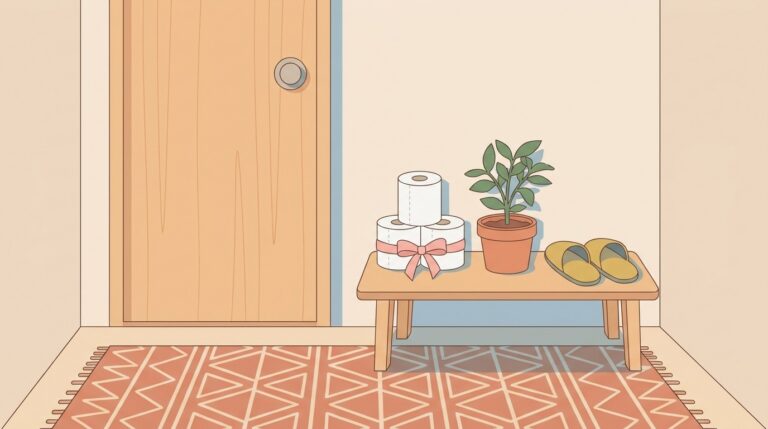
Why do Koreans bring giant packs of toilet paper and liquid laundry detergent to a housewarming party? It is not because they think your house is dirty!
* 🧻 휴지 (Toilet Paper): Just as toilet paper unrolls smoothly and effortlessly (술술 풀리다), it symbolizes that all your future affairs, career, and finances will unravel smoothly without snags.
* 🧼 세제 (Laundry Detergent): The foaming suds and bubbles (거품) represent wealth and prosperity bubbling up rapidly in your new home.
* 🕯️ Scented Candles & Diffusers: In modern one-room studios (원룸), traditional giant bulk packages can take up too much space, so trendy young Koreans now frequently gift diffusers or house plants to fill the new home with good energy and pleasant fragrance.
Phase 5: Real-Life Roleplay Scenario
Setting: Liam has just moved into an apartment near Hongdae. He is inviting his Korean colleague, Min-ji, during a coffee break.
- Liam: 민지 씨, 저 이번에 홍대로 이사 끝났어요! (Min-ji ssi, jeo i-beon-e Hong-dae-ro i-sa kkeut-nat-eo-yo! / Min-ji, I finally finished moving to Hongdae!)
- Min-ji: 🎭 [Claps hands with wide eyes] 정말요? 축하해요, 리암 씨! 집들이 언제 해요? (Jeong-mal-yo? Chuk-ha-hae-yo, Liam ssi! Jip-deu-ri eon-je hae-yo? / Really? Congratulations, Liam! When are you having the housewarming?)
- Liam: 이번 주 토요일 저녁 6시쯤에 편하게 놀러 오세요. (I-beon ju to-yo-il jeo-nyeok yeo-seot-si-jjeum-e pyeon-ha-ge nol-leo o-se-yo. / Feel free to come hang out this Saturday around 6 PM.)
- Min-ji: 토요일 저녁이요? 좋아요! 그런데 집 찾기 어렵지 않아요? (To-yo-il jeo-nyeok-i-yo? Joh-a-yo! Geu-reon-de jip chat-gi eo-ryeop-ji anh-a-yo? / Saturday evening? Sounds great! But isn’t it hard to find your house?)
- Liam: 골목이 조금 헷갈려요. 제가 카톡으로 약도 보내 드릴게요. (Gol-mok-i jo-geum het-gal-lyeo-yo. Je-ga ka-tok-eu-ro yak-do bo-nae deu-ril-ge-yo. / The alleys are a bit confusing. I’ll send you the directions on KakaoTalk.)
- Min-ji: 고마워요! 필요한 거 있어요? 휴지 사 갈까요? (Go-ma-wo-yo! Pil-yo-han geo iss-eo-yo? Hyu-ji sa gal-kka-yo? / Thanks! Do you need anything? Should I buy some toilet paper?)
- Liam: 🎭 [Waves hands gently with a humble smile] 아니에요, 다 있어요! 정말 부담 없이 그냥 오세요. (A-ni-e-yo, da iss-eo-yo! Jeong-mal bu-dam eop-si geu-nyang o-se-yo. / No, no, I have everything! Really, please just come without any burden.)
- Min-ji: 그래도 빈손으로 갈 순 없죠! 토요일에 봐요! (Geu-rae-do bin-son-eu-ro gal sun eop-jyo! To-yo-il-e bwa-yo! / Still, I can’t come empty-handed! See you on Saturday!)
🔀 Interactive Decision Point
Min-ji asks you: “집들이 음식 준비 많이 했어요? (Did you prepare a lot of housewarming food?)” How do you respond?
- Option A: “네, 엄청 많이 했으니까 배고프게 오세요! (Yes, I prepared a ton, so come hungry!)”
- 👉 Feedback (Best!): Perfect! It sounds confident, warm, and sets a fun, generous mood.
- Option B: “아니요, 아무것도 없어요. 밥 먹고 오세요. (No, I have nothing. Please eat before you come.)”
- 👉 Feedback (Bad): Inviting someone to a Korean 집들이 and telling them to eat beforehand is considered quite unwelcoming and awkward!
- Option C: “제가 요리를 못해서 그냥 배달 음식 시켜 먹어요. (I’m not good at cooking, so let’s just order delivery food.)”
- 👉 Feedback (Acceptable/Risk): Very honest and common among young people, but make sure to add “맛있는 거 시켜 드릴게요! (I’ll order something delicious for you!)” so it sounds hospitable.
Phase 6: 10-Second Emotion Shadowing Drill
Practice speaking with real emotional cadence! The slashes (/) represent natural micro-pauses.
[😊 Warm and welcoming]- 이번 주 토요일 / 저녁 6시쯤에 / 편하게 놀러 오세요!
(I-beon ju to-yo-il / jeo-nyeok yeo-seot-si-jjeum-e / pyeon-ha-ge nol-leo o-se-yo!) - “Feel free to come hang out / around 6 PM / this Saturday!”
- 이번 주 토요일 / 저녁 6시쯤에 / 편하게 놀러 오세요!
[📍 Helpful and reassuring]- 골목이 복잡하니까 / 제가 약도 / 찍어서 보내 드릴게요.
(Gol-mok-i bok-jap-ha-ni-kka / je-ga yak-do / jjik-eo-seo bo-nae deu-ril-ge-yo.) - “The alleys are tricky, / so I’ll pin the directions / and send them over to you.”
- 골목이 복잡하니까 / 제가 약도 / 찍어서 보내 드릴게요.
[💖 Modest and considerate]- 선물은 정말 괜찮으니까 / 부담 없이 / 그냥 오세요!
(Seon-mul-eun jeong-mal gwaen-chanh-eu-ni-kka / bu-dam eop-si / geu-nyang o-se-yo!) - “Presents are really not necessary, / so without any pressure, / just come on over!”
- 선물은 정말 괜찮으니까 / 부담 없이 / 그냥 오세요!
Phase 7: K-Culture Mini Dictionary
- 집들이 (Jip-deu-ri) | Noun
- Translation: Housewarming party / celebration.
- Everyday Use: Consists of inviting friends, touring the new space, sharing a hearty meal, and receiving blessing gifts for good luck.
- 약도 (Yak-do) | Noun
- Translation: Simplified sketch map / directions snippet.
- Everyday Use: Unlike a giant geographic map, a yak-do focuses purely on navigational landmarks (e.g., “Come out of Exit 3, turn left at the convenience store”).
- 빈손 (Bin-son) | Noun
- Translation: Empty hands.
- Everyday Use: Often used in the social etiquette rule: “남의 집들이에 빈손으로 가면 안 돼요 (You shouldn’t visit someone’s housewarming empty-handed).”
- 집들이 음식 (Jip-deu-ri Eum-sik) | Noun
- Translation: Housewarming food.
- Everyday Use: Traditionally home-cooked staples like Bulgogi, Japchae, or Galbi-jjim. Nowadays, popular modern hosts curate a spread of premium delivery food arranged aesthetically on neat tableware.
Phase 8: Traveler & Expat Survival Kit
Survival Phrases TOP 3
- 어디쯤 오셨어요? (Eo-di-jjeum o-syeo-sseo-yo?)
- Pro Tip: Use this text message when your guest is slightly late. It politely asks “Around where are you now?” without sounding impatient.
- 근처에 다 와서 연락드렸어요. (Geun-cheo-e da wa-seo yeon-rak-deu-ryeo-sseo-yo.)
- Pro Tip: When visiting someone, text this to the host: “I’m contacting you because I’m almost nearby.” It gives them a 2-minute heads-up to open the front door.
- 실내화 신으시면 돼요. (Sil-nae-hwa sin-eu-si-myeon dwae-yo.)
- Pro Tip: Greet your guests at your apartment entryway by pointing to guest slippers and saying this phrase (“You can wear indoor slippers”).
Editor’s Travel Note: Navigation Mastery
Foreign map apps like Google Maps often struggle with pedestrian walking routes inside Korean residential backstreets. When sending directions to your house, download the Naver Map navigation app guide or KakaoMap route navigation. You can save your home address as a bookmark, copy the direct sharing link (공유 링크), and paste it directly into KakaoTalk so your friends can navigate right to your door with turn-by-turn guidance.
Phase 9: “One Step Deeper” (Cultural Reflection)
Have you ever noticed that Koreans rarely say “내 집 (my house)” and almost always say “우리 집 (our house)”, even if they live completely alone in a tiny studio?
This linguistic habit stems from Korea’s deeply rooted collective culture (정 – Jeong). Welcoming someone into your living space is not viewed as inviting an outsider onto private property; it is an act of opening your communal bubble and sharing comfort (편안함). When you tell someone “편하게 놀러 오세요,” you are symbolically offering them a sanctuary where they can put down their social guards, share warm food, and recharge.
💬 Your Turn: In your home country, what is the customary gift to bring when visiting someone’s new home? Do you have an equivalent concept to “empty hands” (빈손)? Share your thoughts below!
Phase 10: FAQ & Avoiding Misunderstandings
Q: If the host insists “부담 없이 오세요 (Don’t bring anything)”, should I really bring nothing?
A: Absolutely not! In Korean social culture, this is considered humble politeness (예의). If you show up truly empty-handed (빈손), it can be awkward. You don’t need an extravagant gift—a simple roll of premium toilet paper, high-quality dish soap, fruit, or dessert (like a roll cake) is the golden standard.
Q: What is the difference between “약도 (yak-do)” and “지도 (ji-do)”?
A: 지도 (ji-do) is a formal map displaying actual geography, coordinates, and scale. 약도 (yak-do) is a simplified diagram or curated directions created specifically to guide someone from a known point (like a subway exit) to an exact destination.
Q: Can I use “놀러 와 (nol-leo wa)” with my Korean manager or boss?
A: No! “놀러 와” or “놀러 오세요” is intended for friends, colleagues of similar rank, or younger acquaintances. For a boss, senior professor, or elderly guest, you should use formal honorific phrases such as: “저희 집에 모시고 싶습니다 (I would be honored to host you at our home).”
🚨 흔한 실수 (Common Mistakes)
- Mistake 1: Demanding an exact arrival minute (“토요일 정각 6시 00분에 오세요”).
- Correct Action: Soften your invitation by adding ~쯤 (around/approximate): “6시쯤에 편하게 오세요 (Come around 6ish casually).”
- Mistake 2: Greeting your guest at the door with outside shoes still on.
- Correct Action: Keep the entryway clean and have house slippers (실내화) lined up facing the guest.
- Mistake 3: Translating “Please visit” as “방문해 주세요” in casual peer group chats.
- Correct Action: Use 놀러 오세요 (nol-leo o-se-yo) to keep the mood lively and friendly!
Phase 11: Action Missions
- 🥉 Bronze Mission (Solo Practice): Stand in front of your mirror and practice saying: “토요일 저녁 6시쯤에 편하게 놀러 오세요, 약도 보내 드릴게요!” three times with a bright, welcoming smile.
- 🥈 Silver Mission (KakaoTalk Practice): Open your KakaoTalk or messaging notes and draft an actual housewarming invitation message using 편하게, ~쯤, and 부담 없이.
- 🥇 Gold Mission (Real Life Application): The next time you invite a friend for coffee, lunch, or to your room, send a location pin and use the phrase: “약도 보내 드릴게요!”
- 🎮 K-Culture Mission: Watch a modern Korean lifestyle vlog or K-drama episode featuring a moving day. Spot what kind of gifts the visitors carry when they walk through the front door!
Phase 12: Interactive Quiz Challenge
Test your knowledge from today’s guide!
Quiz 1: Situation Judgment
You want to invite your Korean classmate to your new apartment this Friday afternoon around 5. Which sentence is the most natural?
1. 금요일 5시에 저의 가옥으로 방문하십시오.
2. 금요일 5시쯤에 저희 집에 편하게 놀러 오세요.
3. 금요일에 지도 송부할 테니 오시기 바랍니다.
Quiz 2: Fill in the Blank
Complete the sentence to tell your friend not to feel pressured to bring gifts:
* “선물은 괜찮으니까, (____) (____) 그냥 오세요!”
Quiz 3: Cultural True or False
- True or False: Gifting a giant pack of toilet paper at a Korean housewarming party is an insult that implies the apartment is unclean.
👉 Click to view answers and explanations!
- Quiz 1 Answer: 2번 (금요일 5시쯤에 저희 집에 편하게 놀러 오세요.). Option 1 and 3 sound like overly rigid corporate legal notices!
- Quiz 2 Answer: 부담 없이 (bu-dam eop-si) — meaning “without burden/pressure.”
- Quiz 3 Answer: False! Toilet paper symbolizes that problems will unroll easily and smoothly (술술 풀리다). It is one of the most auspicious and beloved traditional housewarming gifts in Korea!
🎬 Watch Our Daily Videos! (Daily Hangul Official Instagram)
Review the expressions you learned in this article with our fun daily short videos! Check out native pronunciation and real-life nuances in action.
- Instagram @dailyhangul_en







