

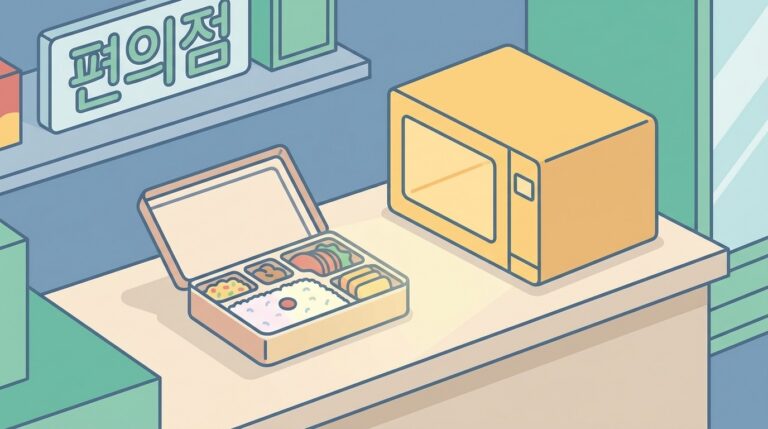
Master the Korean Convenience Store: How to Heat Your Lunchbox Like a Pro
Phase 1: Empathy & Storytelling Opening
안녕하세요! 매일한글 에디터입니다. (Hello! This is your Daily Hangul editor.)
Imagine this: It is 11:30 PM in Hongdae. Your stomach is growling after a long flight, and you step into a brightly lit CU or GS25. The refrigerated shelves look like culinary paradise—neatly stacked rows of savory Bulgogi dosirak (도시락, lunchboxes), spicy pork, rolled omelets, and kimchi. You grab your dream meal with triumph, but as soon as you touch the plastic container, a cold reality hits you: it is ice-cold.
You shuffle to the cashier. The clerk scans the barcode with lightning speed: BEEP. Now comes the dilemma. In your home country, stores might not have microwaves, or the cashier might warm food automatically. In Korea, some staff heat it for you, while other shops expect you to use the customer microwave corner yourself. You freeze. How do you ask them to warm it up without awkwardly flapping your hands or making buzzing microwave sounds?
Take a deep breath! Over the past decade, we have guided hundreds of first-time travelers through this exact late-night panic. Convenience store dining is a beloved pillar of daily Korean life, and learning just one or two polite beginner phrases turns an intimidating counter encounter into a smooth, rewarding victory. Let’s make you sound like a savvy local in under five minutes!
Phase 2: 3 Core Expressions in Depth
1. 이거 데워 주세요 (Igeo deowo juseyo)
- Pronunciation: ee-guh deh-woh joo-seh-yo (Think of “day” followed by “war”—deh-woh—smoothly gliding into joo-seh-yo)
- Meaning: “Please heat this up.” (Literal: “This / warm up / please give me”)
- K-Culture Moment: Seen in countless K-Dramas whenever hungry university students or exhausted office workers grab a late-night bite after overtime.
- Editor’s Insight: This is your golden master-key phrase! You don’t even need to say the word “microwave.” Just pointing to your lunchbox with both hands and saying 이거 데워 주세요 (Igeo deowo juseyo) communicates everything instantly.
- Situation Spectrum:
- Casual (Friends): 🚫 (Too polite for close peers)
- Semi-formal (Store clerks, strangers): ✅ (The ideal, natural standard)
- Formal (Job interview, presentation): ⚠️ (Use 데워 주시겠습니까 instead)
- 🤔 Think About It: In English, we often say “Can you microwave this?” focusing on the tool. Korean focuses on the result: making it warm (데우다). Isn’t it fascinating how the language highlights the comforting warmth of the meal?
2. 전자레인지 어디 있어요? (Jeonjareinji eodi isseoyo?)
- Pronunciation: jeon-ja-reh-in-jee uh-dee eess-uh-yo? (Rhymes with “John-ja-range uh-dee e-saw-yo”)
- Meaning: “Where is the microwave?” (Literal: “Microwave / where / is there?”)
- K-Culture Moment: Essential when you visit a self-service convenience store near the Han River where customers prepare their own ramyeon and dosirak by the window.
- Editor’s Insight: 전자레인지 (Jeonjareinji) is a loan-blend of Sino-Korean 전자 (electronic) and the English word range (stove). If the clerk hands the cold lunchbox back to you in a plastic bag, don’t worry! It just means their microwave is self-service. Ask this question while looking around.
- Situation Spectrum:
- Casual: 🚫
- Semi-formal: ✅
- Formal: ⚠️
- 🤔 Think About It: Notice the word order: Object (전자레인지) + Location (어디) + Verb (있어요). Getting used to placing the topic first is the fastest way to master Korean sentence structure.
3. 여기서 먹고 가도 돼요? (Yeogiseo meokgo gado dwaeyo?)
- Pronunciation: yuh-ghee-suh muk-goh gah-doh dway-yo?
- Meaning: “Can I eat here?” (Literal: “Here / eat and go / is it okay?”)
- K-Culture Moment: The classic convenience store dining experience featured in travel vlogs, sitting at the counter stools watching the street outside.
- Editor’s Insight: While most Korean convenience stores have high stools and counters, smaller city shops might restrict indoor dining during peak cleaning times. Asking this polite question shows immense respect for the shop’s rules.
- Situation Spectrum:
- Casual: 🚫
- Semi-formal: ✅
- Formal: ⚠️
- 🤔 Think About It: Korean culture places high value on communal order (질서). Checking whether eating in is permitted proves you understand local store etiquette.
Phase 3: Textbook Korean vs Real Korean
Situation 1: Asking the clerk to warm your food
- 📖 Textbook Korean: 이 도시락을 전자레인지로 가열해 주시겠습니까? (I dosirageul jeonjareinjiro gayeolhae jusigesseumnikka? – “Would you please heat this lunchbox with a microwave device?”)
- 🗣️ Real Korean: 이거 데워 주세요. (Igeo deowo juseyo. – “Please heat this up.”)
- 💡 Why is it different? Textbook phrases sound like an operating manual! Real Koreans drop grammatical particles (을/를) in spoken conversation and prefer the simple verb 데우다 (to warm up) over technical terms like 가열하다 (to heat/combust).
Situation 2: Doing it yourself at the counter
- 📖 Textbook Korean: 제가 직접 조작하여 가열하도록 하겠습니다. (Jega jikjeop jojakhayeo gayeolhadorok hagesseumnida. – “I shall personally manipulate the controls to heat it.”)
- 🗣️ Real Korean: 제가 직접 돌릴게요! (Jega jikjeop dollilgeyo! – “I will spin (heat) it myself!”)
- 💡 Why is it different? Koreans colloquially describe microwaving as 돌리다 (to spin/turn), because the circular plate inside the microwave rotates. It is vibrant, friendly, and 100% natural!
Phase 4: K-Culture Deep Dive & Non-Verbal Manners
4-1. Nunchi (눈치) & Gestures
When handing your lunchbox to the cashier or paying with your travel card, always use two hands (or support your right forearm lightly with your left hand). This small physical gesture signals politeness and good manners (예의).
Also, keep your nunchi (situational awareness) sharp! Look at the counter:
* If there is a commercial-grade silver microwave behind the cashier: Hand the item and say “이거 데워 주세요 (Igeo deowo juseyo).”
* If you spot an island counter near the trash bins with 2–4 white microwaves: The store is self-service. Simply pay first, head over to the microwave table, open the door, pop your lunchbox in, and press the preset button matching your meal.
4-2. The Convenience Store as a Cultural Sanctuary
In Korean media—from the drama My Liberation Notes to variety shows like I Live Alone—the 24-hour convenience store (편의점, Pyeon-ui-jeom) is never just a grocery outlet. It is a late-night sanctuary. You will see office workers sharing canned beers, students comparing notes over cup ramyeon, and travelers savoring high-quality chef-collaborated dosirak. When you warm your lunchbox and sit at the window counter, you aren’t just eating cheap food; you are partaking in an iconic modern Korean ritual.
Phase 5: Real-Life Roleplay Scenario
Setting: A vibrant GS25 store near Gangnam Station. The fluorescent lights gleam, and upbeat K-Pop plays gently in the background.
Characters: You (jet-lagged explorer) and Minho (a friendly part-time worker wearing a tidy GS25 apron).
- You: 안녕하세요! 저… 이거 데워 주세요. (Annyeonghaseyo! Jeo… igeo deowo juseyo. – “Hello! Um… please heat this up.”)
🎭 Action: You place the pork cutlet dosirak on the counter using both hands and offer a small bow. - Minho: 네! 뚜껑 열고 1분 30초 돌려 드릴게요. (Ne! Ttugkeong yeolgo il-bun samsip-cho dollyeo deurilgeyo. – “Sure! I will take off the lid and warm it for 1 minute and 30 seconds.”)
🎭 Action: Minho swiftly loosens the transparent lid and puts it into the high-powered microwave behind him. - You: 감사합니다! 저, 젓가락 있어요? (Gamsahamnida! Jeo, jeotgarak isseoyo? – “Thank you! Excuse me, are there chopsticks?”)
🎭 Action: You point lightly toward the food. - Minho: 네, 봉투에 같이 넣어 드려요. 봉투 필요하세요? (Ne, bongtue gachi neoeo deuryeoyo. Bongtu piryohaseyo? – “Yes, I will put them together in a bag. Do you need a plastic bag?”)
🎭 Action: Minho holds up a small biodegradable plastic bag. - You: 아니요, 봉투는 괜찮아요! (Aniyo, bongtuneun gwaenchanayo! – “No, the bag is fine [not needed]!”)
🎭 Action: You gently wave one hand to decline. - Minho: 알겠습니다. 계산 도와드릴게요. (Algesseumnida. Gyesan dowadeurilgeyo. – “Understood. I will help you with payment.”)
🎭 Action: Minho taps the screen and gestures toward the card reader. - You: 여기서 먹고 가도 돼요? (Yeogiseo meokgo gado dwaeyo? – “Can I eat here?”)
🎭 Action: You point toward the window counter with two stools. - Minho: 그럼요! 저기 테이블 이용하시면 돼요. 맛있게 드세요! (Geureomyo! Jeogi teibeul iyonghasimyeon dwaeyo. Mas-itge deuseyo! – “Of course! You can use the table over there. Enjoy your meal!”)
🎭 Action: The microwave beeps 딩동 (Ding-dong), and Minho hands you your warm meal alongside wooden chopsticks.
🔀 Interactive Decision Point
Minho points to a promo sign next to your drink that says 1+1 (Won Plus Won). What do you do?
* Option A: Say nothing, pay quickly, and leave with one bottle.
Feedback: [Risk] You paid for one, but in Korea, a 1+1 promotion means the second identical item is 100% free! If you leave it behind, you are missing out on free food or drink!
* Option B: Ask: “하나 더 가져와요?” (Hana deo gajyeowayo? – “Do I bring one more?”) with a curious smile.
Feedback: [Best!] Perfect! Minho will nod cheerfully and say “네, 하나 더 가져오세요!” (Yes, bring one more!). You just unlocked the ultimate Korean shopping perk!
* Option C: Shout “공짜 주세요!” (Gongjja juseyo! – “Give me free stuff!”)
Feedback: [Bad] While 공짜 means free, shouting it can sound aggressive or rude. Sticking to simple questions keeps your interaction warm and respectful.
Phase 6: 10-Second Emotion Shadowing Drill
Practice reading these out loud with rhythm and emotional markers!
[😊 Polite and friendly]
이거 / 데워 주세요!
(Igeo / deowo juseyo!)
→ “Please / warm this up!”-
[🤔 Curious and polite]
전자레인지 / 어디 있어요?
(Jeonjareinji / eodi isseoyo?)
→ “Microwave / where is it?” -
[🙏 Grateful and clear]
나무젓가락 / 하나만 주세요.
(Namu-jeotgarak / hanaman juseyo.)
→ “Wooden chopsticks / just one please.”
Phase 7: K-Culture Mini Dictionary
- 도시락 (Dosirak) | Korean Bento / Packed Meal
A pre-packaged tray containing rice, savory meat, and assorted Korean side dishes (반찬, banchan). A true budget-friendly lifesaver starting at around 4,500 KRW ($3.50 USD). - 전자레인지 (Jeonjareinji) | Microwave Oven
Everyday appliance present in all convenience stores. Most store dosirak packages list heating times on the front label (e.g., 매장용 1분 30초 = Store model 1 min 30 sec). - 삼각김밥 (Samgak-gimbap) | Triangle Rice Ball
Savory rice wrapped in crisp seaweed with fillings like tuna mayo (참치마요) or spicy pork (제육). Pro tip: Heat it for just 15 to 20 seconds so the rice becomes tender while keeping the nori crisp! - 1+1 / 2+1 (Won-plus-won / Too-plus-won) | Korean Value Promotion
The legendary hallmark of Korean convenience stores! Buying items marked with these tags entitles you to an extra item for free.
Phase 8: Traveler’s Survival Kit
Survival Expressions TOP 3
- 젓가락 챙겨 주세요. (Jeotgarak chaeng-gyeo juseyo.)
Meaning: Please give me chopsticks.
Pro Tip: Wooden chopsticks are usually kept beneath the counter. Cashiers often include them automatically, but if they forget, this phrase saves the day. - 봉투 필요 없어요. (Bongtu piryo eopseoyo.)
Meaning: I don’t need a bag.
Pro Tip: Plastic bags incur a tiny 20–100 KRW environmental fee across South Korea. If you have a backpack, use this line! - 영수증 버려 주세요. (Yeongsujeung beoryeo juseyo.)
Meaning: Please throw away the receipt.
Pro Tip: Super practical! Many Koreans prefer to leave paper receipts behind.
Editor’s Travel Note
- Navigation: Google Maps often has limited pedestrian navigation inside South Korea. Always use a dedicated tool like the Naver Map app download guide to locate 24-hour convenience stores within seconds.
- Transit & Payment: You can pay for your convenience store dosirak using your transit card (T-Money or Climate Card)! Simply tap your card on the reader where credit cards are inserted.
Phase 9: A Step Deeper (한 발 더 깊이)
Have you noticed how many Korean sentences end with ~주세요 (~juseyo)? Derived from the honorific verb 주다 (to give), it transforms any noun or basic request into an inherently polite plea: “Please do this as a favor for me.”
In Korean society, convenience stores are designed around the concept of mutual convenience and rapid pace (빨리빨리, ppalli-ppalli). The system respects both your time and the worker’s effort. When you say “데워 주세요” instead of a demanding command, you acknowledge the person behind the counter not as an automated service robot, but as a helpful neighbor in your community.
💬 Your Turn: What is the first Korean convenience store item you plan to warm up when you land in Seoul? A bulgogi bento, a spicy triangle kimbap, or cheese ramyeon? Tell us in the comments below!
Phase 10: FAQ & Common Mistakes
Q: Can I microwave the lunchbox with the plastic lid on?
A: Most Korean dosirak lids are made of microwave-safe PET or PP plastic, but standard practice is to gently remove or tilt the lid slightly to let steam vent safely. Look for the phrase 뚜껑을 열고 (Open lid) or 뚜껑을 덮고 (Keep lid on) written on the transparent film!
Q: What does “1000W / 700W” mean on the microwave?
A: Commercial store microwaves behind the counter are usually high-power (1000W), warming food in about 1 minute and 30 seconds. Home or self-service customer microwaves might be 700W, which requires about 2 minutes. The packaging always lists both times side-by-side!
Q: Is hot water for cup noodles completely free?
A: Yes! Every convenience store provides continuous boiling hot water dispensers (온수기) free of charge when you purchase ramyeon or instant soup at the store.
🚨 Common Mistakes Warning Board
| Mistake | Why it Causes Confusion | Correct Action |
|---|---|---|
| 1. Putting metallic cup noodles in the microwave | Foil lids will spark and cause fires! | Check if the cup says 전자레인지용 (Microwave-safe paper) before putting noodles in. |
| 2. Walking away without your +1 item | Promos are not automatically bundled at the shelf. | Bring both items to the cash register yourself during 1+1 promotions. |
| 3. Leaving your trash on the dining counter | Korean stores have strict trash separation systems. | Throw plastic, food scraps, and general waste into the clearly labeled bins nearby. |
Phase 11: Action Missions
- 🥉 Bronze Mission (Solo Practice): Stand in front of your home microwave. Hold a plate, smile, and say “이거 데워 주세요 (Igeo deowo juseyo)!” three times with crisp pronunciation.
- 🥈 Silver Mission (Social Share): Snap a photo of your favorite Asian snack or lunchbox, post it on Instagram or TikTok, and caption it: “오늘 점심은 이거 데워 주세요! (#DailyHangul #KoreanConvenienceStore)”.
- 🥇 Gold Mission (Real-Life Challenge): On your next trip to Korea (or at a local Korean supermarket with a hot foods section), order entirely in Korean using our 3 core expressions!
🎮 K-Culture Mission: Watch any episode of a contemporary K-Drama (like Business Proposal or Hospital Playlist). Listen carefully during any convenience store scene and see if you can hear the characters say ~주세요 (~juseyo) or 전자레인지 (jeonjareinji)!
Phase 12: Interactive Quiz Challenge
1. Situational Judgment:
You bought a delicious pork dosirak. The clerk scans it, takes your payment, and gently places it back into your shopping bag cold. What should you ask?
* A) 이거 왜 안 줘요? (Why aren’t you giving this to me?)
* B) 전자레인지 어디 있어요? (Where is the microwave?)
* C) 집에 갈게요. (I will go home.)
2. Fill-in-the-Blank:
Complete the sentence to politely ask someone to heat your food:
이거 ______ 주세요. (Hint: “warm up”)
3. True or False:
In South Korea, if an item is marked 1+1, the cashier will run to the shelf and fetch the free second item for you automatically.
👉 Click here for Answers & Explanations
- Answer: B (전자레인지 어디 있어요?)
Explanation: If the clerk doesn’t warm it behind the counter, the store features a customer self-service microwave counter! Asking where it is located allows you to heat it yourself effortlessly. - Answer: 데워 (deowo)
Explanation: 데워 주세요 (Deowo juseyo) means “Please heat/warm this up for me.” - Answer: False!
Explanation: You must bring both items to the cash register yourself! Keep your eyes open for 1+1 tags on drinks, snacks, and desserts before heading to checkout.






