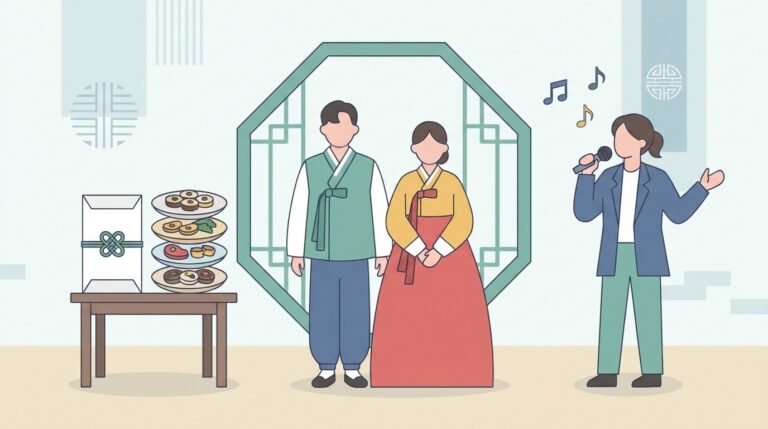
Phase 1: Why Modern Korean Weddings Surprise Everyone
안녕하세요! 매일한글 에디터입니다. (Annyeonghaseyo! Maeil Hangeul editeo-imnida. / Hello! I’m your Daily Hangul Editor.)
Imagine walking into a bright Seoul wedding hall on a Saturday afternoon. You expect a quiet ceremony with a strict older officiant, just like in classic dramas. Suddenly, the groom’s best friend grabs a mic, jokes around, and sings an upbeat K-Pop ballad! Welcome to a modern Korean wedding—fast, fun, and officiant-free. As a tutor who has helped dozens of learners survive their first Korean wedding invite, I know the panic: how much cash goes in the envelope, when do you hit the buffet, and what do you say? Let’s make you the most confident guest in the room!
Phase 2: 3 Essential Expressions for Modern Korean Weddings
1. 결혼 진심으로 축하해요! (Gyeolhon jinsimeuro chukhahaeyo!)
- Pronunciation: Gyeol-hon jin-sim-eu-ro chuk-ha-hae-yo (Think of gyeol like “girl” without the ‘r’ plus a soft ‘y’; chuk-ha blends together and sounds like “chook-ka”!)
- Meaning: Literal: “I congratulate you on your marriage with my true heart.” / Real Nuance: “Congratulations on your wedding, I’m truly happy for you!”
- K-Culture Moment: You’ll hear this constantly in the Sinbudaegishil (신부대기실 – bridal waiting room) before the ceremony starts, just like the lively pre-wedding photo scenes in K-dramas such as Business Proposal.
- Editor’s Insight: Beginners learn 축하해요 (Chukhahaeyo – Congrats), which is fine, but adding 진심으로 (jinsimeuro – sincerely) instantly makes your Korean sound warm, thoughtful, and natural.
- Situation Spectrum: Casual ⚠️ (Drop 요 for close friends: 축하해!) | Semi-formal ✅ | Formal ⚠️ (For bosses or elders, use 축하드립니다! / Chukha-deurimnida!)
- 🤔 Think About It: Why do Koreans emphasize “true heart” (진심) when celebrating big life milestones? How do you make “congratulations” sound extra heartfelt in your native language?
2. 축가 정말 감동이었어요! (Chukga jeongmal gamdong-ieosseoyo!)
- Pronunciation: Chuk-ga jeong-mal gam-dong-i-eo-sseo-yo (Chuk-ga sounds like “chook-kah” with a crisp, punchy ‘k’; gam rhymes with “mom” starting with ‘g’.)
- Meaning: Literal: “The congratulatory song was really an emotional impression.” / Real Nuance: “The wedding song was so touching!”
- K-Culture Moment: Because many modern weddings are 주례 없는 결혼식 (jurye eopsi gyeolhonsik – officiant-free weddings), friends step up to sing a 축가 (chukga – congratulatory song). Sometimes it’s a sweet ballad; other times it’s a hilarious K-Pop dance cover!
- Editor’s Insight: Complimenting the 축가 is the #1 easiest small-talk starter with other guests while waiting in the buffet line.
- Situation Spectrum: Casual ⚠️ (Drop 요: 감동이었어!) | Semi-formal ✅ | Formal ✅
- 🤔 Think About It: In your home country, do friends usually perform solo songs during the ceremony, or does a DJ or band take over at the reception?
3. 식사 맛있게 하세요! (Siksa masitge haseyo!)
- Pronunciation: Sik-sa ma-sit-ge ha-se-yo (Sik sounds like “seek” cut short; masitge smoothly glides as “ma-sheet-geh”.)
- Meaning: Literal: “Please do your meal deliciously.” / Real Nuance: “Enjoy the wedding buffet!”
- K-Culture Moment: Right after the 30-to-40-minute ceremony ends, everyone rushes to the banquet floor holding their paper meal ticket, or 식권 (sikgwon). Friends greet each other over plates of sushi, galbi, and cake.
- Editor’s Insight: Unlike English “Enjoy your meal,” which servers usually say to diners, Koreans say this politely to anyone sitting down to eat—even if you are both guests!
- Situation Spectrum: Casual 🚫 (Say 맛있게 먹어! / Masitge meogeo! to close younger friends) | Semi-formal ✅ | Formal ✅
- 🤔 Think About It: Food is central to Korean hospitality. Why do you think sharing a huge buffet meal is almost more important than the ceremony itself in Korea?
Phase 3: Textbook Korean vs. Real Korean
Situation 1: Explaining an Officiant-Free Wedding
- 📖 Textbook Korean: 주례 선생님이 안 계시는 결혼식이에요. (Jurye seonsaengnimi an gyesineun gyeolhonsigieyo. – It is a wedding where the officiant is not present.)
- 🗣️ Real Korean: 요즘엔 주례 없이 진행해요! (Yojeumen jurye eopsi jinhaenghaeyo! – These days, they run it without an officiant!)
- 💡 Why is it different? Textbooks love long honorific grammar, but real Koreans keep it breezy using 없이 (eopsi – without) and 진행하다 (jinhaenghada – to proceed/run an event).
Situation 2: Finding the Cash Gift Desk & Buffet Ticket
- 📖 Textbook Korean: 축의금을 내는 곳과 식당이 어디에 있습니까? (Chuguigeumeul naeneun gotgwa sikdangi eodie itseumnikka? – Where is the place to pay the cash gift and the restaurant?)
- 🗣️ Real Korean: 축의금 내고 식권 어디서 받아요? (Chuguigeum naego sikgwon eodiseo badayo? – Where do I give the cash gift and get a meal ticket?)
- 💡 Why is it different? At Korean wedding halls, giving your 축의금 (cash gift) and receiving your 식권 (buffet ticket) happen at the exact same reception desk!
Phase 4: K-Culture Deep Dive & Non-Verbal Manners
4-1. Nunchi (눈치) & Gestures
- Two-Handed Envelope Magic: Never hand over your white cash gift envelope (축의금 봉투) with one hand. Hold it with both hands, give a polite slight bow, and make sure your name is written clearly on the back left corner so the couple knows who gave it!
- The “No White” Rule & Casual-Smart Vibe: White is strictly reserved for the bride. Smart casual or neat office wear works great—you don’t need a tuxedo or floor-length gown.
- Clap Along to the 축가: Even if the groom’s friend gets nervous and hits a sour note during the congratulatory song, smile warmly, sway, and clap loudly! Good nunchi means cheering on the friendship.
4-2. Culture Code Analysis: K-Pop & K-Drama Wedding Vibes
If you’ve watched recent K-Dramas or celebrity wedding clips on YouTube, you’ve probably noticed how fast and joyful modern Korean weddings are. Traditional stern officiants lecturing for 20 minutes are disappearing! Instead, parents read touching handwritten letters, and friends turn the stage into a mini K-Pop concert—singing timeless wedding hits by IU or Paul Kim, or even surprising guests with upbeat idol choreographies. Once the couple walks down the aisle to cheers, the formal part wraps up in under an hour, and the true K-Food feast begins at the wedding hall buffet!
Phase 5: Real-Life Roleplay Scenario
Setting: A bright, floral-filled wedding hall lobby in Gangnam, Seoul. Upbeat acoustic music plays while guests line up at the reception table. Characters: Minho (your friendly Korean coworker) and You (attending your first modern Korean wedding).
- Minho: 🎭 Checking his watch and smiling warmly 일찍 오셨네요! 오늘 주례 없는 결혼식이래요. (Iljjik osyeotneyo! Oneul jurye eopsi gyeolhonsigiraeyo. / You arrived early! Today’s wedding is officiant-free, they say.)
- You: 🎭 Holding a white envelope carefully 아, 정말요? 그럼 축가는 누가 불러요? (A, jeongmallyo? Geureom chukganeun nuga bulleoyo? / Oh, really? Then who is singing the congratulatory song?)
- Minho: 🎭 Pointing toward the hall entrance 신랑 친한 친구가 부른대요! 먼저 축의금 내고 식권 받아요. (Sillang chinhan chinguga bureundaeyo! Meonjeo chuguigeum naego sikgwon badayo. / The groom’s close friend is singing it! First, let’s give the cash gift and get our meal tickets.)
- You: 🎭 Handing the envelope with both hands at the desk 감사합니다! 아, 저기 신부 대기실 가요? (Gamsahamnida! A, jeogi sinbu daegishil gayo? / Thank you! Oh, should we go to the bridal waiting room over there?)
- Minho: 🎭 Nodding toward a room full of flowers 네, 가서 인사하고 사진 찍어요! (Ne, gaseo insahago sajin jjigeoyo! / Yes, let’s go say hi and take a photo!)
- (30 minutes later, after a hilarious, sweet song by the groom’s friend, you sit at the buffet table.)
- Minho: 🎭 Holding a tray piled with sushi and steak 와, 친구 축가 진짜 좋았죠? (Wa, chingu chukga jinjja joatjyo? / Wow, the friend’s wedding song was really great, right?)
- You: 🎭 Smiling brightly 네! 축가 정말 감동이었어요! (Ne! Chukga jeongmal gamdong-ieosseoyo! / Yes! The congratulatory song was really touching!)
- Minho: 🎭 Picking up chopsticks 자, 이제 식사 맛있게 하세요! (Ja, ije siksa masitge haseyo! / Now, please enjoy your meal!)
🔀 Interactive Branching Point
The bride and groom walk over to your buffet table to say thank you in their traditional hanbok (폐백/인사). What do you say to them?
- A: “결혼 진심으로 축하해요! 오늘 결혼식 너무 재밌었어요!” (Gyeolhon jinsimeuro chukhahaeyo! Oneul gyeolhonsik neomu jaemisseosseoyo! / “I sincerely congratulate you on your marriage! Today’s wedding was so fun!”)
- B: “주례가 없어서 너무 짧았어요. 음식이 최고예요!” (Juryega eopseoseo neomu jjalbasseoyo. Eumsigi choegoyeyo! / “Because there was no officiant, it was too short. The food is the best!”)
- C: “축하해! 밥 잘 먹을게!” (Chukha-hae! Bap jal meogeulge! / “Congrats! I’ll eat well!”)
Feedback:
* Choice A (Best!): Warm, polite, and naturally praises the fun atmosphere of a modern officiant-free ceremony.
* Choice B (Bad!): Saying the ceremony was “too short” can sound like a complaint. Keep the focus on congratulating the couple!
* Choice C (Risk!): Casual speech (반말) is only okay if you are super close same-age friends or older than the couple. If they are coworkers or older, stick to polite-요endings!
Phase 6: 10-Second Emotion Shadowing Drill
Read aloud with the rhythm slashes (/) and match the emotion!
[😊 Happy & Bright]결혼 / 진심으로 / 축하해요! (Gyeolhon / jinsimeuro / chukhahaeyo!)[🥹 Touched & Warm]친구 축가 / 정말 / 감동이었어요! (Chingu chukga / jeongmal / gamdong-ieosseoyo!)[😋 Cheerful & Friendly]우리 / 식사 / 맛있게 하세요! (Uri / siksa / masitge haseyo!)
Phase 7: K-Culture Mini Dictionary
- 주례 (Jurye) | Wedding officiant | Traditionally an older mentor or professor who gives marriage advice. Modern couples often skip this for a 주례 없는 결혼식 (officiant-free wedding).
- 축가 (Chukga) | Congratulatory song | A live song (or dance!) performed during the ceremony by friends, family, or hired vocalists.
- 축의금 (Chuguigeum) | Congratulatory cash gift | Crisp bills placed in a white envelope given at the lobby desk to help the couple start their new life.
- 식권 (Sikgwon) | Buffet meal ticket | A paper voucher handed to you right after you give your 축의금—never lose this if you want to eat!
Phase 8: Survival Kit for Travelers
Top 3 Survival Phrases
- 신부 측 어디예요? (Sinbu cheuk eodiyeyo?) — “Where is the bride’s side?” (Pro Tip: Lobby desks are split into 신랑 측 [groom’s side] and 신부 측 [bride’s side]. Ask this so your gift goes to the right table!)
- 식권 주세요! (Sikgwon juseyo!) — “Please give me a meal ticket!” (Pro Tip: Usually they hand it over automatically, but say this gently if the desk is super busy.)
- 먼저 갈게요, 축하해요! (Meonjeo galgeyo, chukhahaeyo!) — “I’ll head out first, congratulations!” (Pro Tip: Since weddings move fast, it’s totally normal to leave right after eating.)
Editor’s Travel Note
Korean wedding halls are often located near major subway hubs, and weekend traffic can be wild! Before you go, Download Naver Map for Accurate Korean Transit to find the exact subway exit, and Check Kakao T Taxi Booking Options if you’re wearing dress shoes. Also, grab crisp 50,000 KRW bills from a bank or ATM beforehand—giving crumpled small bills in a white envelope is a no-no! Free white envelopes are always stacked on the lobby table with pens.
Phase 9: One Step Deeper
Why do Koreans give cash gifts and share massive buffets instead of picking toasters off a wedding registry? At the heart of Korean society is a warm concept called 정 (Jeong – deep affection) and an old farming tradition called 품앗이 (Pumasi – mutual help). Historically, villagers pooled money and food so no single family went broke hosting a wedding; later, that family returned the favor at the neighbor’s wedding. Even in ultra-modern Seoul today, your cash envelope is a quiet promise: “We support your new beginning, and we celebrate together over a good meal.”
💬 Your Turn: Would you rather attend a fast, fun Korean wedding with an officiant-free ceremony and a giant buffet, or a traditional all-day wedding party? Tell us in the comments!
Phase 10: FAQ & Common Mistakes
Q: How much cash (축의금) should I put in the envelope?
A: For acquaintances or casual coworkers, 50,000 KRW (around $35–$40 USD) is standard, especially if you aren’t staying for the buffet. If you plan to eat at the buffet or you’re a close friend, 100,000 KRW is the modern norm in Seoul.
Q: What if I’m too busy to stay for the wedding buffet?
A: Don’t worry! Tell the reception desk you can’t eat, and they will usually give you a 답례품 (damnryepum – thank-you return gift) like boxed cookies, towels, or wine instead of a meal ticket.
Q: Do I need to RSVP months in advance?
A: Usually no! While a quick message saying “I’m coming!” helps the couple estimate buffet seats, Korean weddings have very flexible drop-in guest lists compared to Western seated dinners.
🚨 Common Mistakes TOP 3
- Forgetting to write your name on the envelope: If you hand over a blank envelope, the couple won’t know who came! Correct Action: Write your name vertically on the bottom left of the back side of the envelope.
- Leaving cash inside a greeting card with no Korean bills: Foreign currency can’t be easily counted at the desk. Correct Action: Always exchange for crisp Korean Won bills beforehand.
- Waiting for an open bar or dance floor: Korean weddings rarely have late-night drinking or guest dancing; the highlight is the buffet! Correct Action: Enjoy the 1-hour ceremony, feast at the buffet, and mingle over coffee afterward.
Phase 11: Action Mission & Community
- 🥉 Bronze Mission: Read the 3 expressions in Phase 6 out loud three times in front of a mirror with a warm smile.
- 🥈 Silver Mission: Share this guide with a friend who just got invited to a Korean wedding (or dreams of visiting Korea)!
- 🥇 Gold Mission: Next time a Korean friend shares wedding photos on Instagram, leave a comment:
결혼 진심으로 축하해요!(Gyeolhon jinsimeuro chukhahaeyo!) - 🎮 K-Culture Mission: Search YouTube for
주례 없는 결혼식 축가(officiant-free wedding congratulatory song) and listen closely—can you catch the word 축하해요 or 감동 in the crowd’s cheers?
Phase 12: Interactive Quiz Challenge
Quiz 1: Situation Judgment
You just gave your white cash envelope at the wedding desk, and the staff hands you a small paper ticket. What should you do with it?
* A) Put it in the bride’s gift box.
* B) Keep it safe to enter the buffet hall.
* C) Give it to the friend singing the 축가.
Click to Reveal Answer & Explanation
Correct Answer: B! That paper is your 식권 (sikgwon – meal ticket)! You’ll hand it to the staff at the entrance of the buffet hall. (If you chose A or C, you’ll miss out on the amazing galbi and dessert bar!)
Quiz 2: Fill in the Blank
Complete the natural Level 2 sentence to praise a friend’s wedding song:
“_______ 정말 감동이었어요!” (The congratulatory song was really touching!)
Click to Reveal Answer & Explanation
Correct Answer: 축가 (Chukga)! Full sentence: 축가 정말 감동이었어요! (Chukga jeongmal gamdong-ieosseoyo!)
Quiz 3: True or False Cultural Quiz
True or False: Most modern Korean weddings require guests to wear white and sit through a 1-hour lecture by an older officiant before eating.
Click to Reveal Answer & Explanation
Correct Answer: False! Never wear white (that’s for the bride!), and modern Korean weddings are famously fast and 주례 없는 결혼식 (officiant-free), featuring fun 축가 performances from friends before everyone heads to the buffet!
🎬 Watch Our Daily Videos! (Daily Hangul Official Instagram)
Review the expressions you learned in this article with our fun daily short videos! Check out native pronunciation and real-life nuances in action.
- Instagram @dailyhangul_en