

Phase 1: Empathy & Immersion Opening
안녕하세요! 매일한글 에디터입니다.
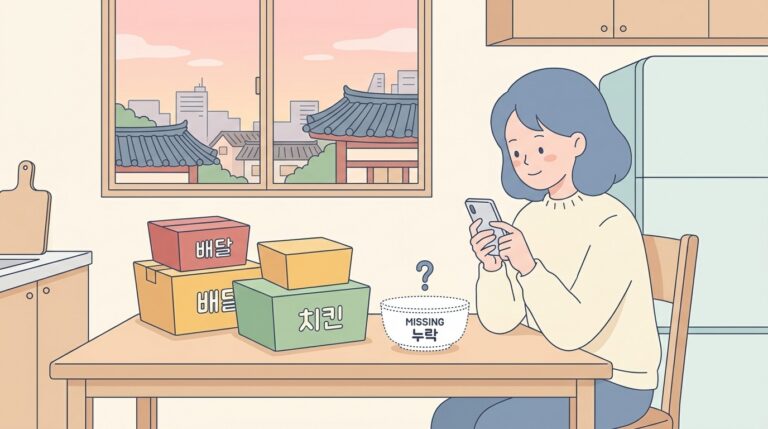
Picture this: It’s 9:30 PM on a crisp Friday evening in Seoul. After a marathon week of studying or working, you finally treat yourself to the ultimate Korean comfort ritual—ordering late-night delivery (야식). You fire up your delivery app, meticulously pick your favorite honey-garlic crispy fried chicken, and proudly add a side of those gooey, golden cheese balls you’ve been craving all week.
Thirty minutes later, the doorbell rings with that iconic delivery chime. You enthusiastically rush to the door, unpack the insulated brown paper bag, lay out the sauces, crack open the soda, and… wait. You look inside the bag. You check under the chicken box. You check the bag again. The cheese balls are nowhere to be found!
Suddenly, cold sweat breaks out. Your stomach is rumbling, but your brain is frozen. “Do I just let it go because my Korean is clumsy? What if the restaurant owner thinks I’m angry? How do I even say ‘missing side dish’ without sounding rude or aggressive?”
If you have ever stared at your phone in sheer panic, debating whether to sacrifice your hard-earned side dish just to avoid a phone call in Korean, you are not alone! Over 80% of our beginner learners at Daily Hangul confess that making a complaint or asking about an order mistake over the phone is their #1 fear. Unlike texting, you can’t rely on Google Translate in real-time.
Take a deep breath! You don’t need native-level fluency or complex business honorifics to get your food sorted. Today, we’re unlocking the exact gentle, respectful, yet crystal-clear phrases native Koreans use when an order arrives missing an item. By the end of this guide, you will pick up the phone with total confidence and claim every single cheese ball you paid for!
Phase 2: Core 3 Expressions In-Depth Breakdown
1. 사이드 메뉴 하나가 누락된 것 같아서 전화드렸어요. (I called because one of the side dishes seems to be missing.)
- Pronunciation: Sa-i-deu me-nyu ha-na-ga nu-rak-doen geot gat-a-seo jeon-hwa-deu-ryeo-sseo-yo. (Sound analogy: Think of saying “sigh-deu men-yu ha-na-gah noo-rack-dwen gut gah-tah-suh jun-hwa-deu-ryuh-ssuh-yo” in a gentle, rolling wave.)
- Meaning:
- Literal: “One side menu appears to have been omitted, so I gave you a call.”
- Real Nuance: “Hi, I’m calling politely just to let you know a side item was left out of my order.”
- K-Culture Moment: You’ll hear this exact sentence in slice-of-life K-Dramas whenever a character politely calls a neighborhood eatery. Notice how nobody starts with “You forgot my food!”
- Editor’s Insight: The secret weapon here is ~누락되다 (nu-rak-doe-da), which means “to be omitted/left out” passively, combined with ~인 것 같아요 (~in geot gat-a-yo) meaning “it seems like.” By describing the item as “omitted” rather than saying “you forgot it,” you remove all personal blame from the busy shop owner.
- Situation Spectrum:
- Casual (Friends): ⚠️ (Too formal for friends; with friends you’d say: 이거 안 왔어!)
- Semi-formal (Store clerk/Owner): ✅ (Absolute perfection!)
- Formal (Official business): ✅
- 🤔 Think About It: In English, we often say “You forgot my side dish.” Why does Korean default to “It seems to be omitted”? Notice how the language protects harmony and mutual dignity.
2. 치즈볼이 안 온 것 같아요. (It looks like the cheese balls didn’t come.)
- Pronunciation: Chi-jeu-bo-ri an on geot gat-a-yo. (Sound analogy: “chee-jeu-bo-ree ahn ohn gut gah-tah-yo”)
- Meaning:
- Literal: “It seems the cheese balls did not come.”
- Real Nuance: “The cheese balls aren’t in the bag.”
- K-Culture Moment: In Korean mukbang livestreams, creators reviewing their delivery bags will often say this casually when an extra sauce or side was missed.
- Editor’s Insight: Notice that Koreans say 안 왔다 (did not come) instead of 안 보냈다 (you didn’t send). By focusing on the food’s arrival rather than the sender’s action, you sound informative rather than accusatory. Just swap 치즈볼 (cheese balls) with whatever is missing (콜라 for cola, 무 for pickled radish).
- Situation Spectrum:
- Casual: ✅
- Semi-formal: ✅ (Everyday polite standard)
- Formal: ⚠️ (A bit conversational for high-level corporate settings)
- 🤔 Think About It: How does shifting the subject from “you” to “the item” change the emotional temperature of a customer service interaction?
3. 다시 보내주시거나 환불해 주실 수 있나요? (Could you send it again or refund it?)
- Pronunciation: Da-si bo-nae-ju-si-geo-na hwan-bul-hae ju-sil su in-na-yo? (Sound analogy: “dah-shee boh-neh-joo-she-guh-nah hwan-bool-heh joo-sheel soo een-nah-yo?”)
- Meaning:
- Literal: “Could you send it again or do a refund for me?”
- Real Nuance: “Would it be possible to redeliver it or process a partial refund?”
- K-Culture Moment: This is the practical fork-in-the-road moment. Usually, Korean restaurant owners will apologize profusely and offer one of these two remedies instantly.
- Editor’s Insight: The ending ~ㄹ 수 있나요? (~l su in-na-yo?) translates to “Is it possible to…?” It gives the shop owner agency to choose what is easier for them—often, if the rider is already gone, they will immediately issue a partial app refund (부분 환불).
- Situation Spectrum:
- Casual: 🚫 (Way too stiff for close friends)
- Semi-formal: ✅ (Polite, fair, and practical)
- Formal: ✅
- 🤔 Think About It: Presenting two solutions simultaneously (보내주시거나 환불) speeds up problem-solving while keeping respect at maximum levels.
Phase 3: Textbook Korean vs Real Korean
Situation 1: Reporting that something was left out
- 📖 교과서 한국어 (Textbook):
- 음식이 빠졌습니다. 확인하십시오. (Eum-si-gi ppa-jyeot-seum-ni-da. Hwa-gin-ha-sip-si-o.)
- “Food has been omitted. Please check it.”
- 🗣️ 진짜 한국어 (Real-world):
- 사장님, 사이드가 하나 누락된 것 같아요. (Sa-jang-nim, sa-i-deu-ga ha-na nu-rak-doen geot gat-a-yo.)
- “Boss, it seems like one of the sides was left out.”
- 💡 왜 다를까? (Why the difference?):
The textbook version sounds like a stern military drill sergeant doing a cargo inventory inspection. In daily life, addressing the owner warmly as 사장님 (Boss/Owner) and using the cushion phrase ~것 같아요 (it seems like) immediately creates goodwill.
Situation 2: Asking for your money back
- 📖 교과서 한국어 (Textbook):
- 제 돈을 돌려주십시오. (Je do-neul dol-lyeo-ju-sip-si-o.)
- “Return my money to me.”
- 🗣️ 진짜 한국어 (Real-world):
- 그 메뉴만 취소나 환불 처리 부탁드려요. (Geu me-nyu-man chwi-so-na hwan-bul cheo-ri bu-tak-deu-ryeo-yo.)
- “Could you please process a cancellation or refund just for that item?”
- 💡 왜 다를까? (Why the difference?):
“돌려주십시오” sounds like a tense movie line where a hostage negotiator demands ransom money! Real customers specify 취소 (cancellation) or 환불 (refund) paired with 부탁드려요 (I kindly request).
Phase 4: K-Culture Deep Dive & Non-Verbal Manners
4-1. Nunchi (눈치) & Phone Tone: The “Smile You Can Hear”
When you make a phone call in Korea, physical bows and hand gestures disappear, making tone of voice (말투) carry 100% of your etiquette.
* The Soft Rising Intonation: Never start flat or low. Begin your call with a bright, gentle, rising greeting: “안녕하세요, 사장님~!”
* The Apologetic Cushion: Even though they made the mistake, Koreans often start customer service inquiries with a soft “저기… 죄송한데요…” (Excuse me, I’m sorry to bother you…). This isn’t an admission of fault; it’s a social lubricant called Nunchi (tactful awareness) signaling: “I know you’re super busy on a Friday night, and I hate to disrupt you, but we have a small fix to make.”
4-2. Delivery App Ecosystem & The Fear of 1-Star Reviews
In South Korea’s hyper-competitive food market—dominated by platforms like Baemin (배달의민족) and Coupang Eats (쿠팡이츠)—small business owners live and die by their star ratings and review photos (리뷰 이벤트).
When a customer receives a wrong order and leaves a stinging 1-star review without calling first, it breaks the owner’s heart. Conversely, when a customer calls politely first to give the restaurant a chance to fix it, owners feel immense gratitude. In fact, don’t be surprised if the redelivered cheese balls arrive with an extra can of soda and a handwritten sticky note apologizing for the inconvenience!
Phase 5: Real-Life Roleplay Scenario
Setting: You ordered from “Golden Crispy Chicken” (황금 치킨). The fried chicken is piping hot, but your beloved order of cheese sticks (치즈스틱) is missing from the bag. You tap the phone icon on your delivery receipt.
- 사장님 (Owner Park): 네, 황금 치킨입니다! (Ne, hwang-geum chi-kin-im-ni-da! / “Yes, Golden Chicken!”)
🎭 (바쁘게 튀김기를 털며 씩씩하게 받는다 / Answering energetically while shaking fry baskets) - 나 (You): 안녕하세요 사장님! 방금 배달받았는데요. (An-nyeong-ha-se-yo sa-jang-nim! Bang-geum bae-dal-ba-dan-neun-de-yo. / “Hello, Boss! I just received my delivery.”)
🎭 (조심스럽고 다정한 목소리로 / In a polite, gentle voice) - 사장님 (Owner Park): 아, 네 고객님! 맛있게 드시고 계신가요? (A, ne go-gaek-nim! Mas-it-ge deu-si-go gye-sin-ga-yo? / “Ah, yes customer! Are you enjoying the meal?”)
🎭 (친절하게 묻는다 / Asking kindly) - 나 (You): 네, 치킨은 잘 왔는데… 치즈스틱 하나가 누락된 것 같아서 전화드렸어요. (Ne, chi-ki-neun jal wan-neun-de… chi-jeu-seu-tik ha-na-ga nu-rak-doen geot gat-a-seo jeon-hwa-deu-ryeo-sseo-yo. / “Yes, the chicken arrived well… but I called because it seems one order of cheese sticks was omitted.”)
🎭 (영수증을 확인하며 조용조용 말한다 / Checking the receipt and speaking calmly) - 사장님 (Owner Park): 아이고, 정말요?! 잠시만요… 아, 포장대 밑에 남아있었네요! 정말 죄송합니다! (A-i-go, jeong-mal-yo?! Jam-si-man-yo… a, po-jang-dae mi-te nam-a-i-sseon-ne-yo! Jeong-mal joe-song-ham-ni-da! / “Oh goodness, really?! One moment please… Ah, it got left under the packing counter! I am so sorry!”)
🎭 (깜짝 놀라며 이마를 탁 친다 / Gasps in shock and slaps his forehead) - 나 (You): 아, 괜찮습니다! 혹시 다시 보내주시거나 환불 처리 가능할까요? (A, gwaen-chan-seum-ni-da! Hok-si da-si bo-nae-ju-si-geo-na hwan-bul cheo-ri ga-neung-hal-kka-yo? / “Ah, that’s okay! By any chance, could you send it again or is a refund possible?”)
🎭 (안심시키듯 미소 지으며 / Smiling as if reassuring him) - 사장님 (Owner Park): 지금 바로 라이더 불러서 10분 안에 보내드릴게요! 서비스 감자튀김도 같이 넣어드리겠습니다! (Ji-geum ba-ro ra-i-deo bul-leo-seo sip-bun an-e bo-nae-deu-ril-ge-yo! Seobiseu gam-ja-twi-gim-do gat-i neo-eo-deu-ri-get-seum-ni-da! / “I will call a rider right now and send it within 10 minutes! I’ll include complimentary French fries too!”)
🎭 (미안해서 허둥지둥 챙긴다 / Hurriedly packing it out of sincere apology) - 나 (You): 네, 감사합니다 사장님! 천천히 보내주셔도 돼요. (Ne, gam-sa-ham-ni-da sa-jang-nim! Cheon-cheon-hi bo-nae-ju-syeo-do dwae-yo. / “Thank you, Boss! No need to rush.”)
🎭 (따뜻하게 통화를 마무리한다 / Wrapping up the call warmly)
🔀 Interactive Decision Branch
What would you say if the restaurant owner replies: “Right now, we don’t have any riders available for redelivery. What should we do?”
- Option A: “왜 배달이 안 돼요? 빨리 보내주세요!” (Why can’t you deliver? Send it quickly!)
- 🚫 Feedback (Bad): Extremely confrontational. It ruins rapport and makes the situation tense.
- Option B: “아, 그럼 앱에서 치즈스틱만 환불해 주실 수 있나요?” (Ah, then could you refund just the cheese sticks through the app?)
- 🌟 Feedback (Best): Spot on! Practical, polite, and solves the problem within 30 seconds without stressing anyone.
- Option C: “아… 네… 알겠습니다… 그냥 먹을게요…” (Ah… yes… okay… I’ll just eat…)
- ⚠️ Feedback (Risk): You lose your money and your food! You don’t have to surrender; Korean customer service is happy to refund you.
Phase 6: 10-Second Emotion Shadowing Drill
Read these out loud! Pause briefly at every / slash mark and match the designated facial expression and feeling:
[🥺 조심스럽고 정중하게 - Polite & cautious]- 저기 사장님, / 사이드 메뉴 하나가 / 누락된 것 같아서 / 전화드렸어요.
(Jeo-gi sa-jang-nim, / sa-i-deu me-nyu ha-na-ga / nu-rak-doen geot gat-a-seo / jeon-hwa-deu-ryeo-sseo-yo.)
- 저기 사장님, / 사이드 메뉴 하나가 / 누락된 것 같아서 / 전화드렸어요.
[🙏 부탁하듯이 부드럽게 - Soft request]- 혹시 / 다시 보내주시거나 / 환불해 주실 수 있나요?
(Hok-si / da-si bo-nae-ju-si-geo-na / hwan-bul-hae ju-sil su in-na-yo?)
- 혹시 / 다시 보내주시거나 / 환불해 주실 수 있나요?
[😊 감사하며 훈훈하게 - Warm & appreciative]- 네, 사장님! / 확인해 주셔서 / 정말 감사합니다.
(Ne, sa-jang-nim! / hwa-gin-hae ju-syeo-seo / jeong-mal gam-sa-ham-ni-da.)
- 네, 사장님! / 확인해 주셔서 / 정말 감사합니다.
Phase 7: K-Culture Mini Dictionary
- 누락 (Nu-rak) | Omission / Missing item
- The gold-standard formal word for when an item is accidentally left out of an order or document. Essential for delivery apps and online shopping inquiries.
- 서비스 (Seo-bi-seu) | On the house / Complimentary gift
- Unlike the English word “service” (customer care), in Korea, 서비스 refers strictly to free items given to customers, such as free dumplings, soda, or snacks.
- 재배달 (Jae-bae-dal) | Redelivery
- The act of sending a delivery rider back out to correct a missing or swapped order.
- 부분 환불 (Bu-bun hwan-bul) | Partial Refund
- The specific refund processed only for the missing side dish, leaving the rest of the meal payment intact on the app.
Phase 8: Traveler’s Survival Kit
Top 3 Immediate Survival Phrases
- “주문 번호는 1234번이에요.” (Ju-mun beon-ho-neun il-i-sam-sa-beon-i-e-yo.)
- Meaning: “My order number is 1234.”
- Pro Tip: Keep your phone screen on the order history page so you can read off the last 4 digits of the order number (주문 번호).
- “영수증 사진 보내드릴까요?” (Yeong-su-jeung sa-jin bo-nae-deu-ril-kka-yo?)
- Meaning: “Shall I send a photo of the receipt?”
- Pro Tip: If the owner wants to double-check what was packed, they might text your mobile number to view the item tag.
- “문 앞에 두고 가주세요.” (Mun ap-e du-go ga-ju-se-yo.)
- Meaning: “Please leave it in front of the door.”
- Pro Tip: Useful if they send redelivery and you are already in your pajamas!
Editor’s Travel Note
If speaking over the phone still feels terrifying, you can take advantage of the live customer service text chat! For instance, you can check the order details directly on the Baemin delivery app on Google Play and use their in-app 1:1 inquiry button (고객센터 문의하기). You can simply copy and paste: “치즈볼이 누락되었으니 부분 환불 부탁드립니다” into the live agent chat!
Phase 9: One Step Deeper (Cultural Thought)
Have you ever wondered why Koreans almost obsessively attach ~것 같아요 (~it seems like) to statements of fact? Even when you are holding an empty paper bag and 100% certain the fries are absent, you still say: “The fries seem to be missing.”
This isn’t self-doubt; it is a linguistic reflection of 정 (Jeong – relational warmth) and 체면 (Che-myeon – face-saving). Direct assertions like “You didn’t give me my fries” place the listener in an adversarial corner. By framing reality as an “observation” or “possibility,” you leave room for the shopkeeper to fix the mistake without embarrassment. Politeness in Korean is rarely about being stiff—it is about creating a cushion where both people can preserve harmony.
💬 Your Turn: In your home country, do customer service complaints tend to be direct and legally minded, or soft and relational? Share your experience in the comments below!
Phase 10: FAQ & Common Mistakes
Q: What if the restaurant owner speaks too fast and I can’t understand?
A: Don’t panic! Simply use this polite phrase: “외국인이라서 조금만 천천히 말씀해 주시겠어요?” (Oe-guk-in-i-ra-seo jo-geum-man cheon-cheon-hi mal-ssum-hae ju-si-get-seo-yo? / “I’m a foreigner, could you please speak just a little slower?”). Korean owners will instantly slow down and enunciate.
Q: Should I call the delivery rider (배달 기사님) or the restaurant (가게)?
A: Always call the restaurant! Riders only pick up sealed bags and deliver them; they do not prepare or pack the items. The phone number for the store is displayed on your app receipt.
Q: Can I request a refund if I already ate the rest of the meal?
A: Absolutely! It is completely normal to eat your main dish while waiting for the missing side dish’s partial refund (부분 환불). You do not have to wait with cold food!
🚨 Common Mistakes Alert
- Mistake: Calling and immediately saying “치즈볼 안 줬어요!” (You didn’t give me cheese balls!).
- Correction: Use the passive phrase “치즈볼이 안 온 것 같아요” (It seems the cheese balls didn’t come).
- Mistake: Forgetting to state your order name or item.
- Correction: Start with “방금 [치킨] 배달받은 사람인데요…” (I’m the person who just received the chicken delivery…).
- Mistake: Demanding compensation aggressively before letting the owner verify.
- Correction: Present options gently: “다시 보내주시거나 환불 가능할까요?”.
Phase 11: Action Mission & Engagement
- 🥉 Bronze Mission (Solo Shadowing): Record a 15-second voice memo on your phone pretending to call Golden Chicken using: “사장님, 사이드 메뉴 하나가 누락된 것 같아서 전화드렸어요.”
- 🥈 Silver Mission (Social Share): Next time you order takeout or watch a K-Drama delivery scene, snap a photo and tag
@DailyHangulon Instagram with your favorite delivery vocabulary word! - 🥇 Gold Mission (Real Life Action): The next time you order on a Korean app, write a polite delivery request (요청사항) in Korean, such as: “문 앞에 두고 벨 눌러주세요!” (Please leave it at the door and ring the bell!).
- 🎮 K-Culture Mission: Watch an episode of a modern food-centric K-Drama (like Let’s Eat or Hospital Playlist) and listen for how characters address small restaurant owners with “사장님~”.
Phase 12: Interactive Quiz Challenge
Quiz 1: Situational Choice
You opened your tteokbokki order and the boiled egg you added for 1,000 KRW is missing. Which phrase is the most natural and polite way to address the owner?
* (A) 야! 계란 왜 안 넣었어? 당장 가져와!
* (B) 사장님, 추가한 계란이 누락된 것 같아서 전화드렸어요.
* (C) 경찰에 신고하기 전에 돈을 돌려주십시오.
Quiz 2: Fill in the Blank
Fill in the missing Korean word:
* “다시 보내주시거나 ________해 주실 수 있나요?” (Could you send it again or refund it?)
Quiz 3: True or False (Culture Quiz)
- True or False: In Korea, when a side menu is missing, you should immediately post a 1-star review on the app before calling the store.
👉 Click to reveal answers & explanations!
- Quiz 1 Answer: (B)
- Explanation: (A) is rude, informal speech (반말), and (C) sounds like an extreme legal threat! (B) is courteous and effective.
- Quiz 2 Answer: 환불 (hwan-bul / refund).
- Quiz 3 Answer: False!
- Explanation: Calling the store first allows the owner to quickly fix the mistake or issue a refund. Jumping straight to a 1-star review is considered poor etiquette in Korean delivery culture.
- Explanation: Calling the store first allows the owner to quickly fix the mistake or issue a refund. Jumping straight to a 1-star review is considered poor etiquette in Korean delivery culture.







