

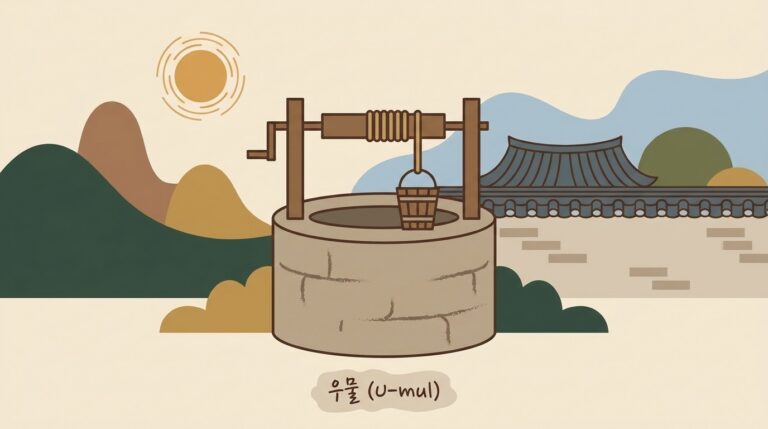
Phase 1: 공감 (Story-Driven Opening)
안녕하세요! 매일한글 에디터입니다. Have you ever sat in a tense meeting room or team chat where a looming deadline was approaching, yet everyone hesitated, waiting for someone else to act? You realize that unless you jump in, nothing gets solved. In K-dramas like Misaeng or Start-Up, there’s always that defining turn where the protagonist stops waiting for rescue and starts building the solution from scratch. That electric, proactive instinct is captured in the proverb: ‘목마른 놈이 우물 판다’ (The thirsty person digs the well). At the C2 level, you need language that embodies true psychological agency. Distilled from real coaching sessions with advanced global leaders navigating Korean organizations, this masterclass explores how to wield this ancient survival wisdom with nuance, humor, and commanding native poise.
Phase 2: 핵심 표현 3선 심층 분석 (Deep-Dive into 3 Core Expressions)
1. 목마른 놈이 우물 판다 (Mokmaleun nomi umul panda)
- Pronunciation: [Mok-ma-reun no-mi u-mul pan-da] (Sounds like “Moke-mah-reun no-mee oo-mool pahn-dah”, hitting the sharp ‘k’ in mok like the click of dry throat)
- Meaning: Literal: “The thirsty bastard digs the well.” / Pragmatic: The person with the greatest need or direct stake must inevitably take the initiative to solve the problem without waiting for external help.
- K-Culture Moment: Seen frequently in intense workplace dramas when a junior partner realizes head office will never allocate the budget, so they pound the pavement alone to secure local sponsorships.
- Editor’s Insight: Notice the earthy noun 놈 (nom). While often translated as “fellow” or colloquially “guy/bastard,” here it strips away polite pretension. It highlights the raw, primal state of an individual driven by unvarnished human urgency. It is assertive, self-aware, and slightly biting.
- Situation Spectrum: Casual: ✅ | Semi-formal: ✅ | Formal: ⚠️ (Acceptable in formal debates or executive meetings as a rhetorical metaphor, but soften ‘놈’ to ‘사람’ (saram) if addressing superiors directly).
- 🤔 Think About It: English says “Necessity is the mother of invention,” an abstract systemic truth. Korean focuses on the specific, sweat-stained agent: the thirsty human holding the shovel. What does this tell you about Korean views on personal ownership?
2. 발등에 불이 떨어지다 (Baldeunge buri tteoreojida)
- Pronunciation: [Bal-deung-e bu-ri tteo-reo-ji-da] (Pronounce ‘tteo’ with a sudden burst of pressurized air, like stamping out a dropped match)
- Meaning: Literal: “Fire has fallen onto the top of one’s foot.” / Pragmatic: To be confronted with a razor-sharp, unavoidable crisis that leaves zero room for procrastination.
- K-Culture Moment: Classic variety show panic where cast members suddenly discover they have three minutes left before mission failure and start sprint-scrambling across the set.
- Editor’s Insight: This phrase pairs seamlessly with ‘목마른 놈이 우물 판다’. When the embers hit your shoes, polite committee discussions cease; the survival reflex takes over.
- Situation Spectrum: Casual: ✅ | Semi-formal: ✅ | Formal: ✅
- 🤔 Think About It: While Western idioms often speak of “being under the gun” (external threat), Korean culture invokes physical burning on one’s own feet (immediate tactile pain requiring frantic bodily response).
3. 궁하면 통한다 (Gunghamyeon tonghanda)
- Pronunciation: [Gung-ha-myeon tong-han-da] (Smooth nasal transition on ‘gung’ resonates like a temple gong, followed by the crisp snap of ‘tong’)
- Meaning: Literal: “When driven to the absolute extremity, a breakthrough opens.” / Pragmatic: Desperation breeds ingenuity; when all conventional routes are blocked, extreme urgency clears a hidden passage.
- K-Culture Moment: The climactic turn in historical period dramas (Sageuk) where an exiled strategist turns an impending military massacre into a triumph using improvised terrain tactics.
- Editor’s Insight: Rooted in the I Ching (주역), this expression is the philosophical elder sister of our well-digging proverb. It elevates gritty pragmatism into an almost cosmic principle of resilience.
- Situation Spectrum: Casual: ⚠️ | Semi-formal: ✅ | Formal: ✅
- 🤔 Think About It: Does true creativity require abundant resources, or does human ingenuity only peak when stripped down to zero alternatives?
Phase 3: 교과서 한국어 vs 진짜 한국어 (Textbook vs. Real-World Korean)
Situation 1: Stepping up because no one else is moving
- 📖 교과서 한국어:
- 문제가 급박하니 가장 필요한 사람이 직접 조치를 취해야 합니다.
- (Since the problem is urgent, the person with the greatest need should take action directly.)
- 🗣️ 진짜 한국어:
- 결국 답답한 사람이 먼저 움직여야죠. 목마른 놈이 우물 판다고, 제가 먼저 기획안 넘길게요.
- (In the end, the frustrated one moves first. Since the thirsty person digs the well, I’ll pass over the proposal draft first.)
- 💡 왜 다를까? Textbook Korean sounds like an impersonal administrative manual. Real-world C2 Korean frames self-initiative with an acknowledged touch of pragmatic resignation and confident leadership.
Situation 2: Explaining sudden proactive shifts under intense pressure
- 📖 교과서 한국어:
- 마감 기한이 다가와서 우선순위를 변경하여 작업하겠습니다.
- (As the deadline is approaching, I will alter our priorities to work.)
- 🗣️ 진짜 한국어:
- 지금 발등에 불 떨어졌는데 찬밥 더운밥 가릴 때가 아니에요. 뭐라도 당장 파헤쳐 봐야죠.
- (Fire just fell on our feet; we can’t afford to be picky between cold rice and hot rice. We have to dig into whatever we can right now.)
- 💡 왜 다를까? Native speakers blend sensory idioms (cold rice vs. hot rice, fire on the instep) to express that standard deliberations are out the window.
Phase 4: K-Culture 딥다이브 & 비언어적 매너 (Cultural Codes & Non-Verbal Nuance)
4-1. 눈치 (Nunchi) & Somatic Gestures
When invoking 목마른 놈이 우물 판다 in a professional Korean environment, your physical demeanor must balance assertiveness with self-deprecating grace:
* The Self-Pointing Smile: Instead of pointing outward at passive team members (which reads as hostile indictment), point a soft thumb or open hand toward your own chest with an ironic smile. This signals: “I know I look crazy doing all this extra work, but I want the result too much to wait.”
* Sleeve-Rolling (팔을 걷어붙이다): A subtle roll of your sleeves prior to speaking signals that you are not merely complaining about stagnation; you are stepping into the arena as the lead builder.
* Gaze Grounding: Look down briefly as you say “우물 판다고…” before snapping direct, resolute eye contact back to your counterpart. It transforms potential frustration into charismatic resolution.
4-2. Cultural Code: The ‘Han’ (한) Turned Into ‘Heung’ (흥) and Initiative
In modern Korean venture hubs like Pangyo and Teheran-ro, wait-and-see bureaucracy is lethal. The ancestral ethos of digging one’s own well reflects Korea’s post-war trajectory: no external salvation was coming, so survival had to be engineered from barren soil. When you quote this proverb, Koreans do not just hear a colorful metaphor; they hear that you share their fundamental DNA of relentless, autonomous grit.
Phase 5: 실전 롤플레이 시나리오 (Real-World Role-Play Scenario)
- Setting: A glass-walled strategy room at a dynamic Seongsu-dong startup. It is 8:45 PM. The product release is stalled because the external logistics vendor hasn’t answered communications for three days.
- Character: Team Lead Min (민 팀장) – Sharp, brutally realistic, but deeply respectful of team members who demonstrate decisive initiative.
Turn 1
* 팀장 민: 아직도 협력업체 쪽 회신이 감감무소식이네요. 내일 모레 오픈인데 발주 라인이 멈춰 있으면 어쩌자는 건지…
(Ajikdo hyeomnyeogopche jjok hoesini gamgammusosik-ineyo. Naeil more opeun-inde balju rain-i meomchwo isseumyeon eojjeojaneun geonji…)
(Still not a whisper from the partner vendor. The launch is the day after tomorrow—what on earth are we supposed to do if the purchase order line is completely frozen…)
🎭 마른세수를 하며 한숨을 깊게 내쉰다 (Rubs dry face with hands and sighs deeply)
Turn 2
* 나 (Learner): 마냥 기다릴 순 없습니다. 목마른 놈이 우물 파야죠. 제가 직접 물류 센터로 찾아가서 담당자 만나겠습니다.
(Manyang gidaril sun eopseumnida. Mokmaleun nomi umul payajyo. Jega jikjeop mullyu senteoro chajagaseo damdangja mannagesseumnida.)
(We can’t just wait endlessly. The thirsty person has to dig the well. I will go down to the logistics center myself and confront the manager in person.)
🎭 소매를 단호하게 걷어붙이며 시선을 정면으로 맞춘다 (Firmly rolls up sleeves and locks eyes directly)
Turn 3
* 팀장 민: 직접 가겠다고요? 지금 시간엔 현장 소장님 만나기도 힘들 텐데, 괜히 헛걸음하는 거 아니에요?
(Jikjeop gagetdagoyo? Jigeum sigan-en hyeonjang sojangnim mannagido himdeul tende, gwaenhi heotgeoreumhaneun geo anieyo?)
(You’ll go in person? At this hour, it won’t even be easy to catch the site director. Aren’t you risking a completely wasted trip?)
🎭 안경을 고쳐 쓰며 의구심 섞인 눈길로 바라본다 (Adjusts glasses and looks over with a skeptical gaze)
Turn 4
* 나 (Learner): 헛걸음이 되더라도 가야 합니다. 지금 발등에 불 떨어졌는데 메일함만 들여다보고 있을 순 없잖아요.
(Heotgeoreumi doedeorado gayahamnida. Jigeum baldeunge bul tteoreojyeonneunde meilhamman deuryeodabogo isseul sun eopjanayo.)
(Even if it ends up a wild goose chase, I have to go. Fire just hit our feet; we can’t sit around staring at an empty email inbox.)
🎭 차 키와 태블릿을 챙기며 흔들림 없는 표정을 짓는다 (Picks up car keys and tablet with an unwavering expression)
Turn 5
* 팀장 민: 하긴… 궁하면 통한다고, 현장 가서 부딪히면 뭐라도 풀리긴 하겠지. 가만히 앉아서 속 태우는 것보단 낫겠네요.
(Hagin… gunghamyeon tonghandago, hyeonjang gaseo budichimyeon mworado pulligin hagetji. Gamanhi anjaseo sok taeuneun geotbodan natgenneyo.)
(True enough… As they say, extremity opens a way. Crashing into the site might break something loose. Better than sitting motionless burning our own insides up.)
🎭 살짝 감탄한 듯 고개를 끄덕인다 (Nods slightly as if quietly impressed)
Turn 6
* 나 (Learner): 현장 도착하는 대로 실시간 재고 파악해서 메신저로 쏘겠습니다. 팀장님은 본사 보고 라인만 방어해 주세요.
(Hyeonjang dochakhaneun daero silsigan jaego pa-akhaeseo mesinjeoro ssogesseumnida. Timjangnimeun bonsa bogo rainman bangeohae juseyo.)
(The second I reach the ground, I’ll assess real-time stock and fire it over messenger. Team Lead, please just hold the defense line with headquarters.)
🎭 짧고 단호한 목례를 건넨다 (Offers a brief, resolute nod of respect)
Turn 7
* 팀장 민: 알겠습니다. 총대는 본인이 멨으니, 위쪽 불화살은 내가 다 막아줄게요. 몸조심해서 다녀와요!
(Algetseumnida. Chongdaeneun bonin-i messeuni, wijjok bulhwasareun naega da magajulgeyo. Momjosimhaeseo danyeowayo!)
(Understood. Since you took up the rifle yourself, I will block all the flaming arrows coming from the top. Stay safe out there!)
🎭 주먹을 불끈 쥐며 격려의 미소를 보낸다 (Clenches fist tightly and offers an encouraging smile)
Turn 8
* 나 (Learner): 네, 우물 제대로 파고 오겠습니다. 다녀오겠습니다!
(Ne, umul jedaero pago ogesseumnida. Danyeo-ogesseumnida!)
(Understood, I will dig this well properly and return. See you shortly!)
🎭 문을 열고 자신감 있게 발걸음을 옮긴다 (Opens the door and steps out with confident strides)
🔀 인터랙티브 분기점 (Interactive Fork: Turn 2)
If you were in Turn 2, which move would you make?
- Option A: “목마른 놈이 우물 판다고 하니, 당장 제가 센터로 뛰어가서 물류 라인 잡아채 오겠습니다.”
👉 Feedback: [Best Choice] Shows ultimate agency, respectful ownership, and uses the cultural proverb as dynamic fuel. You immediately earn the team lead’s strategic backing. - Option B: “왜 아무도 안 움직이죠? 목마른 놈이 우물 파야 되니까 다른 팀원들이 가야 하는 거 아닙니까?”
👉 Feedback: [Bad Choice] Weaponizes the proverb outward. Accusing others violates team cohesion and distorts the idiom into an offensive critique. - Option C: “우물 파는 심정으로 메일을 세 통 더 보내두고 밤새 기다려 볼까요?”
👉 Feedback: [Risk Choice] Contradicts the idiom’s spirit. Writing passive follow-up emails is precisely the opposite of “digging a well”; it reveals indecisiveness.
Phase 6: 10초 감정 섀도잉 드릴 (10-Second Shadowing Drill)
Practice these lines focusing on rhythmic pauses (/) and internalizing the specific psychological state:
[🔥 결의에 차서 당당하게 - Resolute & Audacious]
결국 / 답답한 사람이 / 먼저 움직여야죠. / 목마른 놈이 / 우물 파는 법입니다!
(Gyeolguk / dapdaphan sarami / meonjeo umjigyeoyajyo. / Mokmaleun nomi / umul paneun beobimnida!)-
[⚡ 위기감 속 번뜩이는 직관 - Sharp Intuitive Urgency]
지금 / 발등에 불 떨어졌는데 / 언제까지 / 눈치만 보고 있겠습니까?
(Jigeum / baldeunge bul tteoreojyeonneunde / eonjekkaji / nunchiman bogo itgesseumnikka?) -
[😌 담담하면서도 묵직한 통찰 - Calm Philosophical Grounding]
길이 막혔다고 / 주저앉지 마세요. / 궁하면 / 다 통하게 되어 있습니다.
(Giri makhyeotdago / jujeo-anjji maseyo. / Gunghamyeon / da tonghage doe-eo isseumnida.)
Phase 7: K-Culture 미니 사전 (Mini Dictionary)
- 당사자성 (Dangsajaseong – Firsthand Stake / Direct Accountability)
The existential sense that an issue belongs entirely to you. In contemporary Korean politics, tech startups, and social movements, individuals with high dangsajaseong are the only ones trusted to lead systemic reforms. - 총대 메다 (Chongdae meda – To Shoulder the Rifle)
Originally a military metaphor, this refers to being the brave scapegoat or pioneer who steps out of the trenches to confront leadership or assume personal risk on behalf of the group. - 자수성가 (Jasusung-ga – Self-Made Success)
Achieving prosperity through nothing but one’s own grit and bare hands without inheriting family wealth. The modern archetype of the person who dug their own well. - 사활을 걸다 (Sahwareul geolda – Staking Life and Death)
To invest every ounce of capital, energy, and honor into a critical project where failure is existential.
Phase 8: 여행자를 위한 생존 키트 (Traveler’s Survival Kit)
When traveling off the beaten path in Korea, services do not always cater automatically to tourists. Use these pro-active survival expressions:
- 1. 제가 직접 알아보고 처리할게요. (Jega jikjeop arabogo cheorihalgeyo.)
- Meaning: “I will look into it and take care of it myself.”
- Pro Tip: Use this at train stations or boutique hotels when the clerk seems paralyzed by language barriers. It politely disengages them and signals self-sufficiency.
- 2. 급한 불부터 먼저 끌게요. (Geuphan bulbuteo meonjeo kkeulgeyo.)
- Meaning: “I’ll put out the most urgent fire first.”
- Pro Tip: Perfect when checking in late or handling a misbooked reservation with multiple complicated layers.
- 3. 혹시 다른 뚫을 방법이 없을까요? (Hoksi dareun ttureul bangbeobi eopseulkkayo?)
- Meaning: “Could there perhaps be another way to break through this?”
- Pro Tip: When an attendant says a train or restaurant is entirely booked (“No seats”), this respectful framing often prompts them to search for cancellation standby.
Editor’s Travel Note: Advanced Autonomous Navigating
Don’t wait around for English signage on remote paths. Take charge of your journey by downloading Naver Map app for transit navigation. When riding high-speed KTX trains without assigned seats during peak holidays, head straight to the cafe car or vestibule jump-seats (입석). Remember: in Korea, the traveler who maneuvers actively always finds a seat!
Phase 9: “한 발 더 깊이” (Deep Cultural Reflection)
Western psychology often views autonomy and collectivism as binary opposites: you either act for yourself, or you submit to the group. Korean culture, however, harmonizes them through proverbs like 목마른 놈이 우물 판다. Taking individual initiative is not seen as selfish defiance; rather, the community tacitly respects the desperate person who breaks organizational paralysis by digging the well that everyone eventually drinks from. True leadership in Korea is rarely designated by a corporate crown; it is claimed by whoever cannot stand the thirst any longer.
💬 Your Turn: Have you ever worked in an environment where everyone was frozen until one person finally took ownership? How would your native culture describe the person who “digs the well”? Share your story in the comments below!
Phase 10: FAQ & 오해 방지 (FAQ Schema)
Q: Isn’t calling someone or myself ‘놈’ (nom) insulting in a professional workplace?
A: If you refer to your boss or client as a ‘놈’, it is deeply offensive. However, when citing the established idiom “목마른 놈이 우물 판다”, the word is treated as an organic piece of the proverb’s earthy heritage. When you apply it to yourself (“I’m the thirsty guy here, so I’ll dig”), it demonstrates humility and high-level rhetorical color. If speaking in ultra-conservative boardrooms, simply swap it: “목마른 사람이 우물 판다고…”
Q: Can I use this proverb to tell my coworker they need to solve their own problem?
A: Proceed with extreme caution! Telling a frustrated colleague “목마른 놈이 우물 파세요” can come across as cold, dismissive, and cynical (equivalent to “Sucks to be you, figure it out yourself”). It is best used when diagnosing a collective situation or explaining why you personally are taking action.
Q: What is the difference between ‘궁하면 통한다’ and ‘목마른 놈이 우물 판다’?
A: 목마른 놈이 우물 판다 emphasizes action and manual effort (you must pick up the shovel). 궁하면 통한다 emphasizes the opening of possibilities (when pressure reaches maximum threshold, reality yields an unexpected route).
🚨 흔한 실수 (Common Mistakes) 경고판
- Mistake: Using the proverb to criticize someone else’s passive inaction in front of their superiors.
👉 Correct Action: Use it strictly to explain your own proactive choices, or use the neutral formulation “필요한 쪽에서 먼저 움직여야 합니다.” - Mistake: Translating “well” literally to mean digging for literal water in modern contexts.
👉 Correct Action: Treat “우물” purely as a metaphor for creative solutions, system workarounds, or administrative shortcuts. - Mistake: Pronouncing ‘놈이’ as ‘노미’ with a lazy English ‘n’.
👉 Correct Action: Keep the nasal ‘ㅁ’ firm and articulate the sound cleanly at the front of your lips.
Phase 11: 액션 미션 & 참여 유도 (Action Missions)
- 🥉 Bronze Mission (Solo Shadowing): Stand in front of a mirror, roll up your sleeves, and recite the Turn 2 dialogue from Phase 5 with sharp, proactive energy three times.
- 🥈 Silver Mission (Social Application): The next time you solve a difficult research problem or troubleshoot code independently, post an update with the caption: “목마른 놈이 우물 팠습니다 🛠️”.
- 🥇 Gold Mission (Real-Life Deployment): In your next Korean workplace, study group, or social meetup, volunteer to take on a stalled project using the phrase: “제가 답답해서 안 되겠습니다. 목마른 놈이 우물 판다고, 제가 먼저 초안 잡아 올게요!”
- 🎮 K-Culture Mission: Watch an episode of a workplace K-drama like Misaeng (미생), Agency (대행사), or Itaewon Class (이태원 클라쓰). Identify the exact moment when the protagonist stops negotiating and starts “digging their own well.” Note how the other characters react!
Phase 12: 인터랙티브 퀴즈 챌린지 (Interactive Quiz Challenge)
Q1. Situational Judgment
Your Korean project team is waiting for a design asset, but the central design department is backed up for two weeks. The deadline is in three days. Which response demonstrates C2-level initiative using our cultural proverb?
* (A) “목마른 놈이 우물 파야 하니까, 디자인팀 분들에게 밤새라고 전화하겠습니다.”
* (B) “디자인팀만 바라보고 있을 순 없네요. 목마른 놈이 우물 판다고, 제가 기본 템플릿으로 가시안 먼저 만들어 볼게요.”
* (C) “우물이 마를 때까지 기다리는 것이 팀워크의 도리입니다.”
Q2. Fill-in-the-Blank
Fill in the missing words to complete this classic pair of survival expressions:
“지금 (____________)에 불이 떨어졌으니, 체면 따질 것 없이 (____________) 놈이 우물이라도 파야 합니다.”
Q3. True / False Cultural Insight
Is it culturally appropriate to address an executive director directly by saying: “이사님이 목마른 놈이시니까 이사님이 우물을 파셔야 합니다”? (True / False)
👉 Click to reveal answers & detailed explanations!
- Q1 Answer: (B)
Explanation: (B) perfectly directs the urgency onto oneself by taking concrete creative action without attacking or alienating colleague departments. (A) uses the idiom to abuse others, and (C) is nonsensical. - Q2 Answer: 발등 / 목마른
Explanation: “지금 발등에 불이 떨어졌으니, 체면 따질 것 없이 목마른 놈이 우물이라도 파야 합니다.” (Now that fire has fallen onto the top of our feet, without worrying about saving face, the thirsty person must dig the well.) - Q3 Answer: False!
Explanation: Never apply the word ‘놈’ (nom) directly to an elder, senior, or executive! That is a major linguistic disaster. With superiors, you would say: “가장 절실한 사람이 먼저 솔선수범해야 할 것 같습니다.”







