

Phase 1: Empathy (Welcome from your Daily Hangul Editor)
안녕하세요! 매일한글 에디터입니다. (Hello! This is your Daily Hangul editor.) Picture this: You just spent an exciting evening exploring Seoul, feasting on delicious spicy tteokbokki and crispy hotteok. But late at night in your hotel, your stomach sounds an urgent alarm, or a painful blister strikes after walking 20,000 steps around Gyeongbokgung. Your map app looks confusing, and panic starts to set in. Finding medicine in a foreign country feels intimidating, but in Korea, it is surprisingly easy once you know a few magic words. This beginner guide is crafted from real classroom feedback from our A1 students. Master these simple survival phrases today so you can explore Korea with total peace of mind!
Phase 2: Top 3 Core Expressions Deep Dive
1. 약국 어디예요? (Yakguk eodiye-yo?)
- Pronunciation: [Yak-guk eo-di-ye-yo?] (Think of an animal yak, then gook, followed by uh-dee-yay-yo!)
- Meaning: Literal: “Pharmacy where is it?” vs. Real Nuance: “Excuse me, could you tell me where the pharmacy is?”
- K-Culture Moment: In almost every romantic K-drama, when the lead character scrapes their knee, someone rushes out into the neighborhood frantically asking passersby, “약국 어디예요?”
- Editor’s Insight: This is the ultimate A1 question pattern. You can replace 약국 (yakguk) with any destination: 화장실 어디예요? (Where is the restroom?) or 지하철역 어디예요? (Where is the subway station?).
- Situation Spectrum:
- Casual: ⚠️ 약국 어디야? (Yakguk eodiya? – Close friends only)
- Semi-formal: ✅ 약국 어디예요? (Yakguk eodiye-yo? – Perfect for strangers & shopkeepers)
- Formal: ✅ 약국이 어디입니까? (Yakguk-i eodi-imnikka? – Official announcements)
- 🤔 Think About It: In English, we often ask indirectly: “Do you know if there’s a pharmacy around here?” In Korean, asking directly “Where is the pharmacy?” with polite ~예요 is considered standard, natural, and completely polite. Why do you think Korean prefers direct clarity over indirect questioning here?
2. 두통약 있어요? (Dutong-yak isseoyo?)
- Pronunciation: [Du-tong-yak i-sseo-yo?] (Sounds like doo-tong-yahk ee-suh-yo)
- Meaning: Literal: “Headache medicine exists?” vs. Real Nuance: “Do you have pain relief medicine for a headache?”
- K-Culture Moment: In the hit office drama Misaeng, exhausted workers rubbing their aching temples after long overtime hours walk up to the pharmacist asking, “두통약 있어요?”
- Editor’s Insight: The word 약 (yak) means medicine. Just attach it to common body parts: 머리 (head) -> 두통 (headache, Sino-Korean root) + 약 = 두통약 (headache medicine).
- Situation Spectrum:
- Casual: ⚠️ 두통약 있어? (Dutong-yak isseo?)
- Semi-formal: ✅ 두통약 있어요? (Dutong-yak isseoyo?)
- Formal: ✅ 두통약 있습니까? (Dutong-yak isseumnikka?)
- 🤔 Think About It: Notice how the Korean sentence skips “Do you…” completely! In Korean polite conversation, the topic item is placed front and center, omitting unnecessary pronouns. Does your native language require a subject in every sentence?
3. 소화제 주세요 (Sohwaje juseyo)
- Pronunciation: [So-hwa-je ju-se-yo] (Sounds like so-hwa-jeh joo-say-yo)
- Meaning: Literal: “Digestive medicine, give please.” vs. Real Nuance: “May I have some digestive medicine, please?”
- K-Culture Moment: On popular Korean variety shows like Running Man, cast members downing a small brown glass bottle of liquid digestive tonic (Gas Hwalmyeongsu) after an epic food tour is an iconic sight!
- Editor’s Insight: 주세요 (Juseyo) is your magic beginner wand in South Korea. Point at anything and say “[Item] 주세요” to make a polite, foolproof request.
- Situation Spectrum:
- Casual: 🚫 소화제 줘 (Sohwaje jwo – Rude to strangers)
- Semi-formal: ✅ 소화제 주세요 (Sohwaje juseyo – Gold standard)
- Formal: ✅ 소화제 주십시오 (Sohwaje jusipsio – Very formal service setting)
- 🤔 Think About It: Even though 주세요 means “give me,” tone and facial warmth turn it into the kindest request possible. How does tone transform direct verbs in your own language?
Phase 3: Textbook Korean vs. Real Korean
Situation 1: Asking a passerby for directions
- 📖 교과서 한국어 (Textbook): 실례지만, 가장 가까운 약국이 어디에 위치해 있습니까? (Sillyejiman, gajang gakkaun yakguk-i eodie wichihae isseumnikka? / Excuse me, where is the nearest pharmacy situated?)
- 🗣️ 진짜 한국어 (Real-life): 저기요, 근처에 약국 있어요? (Jeogiyo, geuncheoe yakguk isseoyo? / Excuse me, is there a pharmacy nearby?)
- 💡 왜 다를까? (Why is it different?): Native speakers rarely use stiff documentary words like “위치해 있습니까” (situated at) on the street. A quick, friendly “저기요” (excuse me) paired with “근처에 약국 있어요?” gets you an immediate, helpful answer.
Situation 2: Describing an upset stomach
- 📖 교과서 한국어 (Textbook): 소화 불량 증상이 있습니다. (Sohwa bullyang jeungsang-i isseumnida. / I am exhibiting symptoms of indigestion.)
- 🗣️ 진짜 한국어 (Real-life): 배 아파요. 체했어요. (Bae apayo. Che-haesseoyo. / My stomach hurts. I have indigestion.)
- 💡 왜 다를까? (Why is it different?): Koreans describe health in visceral, intuitive terms. Saying “배 아파요” (my belly hurts) or “체했어요” (food feels stuck) explains your condition faster and more clearly than medical jargon.
Phase 4: K-Culture Deep Dive & Non-Verbal Manners
4-1. 눈치 (Nunchi) & Gestures
- The Soft Approach: Before blurting out your question on the street, catch someone’s eye, give a polite 15-degree head bow, and lead with a gentle, questioning “저기요…” (Jeogiyo…).
- The Respectful Two-Handed Pass: When handing your payment card or receiving your medicine bag, always use both hands (or touch your right forearm lightly with your left hand). This tiny gesture of respect instantly endears you to elderly pharmacists.
4-2. Cultural Code Analysis: The Korean “Yakguk” (약국)
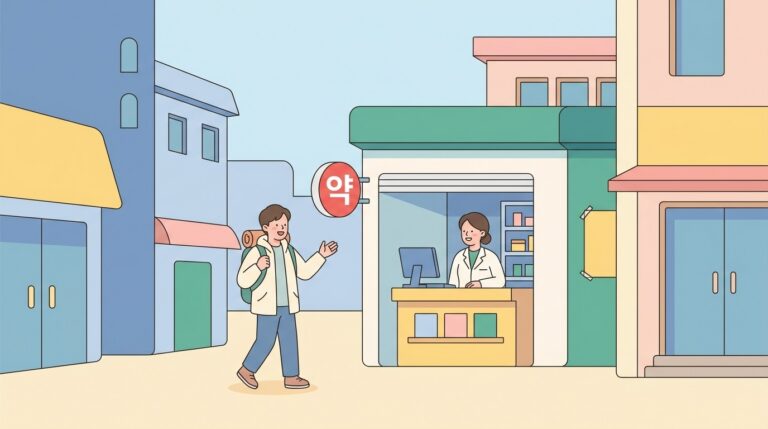
- Look for the Big Red Sign: Korean pharmacies are easily spotted from afar by a glowing red or green Korean letter: 약 (Yak).
- The Pharmacist is Your Guide: Unlike Western drugstores where you wander aisles of giant boxes, Korean pharmacies are counter-service. You describe your symptoms, and the licensed pharmacist curates a customized small package—often pairing a blister pack of pills with a warm herbal tonic drink.
- Nighttime Lifesaver: If pharmacies close, look for a 24-hour convenience store (CU, GS25, 7-Eleven). By law, they stock 13 basic 안전상비의약품 (Safety Household Medicines), including Tylenol, pediatric fever medicine, and digestive drinks.
Phase 5: Real-Life Roleplay Scenario
Setting: A cozy neighborhood pharmacy near Mangwon Station. Pharmacist Mr. Park, wearing a pristine white coat and round spectacles, looks up from his desk with a welcoming smile.
- You: (Peeking in with a gentle bow) 저기요, 안녕하세요. (Jeogiyo, annyeonghaseyo. / 🎭 Approaching the counter politely)
- Mr. Park: 네, 어서 오세요! 어디 아프세요? (Ne, eoseo oseyo! Eodi apeuseyo? / 🎭 Smiling warmly and leaning forward)
- You: 머리가 아파요. 두통약 있어요? (Meoriga apayo. Dutong-yak isseoyo? / 🎭 Touching your forehead with a tired expression)
- Mr. Park: 네, 있어요. 혹시 열도 나요? (Ne, isseoyo. Hoksi yeoldo nayo? / 🎭 Reaching for a shelf behind him)
- You: 아니요, 열은 없어요. (Aniyo, yeoreun eopseoyo. / 🎭 Shaking your head gently)
- Mr. Park: 그럼 이 약 드세요. 식사 후에 한 알 드세요. (Geureom i yak deuseyo. Siksa hue han al deuseyo. / 🎭 Placing a small blister pack on the counter)
- You: 네, 감사합니다. 얼마예요? (Ne, gamsahamnida. Eolmayeyo? / 🎭 Handing over your card with both hands)
- Mr. Park: 삼천 원이에요. 물 많이 드세요! (Samcheon won-ieyo. Mul mani deuseyo! / 🎭 Returning card with both hands and waving encouragingly)
🔀 Interactive Decision Point
How would you ask the pharmacist for medicine?
* Choice A: “두통약 주세요.” (Dutong-yak juseyo.)
* Feedback [Best]: Polite, natural, and concise! The pharmacist knows exactly what you need and will hand it over right away.
* Choice B: “약 줘.” (Yak jwo.)
* Feedback [Bad]: This is impolite banmal (informal talk). Using this with an unfamiliar professional will sound shockingly blunt and rude.
* Choice C: “머리 병원 가요?” (Meori byeongwon gayo?)
* Feedback [Risk]: Broken syntax. The pharmacist might think you suffered a traumatic head injury and rush to dial emergency services (119)!
Phase 6: 10-Second Emotion Shadowing Drill
Practice reading these out loud by matching the emotional cues and pauses (/):
[🥺 Seeking help, tired voice]저기요… / 근처에 / 약국 어디예요? (Jeogiyo… / geuncheoe / yakguk eodiye-yo?)[😣 Clutching temples, slight discomfort]머리가 아파요. / 두통약 있어요? (Meoriga apayo. / Dutong-yak isseoyo?)[😊 Relieved, bright smile]네, / 소화제 주세요! / 감사합니다! (Ne, / sohwaje juseyo! / Gamsahamnida!)
Phase 7: K-Culture Mini Dictionary
- 약 (Yak): Medicine. The root word found in pharmacy (약국) and pharmacist (약사).
- 밴드 (Baendeu): Adhesive bandage / Band-Aid. Indispensable when new walking sneakers give you blisters while touring Hanok villages.
- 소화제 (Sohwaje): Digestive medicine. Commonly taken after experiencing mouth-watering Korean barbecue feasts.
- 파스 (Paseu): Medicated pain-relief patch. Widely used across Korea for sore calf muscles or stiff necks after long flights.
Phase 8: Survival Kit for Travelers
Essential Travel Phrases TOP 3
- 약국 어디예요? (Yakguk eodiye-yo? / Where is the pharmacy?) — Pro Tip: Use this when asking subway station staff or convenience store clerks.
- 이거 주세요. (Igeo juseyo. / Please give me this.) — Pro Tip: Take a photo or screenshot of the symptom or medicine box on your smartphone and point to your screen while saying this.
- 편의점에 상비약 있어요? (Pyeonuijeome sangbiyak isseoyo? / Do you have basic medicine at this convenience store?) — Pro Tip: Perfect lifesaver phrase after 9 PM when neighborhood pharmacies are closed.
Editor’s Travel Note
- Install the 네이버 지도 앱 (Naver Map App Download) before your trip. Google Maps does not support walking routes in South Korea. Type 약국 directly into Naver Map’s search bar to spot open pharmacies near your live GPS coordinates!
Phase 9: “One Step Deeper” (Cultural Reflection)
In South Korea, local pharmacies are pillars of neighborhood community care (Jung, 정). Unlike big chain stores where interactions feel transactional, a Korean pharmacist will often ask if you’ve had a warm meal today, remind you to drink hot water, and hand you a warm complimentary vitamin drink. Health in Korea is viewed through a collective lens: looking out for a visitor’s physical comfort is an extension of national hospitality.
💬 Your Turn: Have you ever needed medicine while traveling in another country? How did you navigate the language barrier? Share your story in the comments below!
Phase 10: FAQ & Common Mistakes
Q: Can I buy painkillers like Tylenol or Ibuprofen without a prescription in Korea?
A: Yes! Basic over-the-counter painkillers (such as Tylenol, Advil, and E-dex) are available at any pharmacy and at most 24-hour convenience stores without a doctor’s prescription.
Q: Do Korean pharmacists speak English?
A: In major travel areas like Myeongdong, Hongdae, and Gangnam, many pharmacists speak conversational English. In residential areas, showing translated symptom keywords or simply saying “[Symptom]-약 있어요?” works wonderfully.
Q: What should I do if I need medicine late on a Sunday?
A: Most neighborhood pharmacies close on Sundays, but designated “Duty Pharmacies” (당번약국) remain open on a rotation. You can also visit any convenience store for basic fever, pain, and digestive relief medicines.
🚨 흔한 실수 (Common Mistakes) 경고판
- Mistake: Searching for an “Olive Young” to buy medicine. Correct Action: Olive Young is a beauty and skincare shop (K-Beauty), not a pharmacy! Always look for the red 약 sign.
- Mistake: Forgetting the magic word 주세요 (Juseyo). Correct Action: Never just say the noun alone (e.g., “두통약!”). Always say “두통약 주세요” to keep your interaction warm and respectful.
- Mistake: Assuming you need an appointment or hospital visit for mild sickness. Correct Action: Head straight to a neighborhood pharmacy first. Korean pharmacists can resolve most minor stomach aches, colds, and minor sprains immediately.
Phase 11: Action Missions
- 🥉 Bronze Mission (Solo Practice): Stand before a mirror and pronounce “약국 어디예요?” three times with clear pronunciation and a friendly facial expression.
- 🥈 Silver Mission (Social Share): Snap a photo of your travel medicine pouch, share it on your Instagram Story or study group, and write: “약국 어디예요? Ready for Korea with #DailyHangul!”
- 🥇 Gold Mission (Real-world Challenge): Enter a Korean grocery mart or visit a convenience store in Korea, locate the first-aid shelf, and practice asking for “밴드 있어요?” (Baendeu isseoyo?).
- 🎮 K-Culture Mission: Watch any slice-of-life K-drama episode this week and spot when a character offers someone a small bottled drink or medicine patch (paseu)!
Phase 12: Interactive Quiz Challenge
Test your knowledge with these three quick questions! Click the toggles below to verify your answers:
1. Situational Quiz: You spent the afternoon hiking Namsan Mountain and your back is sore. You enter a pharmacy. What do you ask for?
* A) 아이스 아메리카노 주세요 (Ice Americano please)
* B) 파스 있어요? (Do you have pain-relief patches?)
* C) 지하철역 어디예요? (Where is the subway station?)
👉 Click to reveal Answer & Explanation
Correct Answer: B) 파스 있어요? (Paseu isseoyo?)
Explanation: 파스 (Paseu) refers to medicated pain patches applied to sore muscles, shoulders, and backs. Option A is coffee, and Option C asks for the subway station!
2. Fill-in-the-Blank: Complete the polite sentence to ask for digestive medicine:
“소화제 ________.”
👉 Click to reveal Answer & Explanation
Correct Answer: 주세요 (Juseyo)
Explanation: “소화제 주세요” (Sohwaje juseyo) means “Digestive medicine, please.” Always pair your desired item with 주세요 for instant polite requests.
3. True or False Cultural Quiz: You can buy basic painkillers like Tylenol at major Korean convenience stores even if the pharmacy down the street is closed at midnight.
👉 Click to reveal Answer & Explanation
Correct Answer: True (참)
Explanation: Korean convenience stores (CU, GS25, 7-Eleven) legally stock 13 designated over-the-counter emergency medications 24 hours a day!







