

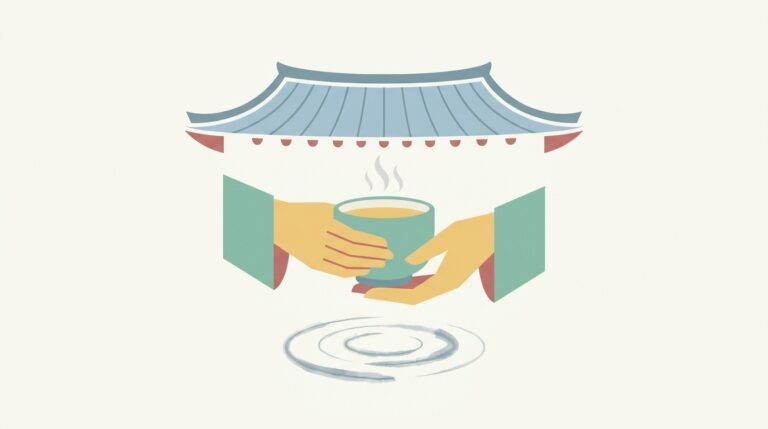
Phase 1: Empathy (Story-Immersive Opening)
안녕하세요! 매일한글 에디터입니다. (Annyeonghaseyo! It’s your Daily Hangul editor here.)
Have you ever found yourself sitting silently at the end of a masterwork like My Mister (나의 아저씨), Bong Joon-ho’s Parasite, or listening to a haunting pansori performance, feeling a tidal wave of sorrow that somehow doesn’t leave you feeling empty, but profoundly connected to humanity? Or perhaps you’ve sat in an unassuming, smoky back-alley soup shop in Seoul, where an elderly owner roughly slams down a steaming bowl of sundae-guk, grumbles that you look too skinny, and slips an extra mountain of side dishes onto your table without charging a single won.
To the untrained eye, these scenes seem paradoxical. Why does Korean sorrow feel so dignified, and why does Korean love often look like gruff irritation? For advanced C2 learners, the greatest hurdle isn’t memorizing grammatical conjugations or idiomatic proverbs; it is deciphering the invisible metaphysical engine driving Korean psychological life: 한 (Han) and 정 (情, Jeong).
Foreign textbooks often commit the grave sin of flattening these immense concepts. They translate Han as “unresolved resentment” and Jeong as “affection.” But this reductionist view strips away centuries of collective resilience, trauma, and communal solidarity. After a decade of mentoring diplomatic attachés, literary translators, and advanced scholars, I’ve compiled this humanistic guide to help you articulate the very soul of the Korean language. Let us venture past superficial small talk into the profound emotional terrain that native Koreans carry in their bones.
Phase 2: Core Expressions Deep Dive
1. 한을 삭이다 (Haneul sag-ida)
- Pronunciation: [Haneul sag-ida] (Think of the sharp breath ‘Hahn’ followed by the crisp crunch of autumn leaves: ‘sahg-ee-da’)
- Meaning: Literal: To ferment/digest one’s Han. | Actual Nuance: Rather than letting grief rot into destructive vengeance, you internalize, weather, and distill profound agony into resilient endurance.
- K-Culture Moment: Seen in historical dramas like Mr. Sunshine or the literary epic Toji (The Land), where characters swallow agonizing personal and national tragedies, quietly rebuilding their dignity through quiet perseverance rather than blind rage.
- Editor’s Insight: The verb 삭이다 is intimately connected to culinary fermentation (like mature kimchi or fermented skate). It implies that sorrow is an active, organic material. You do not “cure” Han; you ferment it until its poison transforms into profound moral depth and compassion.
- Situation Spectrum:
- Casual: ⚠️ (Sounds overly poetic or dramatic for everyday gossip)
- Semi-formal: ✅ (Appropriate in reflective, intimate, or intellectual conversations)
- Formal / Literary: ✅ (Extensively used in essays, serious interviews, and historical commentary)
- 🤔 Think About It: In Western psychoanalysis, catharsis often demands externalizing trauma—speaking it out, confronting the perpetrator. How does the Korean ideal of “fermenting grief inward” reshape the concept of personal strength?
2. 미운 정 고운 정 다 들다 (Miun jeong goun jeong da deulda)
- Pronunciation: [Mi-un jeong go-un jeong da deul-da] (Flows like a melodious lullaby: ‘mee-oon jung, go-oon jung, dah deul-dah’)
- Meaning: Literal: To absorb both the hateful Jeong and the sweet Jeong. | Actual Nuance: True, unbreakable bonding occurs not through flawless romance, but through shared friction, mutual irritations, and surviving life’s messiness side-by-side.
- K-Culture Moment: Perfectly captures the dynamic between elderly couples on shows like You Quiz on the Block, or long-time bickering business partners in Reply 1988 who complain bitterly about each other yet would sacrifice their lives without a second thought.
- Editor’s Insight: Jeong is sticky, viscous, and often involuntary. Western love often emphasizes emotional symmetry and mutual attraction; Jeong is circumstantial proximity. Miun jeong (affection forged through resentment) is frequently considered far deeper and hardier than goun jeong (sweet affection).
- Situation Spectrum:
- Casual: ✅ (Perfect when laughing about a chaotic friendship or sibling dynamic)
- Semi-formal: ✅ (Frequently used by adults discussing long-term colleagues or partnerships)
- Formal: ✅ (Used in sociolinguistic discussions on Korean relational ethics)
- 🤔 Think About It: Does your native culture acknowledge affection born strictly out of shared hardship and annoyance, or is love strictly contingent on positive reinforcement?
3. 신명 나게 풀다 (Sinmyeong nage pulda)
- Pronunciation: [Sin-myeong na-ge pul-da] (A buoyant, rhythmic surge: ‘shin-myung nah-geh pool-dah’)
- Meaning: Literal: To unravel/untie knots with divine exuberance. | Actual Nuance: Transfiguring deep-seated collective grief (Han) into an explosion of ecstatic, communal celebration and defiance.
- K-Culture Moment: The core philosophy behind traditional pansori, pungmul (farmer’s percussion), and even BTS’s global stadium anthem IDOL, which fuses traditional Korean samulnori chants with modern beats to conquer pain through euphoric dance.
- Editor’s Insight: In Korean folk thought, unresolved grief becomes a tangled “knot” (한의 매듭). If you leave it alone, it festers. The ultimate resolution isn’t quiet stoicism; it is 신명 (Sinmyeong)—a wild, ecstatic, collective release that turns tears into dance.
- Situation Spectrum:
- Casual: ✅ (Used when letting loose at a karaoke room after grueling exams)
- Semi-formal: ✅ (Describing festival atmospheres or artistic performances)
- Formal: ✅ (Found in cultural critiques and performance art treatises)
- 🤔 Think About It: Notice the verb 풀다 (to untie/solve). In Korean, you “untie” stress (스트레스를 풀다), “untie” anger (화가 풀리다), and “untie” Han (한을 풀다). What does this reveal about emotional health as an act of liberating trapped energy?
Phase 3: Textbook Korean vs. Real Korean
Situation 1: Describing a decadelong, tumultuous bond with a colleague or friend
- 📖 Textbook Korean: 우리는 오랫동안 함께 일하며 깊은 우정을 쌓았습니다.
(Uri-neun oraedong-an hamkke ilhamyeo gipeun ujeong-eul ssah-asseumnida. / We worked together for a long time and built a deep friendship.) - 🗣️ Real Native Korean: 볼 꼴 못 볼 꼴 다 보고, 이제는 미운 정 고운 정 다 들었지 뭐.
(Bol kkol mot bol kkol da bogo, ijeneun miun jeong goun jeong da deureotji mwo. / We’ve seen each other at our absolute worst; by now, every kind of Jeong—the sweet and the bitter—has settled in.) - 💡 Why the Difference? C2 fluency requires shedding sterile corporate abstractions. Native Koreans acknowledge relational grit using evocative idioms like “seeing everything worth seeing and not seeing” (볼 꼴 못 볼 꼴), framing devotion through resilience rather than perfection.
Situation 2: Reflecting on generational trauma and historic hardship
- 📖 Textbook Korean: 우리 조상들은 비극적인 역사 속에서 큰 슬픔을 참아냈습니다.
(Uri josangdeur-eun bigeukjeogin yeoksa sog-eseo keun seulpeum-eul chamanaesseumnida. / Our ancestors endured great sorrow amidst tragic history.) - 🗣️ Real Native Korean: 모진 풍파를 견디며 한을 삭여내고, 기어이 질긴 생명력을 꽃피워 낸 거지요.
(Mojin pungpareul gyeon-dimyeo haneul sag-yeonaego, gieoi jilgin saengmyeongryeog-eul kkotpiwo naen geojiyo. / Through bitter gales, they fermented their Han inward, stubbornly bringing their tenacious vitality into full bloom.) - 💡 Why the Difference? C2-level humanistic discourse relies on organic, visceral imagery. Substituting flat verbs like “참다” (to endure) with cultural metaphors like “한을 삭이다” (fermenting Han) and “질긴 생명력” (tenacious, fibrous life-force) establishes profound cultural resonance.
Phase 4: K-Culture Deep Dive & Non-Verbal Manners
4-1. 눈치 (Nunchi) & Somatic Manifestations of Emotion
In Korean cultural psychology, Han and Jeong are bodily experiences:
* 가슴을 치다 (Striking one’s chest): When Han or deep injustice suffocates the spirit (답답하다), Koreans instinctively thump their sternum with an open palm or loose fist. It is an unconscious somatic attempt to dislodge the physical “knot” of blocked chi. As an observer, recognizing this gesture signals that someone isn’t just annoyed—they are experiencing acute emotional existential blockage.
* The Heavy Sigh (한숨 쉬다): A Korean sigh is rarely just boredom. It is a biological release valve for internal combustion. Notice how elders sigh with a resonant vocalization (휴… / 아이고…). Responding with immediate, abrasive cheerful optimism can be perceived as an egregious lack of Nunchi. Instead, a solemn nod or silently pouring a cup of water demonstrates profound non-verbal empathy.
* The Aggressive Offering (정의 손길): Jeong often manifests as an infringement upon personal boundaries. An elder picking up a piece of savory pancake with their bare chopsticks and dropping it directly into your rice bowl is the ultimate somatic transmission of Jeong. Declining it with sterile germaphobic panic breaks the relational circuit; accepting it with a bright, appreciative bow honors the communal fabric.
4-2. Cultural Code Analysis: The Cinematic Alchemy of Melodrama
Why are Korean revenge thrillers (The Glory, Oldboy) and emotional sagas (Pachinko) globally intoxicating? Because they are fueled by the dialectical tension between Han and Jeong.
Western tragedy frequently ends in nihilism, but Korean storytelling navigates a distinct cycle: Han (trauma/blockage) ➔ Jeong (relational solidarity that prevents moral rot) ➔ Heung/Sinmyeong (cathartic explosion). Notice how even the darkest K-dramas feature comic relief through shared soju, communal meals, and fierce interpersonal loyalty. Jeong is the antidote that keeps Han from turning purely demonic.
Phase 5: Real Roleplay Scenario
Setting: A rainy autumn evening inside a traditional, rain-splattered red pojangmacha (포장마차) in Euljiro, Seoul. The air smells of toasted sesame oil, steaming fish cakes, and wet asphalt.
Characters:
* 이모님 (Imo-nim): The 68-year-old tent owner with sharp eyes, rough hands, and an unshakeable maternal warmth.
* 당신 (You): An advanced Korean culture researcher reflecting on the complexities of life in Seoul.
Dialogue:
- 당신: 이모님, 비도 오는데 포장마차 안은 참 아늑하네요. 국물이 정말 깊고 진해요.
(Imo-nim, bido oneunde pojangmacha aneun cham aneukhaneoyo. Gungmuri jeongmal gipgo jinhaeyo.)
“Auntie, with the rain pouring outside, it feels so cozy in here. This broth is remarkably rich and deep.”
🎭 Gently cradling the paper cup of steaming fish-cake broth with both hands. -
이모님: 비 오면 마음이 헛헛한 법이지. 젊은 양반이 표정이 왜 그리 쓸쓸해? 사는 게 뜻대로 안 풀려?
(Bi omyeon maeumi heotheothan beobiji. Jeolmeun yangbani pyojeongi wae geuri sseulsseulhae? Saneun ge tteutdaero an pullyeo?)
“When it rains, the heart tends to feel hollow. Why does a young scholar have such a forlorn look? Life not unraveling the way you planned?”
🎭 Wiping down the stainless-steel counter briskly with a coarse cotton cloth. -
당신: 그러게요. 공들였던 프로젝트가 틀어져서 속상했는데… 문득 우리 선조들이 말하던 ‘한’이 이런 건가 싶더라고요.
(Geureogeyo. Gongdeuryeotdeon peurojekteuga teureojyeoseo soksanghaenneunde… Mundeuk uri seonjodeuri malhadeon ‘han’i ireon geon-ga sipdeoragoyo.)
“Indeed. A project I poured my soul into fell apart, and I was disheartened… It made me wonder if this is what our ancestors called ‘Han.'”
🎭 Looking down into the broth, letting out a self-deprecating chuckle. -
이모님: 에구, 고작 그 정도로 무슨 한씩이나! 한은 말이야, 억울하게 가슴에 돌덩이가 얹혀도 반평생을 삭여내야 비로소 한인 게야.
(Egu, gojak geu jeongdoro museun hanssik-ina! Haneun mariya, eogulhage gaseume doldeong-iga eonhyeodo banpyeongsaeng-eul sag-yeonaeya biroso hanin geya.)
“Aish, don’t go throwing the word ‘Han’ around over a small scrape! Real Han is when a stone is unjustly lodged in your chest, and you have to ferment it for half a lifetime to even call it Han.”
🎭 Scooping up a generous, unprompted helping of spicy stir-fried pork (제육볶음) and sliding it toward you. -
당신: 이모님 말씀이 맞네요. 가벼운 속상함을 한으로 포장할 뻔했습니다. 그래도 가슴 한구석이 꽉 막힌 듯 답답하긴 합니다.
(Imo-nim malsseumi matneyo. Gabyeoun soksanghameul haneuro pojanghal ppeonhaessseumnida. Geuraedo gaseum hanguseogi kkwak makhin deut dabdabhagin hamnida.)
“You’re completely right, Imo-nim. I nearly packaged mere disappointment as historical sorrow. Yet, my chest still feels tightly knotted.”
🎭 Lightly tapping your sternum with your knuckles in a subtle somatic nod. -
이모님: 원래 사람 사는 게 미운 정 고운 정 부대끼며 닳고 닳는 과정이야. 자, 이거 서비스니까 얼른 먹어 치워!
(Wonrae saram saneun ge miun jeong goun jeong budaekkimyeo dalgo dalneun gwajeong-iya. Ja, igeo seobiseunikka eolleun meogeo chiwo!)
“Living is just wearing down your edges while rubbing shoulders with bitter and sweet Jeong. Here, this is on the house, so devour it quickly!”
🎭 Clicking her tongue with affectionate gruffness, refusing to accept any money for the extra plate. -
당신: 매번 이렇게 덤을 얹어 주시니… 이 골목을 도무지 떠날 수가 없네요. 이게 바로 정인가 봅니다.
(Maebeon ireoke deom-eul eonjeo jusini… I golmogeul domuji tteonal suga eopneyo. Ige baro jeong-in-ga bomnida.)
“You constantly heap these extra gifts on me… I find it impossible to ever leave this neighborhood. This must be the very essence of Jeong.”
🎭 Bowing your head deeply, accepting the plate with both palms. -
이모님: 쓸데없는 소리 말고 잔이나 채워! 툴툴 털고 일어나서 내일은 신명 나게 달려봐야지!
(Sseuldeeopneun sori malgo jan-ina chaeweo! Tultul teolgo ireonaseo naeireun sinmyeong nage dallyeobwayaji!)
“Quit the philosophical babble and fill your glass! Shake off the dust, rise up, and run with wild fire tomorrow!”
🎭 Clinking a tiny green soju glass against yours with a robust, infectious laugh.
🔀 Interactive Scenario Branch
How do you respond to Imo-nim’s toast?
- Option A: “감사합니다, 이모님! 이 한 잔으로 훌훌 털어내고 내일부터 다시 신명 나게 풀어보겠습니다!”
(Thank you, Imo-nim! With this single cup, I will brush it all off and untie this knot with fiery resolve tomorrow!)
👉 Feedback [Best]: Perfect situational mastery. You match her high-context cultural energy, utilize the concept of Sinmyeong, and honor her maternal encouragement. Her respect for you skyrockets. -
Option B: “공짜 음식은 규정상 곤란하니 정산서에 제육볶음 가격을 정확히 포함해 주십시오.”
(As complimentary food creates administrative issues, please accurately itemize the pork stir-fry on my bill.)
👉 Feedback [Bad]: Catastrophic conversational failure. You just weaponized cold procedural logic against an act of pure communal Jeong. The Imo-nim will feel deeply insulted and likely ask you to leave. -
Option C: “이모님의 거친 말씀 속에 담긴 사회학적 구조주의를 논문 각주에 반영하도록 하겠습니다.”
(I will be sure to incorporate the structural sociology embedded within your coarse rhetoric into my thesis footnotes.)
👉 Feedback [Risk]: Overly academic detachment. While linguistically sophisticated, treating an elder’s living, breathing affection as an academic specimen creates emotional coldness. She will think you’re eccentric and out of touch.
Phase 6: 10-Second Emotional Shadowing Drill
Read these lines aloud, observing the rhythm slashes / and embodying the designated emotional states.
- [🥺 묵직하고 애틋하게 / Heavy, stoic, and deeply tender]
한을 가슴에 묻고 / 모진 세월을 삭여내는 게 / 어디 말처럼 쉽겠습니까.
(Haneul gaseume mutgo / mojin seworeul sag-yeonaeneun ge / eodi malcheoreom swipgetseumnikka.)
“Burying that Han in one’s chest / and fermenting those harsh, unforgiving years / is never as easy as words suggest.” -
[🤝 미소 머금고 덤덤하게 / Wry, affectionate, and accepting]
맨날 싸우고 지지고 볶아도 / 미운 정 고운 정 다 들어서 / 이제는 남 같지가 않아요.
(Maennal ssaugo jijigo bokkado / miun jeong goun jeong da deureoseo / ijeneun nam gatjiga anh-ayo.)
“Even though we bicker and fry each other’s nerves daily / we’ve soaked up so much bitter and sweet Jeong / that they feel like flesh and blood now.” -
[🔥 억눌린 슬픔을 터뜨리듯 당차게 / Defiantly, exploding out of suppression]
흘린 눈물만큼 / 툭툭 털어내고 / 오늘 밤은 신명 나게 놀아봅시다!
(Heullin nunmulmankeum / tuktuk teoreonaego / oneul bameun sinmyeong nage norabopsida!)
“As much as we have wept / let’s dust ourselves off cleanly / and revel with ecstatic fire tonight!”
Phase 7: K-Culture Mini Dictionary
-
한풀이 (Hanpuri)
Literal: The untying or unraveling of Han.
Contextual Nuance: The collective, psychological, or ritual process of liberating long-held grievances. Whether through traditional shamanic exorcisms (Gut), contemporary street protests set to upbeat pop music, or writing an incendiary film script, Hanpuri is the engine of creative resolution in Korean society. -
정나미 (Jeongnami)
Literal: The emotional flavor or attachment of Jeong.
Contextual Nuance: Almost exclusively used in negative idioms like 정나미가 떨어지다 (to have every drop of affection drained away). It describes the sudden, bone-chilling revulsion you feel toward someone when they breach fundamental basic human empathy, severing years of sticky Jeong in an instant. -
애환 (Aehwan – 哀歡)
Literal: Sorrow (애) and Joy (환).
Contextual Nuance: The inextricably woven tapestry of life’s grief and delight. Used in professional, literary, and sociopolitical contexts (e.g., 서민들의 애환 – “the bittersweet joys and sorrows of working-class people”). It rejects binary emotional thinking. -
끈끈하다 (Kkeun-kkeunhada)
Literal: Sticky, viscous, adhesive.
Contextual Nuance: Describing relationships that have transcended contract, law, and mere liking. A 끈끈한 사이 (sticky relationship) is one forged through collective survival, intense shared suffering, and profound, unspoken loyalty.
Phase 8: Traveler’s Survival Kit
High-Context Survival Expressions
- “정이 넘치시네요!” (Jeong-i neomchisineyo!)
Pro Tip: Use this when a market vendor gives you 덤 (extra free portions) or goes out of their way to walk you to a train station. It acknowledges their dignity far better than a dry “감사합니다.” - “가슴이 먹먹합니다.” (Gaseumi meongmeokhannida.)
Pro Tip: Use this at solemn cultural landmarks like the Seodaemun Prison History Hall or the Gwangju May 18th Memorial. It describes a chest plugged with breathless historical empathy. - “우리 사이에 계산은 무슨요.” (Uri saie gyesaneun museunyo.)
Pro Tip: When an elder or mentor tries to pay back a small favor. It asserts that your relationship exists in the realm of Woori (collective “us”), not contractual capitalism.
Editor’s Cultural Travel Note
To tangibly experience the continuum of Han and Jeong, bypass polished tourist malls and explore the historic spine of Seoul. Walk from the labyrinthine alleys of Euljiro 3-ga where industrial ironworkers have shared stew for half a century, up toward Jongmyo Shrine where elderly men gather daily over baduk (Go) boards.
* Essential Navigation: Rather than relying on generic global maps that fail in South Korea, ensure you use a dedicated local tool by following this guide to download Naver Map for local navigation. It accurately shows hidden tent stalls (pojangmacha) and historic markets.
* Cash & Etiquette: In traditional markets like Gwangjang or Tongin, carrying crisp 10,000-won bills allows you to experience the transactional rhythm of 덤 (extra scoops). Remember to always receive items with both hands, lowering your posture slightly.
Phase 9: “One Step Deeper” (Critical Thinking)
In contemporary Western individualism, the sovereign self is an autonomous fortress, guarded by personal boundaries and transactional contracts. Korean culture, however, has historically viewed the self not as an isolated dot, but as an intersecting knot within an infinite communal matrix—the world of 우리 (Woori, We).
Han is what happens when this collective body is violently ruptured by colonialism, war, military dictatorship, or predatory hyper-capitalism; it is the shared wound of historical vulnerability. Jeong, conversely, is the metaphysical adhesive that repairs the fracture. It deliberately blurs boundaries, demanding that you care for the stranger who shares your neighborhood because their suffering compromises your own equilibrium. Understanding Korean communication at a C2 level requires recognizing that every polite deference, every shared bowl of stew, and every explosive street protest is an ongoing renegotiation between the agony of Han and the warmth of Jeong.
💬 Your Turn: In your own native language or culture, is there an emotion that simultaneously contains sorrow, endurance, and love? Or do you categorize pain and affection as entirely opposing forces? Share your philosophical reflections below!
Phase 10: FAQ & Avoiding Misunderstandings
Q: Is Han simply the Korean version of a victim mentality or chronic depression?
A: Absolutely not. This is a common Western psychological mischaracterization. Han is active, not passive. It possesses kinetic potential. Clinical depression leads to lethargy and isolation; Han historically fueled national mobilization, the Miracle on the Han River, democratic uprisings, and the intense creative dynamism of contemporary Korean cinema and music. It is pain compressed into fuel.
Q: Can a foreigner ever truly experience or possess ‘Jeong’?
A: Unquestionably, yes. Jeong is not an ethnic gene; it is a relational posture. If you live in Korea, share meals without hyper-individualistic scorekeeping, check in on neighbors during cold winters, and accept people’s flaws through 미운 정, native Koreans will warmly exclaim: “완전 한국 사람 다 됐네, 정이 넘쳐!” (You’ve become entirely Korean; you’re overflowing with Jeong!).
Q: Why do Koreans say ‘우리 집’ (Our home) or ‘우리 남편’ (Our husband) instead of ‘My’?
A: It stems directly from the communal ethos of Jeong. Claiming exclusive possession (내 남편, 내 집) sounds linguistically alienating and self-aggrandizing in high-context Korean. The individual exists as a steward of communal life, nested securely within the collective Woori.
🚨 Common Mistakes Alert
| Mistake | Why It Breaks Cultural Rapport | Correct Action |
|---|---|---|
| Splitting bills down to the exact single won (N빵) with Korean elders or mentors. | Treats a holistic relational gesture as an icy corporate audit, draining the interaction of Jeong. | Let the elder pay comfortably. Express genuine gratitude, then insist gracefully on buying round two (coffee/dessert). |
| Translating ‘한’ as direct anger/grudge during interpersonal fights. | Misapplies an existential, historical trauma concept to mundane, petty interpersonal squabbles. | Use standard terms for personal anger: 섭섭하다 (disappointed/hurt) or 속상하다 (upset/frustrated). |
| Rudely declining communal banchan or food because ‘I didn’t order it.’ | Rejects an unasked-for gesture of warmth, reducing dining to an algorithmic retail transaction. | Accept with both hands, try at least a modest bite with an appreciative smile, or politely explain dietary limitations with deep humility. |
Phase 11: Action Missions
- 🥉 Bronze Level: The next time a close friend does something slightly annoying, catch yourself before reacting with irritation. Practice muttering under your breath: “미운 정 고운 정 다 들었지 뭐.” Shift your internal framing from annoyance to relational depth.
- 🥈 Silver Level: Watch an acclaimed humanistic Korean film (e.g., Peppermint Candy, The Childe, or Pachinko). Write a three-sentence critique in Korean on social media analyzing how the protagonist ferments their Han (한을 삭이다).
- 🥇 Gold Level: During your next interaction with an elderly Korean vendor, barista, or neighbor, replace the sterile “감사합니다” with a warm, authentic relational acknowledgement: “이모님, 따뜻한 정 베풀어 주셔서 오늘 하루가 든든합니다!” Observe how their facial expression transforms.
🎮 K-Culture Mission: Listen to contemporary hip-hop tracks that sample traditional pansori (such as Agust D’s Daechwita or Leellamarz’s works). Identify the moment where the lyrical narrative shifts from brooding trauma (한) to explosive artistic triumph (신명/풀이). Post the timestamp and your breakdown in our learner community!
Phase 12: Interactive Quiz Challenge
Test your mastery of Korean emotional mechanics!
1. Scenario Judgment
An overseas business partner from Seoul who has known you for seven years experiences a devastating corporate setback. During an evening dinner, they sit silently, stare into their drink, and lightly strike their chest with their fist. Which response demonstrates C2-level cultural mastery?
* A) “계약서 4조 2항을 검토해 법적 손해배상을 청구하시는 것이 합리적입니다.” (You should rationally sue.)
* B) “가슴을 치시는 행동은 의학적으로 흉통의 증상이니 즉시 응급실로 가시지요.” (That indicates angina; go to the ER.)
* C) “얼마나 가슴이 먹먹하고 답답하시겠습니까. 오늘은 일 생각 마시고 그저 한 잔 털어내시지요.” (How suffocating and heavy your chest must be. Put work aside and let us brush this cup away.)
2. Fill-in-the-Blank
오랜 세월 동안 억울한 누명을 쓰고 옥살이를 하면서도, 그는 복수심에 불타기보다 감옥 안에서 묵묵히 글을 쓰며 자신의 ( ).
(Despite being framed and imprisoned for decades, rather than burning with vengeance, he quietly wrote in prison, fermenting his Han.)
3. Cultural True or False
- Statement: In Korean philosophy, Jeong is strictly an elevated, pure state of unconditional romantic love, entirely divorced from negative feelings or mutual irritation.
- [ ] True
- [ ] False
👉 Click here to reveal the answers and explanations
Answers & In-Depth Solutions:
-
Scenario Judgment: Correct Answer is C
Explanation: Striking the chest (가슴을 치다) is the quintessential somatic manifestation of blocked, suffocating Han/frustration (답답함). Option A offers cold, transactional legalism, while Option B pathologizes a deeply cultural somatic gesture. Option C validates their interior emotional state using high-register humanistic vocabulary (가슴이 먹먹하다) and offers communal solidarity. -
Fill-in-the-Blank: 한을 삭였다 (or 한을 삭여냈다)
Explanation: The context demands the verb meaning “to internalize, endure, and spiritually ferment sorrow into wisdom.” The base form is 한을 삭이다. -
Cultural True or False: False
Explanation: Jeong is famously ambivalent and viscous! It explicitly incorporates both 고운 정 (sweet affection) and 미운 정 (affection forged through resentment, annoyance, and shared survival). Calling it purely romantic or sanitizing its friction misses the core of Korean relational psychology.







