

How to Throw Away Bulky Waste in Korea: The Ultimate Waste Sticker Guide
Phase 1: Empathy (Storytelling Opening)
안녕하세요! 매일한글 에디터입니다. (Hello! It’s your Daily Hangul editor.)
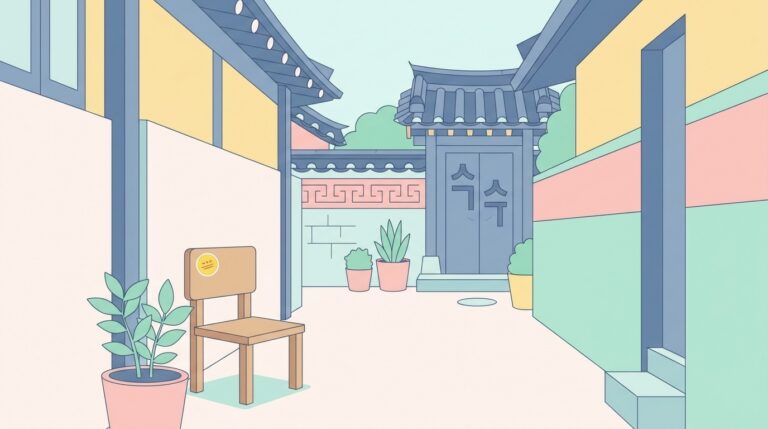
Picture this: You just moved into a cozy one-room studio apartment in Seoul, feeling like the main character in a cozy slice-of-life K-drama like Because This Is My First Life. You assemble a sleek new desk and realize you need to toss your wobbly old chair. You proudly carry it downstairs, leave it next to the neat row of colorful recycling bins, and pat yourself on the back. But the next morning, disaster strikes: a fluorescent warning flyer is taped to your chair with bold red letters reading ‘무단투기’ (Illegal Dumping), accompanied by a warning of a fine up to 1,000,000 KRW! You stand frozen under the watchful glare of the neighborhood CCTV. Don’t panic! You didn’t do it out of bad intentions; you simply didn’t know about Korea’s large waste sticker system. In Korea, oversized items cannot just be discarded—they need a pre-paid regional waste sticker. This guide is crafted directly from the real-life struggles of our international students, so you can navigate Korean convenience stores, request the exact sticker you need, and dispose of bulky items like a savvy local resident!
Phase 2: Core Expressions (Top 3 In-Depth Analysis)
1. 대형 폐기물 스티커 주세요 (Daehyeong pyegimul seutikeo juseyo)
- Pronunciation: [Dae-hyeong pye-gi-mul seu-ti-keo ju-se-yo] (Sounds like: “Day-hyung pay-gee-mool sticker joo-say-yo”)
- Meaning: Literal: “Please give me a large-size waste sticker.” / Real Nuance: “I would like to buy a bulky waste disposal sticker.”
- K-Culture Moment: You will hear this exact phrase whenever characters in Korean neighborhood dramas move out of their rooftop houses (옥탑방) or pack up boxes after a breakup.
- Editor’s Insight: 대형 (daehyeong) means large-sized, and 폐기물 (pyegimul) is the formal term for discarded goods. When talking to a busy convenience store owner, this phrase instantly communicates your goal without ambiguity.
- Situation Spectrum: Casual 🚫 | Semi-formal ✅ | Formal ✅
- 🤔 Think About It: In many Western countries, bulk pickup is either included in property taxes or scheduled via phone without buying a physical stamp. Why do you think Korea relies on prepaid barcode stickers for oversized garbage?
2. 이거 버리려면 얼마짜리 붙여야 해요? (Igeo beoriryeomyeon eolmajjari buchyeoya haeyo?)
- Pronunciation: [I-geo beo-ri-ryeo-myeon eol-ma-jja-ri bu-chyeo-ya hae-yo?] (Sounds like: “Ee-gaw buh-ri-ryuh-myun ull-ma-jah-ree boo-chyu-ya hay-yo?”)
- Meaning: Literal: “If I want to throw this away, how-much-value [sticker] must I stick?” / Real Nuance: “How much of a sticker fee do I need for this item?”
- K-Culture Moment: Whip out your smartphone, show a photo of your broken mirror or suitcase to the store clerk, and say this line. It saves you from guessing price charts!
- Editor’s Insight: The suffix -짜리 (-jjari) attaches to numbers or costs to denote denomination (e.g., 이천 원짜리 = a 2,000-won valued item). It sounds effortlessly natural and fluent.
- Situation Spectrum: Casual ⚠️ | Semi-formal ✅ | Formal ✅
- 🤔 Think About It: Showing a picture while using this sentence bridges any vocabulary gap. How does visual communication reflect Korean 눈치 (nunchi – situational quick-wit)?
3. 어디에 내놓으면 돼요? (Eodie naenoh-eumyeon dwaeyo?)
- Pronunciation: [Eo-di-e nae-no-eu-myeon dwae-yo?] (Sounds like: “Uh-dee-ay nay-noh-oo-myun dway-yo?”)
- Meaning: Literal: “Where if I put [it] out is it fine?” / Real Nuance: “Where should I leave this outside for collection?”
- K-Culture Moment: Every Korean district has designated spots—sometimes right in front of your building gate, sometimes by the corner utility pole.
- Editor’s Insight: 내놓다 (naenohda) is a compound verb combining 내다 (to bring out) and 놓다 (to place). It is the standard Korean verb for setting garbage out onto the street.
- Situation Spectrum: Casual 🚫 | Semi-formal ✅ | Formal ✅
- 🤔 Think About It: In crowded Korean alleys, precise placement keeps roads clear for emergency vehicles and neighbors. How does this reflect collective civic responsibility?
Phase 3: Textbook Korean vs. Real Korean
Situation 1: Asking if an item needs a special disposal sticker
- 📖 교과서 한국어: 이 물품을 폐기 처분하려면 규격 스티커를 부착해야 합니까? (I mulpumeul pyegi cheobunharyeomyeon gyugyeok seutikeoreul buchakhaeya hamnikka?)
- 🗣️ 진짜 한국어: 이거 스티커 붙여야 돼요? (Igeo seutikeo buchyeoya dwaeyo?)
- 💡 왜 다를까?: Textbook Korean relies on rigid Sino-Korean administrative jargon (폐기 처분, 부착). Real Koreans simplify this into everyday active verbs: 이거 (this) + 스티커 붙이다 (to stick a sticker) + -아/어야 되다 (must do).
Situation 2: Asking if the convenience store sells these stickers
- 📖 교과서 한국어: 이곳 매장에서 폐기물 배출 스티커를 취급하고 계십니까? (Igot maejang-eseo pyegimul baechul seutikeoreul chwigeuphago gyesimnikka?)
- 🗣️ 진짜 한국어: 여기 쓰레기 스티커도 팔아요? (Yeogi sseuregi seutikeodo parayo?)
- 💡 왜 다를까?: Convenience stores sell everything from ramen to phone chargers. Asking plainly with 팔아요? (Do you sell…?) sounds warm, natural, and immediately understood by any store elder (아주머니/아저씨).
Phase 4: K-Culture Deep Dive & Non-Verbal Manners
4-1. Nunchi & Gestures: Store Counter Etiquette
When asking for waste stickers at your local convenience store (GS25, CU, 7-Eleven) or Community Center (주민센터):
1. Take a Phone Photo First: Large waste prices depend strictly on item dimensions (e.g., a 24-inch suitcase vs. a 28-inch suitcase). Have your phone camera ready to show the item.
2. Two-Handed Courtesy: When handing over your payment card or receiving the sticker sheet, always use two hands (or support your right forearm with your left hand). This shows respect to older store owners.
3. Do Not Lose the Receipt Slip: Many stickers come with a stub (신청인 보관용). Keep it until the waste collectors pick up the item in case the sticker peels off in the rain!
4-2. Culture Code: The “Jongnyangje” (Volume-Rate Waste) Pride
Introduced nationwide in 1995, South Korea’s 쓰레기 종량제 (volume-based waste fee system) is one of the world’s most successful recycling programs. Because citizens pay directly for disposable plastic bags and bulky stickers, recycling rates skyrocketed above 60%. Leaving unstickered items on the street isn’t just a minor slip—to older neighbors, it feels like cheating the community fund. That is why neighborhood grandmothers and building managers will inspect unstickered items promptly! Knowing the sticker rules proves you are a responsible member of Korean society.
Phase 5: Real-Life Roleplay Scenario
- Setting: A brightly lit CU convenience store in Mapo-gu, Seoul on a rainy Tuesday evening.
- Characters:
- You: An international resident trying to throw away a broken electric desk fan and a full-length mirror.
- 사장님 (Store Owner): A friendly, bespectacled Korean uncle in his late 50s wearing a blue CU vest.
Turn 1 (You):
안녕하세요! 혹시 대형 폐기물 스티커도 파세요?
(Annyeonghaseyo! Hoksi daehyeong pyegimul seutikeodo paseyo?)
“Hello! By any chance, do you also sell bulky waste stickers?”
🎭 Action: Give a polite 30-degree bow while walking up to the counter.
Turn 2 (Owner):
네, 팔아요! 어떤 물건 버리시게요?
(Ne, parayo! Eotteon mulgeon beorisigeyo?)
“Yes, we do! What kind of item are you throwing away?”
🎭 Action: Opens a wooden drawer under the register containing various printed sticker sheets.
Turn 3 (You):
선풍기 하나랑 전신거울 하나요. 사진 여기 있어요.
(Seonpung-gi hanarang jeonsin-geoul hanayo. Sajin yeogi isseoyo.)
“One electric fan and one full-length mirror. Here is the photo.”
🎭 Action: Turn your smartphone screen toward the owner to show the items clearly.
Turn 4 (Owner):
아, 선풍기는 이천 원이고, 거울은 크니까 삼천 원짜리 붙여야겠네.
(A, seonpung-gineun icheon won-igo, geour-eun keunikka samcheon won-jjari buchyeoyagetne.)
“Ah, the fan is 2,000 KRW, and since the mirror is large, you should put a 3,000 KRW sticker on it.”
🎭 Action: Peels two official sticker sheets and taps the price on the barcode scanner.
Turn 5 (You):
총 오천 원이네요. 카드로 결제할게요.
(Chong ocheon won-ineyo. Kadeuro gyeoljehalgeyo.)
“That’s 5,000 KRW in total. I will pay by card.”
🎭 Action: Hand over the credit card with both hands.
Turn 6 (Owner):
여기 스티커랑 영수증이요. 스티커에 이름이랑 전화번호 꼭 써서 붙여요.
(Yeogi seutikeorang yeongsujeung-iyo. Seutikeoe ireum-irang jeonhwabeonho kkok sseoseo buchyeoyo.)
“Here are your stickers and receipt. Make sure to write your name and phone number on the sticker.”
🎭 Action: Hands the stickers over with a pen tap on the empty signature blank.
Turn 7 (You):
감사합니다! 그런데 이거 어디에 내놓으면 돼요?
(Gamsahamnida! Geurende eodie naenoh-eumyeon dwaeyo?)
“Thank you! By the way, where should I leave these outside?”
🎭 Action: Receive the stickers and tilt head inquisitively.
Turn 8 (Owner):
빌라 대문 앞 쓰레기 모으는 곳에 오늘 밤에 내놓으면 내일 아침에 수거해가요.
(Billa daemun ap sseuregi moeuneun gose oneul bame naenoh-eumyeon naeil achime sugeohaegayo.)
“Leave them out tonight by the trash collection spot in front of your villa gate, and they will collect them tomorrow morning.”
🎭 Action: Points outside toward the residential alleyway with a warm smile.
🔀 Interactive Choice Branch
Now that you bought your stickers, what do you do next when placing the items outside?
- Choice A: Slap the stickers on, write down your phone number, take a photo of the stickered items outside, and go back upstairs.
- Choice B: Keep the stickers in your pocket, leave the mirror on the curb, and stick the tags on tomorrow when the garbage truck arrives.
- Choice C: Stick only the 2,000 KRW tag on the mirror and keep the 3,000 KRW tag to save money.
[Choice Feedback]
* Best Choice (A): Perfect! Writing your phone number allows the district sanitation team to call you if there is any question, and taking a photo proves you paid in case someone tampers with the sticker.
* Bad Choice (B): Danger! Unattended bulky trash without visible stickers can be reported by neighbors or sanitation officers within hours, risking a hefty fine before the truck even comes.
* Risk Choice (C): Penalty alert! Sanitation workers check barcode prices against item categories. If underpaid, they will slap a yellow non-collection notice on it, leaving your junk stuck in front of your home.
Phase 6: 10-Second Emotional Shadowing Drill
Practice these natural cadence drills aloud! Notice the slashes / where native speakers pause for breath.
- Drill 1 [😊 Polite & Clear at the Store Counter]:
대형 폐기물 스티커 / 사러 왔는데요, / 거울은 얼마짜리예요?
(Daehyeong pyegimul seutikeo / sareo watneundeyo, / geour-eun eolmajjariyeyo?)
“I came to buy a bulky waste sticker / how much is it for a mirror?” -
Drill 2 [🤔 Inquiring with Friendly Curiosity]:
이거 / 빌라 대문 앞에 / 오늘 밤에 내놓으면 되나요?
(Igeo / billa daemun ape / oneul bame naenoh-eumyeon doenayo?)
“If I put this / in front of the villa gate / tonight, is that okay?” -
Drill 3 [💡 Relieved & Grateful Departure]:
아, 네! / 이름 써서 / 잘 붙여놓을게요! / 감사합니다!
(A, ne! / ireum sseoseo / jal buchyeonoh-eulgeyo! / Gamsahamnida!)
“Ah, yes! / I will write my name / and stick it on securely! / Thank you!”
Phase 7: K-Culture Mini Dictionary
- 대형 폐기물 (Daehyeong pyegimul): Bulky/Oversized Waste. Refers to any household item that does not fit into a standard 20-liter standard waste bag, such as desks, mattresses, fans, and suitcases.
- 종량제 봉투 (Jongnyangje bongtu): Pay-as-you-throw designated trash bags. Available in white/light yellow for general waste and food waste bags in blue/orange depending on your city district (Gu).
- 무단 투기 (Mudan tugi): Illegal dumping or unauthorized abandonment of waste. Strictly prohibited in Korea, monitored via neighborhood CCTV, and punished with fines up to 1,000,000 KRW.
- 배출일 (Baechul-il): Designated trash discharge days. Most residential neighborhoods designate specific days of the week (e.g., Sunday through Thursday evenings) when you can put waste outside.
Phase 8: Expat & Traveler Survival Kit
Top 3 Survival Phrases for Waste Management
- 이거 일반 쓰레기예요? (Igeo ilban sseuregiyeyo?)
- Meaning: “Is this general waste?”
- Pro Tip: Use this when sorting tricky items (like coated paper, broken ceramic, or delivery food containers).
- 스티커 어디서 사요? (Seutikeo eodiseo sayo?)
- Meaning: “Where can I buy the sticker?”
- Pro Tip: If your nearest convenience store happens to be out of stock, ask this and they will point you to the nearest grocery mart or local office.
- 수거해 주세요 (Sugeohae juseyo)
- Meaning: “Please pick it up / collect it.”
- Pro Tip: Useful when registering your items online through the district office website.
Editor’s Travel Note
- Must-Have App Guide: Don’t want to walk to the convenience store? Check out the official Korean smart bulky waste pickup app! Search and perform a Ppaegi App download on mobile (빼기 app). You simply take a photo of your furniture, pay via international credit card in the app, and write the generated confirmation number on any paper and tape it to your item!
- Payment & Cash: Convenience store staff are happy to accept Korean debit/credit cards or T-Money transport cards for sticker purchases.
Phase 9: “One Step Deeper” (Reflective Cultural Essay)
In South Korea’s high-density urban landscape, trash disposal is far more than sanitation—it is a social contract. Because millions live close together in villas and high-rise apartments, the way one handles waste reveals one’s respect for the shared community space. When you take the extra ten minutes to walk to the store, purchase the correct sticker, and write your contact details neatly on the tag, you are quietly signaling to your Korean neighbors: “I care about our shared street as much as you do.” It turns a simple chore into an act of neighborhood citizenship.
💬 Your Turn: How does your home country handle bulky garbage like furniture or appliances? Have you ever had a confusing moment with Korean recycling bins? Let’s chat in the comments below!
Phase 10: FAQ & Common Mistakes
Q: Can I buy a bulky waste sticker in Gangnam and use it in Mapo?
A: No! Waste management is handled independently by each local district office (Gu-cheong). A sticker bought in Mapo-gu is only valid within Mapo-gu. Always purchase your sticker in the neighborhood where you live.
Q: What should I do if it rains after I put my sticker on the furniture outside?
A: Heavy rain can wash paper stickers away! Always write the reservation number with a permanent marker directly on a piece of cardboard or cover the sticker completely with clear packing tape.
Q: Are small electronics like hairdryers or toasters considered bulky waste?
A: In most Korean cities, small home electronics (소형 가전) like kettles, toasters, and irons can actually be disposed of for free! Many apartment complexes have a dedicated small electronics bin, or you can drop them off at the local Community Center (주민센터).
🚨 Common Mistakes Alert Board
- Mistake: Leaving furniture outside with a handwritten note saying “Free to take!” (무료로 가져가세요) without a sticker.
- Correct Action: If someone doesn’t take it within a few hours, it is considered illegal dumping. If you want to give it away, post it on the local secondhand app Karrot Market (당근마켓) instead!
- Mistake: Shoving a broken floor lamp into a regular blue recycling bin.
- Correct Action: Broken lamps and items mixed with metals, glass, and wiring require either disassembly or a waste sticker.
- Mistake: Throwing away the sticker receipt right away.
- Correct Action: Keep the receipt or take a clear photo of the sticker’s barcode until the item has physically disappeared from the street.
Phase 11: Action Missions & Community Engagement
- 🥉 Bronze Level (Solo Practice): Stand in front of a mirror and recite the sentence: “대형 폐기물 스티커 주세요!” with confident pronunciation three times.
- 🥈 Silver Level (Observation Mission): While walking through a Korean residential neighborhood today, spot at least one piece of furniture waiting on the curb. Check whether it has a sticker attached and identify what district it belongs to!
- 🥇 Gold Level (Real-World Master): Go into your nearest Korean convenience store and ask: “여기 쓰레기 스티커도 팔아요?” to confirm whether your local shop stocks them.
- 🎮 K-Culture Mission: In the next K-drama episode you watch featuring an apartment move, spot the bright yellow or white garbage bags piled outside the building gate!
Phase 12: Interactive Quiz Challenge
Test your waste sticker knowledge with these 3 quick questions!
- Situational Judgment: You want to throw away an office chair. You visit the convenience store in your neighborhood. Which sentence should you say to the clerk?
- A) 이거 환불해 주세요. (Igeo hwanbulhae juseyo.)
- B) 의자 버리려는데 스티커 얼마짜리 붙여야 해요? (Uija beoriryeoneunde seutikeo eolmajjari buchyeoya haeyo?)
- C) 종량제 봉투 제일 큰 거 하나 주세요. (Jongnyangje bongtu jeil keun geo hana juseyo.)
- Fill in the Blank: Fill in the missing word:
- “어디에 ________ 돼요?” (Where should I put this out?)
- (Hint: It is a compound verb meaning to put outside)
- True or False: If you move from Hongdae (Mapo-gu) to Itaewon (Yongsan-gu), you can use the leftover Mapo waste stickers for your new apartment.
- (True / False)
👉 Click to view answers and explanations!
- Answer: B.
- Explanation: Option A means “Please refund this,” and Option C means “Please give me the largest standard trash bag.” Option B correctly asks for the appropriate sticker price for discarding a chair.
- Answer: 내놓으면 (naenoh-eumyeon).
- Explanation: 내놓다 means to place out, and -으면 돼요 means “is it fine if I…”.
- Answer: False.
- Explanation: Stickers are district-specific (Gu level). You cannot use Mapo-gu stickers in Yongsan-gu!
- Explanation: Stickers are district-specific (Gu level). You cannot use Mapo-gu stickers in Yongsan-gu!







