

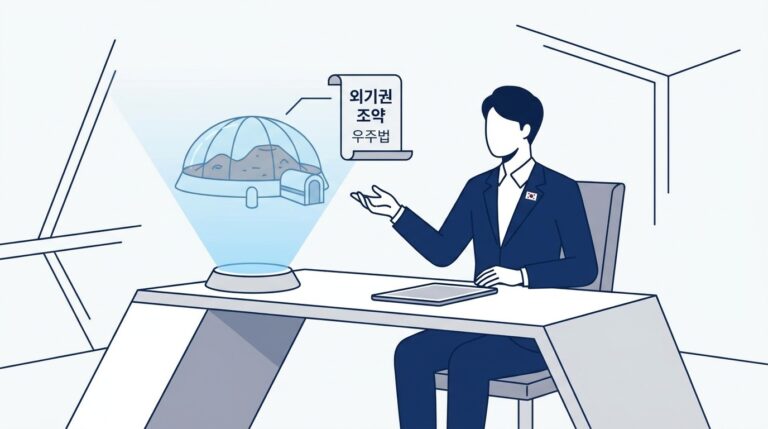
Conquering the Cosmos: How to Debate Space Treaties and Planetary Habitation Rights in Fluent C2 Korean
Phase 1: 공감 (Story-Driven Opening)
안녕하세요! 매일한글 에디터입니다. Have you ever watched a high-stakes Korean sci-fi thriller like Space Sweepers (승리호) or The Silent Sea (고요의 바다) and marveled at how effortlessly Korean characters spar over orbital salvage contracts, extraterrestrial resource jurisdiction, and planetary survival rights? Now imagine finding yourself in an international aerospace law symposium in Daejeon, sitting across from seasoned researchers from the Korea Aerospace Research Institute (KARI) or legal scholars from Seoul National University. The coffee is hot, the stakes are cosmic, and someone raises the trillion-dollar question: “If a multinational coalition or a private enterprise builds a permanent habitat on Mars, who holds legal sovereignty?”
You understand the 1967 Outer Space Treaty down to the comma in English. But when you try expressing these dense multilateral legal nuances in Korean, your words tumble out sounding like a mechanical, direct translation from a nineteenth-century maritime manual. Our advanced learners constantly tell us: “I can write academic papers, but when participating in high-level policy debates, I sound either awkwardly aggressive or archaic.” This guide is built directly on field notes and feedback from foreign legal analysts and aerospace researchers working in Korea. By mastering the refined discourse markers, legal registers, and subtle socio-cultural posturing covered here, you will transition from translating abstract English doctrine to commanding the room like an authentic Korean space law authority.
Phase 2: 핵심 표현 3선 심층 분석 (Core Expressions In-Depth)
1. 영유권 불인정 원칙 (Yeong-yugwon burinjeong wonchik)
- Pronunciation: [Yeong-yu-gwon bu-rin-jeong won-chik] (Sounds like young-you-gwon boo-reen-jeong won-cheek)
- Meaning: Literal: “Principle of non-recognition of territorial sovereignty” | Real Nuance: The cornerstone principle of international space law prohibiting any nation or entity from claiming sovereignty over celestial bodies (Outer Space Treaty Article II).
- K-Culture Moment: Imagine a tense boardroom scene in a high-budget K-drama where a cutthroat mega-corporation attempts to monopolize lunar mining corridors, only for a sharp aerospace attorney to pull up a holographic treaty and declare, “기지 건설이 곧 영유권을 의미하지는 않습니다” (Giji geonseori got yeong-yugwoneul uimihajineun anseumnida – Establishing a base does not equate to sovereign appropriation).
- Editor’s Insight: Notice the Sino-Korean root 영유 (領有 – possession/sovereignty) combined with 불인정 (不認定 – non-recognition). In high-level Korean debates, using nominal compounds like this conveys constitutional weight rather than everyday descriptive phrases.
- Situation Spectrum: Casual 🚫 | Semi-formal ⚠️ | Formal ✅
- 🤔 Think About It: English uses the negative term “non-appropriation.” Korean uses “영유권 불인정” (refusal to recognize sovereignty claims). How does shifting the focus from “taking” to “state recognition” change the diplomatic power balance in a multilateral dialogue?
2. 거주권 및 사법관할권 (Geojugwon mit sabeopgwanhalgwon)
- Pronunciation: [Geo-ju-gwon mit sa-beop-gwan-hal-gwon] (Sounds like guh-joo-gwon meet sah-buhp-gwan-hahl-gwon)
- Meaning: Literal: “Right of residence and judicial jurisdiction” | Real Nuance: The dual legal status governing who may reside within off-world habitats and whose legal courts have the authority to adjudicate criminal, civil, and property disputes on planetary surfaces.
- K-Culture Moment: Think of The Silent Sea when crew members debate whose command orders take precedence within an abandoned lunar research post. A character strictly invokes the jurisdictional supremacy of the registered state.
- Editor’s Insight: 사법관할권 (司法管轄權) refers specifically to adjudicative authority. In off-planet colonies, distinguishing between administrative control (행정 통제) and judicial jurisdiction (사법관할) is critical for C2-level precision.
- Situation Spectrum: Casual 🚫 | Semi-formal ⚠️ | Formal ✅
- 🤔 Think About It: Does “거주권” imply a human right to shelter, or a civil permit granted by a launching state? Reflect on how Korean legal phrasing ties rights tightly to recognized institutional bodies.
3. 인류 공동의 유산 (Illyu gongdong-ui yusan)
- Pronunciation: [Il-lyu gong-dong-ui yu-san] (Sounds like eel-lyoo gohng-dohng-eui yoo-sahn)
- Meaning: Literal: “Common heritage of humanity” | Real Nuance: The legal philosophy (rooted in the Moon Agreement) designating outer space and its celestial bodies as collective human domains that cannot be commercially or militarily exploited for unilateral benefit.
- K-Culture Moment: Echoing the collective altruism seen in Korean sci-fi narratives where marginalized scavengers band together to safeguard space technology for all mankind rather than selling out to orbital oligarchs.
- Editor’s Insight: This phrase is an indispensable diplomatic weapon in Korean international relations debates. Invoking 인류 공동의 유산 frames unilateral resource claims as regressive and contrary to universal equity.
- Situation Spectrum: Casual 🚫 | Semi-formal ✅ | Formal ✅
- 🤔 Think About It: How does the Confucian value of collective harmony (대동사회 – the Great Commonwealth) influence modern Korean perspectives on equitable cosmic resource sharing?
Phase 3: 교과서 한국어 vs 진짜 한국어 (Textbook vs. Real Native Korean)
Scenario 1: Discussing whether a private firm can claim lunar/Martian regolith
- 📖 교과서 한국어: 민간 기업은 화성의 영토를 법적으로 소유할 수 없습니다. (Mingan gieobeun hwaseong-ui yeongtoreul beopjeogeuro soyuhal su eopseumnida.) — Private companies cannot legally own Martian territory.
- 🗣️ 진짜 한국어: 민간이 화성 자원을 선점하려는 순간, 외기권 조약상 바로 영유권 침해 시비에 휘말릴 수밖에 없죠. (Mingani hwaseong jawoneul seonjeomharyeoneun sungan, oegikwon joyaksang baro yeong-yugwon chimhae sibie hwimallil subakke eopjyo.) — The moment the private sector moves to monopolize Martian resources, it will inevitably trigger immediate disputes over sovereign territorial infringement under the Outer Space Treaty.
- 💡 왜 다를까? C2 native discourse rarely relies on basic negations like 소유할 수 없습니다 (cannot own). Instead, experts utilize structural critique terms such as 선점하다 (preempt/monopolize) and 시비에 휘말리다 (become entangled in legitimate dispute).
Scenario 2: Addressing criminal acts inside a multinational planetary dome
- 📖 교과서 한국어: 기지 안에서는 모듈을 만든 나라의 법률을 따라야 합니다. (Giji aneseoneun modyureul mandeun naraui beomnyureul ttaraya hamnida.) — Inside the base, you must follow the laws of the country that built the module.
- 🗣️ 진짜 한국어: 모듈 등록국 관할주의를 고수하다 보면, 다국적 기지에선 심각한 사법 공백이 터질 공산이 큽니다. (Modyul deungnokguk gwanhaljuuireul gosuhada bomyeon, dagukjeok gijieseon simgakan sabeop gongbaegi teojil gongsani keumnida.) — If we stubbornly adhere to registered state jurisdiction for each module, there is an immense risk of triggering catastrophic judicial vacuums within multinational habitats.
- 💡 왜 다를까? Educated native speakers employ analytical constructs such as 관할주의를 고수하다 (strictly adhere to jurisdictional doctrines) and ~ㄹ 공산이 크다 (high likelihood/probability) to demonstrate analytical rigor and objectivity.
Phase 4: K-Culture 딥다이브 & 비언어적 매너 (Deep Dive & Non-Verbal Protocol)
4-1. 눈치(Nunchi) & Gestures in High-Stakes Aerospace Policy
In elite Korean academic and policy environments, presenting a controversial legal thesis (such as recognizing private planetary real estate claims) requires refined 눈치 (nunchi) and calibrated non-verbal manners:
* The Two-Hand Document Presentation: When handing over policy dossiers or tablet presentations to senior delegates, hold the item with both hands, elbows lightly tucked. Never thrust a draft across the table with one hand.
* The Considered Pause: When countering a senior legal counsel’s point, avoid immediate interjection. Pause for 1.5 seconds, nod once with a respectful eye gaze, and preface your rebuttal with softening rhetoric such as “위원장님의 우려 역시 타당합니다만…” (The committee chair’s concerns are undeniably valid; however…).
* Contained Posture: Avoid wide, sweeping hand gestures common in Western debates. Keep your hands resting neatly within shoulder width, fingers lightly grouped, projecting deliberate intellectual control.
4-2. Cultural Code Analysis: Korean Sci-Fi and Cosmopolitan Sovereignty
Unlike classical Western science fiction, which historically drew inspiration from 19th-century frontier mentalities and resource colonization, Korean contemporary space narratives (such as Space Sweepers) frequently present a distinct skepticism toward unbridled space-capitalism. Korean public and legal discourse views aerospace technology not merely as an imperialistic race, but as a critical safeguard for national technological sovereignty within a multilateral global framework. Korea’s rapid ascension into the elite club of space-faring nations—demonstrated by the indigenous Nuri (누리호) launch vehicle and the Danuri (다누리) lunar orbiter—colors its legal debates. Consequently, Korean scholars champion legal architectures where planetary habitation rights are governed by equitable international frameworks rather than unilateral “first-come, first-served” frontier doctrines.
Phase 5: 실전 롤플레이 시나리오 (Interactive Real-Life Scenario)
Setting: The high-level conference room at the Korea Aerospace Research Institute (KARI) in Daejeon. Sunlight filters through polarized panoramic windows overlooking satellite assembly facilities. You are participating in a bilateral working group with Dr. Park Ji-hoon (박지훈 박사), Senior Legal Advisor on Outer Space Governance.
- Dr. Park: 우리 연구원이 구상 중인 2040년 달 영구 기지 모델에서, 가장 첨예한 쟁점은 역시 기지 구역에 대한 배타적 통제권 문제입니다. (Uri yeonguwoni gusang jung-in icheonsasipnyeon dal yeong-gu giji modeseo, gajang cheomyehan jaengjeomeun yeoksi giji guyeoge daehan baetajeok tongjegwon munjeimnida.)
🎭 Leaning forward, adjusting his wire-rimmed glasses while gesturing toward the holographic base schematic.
“In our research institute’s 2040 permanent lunar habitat blueprint, the most acute issue is inevitably the question of exclusive regulatory control over the habitat perimeter.” -
Learner: 외기권 조약 제2조가 명시한 영유권 불인정 원칙과 정면으로 충돌할 소지가 다분하니까요. (Oegikwon joyak jeejoga myeongsihan yeong-yugwon burinjeong wonchikgwa jeongmyeoneuro chungdolhal sojiga dabunhanikkayo.)
🎭 Maintaining an upright, measured posture, fingers neatly resting on the memorandum.
“Precisely because it carries a profound risk of colliding head-on with the principle of non-appropriation codified in Article II of the Outer Space Treaty.” -
Dr. Park: 맞습니다. 하지만 거주민의 생명권과 안전을 담보하기 위한 최소한의 안전구역(Safety Zone) 설정마저 영유권 주장으로 매도할 수는 없지 않겠습니까? (Masseumnida. Hajiman geojuminui saengmyeong-gwongwa anjeoneul dambohagi wihan choesohanui anjeon-guyeok seoljeongmajeo yeong-yugwon jujang-euro maedohal suneun eopji anketseumnikka?)
🎭 Knitting his brows slightly, speaking with measured urgency.
“Correct. Yet, can we genuinely condemn the establishment of minimal ‘safety zones’—designed to guarantee inhabitants’ fundamental right to life and physical security—as sovereign territorial appropriation?” -
Learner: 안전 확보 조치와 영토적 배타성은 법리적으로 엄격히 구별되어야 마땅합니다. (Anjeon hwakbo jochiwa yeongtojeok baetaseong-eun beomnijeogeuro eomgyeoki gubyeoldoeeoya mattanghamnida.)
🎭 Nodding once with a calm, composed tone, looking directly into Dr. Park’s eyes.
“Operational safety measures and territorial exclusivity must, by legal doctrine, remain strictly demarcated.” -
Dr. Park: 그렇다면 민간 채굴 모듈이 인접 부지에서 자원을 추출할 때 발생하는 사법관할권 충돌은 어떤 프레임워크로 풀어야 한다고 보십니까? (Geureotamyeon mingan chaegul modyuri injeop bujieseo jawoneul chuchulhal ttae balsaenghaneun sabeopgwanhalgwon chungdoreun eotteon peureimweokeuro pureoya handago bosimnikka?)
🎭 Tapping his pen deliberately on the agenda tablet, awaiting your strategic thesis.
“In that case, under what institutional framework do you propose resolving the jurisdictional clashes that will occur when private extraction modules mine adjacent parcels?” -
Learner: 등록국 관할을 넘어선 ‘기능적 관할권’ 중심의 다자간 협정을 선제적으로 마련해야 합니다. (Deungnokguk gwanhareul neomeoseon ‘gineungjeok gwanhalgwon’ jungsimui dajagan hyeopjeong-eul seonjejeogeuro maryeonhaeya hamnida.)
🎭 Opening both palms slightly toward the center of the table.
“We must proactively construct a multilateral covenant centered on ‘functional jurisdiction’ rather than relying solely on launching-state registries.” -
Dr. Park: 기능적 관할권이라… 매우 진취적인 발상이군요. 이를 아르테미스 약정(Artemis Accords) 체제와 조율할 구체적인 복안이 있으신가요? (Gineungjeok gwanhalgwon-ira… maeu jinchwijogin balsang-igunyo. Ireul areutemiseu yakjeong chejewa joyulhal guchejeogin bogani isseusingayo?)
🎭 A faint, impressed smile surfaces as he marks a check on his tablet.
“Functional jurisdiction… That is a remarkably progressive thesis. Do you possess a concrete strategy to harmonize this with the Artemis Accords architecture?” -
Learner: 양자주의적 선언을 다자간 감시 기구 산하의 표준 규약으로 승화시키는 외교적 로드맵을 제안하고자 합니다. (Yangjajuuijeok seoneoneul dajagan gamsi gigu sanhaui pyojun gyuyageuro seunghwasikineun oegyojeok rodeumaebeul jean-hagoja hamnida.)
🎭 Concluding with a confident, polite micro-nod.
“I propose a diplomatic roadmap that sublimates bilateral declarations into standardized conventions beneath an impartial multilateral oversight organ.”
🔀 인터랙티브 분기점 (Interactive Branching Point)
At this critical juncture, Dr. Park asks how private entities should register their off-world property claims. How do you respond?
- Option A: “민간 기업의 채굴 자유는 시장 논리에 맡기고 등록 절차를 최소화해야 합니다.” (Mingan gieobui chaegul jayuneun sijang nonrie matgigo deungnok jeolchareul choesohwahae ya hamnida.)
- Option B: “국제우주기구 산하에 자원 등록부를 신설하여, 채굴권 승인과 공공 기금 환원을 연계해야 합니다.” (Gukje-uju-gigu sanhae jawon deungnokbureul sinseolhayeo, chaegulgwon seung-ingwa gong-gong gigeum hwanwoneul yeon-gyehae ya hamnida.)
- Option C: “우주에선 법보다 군사적 억지력이 우선하니 강대국의 기지 조약에 무조건 편승해야죠.” (Ujueseon beopboda gunsajeok eokjiryeogi useonhani gangdaegugui giji joyage mujokeon pyeonseunghae yajyo.)
Feedback:
* Option A (Risk): Fails to respect South Korea’s multilateral diplomatic emphasis. In Korean policy circles, advocating unrestricted corporate extraction triggers fierce pushback regarding treaty violations.
* Option B (Best): Superb C2 performance! Balances commercial innovation (채굴권 승인) with international accountability (공공 기금 환원), commanding respect from Korean diplomatic elites.
* Option C (Bad): Extreme breach of diplomatic decorum. Cynical realpolitik delivered bluntly damages institutional rapport and demonstrates a lack of refined register.
Phase 6: 10초 감정 섀도잉 드릴 (Emotional Shadowing Drill)
Practice these high-level rhetorical phrases using the precise breath pauses marked by / and guided by the emotional inflection tags.
[⚖️ 확고하고 무게감 있게 / Resolute & Authoritative]
“외기권 조약 제2조는 / 어떠한 명분으로도 / 천체의 전유를 용납하지 않습니다.”
(Oegikwon joyak jeejoneun / eotteohan myeongbuneurodo / cheoncheui jeonyureul yongnapanji anseumnida.)
— Article II of the Outer Space Treaty does not, under any pretext whatsoever, permit the appropriation of celestial bodies.-
[🤝 유연하고 설득력 있게 / Diplomatic & Conciliatory]
“단순한 점유를 넘어, / 실질적인 기능적 관할권을 확립하는 것이 / 현실적인 타협점입니다.”
(Dansunhan jeomyureul neomeo, / siljiljeogin gineungjeok gwanhalgwoneul hwangniphaneun geosi / hyeonsiljeogin tahyeopjeomimnida.)
— Moving beyond simple possession, establishing substantive functional jurisdiction constitutes the pragmatic compromise. -
[⚠️ 경각심을 일깨우며 / Cautionary & Incisive]
“거주권의 법적 공백을 방치한다면, / 행성 기지는 순식간에 / 치외법권적 무법지대로 전락할 것입니다.”
(Geojugwonui beopjeok gongbaegeul bangchihandamyeon, / haengseong gijineun sunsik-gane / chioebeopgwonjeok mubeopjidaero jeollakhal geosimnida.)
— If we neglect the legal vacuum surrounding habitation rights, planetary bases will degenerate into extraterritorial lawless frontiers in an instant.
Phase 7: K-Culture 미니 사전 (Aerospace Law Glossary)
- 외기권 조약 (Oegikwon Joyak) | Outer Space Treaty (OST)
Context: Formal moniker for the 1967 international covenant forming the constitutional backbone of outer space legal discourse in Korea. - 기국주의 (Gigukjuui) | Flag-State Jurisdiction Doctrine
Context: The principle derived from maritime law whereby the nation on whose registry an aerospace launch object is carried retains ultimate jurisdiction and control over personnel therein. - 자원 전유 (Jawon Jeonyu) | Appropriation of Resources
Context: A technical legal term distinguishing lawful scientific sample collection from the controversial unilateral exploitation/ownership of extraterrestrial minerals. - 법적 공백 (Beopjeok Gongbaek) | Legal Vacuum / Lacuna
Context: Indispensable rhetorical compound used during academic and legislative debates to identify critical lapses where codified law fails to address technological realities.
Phase 8: 전문가를 위한 서바이벌 키트 (Survival Kit for Aerospace Professionals)
TOP 3 Power Sentences
- “국제 규범과의 정합성을 면밀히 검토해야 합니다.” (Gukje gyubeomgwaui jeonghasseong-eul myeonmiri geomtohaeya hamnida.)
Pro Tip: Use this to politely freeze an overly aggressive proposal. It means: “We must rigorously review its coherence with existing international norms.” - “선점권 주장은 외교적 마찰을 야기할 소지가 큽니다.” (Seonjeomgwon jujang-eun oegyojeok machareul yagihal sojiga keumnida.)
Pro Tip: Translates to “Claims of preemptive rights bear a high likelihood of triggering diplomatic friction.” - “다자주의적 거버넌스를 선도하는 것이 국가적 실익에 부합합니다.” (Dajajuuijeok geobeoneonseureul seondohaneun geosi gukgajeok sirige buhaphamnida.)
Pro Tip: Perfect concluding argument: “Spearheading multilateral governance aligns directly with our tangible national interests.”
Editor’s Professional Note
When attending aerospace summits or academic panels in South Korea, verify key official policy position papers beforehand via the 대한민국 과학기술정보통신부 공식 누리집 (Ministry of Science and ICT Official Portal). If attending summits in Daejeon’s Daedeok Innopolis, book domestic travel through the 코레일 한국철도공사 예매 앱 using the KTX to Daejeon Station. Taxis throughout Korean research clusters readily accept international credit cards and T-Money transport cards; keep digital conference itineraries saved offline on your smartphone for effortless security gate check-ins.
Phase 9: “한 발 더 깊이” (Philosophical Reflection)
Traditional Korean concepts of property and communal space have long rested upon the ethos of 상생 (Sangsaeng – Mutual Coexistence) and collective stewardship over uncultivated nature. When Korean jurists evaluate outer space treaties, this civil heritage intersects with a distinct wariness toward historical colonial monopolization. Space is perceived not as an empty vacuum awaiting conquerors, but as an existential testing ground for whether humanity can transcend sovereign egoism. By debating planetary habitation rights through this lens, your Korean conversations transcend mere regulatory compliance and embrace a profound philosophical quest for humanity’s shared destiny.
💬 Your Turn: If you were tasked with authoring the constitutional charter for Mars’s first permanent multinational habitat, would you adopt strict flag-state sovereignty or universal collective governance? Leave your perspective in Korean below!
Phase 10: FAQ & 오해 방지 (FAQ & Common Pitfalls)
Q: Can I use everyday words like ‘땅’ (land) or ‘집’ (house) when discussing planetary habitation in Korean?
A: In academic or professional contexts, avoid everyday terms like “달의 땅” (moon’s ground) or “화성 집” (Mars house). Always use precise legal nomenclature: 천체 표면 (surface of celestial bodies), 영구 기지 (permanent habitat/base), and 정주 구역 (settlement zone).
Q: Does Korea recognize private property rights on the Moon under the Artemis Accords?
A: South Korea signed the Artemis Accords in 2021, which support commercial resource extraction under specific transparent frameworks. However, Korean jurisprudence maintains that extraction does not equate to territorial sovereignty under the Outer Space Treaty. Use the phrase “자원 추출권과 영유권의 준별” (Strict distinction between resource extraction rights and territorial sovereignty) to explain this distinction.
Q: How do I disagree with a senior Korean researcher without sounding combative?
A: Never open with “틀렸습니다” (You are wrong) or a blunt “동의하지 않습니다” (I disagree). Instead, cushion your stance using the classic double-negative or inductive concession: “위원장님의 통찰은 매우 예리하십니다만, 조약 해석상 다른 법리적 견해가 병존할 가능성이 있습니다” (Your insight is exceptionally sharp; however, under treaty interpretation, there exists the distinct possibility that alternative legal doctrines coexist).
🚨 흔한 실수 (Common Mistakes) 경고판
- Mistake: Confusing 소유권 (Private ownership rights) with 영유권 (State territorial sovereignty).
Correct Action: In public space law debates, states exercise 영유권 (sovereignty), while private individuals/entities claim 소유권 (ownership). Conflating the two invalidates your legal argument. - Mistake: Pronouncing 외기권 (Outer Space) as [외-기-권] with flat, clipped English vowels.
Correct Action: Pronounce it smoothly as [Oegikwon] without aspirating the k sound. - Mistake: Using aggressive debate markers like “당신의 논리는” (Your logic is…).
Correct Action: Never address a Korean counterpart as “당신” in professional debate. Substitute with their title + honorific: “박 박사님의 고견은…” (Dr. Park’s valued opinion…).
Phase 11: 액션 미션 & 참여 유도 (Action Missions)
- 🥉 Bronze Level: Read the 3 shadowing sentences from Phase 6 out loud three times each, timing yourself to ensure each sentence takes no more than 10 seconds while maintaining clear prosodic pauses.
- 🥈 Silver Level: Craft a 3-sentence statement in Korean analyzing whether the Artemis Accords conflict with the Outer Space Treaty. Share your script in our comment section for line-by-line feedback.
- 🥇 Gold Level: Watch a Korean aerospace interview or episode of Space Sweepers (승리호). Identify at least two instances where sovereignty, salvage rights, or jurisdictional authority are referenced, and write a summary paragraph in C2-level formal Korean (하십시오체).
Phase 12: 인터랙티브 퀴즈 챌린지 (Interactive Quiz)
1. 상황 판단 (Context Evaluation)
You are drafting a legal memorandum for the Korea Aerospace Research Institute regarding commercial lunar habitats. Which sentence represents the most natural, C2-level formal prose?
A) 회사가 달에 집을 지으면 그 땅은 자동으로 회사 소유가 됩니다.
B) 행성 표면 내 기지 구축이 곧 당해 구역에 대한 배타적 영유권 취득으로 귀결되지는 않습니다.
C) 우주 조약은 너무 옛날 법이라 이제 민간 기업이 마음대로 해도 상관없습니다.
👉 정답 및 해설 (Click for Answer)
정답: B
해설: Option B utilizes sophisticated legal vocabulary (구축, 배타적 영유권 취득, 귀결되다) appropriate for formal memorandums. Option A is colloquial and legally inaccurate, while Option C lacks professional academic decorum.
2. 빈칸 채우기 (Fill-in-the-Blank)
외기권 조약 제2조에 명시된 ( ) 원칙에 따라, 어떠한 주권 국가도 화성 표면에 대한 주권적 배타성을 주장할 수 없습니다.
👉 정답 및 해설 (Click for Answer)
정답: 영유권 불인정 (Principle of Non-Appropriation)
해설: The foundational legal doctrine codified in Article II of the 1967 Outer Space Treaty is the Principle of Non-Appropriation (영유권 불인정 원칙).
3. True / False 문화 퀴즈
문제: 한국의 외교 및 항공우주 정책 기조에서는 자원 채굴의 효율성만을 앞세워 미국 중심의 양자 협정만을 전적으로 지지하며, 다자간 우주 조약(OST)의 구속력을 무시하는 경향이 강하다. (O / X)
👉 정답 및 해설 (Click for Answer)
정답: X (False)
해설: South Korea maintains a balanced, multilateral diplomatic stance. While participating in the Artemis Accords, Korean legal scholars and state representatives consistently emphasize alignment with the foundational multilateral principles of the 1967 Outer Space Treaty and global equity.







