

Phase 1: Empathy & Storytelling Opening
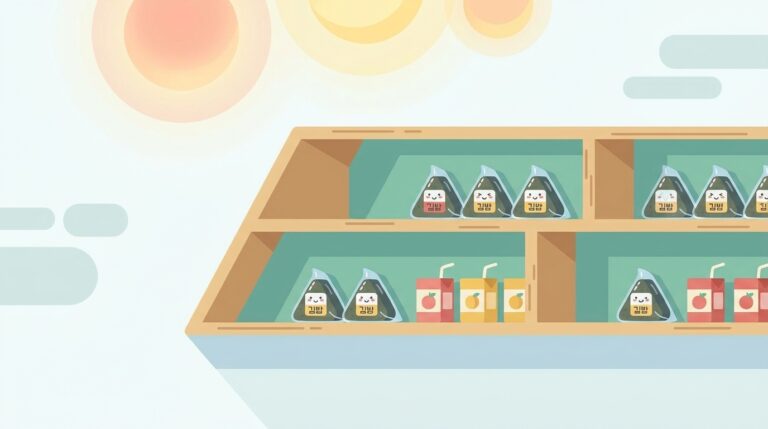
안녕하세요! 매일한글 에디터입니다. (Hello! I’m your Daily Hangul editor.) Imagine this: it is 11:30 PM in Seoul, your flight landed just a couple of hours ago, and your stomach is rumbling with hunger. You stroll down a glowing neon street and step inside a bright, welcoming GS25 convenience store. You have seen those delicious, crispy triangle kimbap (삼각김밥) in so many K-dramas, and you finally want to taste one for yourself. But as you walk up to the chilled open shelves, you freeze. There are dozens of triangular packages stacked together with vibrant labels. Which one is tuna mayo? Which one is spicy chicken? Where are they even located? Standing frozen in the aisle while the clerk looks on is a common rite of passage. Don’t worry! Based on real classroom scenarios from over 1,000 beginner learners, this friendly A1 survival guide will give you the exact words to find your dream snack with zero stress.
Phase 2: Core 3 Key Expressions
1. 삼각김밥 어디에 있어요? (Samgakgimbap eodie isseoyo?)
- Pronunciation: [Sam-gak-gim-bap eo-di-e iss-eo-yo?] (Think: “Sam” like Uncle Sam, “gahk”, “geem” like steam, “bahp” like pop; “uh-dee-eh eess-uh-yo?”)
- Meaning: Literal: “Triangle kimbap, at where does it exist?” | Real Nuance: “Excuse me, where can I find the triangle kimbap?”
- K-Culture Moment: You will see this phrase in slice-of-life K-dramas whenever a character rushes into a convenience store during a lunch break looking for a quick meal.
- Editor’s Insight: If you feel nervous, just add 저기요 (jeo-gi-yo / excuse me) right before this phrase. It instantly softens your tone and gets the clerk’s attention politely.
- Situation Spectrum: Casual: ⚠️ (Use “삼각김밥 어디 있어?” with close friends only) | Semi-formal: ✅ (Perfect for retail clerks) | Formal: 🚫 (Too stiff for a convenience store)
- 🤔 Think About It: In English, we often ask “Do you sell triangle kimbap?” In Korean, asking “Where is it?” assumes the store already carries it, keeping the interaction fast and direct.
2. 참치마요 있어요? (Chamchimayo isseoyo?)
- Pronunciation: [Cham-chi-ma-yo iss-eo-yo?] (Think: “Chahm” like charm, “chee” like cheese, and “mayo” just like mayonnaise!)
- Meaning: Literal: “Does tuna mayo exist?” | Real Nuance: “Do you have the tuna mayo flavor?”
- K-Culture Moment: Tuna mayo is South Korea’s undisputed number-one convenience store snack flavor, famously loved by K-pop idols during trainee days.
- Editor’s Insight: You do not need to repeat the full noun “삼각김밥” every time. Once context is set, just name the flavor followed by 있어요?.
- Situation Spectrum: Casual: ⚠️ | Semi-formal: ✅ (Natural standard) | Formal: 🚫
- 🤔 Think About It: Korean spoken grammar frequently drops object particles like “-을/를” to speed up everyday transactions.
3. 데워야 해요? (Deowoya haeyo?)
- Pronunciation: [De-wo-ya hae-yo?] (Think: “Deh” like desk, “wo” like walk, “yah”, “heh-yo”)
- Meaning: Literal: “Must I warm it up?” | Real Nuance: “Should I microwave this?”
- K-Culture Moment: Debating whether to eat triangle kimbap cold (to keep the seaweed extra crispy) or warm (for gooey rice and fillings) is a classic debate on Korean variety shows.
- Editor’s Insight: If the clerk responds “네, 15초요” (Ne, sip-o-cho-yo / Yes, 15 seconds), head over to the microwave counter near the window!
- Situation Spectrum: Casual: ⚠️ | Semi-formal: ✅ | Formal: 🚫
- 🤔 Think About It: In Korea, convenience store dining is self-serve, so asking whether heating is recommended helps you enjoy food at peak quality.
Phase 3: Textbook Korean vs. Real Korean
Situation 1: Asking for location
- 📖 교과서 한국어 (Textbook): 삼각김밥이 어디에 위치해 있습니까? (Samgakgimbabi eodie wichihae isseumnikka?)
- 🗣️ 진짜 한국어 (Real-Life): 삼각김밥 어디 있어요? (Samgakgimbap eodi isseoyo?)
- 💡 왜 다를까? (Why the difference?): Real Koreans drop grammatical particles like “-이” and replace formal terms like “위치해 있습니까” (is it positioned) with the brisk, friendly “어디 있어요?”.
Situation 2: Asking if a specific flavor is in stock
- 📖 교과서 한국어 (Textbook): 참치마요 삼각김밥을 판매합니까? (Chamchimayo samgakgimbabeul panmaehamnikka?)
- 🗣️ 진짜 한국어 (Real-Life): 참치마요 있어요? (Chamchimayo isseoyo?)
- 💡 왜 다를까? (Why the difference?): Using “판매합니까?” (Do you sell?) sounds like a corporate supply chain inquiry. “있어요?” (Do you have it?) is casual, polite, and universally understood.
Phase 4: K-Culture Deep Dive & Non-Verbal Manners
4-1. 눈치 (Nunchi) & Gestures
- Polite Pointing: When indicating an aisle or an item, avoid pointing with an outstretched index finger. Instead, use an open palm facing upward with a slight arm extension.
- The 15-Degree Bow: When saying “저기요” (excuse me) or “감사합니다” (thank you), a subtle head nod or 15-degree bow shows great respect without feeling overly dramatic.
- Card Exchange: When handing your payment card to the clerk, hold the card with both hands or support your right elbow with your left hand.
4-2. Culture Code Analysis: The Art of the 1-2-3 Strip
Triangle kimbap packaging is an engineering marvel designed to separate the roasted seaweed (김 / gim) from the moist rice until the exact second you eat it. Look closely at the plastic wrapper: you will see numbers 1, 2, and 3. Pull tab 1 straight down and all the way around the back. Then gently pull tab 2 to the right, and tab 3 to the left. If you do this without ripping the seaweed, locals will view you as an honorary Korean!
Phase 5: Real-Life Roleplay Scenario
- Setting: 10:30 PM at a bustling CU store in Hongdae. Fluorescent lights humming, instant ramen aroma in the air.
- Characters: You (a hungry traveler) and Minho (a friendly 20-something college student working the night shift).
-
Turn 1 (You): 저기요, 실례합니다! (Jeogiyo, sillyehamnida! / Excuse me, pardon me!) 🎭 [Politely steps near the counter with a modest head nod]
- Turn 2 (Minho): 네, 어서오세요! 뭐 찾으세요? (Ne, eoseooseyo! Mwo chajeuseyo? / Yes, welcome! What are you looking for?) 🎭 [Pauses stocking shelf and smiles]
- Turn 3 (You): 삼각김밥 어디에 있어요? (Samgakgimbap eodie isseoyo? / Where is the triangle kimbap?) 🎭 [Gestures gently toward the back refrigerators]
- Turn 4 (Minho): 아, 저쪽 안쪽 냉장 코너에 있어요! (A, jeojjok anjjok naengjang koneoe isseoyo! / Ah, it is over there in the refrigerated section on the inside!)
- Turn 5 (You): 참치마요 있어요? (Chamchimayo isseoyo? / Do you have tuna mayo?) 🎭 [Looks eagerly at the shelves]
- Turn 6 (Minho): 네, 방금 채워서 두 개 남아 있어요! (Ne, banggeum chaewoseo du gae nama isseoyo! / Yes, I just refilled it, there are two left!) 🎭 [Points with an open hand]
- Turn 7 (You): 이거 데워야 해요? (Igeo deowoya haeyo? / Should I microwave this?) 🎭 [Holds up the package with both hands]
- Turn 8 (Minho): 그냥 드셔도 되고, 15초만 데우면 더 맛있어요! (Geunyang deosyeodo doego, sib-o-cho-man de-u-myeon deo mas-it-seoyo! / You can eat it cold, or heat it for 15 seconds for better taste!)
🔀 Interactive Choice Point
How do you reply to Minho to complete your purchase?
* Option A: “감사합니다! 15초 데워 먹을게요.” (Gamsahamnida! Sib-o-cho deowo meogeulgeyo. / Thank you! I’ll heat it for 15 seconds and eat.)
* Feedback: [Best Choice] Polite, natural, and proves you understood his friendly suggestion perfectly.
* Option B: “삼각김밥 싫어요. 라면 끓여주세요.” (Samgakgimbap sileoyo. Ramyeon kkeul-yeojuseyo. / I hate triangle kimbap. Cook ramen for me.)
* Feedback: [Bad Choice] Rude and demanding. Korean convenience stores are self-service, so clerks do not cook for you!
* Option C: “야, 전자레인지 어디 있어?” (Ya, jeonjareinji eodi isseo? / Hey, where is the microwave?)
* Feedback: [High Risk] Uses extreme casual language (반말 / banmal). This will startle and offend the clerk.
Phase 6: 10-Second Emotion Shadowing Drill
Practice reading these out loud at normal conversational speed:
[🥺 Polite & Inquiring]저기요, / 삼각김밥 / 어디에 있어요? (Jeogiyo, / samgakgimbap / eodie isseoyo?)[🤤 Curious & Hopeful]혹시 / 참치마요 / 있어요? (Hoksi / chamchimayo / isseoyo?)[🤔 Practical & Attentive]이거 / 전자레인지에 / 데워야 해요? (Igeo / jeonjareinjie / deowoya haeyo?)
Phase 7: K-Culture Mini Dictionary
- 삼각김밥 (Sam-gak-gim-bap): Triangle Kimbap. A triangular snack made of seasoned rice stuffed with flavorful meat or fish and wrapped in dried nori seaweed.
- 편의점 (Pyeon-ui-jeom): Convenience Store. In Korea, this is a 24-hour community hub where you can pay bills, buy transit tickets, eat hot meals, and charge your phone.
- 참치마요 (Cham-chi-ma-yo): Tuna Mayonnaise. The most popular savory filling in Korea, balancing creamy texture with rich protein.
- 전자레인지 (Jeon-ja-re-in-ji): Microwave Oven. The ubiquitous tabletop appliance available in convenience stores with 15-second, 30-second, and 1-minute quick buttons.
Phase 8: Survival Kit for Travelers
Top 3 Survival Expressions
- 봉투 필요하세요? (Bongtu piryohaseyo?): “Do you need a plastic bag?”
- Pro Tip: Reply with “네” (Ne / Yes, costs ~100 won) or “괜찮아요” (Gwaenchanayo / No thank you, it’s fine).
- 카드로 할게요 (Kadeuro halgeyo): “I will pay by card.”
- Pro Tip: Say this while holding your payment card or T-money transit card toward the card terminal.
- 영수증 버려주세요 (Yeongsujeung beoryeojuseyo): “Please throw away the receipt for me.”
- Pro Tip: Clerks frequently ask if you want the receipt. This phrase saves unnecessary paper.
Editor’s Travel Note
Before stepping outside your hotel, ensure you have the Naver Map App Download ready on your phone because international map apps often fail to show opening hours or store entrances in Korea. Also remember that convenience store microwaves are powerful (often 1000W), so heat your triangle kimbap for only 15 to 20 seconds. If heated too long, the seaweed gets soggy!
Phase 9: “One Step Deeper” (Reflective Essay)
Korean convenience store interactions are a mirror into modern Korean social rhythm: fast-paced yet deeply mindful of interpersonal boundaries. The simple suffix -요 (-yo) transforms brief words into genuine expressions of everyday respect. Even during a 30-second late-night transaction, using polite forms signals that you see the part-time worker as an equal and valued member of the neighborhood community.
💬 Your Turn: Which triangle kimbap flavor are you most curious to try: classic Tuna Mayo (참치마요), spicy Jeonju Bibimbap (전주비빔밥), or sweet Bulgogi (불고기)? Share your choice in the comments below!
Phase 10: FAQ & Avoiding Misunderstandings
Q: Can I pay with an international foreign credit card at Korean convenience stores?
A: Yes! Most major convenience stores like CU, GS25, and 7-Eleven accept foreign Visa, Mastercard, and American Express chip cards with zero issues.
Q: Do I need to unwrap the plastic before putting the triangle kimbap in the microwave?
A: No, do not remove the wrapper entirely! Simply pull strip #1 down about an inch so steam can vent, then microwave for 15 seconds. This keeps the seaweed separate from moisture while warming the inner rice.
Q: What should I do with my trash after eating at the store counter?
A: Korean convenience stores have strict recycling bins. Separate your clear plastic wraps, paper cups, food scraps, and general waste into the clearly marked receptacles next to the hot water machine.
🚨 흔한 실수 (Common Mistakes) Checklist
- ❌ Mistake 1: Pulling corners #2 and #3 before pulling strip #1 down completely.
- 👉 Correct Action: Always pull strip #1 straight down the middle and around the back before pulling the side corners!
- ❌ Mistake 2: Heating triangle kimbap for a full minute like standard leftovers.
- 👉 Correct Action: Only heat for 15 to 20 seconds to prevent the rice from collapsing and the seaweed from turning rubbery.
- ❌ Mistake 3: Addressing a young clerk as “아줌마” (Ajumma) or “아저씨” (Ajeossi).
- 👉 Correct Action: Stick to the universal, polite greeting “저기요” (Jeogiyo / Excuse me) or “사장님” (Sajangnim).
Phase 11: Action Missions & Engagement
- 🥉 Bronze Mission (Solo Drill): Look in the mirror and repeat “삼각김밥 어디에 있어요?” three times out loud with a friendly smile.
- 🥈 Silver Mission (Social Connection): Write your favorite Korean snack flavor in Hangul and share it on Instagram or TikTok with the tag #DailyHangul.
- 🥇 Gold Mission (Real-World Test): Visit a local Korean supermarket or a Seoul convenience store and locate a snack using only Korean phrases without speaking English!
- 🎮 K-Culture Mission: Watch any episode of a contemporary K-drama and identify what snack the lead characters eat at the outside convenience store plastic tables.
Phase 12: Interactive Quiz Challenge
1. Situational Judgment
You are standing in a convenience store looking for your favorite flavor. Which phrase should you say to the clerk?
* A) 참치마요 있어요? (Chamchimayo isseoyo?)
* B) 참치마요 줘. (Chamchimayo jwo.)
* C) 참치마요 어디로 가요? (Chamchimayo eodiro gayo?)
2. Fill in the Blank
Complete the sentence to ask where triangle kimbap is located:
“삼각김밥 ________ 있어요?”
* Choices: [언제 / 어디에 / 누구]
3. True or False
Triangle kimbap must always be microwaved for at least 60 seconds before eating. (True / False)
👉 Click here to check the answers and explanations!
-
Answer: A) 참치마요 있어요?
Explanation: This is the polite, semi-formal way to ask if an item is available. Option B is overly casual (banmal), and Option C asks “Where is it going?”. -
Answer: 어디에 (eodie)
Explanation: “어디에 있어요?” means “Where is it located?”. “언제” means when, and “누구” means who. -
Answer: False
Explanation: Triangle kimbap is already fully cooked and safe to eat cold. If you prefer it warm, heat it for only 15 to 20 seconds so the seaweed stays crisp!







