

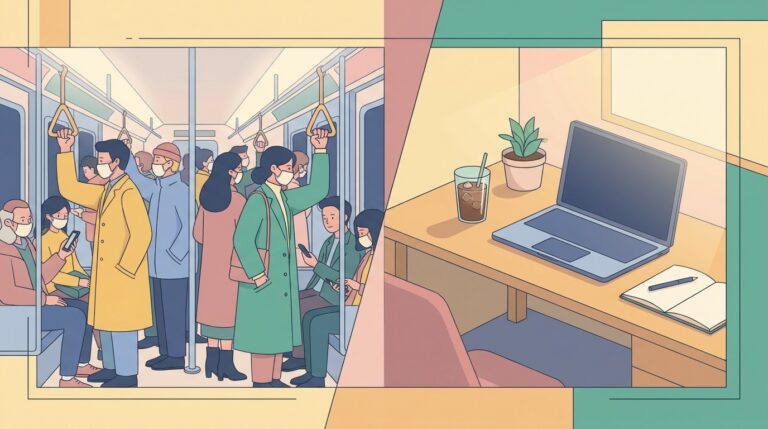
Phase 1: Why Every Worker in Seoul Dreams of Skipping the Morning Rush
안녕하세요! 매일한글 에디터입니다. (Annyeonghaseyo! Ma-eil Hangeul editeo-imnida. / Hello! I’m your Daily Hangul Editor.) Picture this: it’s 8:15 AM on Seoul Subway Line 9. You’re holding your precious Iced Americano like a shield while squeezed shoulder-to-shoulder in a packed train car—what Koreans famously call “hell subway.” Now imagine trading that exhausting two-hour round-trip commute for your cozy desk, sweatpants, and total focus. Whether you’re debating hybrid policies with Korean coworkers or chatting about work-life balance, textbook phrases just won’t cut it. Built from real feedback from our intermediate learners, this guide equips you with natural, nuanced Korean expressions to compare remote and office life like a local bestie.
Phase 2: Top 3 Key Expressions Deep Dive
1. 지옥철 (Ji-ok-cheol / Hell Subway)
- Pronunciation: Ji-ok-cheol (Sounds like “Jee-oak-chul,” with a sharp, slightly clipped “chul” like the start of “chuckle”)
- Meaning: Literal translation is “Hell (지옥) + Subway (지하철).” Actual nuance: A painfully relatable, slightly humorous slang-turned-everyday noun for ultra-crowded rush-hour subway trains where you can barely breathe, let alone move your arms.
- K-Culture Moment: Think of office K-dramas like My Liberation Notes, where characters stare blankly out the train window or stand motionless in packed commuter cars traveling from Gyeonggi-do into Gangnam every single morning.
- Editor’s Insight: Even though it contains the word “hell,” Koreans use
지옥철casually with bosses, colleagues, and news anchors alike! It instantly triggers instant sympathy and bonding.- Situation Spectrum: Casual ✅ | Semi-formal ✅ | Formal ⚠️ (Use
혼잡한 출근길 지하철in ultra-formal presentations, though지옥철works in relaxed business meetings)- 🤔 Think About It: In English, people say “packed like sardines” or “cattle car.” Why do you think Korean blends “hell” directly into the word for subway? How does naming a daily struggle this dramatically help Koreans cope together?
2. 왕복 두 시간이나 걸리다 (Wang-bok du si-gan-i-na geol-li-da / To take as long as two hours round-trip)
- Pronunciation: Wang-bok du si-gan-i-na geol-li-da (“Wahng-boak doo shee-gah-nee-nah gul-lee-dah” — stretch out
-naslightly to emphasize how ridiculously long it feels)- Meaning: Literal translation is “Round-trip two hours-as-much-as takes.” Actual nuance: The particle
-(이)나adds emotional weight—meaning “a whopping two hours!” It signals to the listener that the time feels burdensome or excessive.- K-Culture Moment: You’ll hear this often in Korean lifestyle vlogs (직장인 브이로그) when young professionals explain why they finally moved closer to their office or jumped at a hybrid job offer.
- Editor’s Insight: Many intermediate learners say
두 시간 걸려요(It takes two hours), which sounds neutral. Adding왕복(round-trip) and-(이)나(as long as) transforms a flat fact into a compelling argument for working from home.- Situation Spectrum: Casual ✅ | Semi-formal ✅ | Formal ✅
- 🤔 Think About It: Korean attaches emotional judgment right onto numbers using tiny particles like
-(이)나(more than expected) vs.밖에(less than expected). When you talk about commute time in your native language, do you rely more on tone of voice or specific adjectives?3. ~에 에너지를 쏟지 않아도 된다는 거예요 (~e e-neo-ji-reul ssot-ji a-na-do doen-da-neun geo-ye-yo / It’s that you don’t have to pour energy into…)
- Pronunciation: ~e e-neo-ji-reul ssot-ji a-na-do doen-da-neun geo-ye-yo (Notice
쏟지sounds like “ssot-jjee” with a tense, explosive doublessandjj—imagine pouring out a heavy bucket of water!)- Meaning: Literal translation is “It is the fact that one doesn’t have to pour energy into [X].” Actual nuance: A polished, persuasive way to highlight a key benefit. The verb
쏟다(to pour) paints energy as a finite liquid you don’t want to waste.- K-Culture Moment: Perfect for realistic workplace debate shows or modern K-dramas like Gaus Electronics, where younger team members passionately pitch remote-work perks to skeptical managers.
- Editor’s Insight: Ending with
-다는 거예요(it’s that…) is a Level 3 power move! When paired with재택근무의 가장 큰 장점은(The biggest advantage of remote work is…), it frames your opinion cleanly and logically without sounding robotic.- Situation Spectrum: Casual ⚠️ (Drop
-요to~거야) | Semi-formal ✅ | Formal ✅ (Use~다는 것입니다in speeches)- 🤔 Think About It: Comparing energy to something you “pour” (
쏟다) versus “burn” or “spend” in English—notice how both languages treat human stamina like a limited resource! In your culture, is protecting commute energy seen as smart efficiency or avoiding hard work?
Phase 3: Textbook Korean vs. Real Korean
Situation 1: Explaining why commuting drains your soul
- 📖 Textbook Korean: 출퇴근 시간이 길어서 너무 피곤합니다. (Chul-toe-geun si-gan-i gi-reo-seo neo-mu pi-gon-ham-ni-da. / Because commuting time is long, I am very tired.)
- 🗣️ Real Korean: 출근길 지옥철에서 이미 기 다 빨려요. (Chul-geun-gil ji-ok-cheol-e-seo i-mi gi da ppal-lyeo-yo. / On the morning hell subway, all my energy already gets sucked dry.)
- 💡 Why the difference? Textbooks prioritize clean cause-and-effect (
-아/어서), while real Koreans vividly describe losing기(life force/energy) before they even open their laptops! Using기 빨린다makes you sound effortlessly fluent.
Situation 2: Comparing remote work vs. office work
- 📖 Textbook Korean: 저는 사무실 출근보다 재택근무를 더 선호합니다. (Jeo-neun sa-mu-sil chul-geun-bo-da jae-taek-geun-mu-reul deo seon-ho-ham-ni-da. / I prefer remote work over going to the office.)
- 🗣️ Real Korean: 아무래도 재택이 워라밸 챙기기에 훨씬 낫죠. 대신 가끔 출근해서 대면 소통하는 것도 필요하긴 해요. (A-mu-rae-do jae-taeg-i wo-ra-bael chaeng-gi-gi-e hwol-ssin nat-jyo. Dae-sin ga-kkeum chul-geun-hae-seo dae-myeon so-tong-ha-neun geot-do pi-ryo-ha-gin hae-yo. / All things considered, remote work is way better for keeping work-life balance. On the flip side, coming in sometimes for face-to-face communication is necessary too.)
- 💡 Why the difference? Saying
더 선호합니다sounds like a survey questionnaire. Real Korean speakers soften opinions with아무래도(after all/all things considered) and balance pros and cons using대신(on the other hand) and-긴 해요(it’s true that…).
Phase 4: K-Culture Deep Dive & Non-Verbal Manners
4-1. Nunchi (눈치) & Body Language
When Koreans talk about 지옥철, watch their shoulders! They often let out a dramatic half-sigh (하아...), drop their shoulders slightly, or mimic holding onto an invisible overhead subway strap while bracing for impact. It’s an invitation for collective empathy. On the flip side, when discussing remote vs. office work with a Korean boss or senior colleague (선배), activate your Nunchi (눈치)! Many traditional managers still associate physical presence in the office with dedication. So instead of beaming too smugly about working in pajamas, keep a thoughtful posture, nod attentively, and pair every remote-work perk with a nod to teamwork—for example, praising how hybrid days boost both focus and collaboration.
4-2. Cultural Code Analysis: The “Gyeonggi-do Commute” & Cafe Culture
In Korea, housing prices in central Seoul have pushed millions of office workers to surrounding cities in Gyeonggi-do (like Bundang, Suwon, or Yongin). That’s why a two-hour round-trip commute (왕복 두 시간 출퇴근) isn’t an exaggeration—it’s a national cultural touchstone featured heavily in slice-of-life K-dramas! Meanwhile, on remote work days, Koreans rarely stay cooped up at home all day. Enter 카공족 (ka-gong-jok) and 재택족 (jae-taek-jok)—people who grab an Iced Americano (아아) and camp out at sleek neighborhood cafes with free high-speed Wi-Fi and power outlets at every seat, turning remote work into a lifestyle aesthetic.
Phase 5: Real-Life Roleplay Scenario
Setting: A sunlit, minimalist coffee shop in Seongsu-dong during lunch break. Laptops are humming quietly nearby, and the aroma of roasted espresso fills the air.
Characters: Minji (a bright, expressive Korean startup product manager who commutes from outside Seoul) and Alex (an intermediate Korean learner working as a marketing lead at the same company).
- Minji: 알렉스 씨, 우리 회사 다음 달부터 하이브리드 근무로 바뀐대요! 들었어요? (Al-lek-seu ssi, u-ri hoe-sa da-eum dal-bu-teo ha-i-beu-ri-deu geun-mu-ro ba-kkwin-dae-yo! Deu-reo-sseo-yo? / Alex, I heard our company is switching to hybrid work starting next month! Did you hear?)
🎭 leans across the wooden table excitedly, eyes wide - Alex: 네, 방금 공지 봤어요! 주 3일 출근에 주 2일 재택이라니 너무 좋네요. (Ne, bang-geum gong-ji bwa-sseo-yo! Ju sam-il chul-geun-e ju i-il jae-taeg-i-ra-ni neo-mu jon-ne-yo. / Yes, I just saw the announcement! Three days in-office and two days remote sounds amazing.)
🎭 smiles warmly while stirring his iced latte - Minji: 맞아요! 근데 알렉스 씨는 집에서 일하는 게 더 좋아요, 아니면 사무실이 더 좋아요? (Ma-ja-yo! Geun-dae Al-lek-seu ssi-neun jib-e-seo il-ha-neun ge deo jo-a-yo, a-ni-myeon sa-mu-sil-i deo jo-a-yo? / Right? By the way, Alex, do you prefer working from home, or do you prefer the office?)
- Alex: 솔직히 재택근무의 가장 큰 장점은 왕복 두 시간이나 걸리는 지옥철 출퇴근에 에너지를 쏟지 않아도 된다는 거예요. (Sol-ji-ki jae-taek-geun-mu-ui ga-jang keun jang-jeom-eun wang-bok du si-gan-i-na geol-li-neun ji-ok-cheol chul-toe-geun-e e-neo-ji-reul ssot-ji a-na-do doen-da-neun geo-ye-yo. / Honestly, the biggest advantage of remote work is not burning energy on a two-hour round-trip rush-hour subway commute.)
🎭 sighs dramatically with a playful grin, shaking his head - Minji: 완전 공감해요! 9호선 급행 탈 때마다 아침부터 기가 다 빨려요. (Wan-jeon gong-gam-hae-yo! Gu-ho-seon geup-haeng tal ttae-ma-da a-chim-bu-teo gi-ga da ppal-lyeo-yo. / I totally relate! Every time I take the Line 9 express train, my energy gets completely drained right from the morning.)
🎭 nods vigorously, placing both hands over her heart - Alex: 그렇죠? 그 대신 사무실에 나오면 팀원들이랑 바로바로 소통할 수 있는 건 편한 것 같아요. (Geu-reo-jyo? Geu dae-sin sa-mu-sil-e na-o-myeon tim-won-deu-ri-rang ba-ro-ba-ro so-tong-hal su in-neun geon pyeon-han geot ga-ta-yo. / Right? On the other hand, when you come to the office, being able to communicate instantly with teammates feels convenient.)
🎭 gestures thoughtfully with open hands - Minji: 맞아요. 집중이 필요한 업무는 집에서 하고, 회의는 사무실에서 하면 딱이겠네요! (Ma-ja-yo. Jip-jung-i pi-ryo-han eom-mu-neun jib-e-seo ha-go, hoe-ui-neun sa-mu-sil-e-seo ha-myeon tta-gi-gen-ne-yo! / True. Doing work that requires deep focus at home and holding meetings at the office will be just right!)
- Alex: 네, 하이브리드 근무가 진짜 이상적인 것 같아요. (Ne, ha-i-beu-ri-deu geun-mu-ga jin-jja i-sang-jeog-in geot ga-ta-yo. / Yes, hybrid work really seems ideal.)
🎭 raises his coffee cup in a friendly toast
🔀 Interactive Branching Point
Just then, your strict Team Leader (팀장님) walks past your table and asks, “재택근무 하면 집에서 놀고 싶지 않아요? (Jae-taek-geun-mu ha-myeon jib-e-seo nol-go sip-ji a-na-yo? / When you work remotely, don’t you just feel like slacking off at home?)” How do you respond?
- Option A: 출퇴근에 에너지를 쏟지 않아도 돼서 오히려 업무 집중도가 훨씬 높아져요! (Chul-toe-geun-e e-neo-ji-reul ssot-ji a-na-do dwae-seo o-hi-ryeo eom-mu jip-jung-do-ga hwol-ssin no-pa-jyeo-yo! / Since I don’t have to spend energy on commuting, my work focus actually gets much higher!) -> Best! Smart, polite, and frames your saved energy as a win for company productivity.
- Option B: 네, 집에서 넷플릭스 보면서 일하니까 완전 편하고 좋아요! (Ne, jib-e-seo net-peul-lik-seu bo-myeon-seo il-ha-ni-kka wan-jeon pyeon-ha-go jo-a-yo! / Yes, working while watching Netflix at home is super comfy and great!) -> Bad! Even as a joke, mentioning Netflix to a traditional Korean manager can trigger instant regret and ruin remote-work trust.
- Option C: 회사가 너무 멀어서 가기 싫을 때만 집에서 일하려고요. (Hoe-sa-ga neo-mu meo-reo-seo ga-gi si-reul ttae-man jib-e-seo il-ha-ryeo-go-yo. / I plan to work from home only when the office feels too far and I don’t feel like going.) -> Risk! Sounds honest among friends, but to a boss,
가기 싫다(not wanting to go) sounds unmotivated rather than strategic.
Phase 6: 10-Second Emotion Shadowing Drill
Read aloud at natural speed, pausing briefly at each / and matching the emotional cue:
- [😫 Exhausted & dramatic]
왕복 두 시간이나 걸리는 / 지옥철 출퇴근 때문에 / 아침부터 기가 다 빨려요. (Wang-bok du si-gan-i-na geol-li-neun / ji-ok-cheol chul-toe-geun ttae-mun-e / a-chim-bu-teo gi-ga da ppal-lyeo-yo. / Because of a two-hour round-trip hell-subway commute, my energy gets drained right from the morning.) -
[😌 Relieved & persuasive]
재택근무의 가장 큰 장점은 / 출퇴근에 에너지를 쏟지 않아도 / 된다는 거예요. (Jae-taek-geun-mu-ui ga-jang keun jang-jeom-eun / chul-toe-geun-e e-neo-ji-reul ssot-ji a-na-do / doen-da-neun geo-ye-yo. / The biggest advantage of remote work is that you don’t have to burn energy on commuting.) -
[🤔 Thoughtful & balanced]
그래도 가끔 사무실에 출근해서 / 대면으로 소통하는 것도 / 나쁘지 않아요. (Geu-rae-do ga-kkeum sa-mu-sil-e chul-geun-hae-seo / dae-myeon-eu-ro so-tong-ha-neun geot-do / na-ppeu-ji a-na-yo. / Still, coming into the office sometimes and communicating face-to-face isn’t bad either.)
Phase 7: K-Culture Mini Dictionary
- 왕복 (Wang-bok) | Round-trip | Used constantly for subway/bus rides, flights, and deliveries (
왕복 요금= round-trip fare; opposite is편도= one-way). - 워라밸 (Wo-ra-bael) | Work-life balance (Konglish abbreviation) | One of the biggest buzzwords in modern Korean job interviews and workplace conversations (
워라밸이 좋다= has great work-life balance). - 하이브리드 근무 (Ha-i-beu-ri-deu geun-mu) | Hybrid work | Standard business Korean for splitting the week between home (
재택근무) and the office (사무실 출근). - 기 빨린다 (Gi ppal-lin-da) | Energy gets drained / emotionally wiped out | Vivid everyday slang used when a crowded subway, intense social gathering, or endless meeting leaves you exhausted.
Phase 8: Survival Kit for Travelers & Digital Nomads
Top 3 Survival Phrases
- 여기에 콘센트 있어요? (Yeo-gi-e kon-sen-teu i-sseo-yo?) — “Is there a power outlet here?” Pro Tip: Essential when working remotely at a Korean café; look under bench seats first!
- 출근 시간 피해서 갈게요. (Chul-geun si-gan pi-hae-seo gal-ge-yo.) — “I’ll go after avoiding rush hour.” Pro Tip: Say this when meeting local friends in Gangnam or Hongdae so you don’t get stuck on Line 2.
- 급행열차는 어디서 타요? (Geup-haeng-yeol-cha-neun eo-di-seo ta-yo?) — “Where do I catch the express train?” Pro Tip: Express trains (
급행) save huge time on Line 9 and Line 1, though they are also peak지옥철during rush hour!
Editor’s Travel Note
If you’re working remotely while visiting Seoul, skip Google Maps and install Korea’s local navigation powerhouse: Download Naver Map for real-time subway congestion alerts, which even shows you which subway car (칸) is least crowded! Also, look into the Seoul Climate Card unlimited transit pass guide if you plan on commuting frequently, and avoid riding Seoul Subway Line 2 or Line 9 between 8:00–9:15 AM and 6:00–7:30 PM unless you want a firsthand taste of 지옥철.
Phase 9: One Step Deeper — The Shift From “Presence” to “Balance”
For decades, Korea’s rapid economic miracle was powered by intense communal hustle—showing up early, staying late, and bonding over after-work 회식 (team dinners). Being physically visible at your desk (출근 도장 찍기) was once treated as proof of loyalty. Today, however, younger Korean generations (often called the MZ generation) are rewriting those unwritten rules, valuing autonomy, mental stamina, and 워라밸 just as highly as salary. Choosing remote or hybrid work isn’t seen as laziness anymore—it’s a quiet revolution to reclaim two hours of life every single day.
💬 Your Turn: How long is your daily commute? Would you choose full remote work, five days in the office, or a hybrid mix—and why? Tell us in the comments using at least one Korean expression from today!
Phase 10: FAQ & Myth-Busting
Q: Is “지옥철” rude to say in front of Korean coworkers or a boss?
A: Not at all! While literally meaning “hell subway,” 지옥철 is a completely normal everyday media and office term in Korea. You can safely use it to bond over traffic struggles, as long as your sentence endings stay polite (-아요/어요 or -습니다).
Q: Can I use “~다는 거예요” when talking to someone much older or a client?
A: In polite conversation (존댓말), ~다는 거예요 works well with coworkers, friendly managers, and peers. For formal client presentations or senior executives, upgrade it slightly to ~다는 점입니다 (it is the point that…) or ~다는 것입니다.
Q: What is the opposite of “재택근무” if I want to contrast both styles?
A: You can contrast 재택근무 (remote work) with 사무실 출근 (commuting to the office) or 대면 근무 (in-person work). Together, blending both is called 하이브리드 근무 (hybrid work).
🚨 Common Mistakes Alert
- Mistake 1: Saying
재택일instead of재택근무. -> Correct Action: Use재택근무(work) or simply shorten it casually to재택(e.g.,오늘 저 재택이에요= I’m working from home today). - Mistake 2: Translating “burn energy” literally as
에너지를 태우다. -> Correct Action: In Korean,태우다is for burning calories or fat! For mental/commute stamina, naturally pair energy with쏟다(pour) or쓰다(use/spend). - Mistake 3: Leaving out
왕복when stating total commute time. -> Correct Action: Specify편도 한 시간(1 hour one-way) or왕복 두 시간(2 hours round-trip) so listeners don’t think your office is two hours away each way!
Phase 11: Action Mission & K-Culture Challenge
- 🥉 Bronze Mission (Solo Practice): Stand in front of a mirror and deliver today’s key sentence—
재택근무의 가장 큰 장점은 왕복 두 시간이나 걸리는 지옥철 출퇴근에 에너지를 쏟지 않아도 된다는 거예요—smoothly in under 6 seconds! - 🥈 Silver Mission (Social Share): Post a photo of your remote-work desk (or your morning coffee commute) on social media with the Korean caption:
오늘도 워라밸 챙기기! 지옥철 안 타서 좋다(Taking care of work-life balance today too! So good not riding the hell subway). - 🥇 Gold Mission (Real-World Use): Next time you chat with a Korean friend, tutor, or language partner, ask them
재택근무랑 사무실 출근 중에 뭐가 더 좋아요?(Which do you prefer between remote work and office work?) and share your reason using~에 에너지를 쏟지 않아도 되다. - 🎮 K-Culture Mission: Search YouTube for
직장인 출근 브이로그(office worker commute vlog) and see how many minutes into the video you hear or see the subtitles지옥철,왕복, or기 빨린다!
Phase 12: Interactive Quiz Challenge
1. Situation Judgment: Your Korean friend says, “우리 회사는 이제 주 5일 다 사무실 출근해야 한대.” (They say our company now requires coming to the office all 5 days a week.) How can you respond sympathetically about their long commute?
A) 어머, 왕복 두 시간이나 걸리는데 지옥철 타느라 기 다 빨겠네요!
B) 와, 하루에 에너지를 많이 태우겠네요!
C) 저는 집에서 놀아서 너무 좋아요!
Click to reveal Answer & Explanation for Q1
Answer: A! Option A naturally combines 왕복 두 시간이나 (as long as 2 hours round-trip), 지옥철 (hell subway), and 기 다 빨겠네요 (that must drain all your energy!). Option B mistakenly uses 태우다 (burn calories) for commute energy, and Option C sounds insensitive and lazy.
2. Fill in the Blank: Complete the sentence meaning “The biggest advantage of remote work is not having to pour energy into commuting.”
재택근무의 가장 큰 장점은 출퇴근에 에너지를 ( _____ ) 않아도 된다는 거예요.
Click to reveal Answer & Explanation for Q2
Answer: 쏟지 (ssot-ji)! The verb 쏟다 (to pour) drops 다 and attaches -지 않아도 되다 (don’t have to) to form 쏟지 않아도 된다는 거예요.
3. True / False Cultural Quiz: In Korea, saying 지옥철 (hell subway) to describe a crowded morning train is considered rude slang that you should only whisper to close friends.
Click to reveal Answer & Explanation for Q3
Answer: False! Despite literally containing the word “hell” (지옥), 지옥철 is universally used across Korean news broadcasts, casual office chats, and everyday life to describe packed rush-hour trains.
🎬 Watch Our Daily Videos! (Daily Hangul Official Instagram)
Review the expressions you learned in this article with our fun daily short videos! Check out native pronunciation and real-life nuances in action.
- Instagram @dailyhangul_en







