

Phase 1: Empathy & Story Opening
안녕하세요! 매일한글 에디터입니다. (Hello! This is your Daily Hangul editor.)
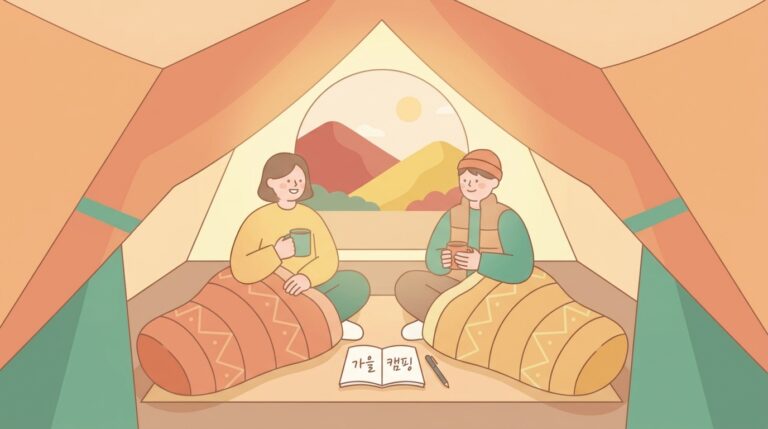
Picture this: You are on an autumn camping trip in the mountains of Gangwon-do with your Korean friends. The campfire crackles, you have just finished a steaming pot of ramyeon under the stars, and the crisp night air starts to turn biting cold. Everyone retreats into the tent. You slip inside, slide into your sleeping bag (침낭), and suddenly realize: your zipper is stuck halfway, your toes feel like icicles, and you have no idea how to ask for an extra heat pack without sounding like an ancient historical drama king!
Most textbooks teach you formal night-time greetings like “안녕히 주무십시오 (Annyeonghi jumusipsio)”, but when you are bundled up like a human burrito inside a nylon cocoon, saying that to your tent-mate just makes everyone burst into laughter. What you really need are warm, gentle, and practical phrases to survive a cozy night outdoors.
In this guide, built directly from real-life feedback of beginner learners tackling Korea’s famous gamseong (aesthetic) camping culture, you will learn the exact survival expressions, polite tent etiquette, and cozy phrases you need to conquer your first Korean camping night!
Phase 2: 3 Key Expressions Deep Dive
1. 침낭 지퍼 좀 올려줄래요? (Chimnang jipeo jom ollyeojullaeyo?)
- Pronunciation: [Chim-nang jee-peo jom ol-lyeo-jool-lae-yo] (Sounds like “chimney” with an ‘ng’, followed by “zipper” with a soft ‘j’ sound)
- Meaning: Literal: “Can you raise the sleeping bag zipper a bit?” | Nuance: “Could you help zip up my sleeping bag?”
- K-Culture Moment: In reality shows like Three Meals a Day (삼시세끼) or Camping Club, someone is always trapped with their arms pinned inside their sleeping bag, asking their campmate with puppy-dog eyes to zip them up to keep the cold draft out.
- Editor’s Insight: When your arms are already tucked inside, zipping the top flap alone is nearly impossible. Adding 좀 (jom) softens the request, making it sound very friendly and natural among tent-mates.
- Situation Spectrum: Casual: ✅ | Semi-formal: ✅ | Formal: ⚠️
- 🤔 Think About It: In your home country, asking someone to zip your sleeping bag might feel strangely intimate. In Korea, tent-mates take care of each other like family—what do you think this reveals about Korean camping culture?
2. 핫팩 하나 더 있어요? (Hatpaek hana deo isseoyo?)
- Pronunciation: [Hat-paek ha-na deo ee-sseo-yo] (Think of “hot pack” with a sharp, crisp ‘k’ at the end of both syllables)
- Meaning: Literal: “Hot pack one more exists?” | Nuance: “Do you happen to have one more heat pack?”
- K-Culture Moment: Essential during late autumn and winter camping in Korea! Campers slip activated heat packs down to the bottom of their sleeping bag to warm their feet before dozing off.
- Editor’s Insight: If you are shivering, never endure it silently out of modesty. Camping in Korea is all about sharing warmth. Asking 하나 더 있어요? (Do you have one more?) is casual and polite.
- Situation Spectrum: Casual: ✅ | Semi-formal: ✅ | Formal: ✅
- 🤔 Think About It: Why do you think Korea developed such a massive commercial market for portable chemical heat packs compared to Western camping traditions?
3. 하나도 안 추워요, 따뜻해요 (Hanado an chuwoyo, ttatteuthaeyo)
- Pronunciation: [Ha-na-do an choo-wo-yo, ttah-tteut-hae-yo] (Pay attention to the double ‘tt’ in 따뜻—it pops sharply like the ‘t’ in ‘stop’)
- Meaning: Literal: “Not even one cold, it is warm.” | Nuance: “I’m not cold at all, I’m super cozy!”
- K-Culture Moment: When a Korean host or camping buddy asks with worry, “추워요? (Are you cold?)”, reassuring them with this sentence instantly puts their mind at ease.
- Editor’s Insight: 하나도 (hanado) means “not even one bit”. Pairing it with 따뜻해요 (ttatteuthaeyo – it is warm) conveys genuine gratitude and comfort.
- Situation Spectrum: Casual: ✅ | Semi-formal: ✅ | Formal: ⚠️
- 🤔 Think About It: Reassuring the host first before stating your own needs is a key element of Korean conversational empathy. Have you noticed similar habits in your native language?
Phase 3: Textbook Korean vs. Real Korean
Situation 1: Saying goodnight inside the tent
- 📖 교과서 한국어 (Textbook): 안녕히 주무십시오. (Annyeonghi jumusipsio.)
- 🗣️ 진짜 한국어 (Real-life): 먼저 잘게요, 따뜻하게 자요! (Meonjeo jalgeyo, ttatteuthage jayeo! / I’m going to sleep first, sleep warmly!)
- 💡 왜 다를까? (Why the difference?): “안녕히 주무십시오” is ultra-formal, best reserved for grandparents or corporate executives in a formal setting. In a close-knit camping tent, wishing someone to “sleep warmly” (따뜻하게 자요) feels considerate, human, and wonderfully authentic.
Situation 2: Asking if your campmate is cold
- 📖 교과서 한국어 (Textbook): 당신은 춥습니까? (Dangsineun chumnikka?)
- 🗣️ 진짜 한국어 (Real-life): 바람 안 들어와요? 괜찮아요? (Baram an deureowayo? Gwaenchanhayo? / Is the draft coming in? Are you okay?)
- 💡 왜 다를까? (Why the difference?): Native Koreans rarely use the pronoun “당신 (dangsin)” in everyday speech because it can sound confrontational or overly dramatic. Instead, they ask about the environmental cause (like the wind/draft) to show care.
Phase 4: K-Culture Deep Dive & Non-verbal Manners
4-1. 눈치 (Nunchi) & Gestures in the Tent
- The Footwear Rule: Never let dirty campsite mud cross the threshold of the tent inner mat (이너매트). Always turn your shoes outward when leaving them at the tent vestibule (전실), so you can step straight into them when waking up.
- The Zipper Whisperer: Nylon zippers can make a screeching noise that echoes across the quiet campsite. When zipping your sleeping bag or the tent door after 매너타임 (Manner Time – usually 10 PM or 11 PM), hold both sides of the fabric taut with one hand and pull slowly with the other to eliminate noise.
- Two-Handed Hot Pack Pass: When passing or receiving a heat pack from a friend, even while half-submerged in a sleeping bag, lightly support your forearm or hold the item with both hands to display polite gratitude.
4-2. Culture Code: 불멍 (Bul-meong) to 침낭 (Chim-nang)
In Korea, camping is not about conquering harsh wilderness; it is about emotional healing (힐링). After an evening of 불멍 (bulmeong)—the therapeutic art of spacing out while watching the campfire flames—campers retreat into ultra-cozy, aesthetically curated sleeping gear. Knowing how to settle down quietly and comfortably while respecting neighboring campers is the ultimate badge of an experienced camper in Korea.
Phase 5: Real-World Roleplay Scenario
- Setting: 10:45 PM. A quiet campsite near the Bukhangang River. The autumn wind is rustling the tent fly. You and your Korean campmate Min-ji (민지) are settling into your sleeping bags.
민지 (Min-ji): 침낭 준비 다 했어요? (Chimnang junbi da haesseoyo? / Are you all set with your sleeping bag?)
[🎭 Unrolling a thick insulated mat and checking the lantern light]
나 (Me): 네, 그런데 지퍼가 걸렸어요. (Ne, geureonde jipeoga geollyeosseoyo. / Yes, but the zipper got stuck.)
[🎭 Lightly tugging at the zipper with a puzzled look]
민지 (Min-ji): 어, 내가 봐줄게요. 살살 당겨봐요. (Eo, naega bwajulgeyo. Salsal danggyeobwayo. / Oh, let me see. Pull it gently.)
[🎭 Shining a small penlight onto the sleeping bag track]
나 (Me): 풀렸어요! 지퍼 올려줘서 고마워요. (Pullyeosseoyo! Jipeo ollyeojwoseo gomawoyo. / It’s unstuck! Thank you for pulling the zipper up.)
[🎭 Smiling and exhaling with relief]
민지 (Min-ji): 발 안 시려워요? 핫팩 발 밑에 넣을래요? (Bal an siryeowoyo? Hatpaek bal mite neoeullaeyo? / Aren’t your feet cold? Do you want to put a hot pack at your feet?)
[🎭 Reaching into a pouch filled with warm pocket warmers]
나 (Me): 와, 핫팩 하나 더 있어요? (Wa, hatpaek hana deo isseoyo? / Wow, do you have one more hot pack?)
[🎭 Rubbing palms together to demonstrate chilly hands]
민지 (Min-ji): 그럼요! 여기 있어요. 쏙 넣고 푹 자요. (Geureomyo! Yeogi isseoyo. Ssok neoko puk jayeo. / Of course! Here you go. Tuck it in and sleep deeply.)
[🎭 Handing over two hot packs with both hands]
나 (Me): 덕분에 하나도 안 추워요. 잘 자요! (Deokbune hanado an chuwoyo. Jal jayeo! / Thanks to you, I’m not cold at all. Sleep well!)
[🎭 Tucking deeply into the sleeping bag hood and waving gently]
🔀 Interactive Choice Point
What would you say if the tent temperature drops around 2 AM and you wake up feeling chilly?
- Option A: “야! 너무 추워! 보일러 틀어! (Ya! Neomu chuwo! Boilleo teuleo! / Hey! Too cold! Turn on the boiler!)”
- Feedback: [Bad] Tents don’t have boilers! Using aggressive informal language (야) will wake up the whole campsite and ruin the mood.
- Option B: “저기, 혹시 담요 하나 더 빌릴 수 있을까요? (Jeogi, hoksi damyo hana deo billil su isseulkkayo? / Excuse me, could I perhaps borrow one more blanket?)”
- Feedback: [Best] Extremely polite, soft, and clear. Even in the middle of the night, this shows respect for your campmate.
- Option C: “저는 지금 얼어 죽을 것 같습니다. (Jeoneun jigeum eoreo jugeul geot gatseumnida. / I appear to be dying of frostbite right now.)”
- Feedback: [Risk] Grammatically correct, but sounds like a tragic news reporter on the evening bulletin. It might make your friend unnecessarily anxious!
Phase 6: 10-Second Emotion Shadowing Drill
Read each line out loud, pausing briefly at the / marks to catch the natural Korean sentence cadence!
[🥺 Chilly & Polite]
핫팩 / 하나 더 있어요? (Hatpaek / hana deo isseoyo? / Do you have / one more heat pack?)-
[😅 Slight Panic & Relief]
지퍼가 꼈어요… / 어, 풀렸다! (Jipeoga kkkyeosseoyo… / eo, pullyeotta! / The zipper is stuck… / Oh, it’s freed!) -
[😊 Warm, Cozy & Reassuring]
하나도 안 추워요, / 따뜻하게 잘게요! (Hanado an chuwoyo, / ttatteuthage jalgeyo! / I’m not cold at all, / I’ll sleep nice and warm!)
Phase 7: K-Culture Mini Dictionary
- 침낭 (Chim-nang) | Sleeping bag. Essential gear for camping, glamping, or even staying in mountain shelters (대피소).
- 핫팩 (Hat-paek) | Disposable chemical hand/body warmer. Sold in every convenience store in Korea during autumn and winter.
- 매너타임 (Mae-neo-ta-im) | Campsite quiet hours. Usually between 10 PM and 7 AM, where bright lights and loud voices are strictly prohibited.
- 전기장판 (Jeon-gi-jang-pan) | Electric heating pad. Premium Korean campsites offer electrical outlets where you plug this pad under your sleeping bag for instant underfloor luxury!
Phase 8: Traveler’s Survival Kit
Top 3 Survival Expressions
- 바람 들어와요, 텐트 좀 닫아주세요. (Baram deureowayo, tenteu jom dadajuseyo.)
- Pronunciation: [Ba-ram deu-reo-wa-yo, ten-teu jom da-da-joo-se-yo.]
- Pro Tip: Use this when someone accidentally leaves the mesh zipper open and a cold gust slips inside.
- 충전기 꽂을 데 있어요? (Chungjeongi kkojeul de isseoyo?)
- Pronunciation: [Choong-jeon-gi kko-jeul de ee-sseo-yo?]
- Pro Tip: Handy when asking if your camp pitch has an accessible electric post for phone or heated pad charging.
- 따뜻한 물 나와요? (Ttatteuthan mul nawayo?)
- Pronunciation: [Ttah-tteut-han mool na-wa-yo?]
- Pro Tip: Ask the campsite manager at the check-in booth to confirm if the washrooms have running hot water.
Editor’s Travel Note
Heading out for camping in Korea? Before packing your tent, make sure to check the local weather and wind warnings via the 기상청 날씨알리미 앱 다운로드 to avoid unexpected cold snaps. If you want to book government-managed national park campsites at budget-friendly rates, head directly to the 국립공원 예약 시스템 웹사이트. Remember, Korean public campsites enforce strict trash sorting (분리수거)—never leave waste inside your tent vestibule overnight, as stray mountain cats (길고양이) love visiting sleeping campers!
Phase 9: A Step Deeper (Reflection)
Camping inside a small tent highlights the core Korean concept of 정 (Jeong)—the warm emotional bond and mutual empathy built through shared experiences. When you share hot packs, adjust each other’s sleeping bag toggles, and lower your voice to respect the neighboring tents, you are actively participating in communal care. It is a reminder that in Korean culture, staying warm is rarely an individual pursuit; it is a shared act of looking out for one another.
💬 Your Turn: Have you ever spent the night in a tent or sleeping bag? What is one comforting phrase in your native tongue you say to someone when tucking in for a cold night? Share with us in the comments!
Phase 10: FAQ & Common Mistakes
Q: Can I wear thick down jackets inside the sleeping bag to stay extra warm?
A: Actually, experienced campers advise wearing thin thermal base layers (내의) inside the sleeping bag rather than a puffy parka! Sleeping bags work by trapping your body heat; bulky down parkas prevent your core temperature from warming the sleeping bag insulation.
Q: What is the polite way to tell a tent neighbor their snoring is keeping me awake?
A: Confronting strangers at night can lead to friction. Instead, bring disposable earplugs (귀마개). If noise violates the official 매너타임 (Manner Time), it is customary to quietly notify the campsite manager rather than knocking on their tent fabric directly.
Q: How do I say “Good morning” when stepping out of my sleeping bag?
A: A warm and natural greeting to your campmates is: 잘 잤어요? 안 추웠어요? (Jal jasseoyo? An chuwosseoyo? / Did you sleep well? Weren’t you cold?).
🚨 Common Mistakes Alert
- Mistake: Calling a heat pack a “히터 (heater)”.
- Correct Action: Say 핫팩 (hatpaek). “히터” refers to a large space heater or radiator.
- Mistake: Using “안녕히 주무세요” with close friends your age.
- Correct Action: Say 잘 자! (Jal ja! – casual) or 푹 자요! (Puk jayeo! – soft polite).
- Mistake: Stepping onto the inner tent mat with socks that touched the bare ground.
- Correct Action: Keep a clean pair of sleeping socks (수면양말) reserved exclusively for inside your sleeping bag.
Phase 11: Action Missions
- 🥉 Bronze Level: Practice saying “핫팩 하나 더 있어요?” three times in front of the mirror with your hands cupped together like you are warming them up.
- 🥈 Silver Level: Next time you watch a camping K-vlog, post a comment in Korean: “침낭이 정말 따뜻해 보여요! (The sleeping bag looks so warm!)”.
- 🥇 Gold Level: During your next trip or outdoor picnic with Korean friends, volunteer to hand out warm drinks or hand warmers while saying: “따뜻하게 있어요! (Stay warm!)”.
🎮 K-Culture Mission: Watch an episode of the variety show House on Wheels (바퀴 달린 집) or Camping Club. Listen carefully for the moment the cast rolls out their sleeping bags (침낭) before bed. Can you spot them passing heat packs to their guests?
Phase 12: Interactive Quiz Challenge
Q1. Situational Judgment
Your campmate is having trouble pulling up the zipper on their sleeping bag because their hands are tucked inside. What is the most natural thing to say?
a) 침낭을 버리세요! (Throw away the sleeping bag!)
b) 지퍼 올려줄까요? (Shall I zip it up for you?)
c) 안녕히 주무십시오. (Good night.)
Q2. Fill in the Blank
“I am not cold at all! It’s warm.”
→ 하나도 안 (_______), 따뜻해요!
Q3. True or False Culture Check
At Korean campsites, it is completely normal to play loud music and talk loudly inside your tent past midnight as long as your tent door is zipped shut. (True / False)
👉 Click to reveal answers & explanations
- A1 Answer: b) 지퍼 올려줄까요? (Shall I zip it up for you?)
- Explanation: Asking politely if they need a hand with the zipper shows attentive camping etiquette.
- A2 Answer: 추워요 (chuwoyo)
- Explanation: The phrase “하나도 안 추워요” means “I’m not cold at all”.
- A3 Answer: False
- Explanation: Most Korean campsites enforce 매너타임 (Manner Time) starting at 10 PM or 11 PM. Sound carries very easily through tent fabric, so campers must whisper and turn off external music.
- Explanation: Most Korean campsites enforce 매너타임 (Manner Time) starting at 10 PM or 11 PM. Sound carries very easily through tent fabric, so campers must whisper and turn off external music.
Good job! Now you are fully prepared to stay warm, polite, and cozy in any Korean tent. 따뜻하게 자요! (Sleep warmly!)






