

Phase 1: Empathy & Immersion Story
안녕하세요! 매일한글 에디터입니다. (Hello! I’m your Daily Hangul editor!)
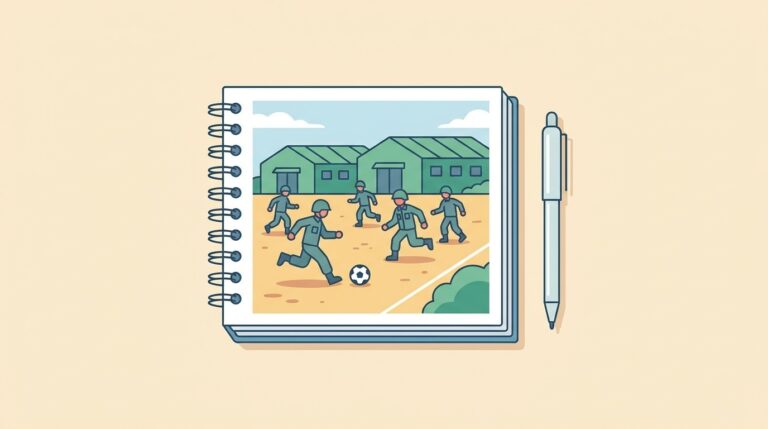
Picture this: You are sitting at a cozy pocha (street pub) in Hongdae with a group of Korean friends. The cold beer is flowing, the crispy Korean fried chicken just arrived, and everyone is having a blast. Then, one friend brings up his mandatory military service (gundae). Within thirty seconds, another chime in, their eyes light up, and the table erupts into an impassioned debate about a legendary soccer match played on a dusty gravel field wearing heavy combat boots.
You might feel completely lost. In Korea, there is a famous running joke about the three most boring conversation topics on a blind date:
1. Stories about soccer.
2. Stories about the military.
3. Stories about playing soccer in the military!
Yet, Korean men simply cannot stop talking about it. This mythical phenomenon is known as 군대스리가 (Gundaeseuriga)—a witty mashup of Gundae (군대, military) and Bundesliga (the German soccer league). While it might seem like endless boyish bragging, understanding this cultural staple is your golden ticket to understanding modern Korean male bonding, workplace hierarchy, and everyday conversational banter. Based on real feedback from intermediate learners who felt sidelined during post-work drinks (hoesik), this guide will teach you the exact phrases and unspoken cultural codes to transform an awkward monologue into a hilarious, bonding conversation.
Phase 2: Core Expressions Deep Dive
1. 군대스리가 (Gundaeseuriga)
- Pronunciation: [Gun-dae-seu-ri-ga] (Think of ‘Goon’ + ‘Day’ + Bundesliga: ‘Goon-day-seu-ree-gah’)
- Meaning: Literal: Military Bundesliga | Real Nuance: The hyper-competitive, chaotic, and legendary soccer matches played during mandatory military service.
- K-Culture Moment: In military-themed K-dramas like D.P. or variety shows like Real Men, you will often see soldiers sprinting on dirt pitches with reckless abandon because the winning platoon gets precious rewards like extra phone time or weekend leave.
- Editor’s Insight: This word is rarely used in official reports; it is an affectionate piece of slang used by civilians looking back at their youth. Mentioning it proves you don’t just speak textbook Korean—you know the culture.
- Situation Spectrum: Casual ✅ | Semi-formal ⚠️ | Formal 🚫
- 🤔 Think About It: Does your home country have an institution or shared rite of passage that turns into endless nostalgic jokes among adults?
2. 눈치껏 차라 (Nunchikkeot chara)
- Pronunciation: [Nun-chi-kkeot cha-ra] (Sounds like ‘Noon-chee’ + ‘kkuht’ + ‘cha-rah’)
- Meaning: Literal: Kick according to nunchi | Real Nuance: Play tactfully! (i.e., Don’t aggressively tackle the senior officer, and let the commander score!)
- K-Culture Moment: In comedy sketches, an overzealous rookie private steals the ball from the Battalion Commander, only to receive horrified glares from his sergeants whispering, “야, 눈치껏 차!” (Hey, play with some tact!).
- Editor’s Insight: Nunchi (social sensing) governs sports in Korea too. Even when sportsmanship is supposed to be equal, corporate and military matches require reading the room.
- Situation Spectrum: Casual ✅ | Semi-formal ⚠️ | Formal 🚫
- 🤔 Think About It: How does social hierarchy influence casual recreation in your culture? Is everyone truly equal on the pitch?
3. 개발 (Gaebal)
- Pronunciation: [Gae-bal] (Sounds like ‘Get’ without the ‘t’ + ‘Bahl’)
- Meaning: Literal: Dog’s foot / paw | Real Nuance: Clumsy feet; someone who is terrible at soccer.
- K-Culture Moment: When your friend kicks the ball completely out of the fence during a friendly match and everyone groans with affectionate laughter: “완전 개발이네!” (You’re a total clumsy foot!).
- Editor’s Insight: It sounds harsh in English, but among friends, it is lighthearted banter. Korean often prefixes gae- (개) to denote awkwardness or roughness.
- Situation Spectrum: Casual ✅ | Semi-formal ⚠️ | Formal 🚫
- 🤔 Think About It: Why do many languages use animal feet or animal references to describe poor physical coordination?
Phase 3: Textbook Korean vs. Real Korean
Situation 1: Describing a soccer match played during army days
- 📖 교과서 한국어: 군대에서 축구 경기를 열심히 했습니다. (Gundae-eseo chukgu gyeonggireul yeolsimhi haetseumnida.) – “I played soccer matches earnestly in the military.”
- 🗣️ 진짜 한국어: 주말마다 군대스리가 뛰느라 죽는 줄 알았어요! (Jumal-mada Gundaeseuriga ttwineura jungneun jul arasseoyo!) – “I thought I was gonna die every weekend running in Gundaesliga!”
- 💡 왜 다를까?: Native speakers rarely use stiff terms like “열심히 했습니다” (played earnestly). Instead, they use dramatic hyperbole like “죽는 줄 알았다” (thought I would die) coupled with the slang “군대스리가” to highlight the sheer physical exhaustion.
Situation 2: Warning a teammate to respect social hierarchy on the field
- 📖 교과서 한국어: 상급자를 조심해서 대하세요. (Sanggeupjareul josimhaeseo daehaseyo.) – “Treat your superiors with caution.”
- 🗣️ 진짜 한국어: 부장님 앞에서는 눈치껏 패스해! (Bujangnim ap-eseoneun nunchikkeot paesae!) – “Pass the ball with some tact in front of the department manager!”
- 💡 왜 다를까?: Rather than explicitly stating hierarchical rules, modern Koreans invoke “눈치껏” (with tact/wit) to remind someone to preserve the elder’s face without killing the mood.
Phase 4: K-Culture Deep Dive & Non-verbal Manners
4-1. Nunchi & Body Language on the Pitch
When sports intersect with Korean hierarchy, physical gestures speak louder than shouting:
* The Two-Hand Apology (양손 사과): If you accidentally bump into or foul someone older or higher ranking, never just walk away. Immediately raise both hands with open palms at chest height, bow slightly, and say, “죄송합니다!” (Joesonghamnida!).
* The Deferential Goal Celebration: When a manager or senior officer scores a goal, teammates clap with both hands held high, cheering enthusiastically while maintaining a respectful posture rather than jumping all over them.
4-2. Culture Code: Why Gundaesliga Never Dies
In South Korea, mandatory military service is a universal milestone for young men. Because individual autonomy is strictly restricted during service, weekend sports become the primary psychological outlet for stress. It represents an unusual paradox: on the field, rank is theoretically secondary to athleticism, yet the social rules of the military never fully vanish. Understanding Gundaesliga is understanding the tension between duty, camaraderie, and dark humor that shapes Korean adult social life.
Phase 5: Real-World Roleplay Scenario
Setting: A pocha near Gangnam station. You are having drinks with your Korean coworker, Min-woo (민우), who completed his military service in the mountains of Gangwon-do.
- 민우 (Min-woo): 혹시 주말에 축구 좋아해요? (Hoksi jumare chukgu joahaeyo? / “By any chance, do you like soccer on weekends?”)
🎭 Grins broadly and pours another glass of beer for you. - 나 (Learner): 좋아하죠! 한국 남자들은 다 축구 잘해요? (Joahajyo! Hanguk namjadeureun da chukgu jalhaeyo? / “I love it! Are all Korean men good at soccer?”)
🎭 Leans forward with curious eyes. - 민우 (Min-woo): 에이, 다 군대스리가 출신이라 기본은 하죠! (Ei, da Gundaeseuriga chulsin-ira giboneun hajyo! / “Haha, we’re all veterans of Gundaesliga, so we all know the basics!”)
🎭 Puffs out his chest with mock pride. - 나 (Learner): 군대스리가요? 그게 진짜 그렇게 치열해요? (Gundaeseurigayo? Geuge jinjja geureoke chiyeolhaeyo? / “Gundaesliga? Is it really that intense?”)
🎭 Raises an eyebrow with an amused smile. - 민우 (Min-woo): 말도 마요. 전투화 신고 흙바닥에서 뛰는데, 포상휴가가 걸려 있었거든요! (Maldo mayo. Jeontuhwa singo heukbadageseo ttwineunde, posanghyugaga geollyeo isseotgeodeunyo! / “Don’t even get me started. We ran on dirt fields in combat boots because vacation rewards were on the line!”)
🎭 Shakes his head dramatically while laughing. - 나 (Learner): 혹시 민우 씨도 개발이었어요? (Hoksi Min-woo ssido gaebalieosseoyo? / “By any chance, were you a clumsy kicker too, Min-woo?”)
🎭 Smirks playfully and tilts head. - 민우 (Min-woo): 저요? 저는 군대의 메시였죠! 다만 눈치껏 양보했을 뿐이에요. (Jeoyo? Jeoneun gundae-ui Messiyeotjyo! Daman nunchikkeot yangbohaesseul ppunieyo. / “Me? I was the Messi of the military! I just tactfully yielded the ball according to nunchi.”)
🎭 Winks and crunches on a piece of fried chicken. - 나 (Learner): 아, 대대장님 골 넣으라고요? (A, daedaejangnim gol neo-euragoyo? / “Ah, so the commander could score a goal?”)
🎭 Clinks glasses together with hearty laughter.
🔀 Interactive Choice Point
Min-woo smiles and asks: “다음 주 일요일에 우리 회사 축구 모임 있는데 같이 갈래요?” (There’s a company soccer meetup next Sunday, wanna join?) How do you respond?
- Option A: “좋아요! 부장님 오시면 눈치껏 패스할게요.” (Joayo! Bujangnim osimyeon nunchikkeot paesahalgeyo.)
👉 Feedback (Best!): Perfect! You show enthusiasm while demonstrating you grasp the workplace culture of nunchi. Min-woo will find you hilarious. - Option B: “군대 축구 이야기 진짜 재미없으니까 그만하세요.” (Gundae chukgu iyagi jinjja jaemieopseunikka geumanhaseyo.)
👉 Feedback (Bad!): Ouch! While Koreans make jokes about military stories being boring, saying it bluntly will kill the vibe and hurt Min-woo’s feelings. - Option C: “저는 완전 개발이라서 민폐 될 것 같아요.” (Jeoneun wanjeon gaebal-iraseo minpye doel geot gat-ayo.)
👉 Feedback (Risk / Safe Decline): Humble and grammatically natural! If you genuinely dislike soccer, this is a charming and polite way to opt out without being rude.
Phase 6: 10-Second Emotion Shadowing Drill
Practice these natural intonations. The / indicates a micro-pause for rhythmic breathing.
[😊 기쁘고 신나게 (Joyful & Excited)]
군대스리가 / 이야기 들으니까 / 진짜 재밌네요!
(Gundaeseuriga / iyagi deureunikka / jinjja jaemitneyo!)
“Hearing stories about Gundaesliga is seriously fun!”-
[🤣 장난스럽고 능청스럽게 (Playful & Cheeky)]
저는 / 완전 개발이라서 / 눈치껏 빠질게요!
(Jeoneun / wanjeon gaebal-iraseo / nunchikkeot ppajilgeyo!)
“I’m a total clumsy foot, so I’ll tactfully step aside!” -
[🥺 아쉽고 귀엽게 (Cute Pouting / Teasing)]
군대 얘기는 / 딱 삼 분만 더 하고 / 치킨 먹어요!
(Gundae yaegineun / ttak sam bunman deo hago / chikin meogeoyo!)
“Let’s talk military for just three more minutes, then eat chicken!”
Phase 7: K-Culture Mini Dictionary
- 조기축구회 (Jogi-chukguhwoe) | Early Morning Soccer Club
Usage: Neighborhood clubs where middle-aged men (ajeossi) gather every Sunday morning at 6 AM wearing full national team kits to play on school grounds. - 포상휴가 (Posang-hyuga) | Reward Vacation Leave
Usage: The ultimate currency in the Korean army. Scored the winning goal in the platoon tournament? You might win a 3-day pass to go home. - 족구 (Jokgu) | Korean Footvolley
Usage: A distinctly Korean sport played over a low tennis net with a soccer ball. Ubiquitous in military bases, company retreats, and picnic areas. - 군무새 (Gunmusae) | Military Parrot (Gundae + Aengmusae/Parrot)
Usage: Slang for a guy who brings every single topic back to his military days. Use lightly as friendly teasing among peers.
Phase 8: Traveler’s Survival Kit
Survival Expressions TOP 3
- 축구 좋아하세요? (Chukgu joahaseyo?) – Do you like soccer?
💡 Pro Tip: The easiest icebreaker with any Korean male colleague or taxi driver. - 나이스 슛! (Naiseu syut!) – Nice shot!
💡 Pro Tip: Universal pitch compliment used constantly in Korean amateur sports. - 군대 이야기 재미있어요! (Gundae iyagi jaemi-isseoyo!) – Your military stories are interesting!
💡 Pro Tip: Saying this will instantly make any Korean man over 25 treat you like his favorite sibling.
Editor’s Travel Note
- Want to experience authentic Korean soccer enthusiasm without waking up at 5 AM? Catch a weekend K-League match in Seoul or Suwon! You can explore schedules via the official K-League ticket reservation platform or simply navigate your route using 네이버 지도 앱 다운로드.
- Public transportation tip: Tap your climate transit card or T-money card when boarding buses to stadiums, and remember that street drinking is restricted around certain stadium gates!
Phase 9: “한 발 더 깊이” (One Step Deeper)
In Western individualist cultures, recreation is often viewed as a complete escape from professional life. However, in South Korea’s collectivist fabric, shared physical trials—exemplified by conscription and soccer—form a lifelong social glue. When Korean men talk incessantly about their soccer days in uniform, they are not merely recounting athletic feats; they are signaling that they survived a rigorous collective rite of passage, learned to endure hardship, and know how to function within a group. By respecting this narrative, you tap directly into the emotional core of Korean society.
💬 Your Turn: Is there a particular sports event, mandatory task, or shared tradition in your home culture that adults look back on with endless stories? Tell us in the comments!
Phase 10: FAQ & Common Mistakes
Q: Why do Korean women joke that military soccer stories are the worst?
A: Because during college and twenties, gatherings often get monopolized by men re-enacting their army games for two hours straight! Knowing this trope lets you tease your Korean friends playfully.
Q: Is Gundaesliga a registered trademark or real league?
A: No! It is purely humorous colloquial slang derived from Gundae (군대) and Bundesliga (분데스리가).
Q: Can I use the word “개발 (gaebal)” in a business setting?
A: No. It is informal slang. In a formal meeting or when speaking with an elder, say “제가 운동에 좀 서툽니다” (Je-ga undonge jom seotumnida / I am a bit clumsy at sports).
🚨 흔한 실수 (Common Mistakes)
- Calling someone a ‘군무새’ in formal settings: This is casual internet slang; calling your boss or elder a gunmusae will cause offense.
- Taking military soccer achievements literally: When a Korean guy claims he was the “Ronaldo of Gangwon-do,” take it with a grain of salt. Humorous exaggeration is expected!
- Confusing 족구 (Jokgu) and 축구 (Chukgu): Chukgu is standard 11-a-side soccer on a field; Jokgu is played over a low net on concrete or grass with 4 players per side. Don’t mix them up!
Phase 11: Action Missions
- 🥉 Bronze Mission (Solo): Stand in front of the mirror and practice saying: “저는 완전 개발이에요!” (I’m a total clumsy foot!) with a lighthearted smile.
- 🥈 Silver Mission (Social): Next time a Korean friend mentions military service or soccer, ask: “혹시 군대스리가 출신이세요?” (Are you from Gundaesliga?) via KakaoTalk or Instagram.
- 🥇 Gold Mission (Real Life): At your next Korean dinner or pub meetup, use “눈치껏” when splitting food or offering drinks.
- 🎮 K-Culture Mission: Watch a short clip of the Korean sports variety show Shooting Stars (골 때리는 그녀들) or A Clean Sweep (최강야구) and listen for the words nunchi or gaebal!
Phase 12: Interactive Quiz Challenge
1. [상황 판단] You accidentally run into your team’s senior manager during a casual company soccer match. What is the most culturally appropriate action?
a) Pretend nothing happened and run away with the ball.
b) Raise both hands, bow slightly, and check on him tactfully.
c) Shout “개발!” at him.
2. [빈칸 채우기] Complete the sentence:
상사 앞에서는 골을 혼자 넣지 말고 _________ 패스해야 돼요.
(In front of superiors, you shouldn’t score alone; you must pass with _________.)
Word bank: [ 눈치껏 / 개발 / 군무새 ]
3. [True or False] ‘군대스리가’ is an official professional soccer league broadcast on Korean national television.
( True / False )
👉 Click to reveal answers & explanations!
- 정답: b) When bumping into an elder or superior in Korea, raising both hands (양손 사과) and offering a polite apology maintains respect while keeping the game friendly.
- 정답: 눈치껏 (Nunchikkeot) – Meaning to do something with tact and situational awareness.
- 정답: False – Gundaesliga is a slang term created by soldiers and civilians, blending ‘Gundae’ and ‘Bundesliga’.







