Master Korean Cafe Kiosks: How to Customize Drinks and Order Like a Local
Phase 1: 공감 (Story-driven Empathy Opening)
안녕하세요! 매일한글 에디터입니다.
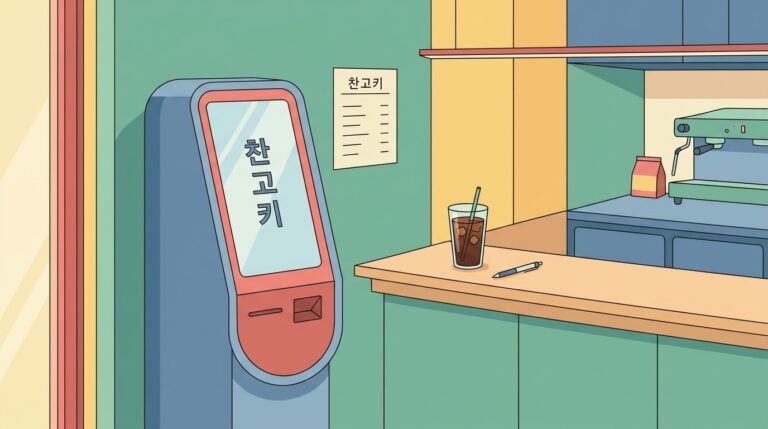
Picture this: It’s 12:45 PM on a Tuesday in Gangnam. The post-lunch rush is at its absolute peak. You step into a buzzing, sleek cafe craving your mid-day caffeine fix, only to be met by a glowing kiosk screen and a line of five office workers behind you, tapping their shoes in rhythm to the infamous Korean ppalli-ppalli (hurry-hurry) beat. You tap the screen with confidence: Iced Americano. But suddenly, the screen explodes with pop-up customization windows: 얼음량 (ice level), 샷 추가 (extra shot), 텀블러 사용 (tumbler usage), 포장 여부 (takeout or here), and a red 60-second countdown timer ticking in the corner. Your palms sweat, your brain scrambles for vocabulary, and you end up pressing cancel, sheepishly walking out empty-handed.
Take a deep breath! You are definitely not alone. Over the past 10 years of mentoring intermediate Korean learners, I’ve seen countless B2 speakers—who can discuss current affairs or K-dramas with ease—freeze completely in front of a digital kiosk. Modern Korean cafe culture moves at lightning speed, and kiosk software relies on condensed compound phrasing and cultural shorthand. This guide is crafted directly from real learner struggles and field-tested in Seoul’s busiest cafes. By the time you finish this guide, you will breeze through kiosk menus, customize your drinks down to the ice cube, and handle barista inquiries like a seasoned local!
Phase 2: 핵심 표현 3선 심층 분석 (Top 3 Core Expressions)
1. 연하게 해 주시고 얼음은 조금만 넣어 주세요.
- Pronunciation: [Yeonhage hae jusigo eoreumeun jogeumman neoeo juseyo.] (Sound analogy: Think of “Yeon” like the start of ‘yawn’, “hae” like ‘head’ without the d, and “juseyo” like ‘juice-say-yo’)
- Meaning: Literal: “Please make it lightly and put in only a little ice.” | Nuance: “Could you make it on the weaker side with light ice?”
- K-Culture Moment: In K-Dramas like Something in the Rain, characters often order their late-night coffee yeonhage (연하게) to avoid coffee jitters while pulling all-nighters.
- Editor’s Insight: Korean espresso is famously bold and dark. When you don’t want a heavy caffeine hit, 연하게 is the magic B2 keyword. On modern kiosks, this often appears as an option labeled 연하게 (1/2 shot).
- Situation Spectrum: Casual ✅ | Semi-formal ✅ | Formal ✅ (Standard polite request suitable for all retail counters)
- 🤔 Think About It: In English, we usually specify “half-caff” or “single shot.” Why do you think Korean uses an adjective describing sensory texture/color (연하다 – soft/light/mild) instead of technical measurements?
2. 텀블러 할인 적용되나요?
- Pronunciation: [Teombeulleo harin jeok-yongdoenayo?] (Sound analogy: “Teom-bull-eo ha-reen jug-young-dway-nah-yo”)
- Meaning: Literal: “Does tumbler discount apply?” | Nuance: “Can I get the personal cup discount with this?”
- K-Culture Moment: Korean variety shows frequently highlight eco-friendly cafe challenges where idols carry customized tumblers to claim the popular 300~500 KRW green discount.
- Editor’s Insight: With strict eco-regulations in Korea, bringing your own tumbler gets you discounts, but kiosks handle this unpredictably. Sometimes there’s a button on screen labeled 개인컵/텀블러, but other times you must ask the staff to validate your cup at the counter.
- Situation Spectrum: Casual ⚠️ | Semi-formal ✅ | Formal ✅
- 🤔 Think About It: Korea has one of the world’s most aggressive eco-laws regarding single-use plastics in cafes. How does this structural policy influence retail conversational Korean?
3. 키오스크에서 결제가 안 넘어가는데 확인 좀 해 주시겠어요?
- Pronunciation: [Kioseukeueseo gyeoljega an neomeoganeunde hwagin jom hae jusigesseoyo?] (Sound analogy: “Key-oh-seu-keu-eh-seo gyul-je-gah an nuh-muh-gah-neun-de…”)
- Meaning: Literal: “Payment does not cross over on the kiosk, so could you check a bit?” | Nuance: “The kiosk seems stuck on the payment step; could you take a look for me?”
- K-Culture Moment: Seen in relatable web dramas when foreign credit cards hit an authentication hiccup and the barista steps in to help with a friendly “IC 카드를 끝까지 밀어 넣어주세요!” (Please push the IC card all the way in!).
- Editor’s Insight: The connective ending -는데 softens the sentence, presenting your dilemma without sounding demanding. 확인 좀 해 주시겠어요? is the gold-standard polite intervention phrase.
- Situation Spectrum: Casual 🚫 | Semi-formal ✅ | Formal ✅
- 🤔 Think About It: Notice the word 좀 (a little). Koreans use 좀 not to indicate physical amount, but as a conversational cushion to reduce imposition on the listener.
Phase 3: 교과서 한국어 vs 진짜 한국어 (Textbook vs. Real Korean)
Situation 1: Takeout vs. Drinking in the Cafe
- 📖 교과서 한국어 (Textbook): 음료를 밖으로 가지고 나가겠습니다. (Eumryoreul bakkeuro gajigo nagagessseumnida.) — “I shall take the beverage outside.”
- 🗣️ 진짜 한국어 (Real-World): 포장해 갈게요. (Pojanghae galgeyo.) or 테이크아웃이요. (Teikeu-a-ut-iyo.)
- 💡 왜 다를까?: In everyday life, speed and economy of language reign supreme. Kiosks will literally display two icons: 매장 (In-store) vs. 포장 (Takeout). At the counter, a snappy “포장이요!” conveys everything clearly in just four syllables.
Situation 2: Customizing Milk Alternatives
- 📖 교과서 한국어 (Textbook): 우유 대신 두유를 넣어 주실 수 있습니까? (Uyu daesin duyureul neoeo jusil su isseumnikka?)
- 🗣️ 진짜 한국어 (Real-World): 우유를 오트밀크(또는 두유)로 변경해 주세요. (Uyureul oteu-milkeu-ro byeongyeonghae juseyo.)
- 💡 왜 다를까?: Kiosk UX interfaces categorise this under the verb 변경 (change/substitute). Using the construction
[A]를 [B]로 변경matches the mental model of both the digital system and modern baristas.
Phase 4: K-Culture 딥다이브 & 비언어적 매너 (Culture Deep Dive & Non-verbal Manners)
4-1. 눈치 (Nunchi) & Screen Etiquette
- Keep the Line Moving: When standing before a kiosk during lunch rush (12:00–1:30 PM), have your payment method (card, mobile pay) in hand before you start tapping. If you are browsing unfamiliar menus, glance back. If someone is waiting right behind you, step slightly to the side with an apologetic smile and say: “먼저 하세요!” (Please go ahead!). That is supreme nunchi.
- Two-Hand Card Retrieval: If an issue arises and the barista handles your card at the counter, always present and receive your card with both hands (or your right hand supported at the elbow by your left hand). It conveys respect effortlessly.
4-2. Cultural Codes: The ‘Eoljuk-a’ and Study Tribes
- 얼죽아 (Eol-juk-ah): An abbreviation for “얼어 죽어도 아이스 아메리카노” (Even if I freeze to death, Iced Americano). Even in -10°C Seoul winters, Koreans drink iced coffee. On kiosks, cold drinks are often the default landing tab!
- 카공족 (Kagongjok): “Cafe Study Tribe.” If you plan to work on your laptop, look out for kiosk prompts specifying seating restrictions. Some cafes restrict kiosk orders to 2-hour limits or designate laptop-free zones.
Phase 5: 실전 롤플레이 시나리오 (Real-world Roleplay Scenario)
- Setting: A high-end cafe in Seongsu-dong at 1:15 PM. Sleek stainless steel kiosk near the entrance; lively upbeat indie music playing.
- Characters:
- Barista Min-woo (민우): Fast, meticulous, wearing a black apron.
- You (Intermediate learner): Trying to order a customized decaf latte with oat milk, but the kiosk payment failed.
Turn 1
* You: 저기요, 죄송한데 키오스크에서 결제가 자꾸 오류가 나서요. (Jeogiyo, joesonghande kioseukeueseo gyeoljega jakku oryuga naseoyo.)
* Translation: Excuse me, sorry, but the kiosk keeps throwing a payment error.
* 🎭 행동 지문: [Step to the counter holding your physical card and pointing toward the kiosk screen with an apologetic smile.]
Turn 2
* Min-woo: 아, 죄송합니다! IC 칩 인식이 가끔 안 될 때가 있어서요. 카운터에서 바로 도와드릴게요. 어떤 음료 주문하시겠어요? (A, joesonghapnida! IC chip insigi gakkeum an doel ttaega isseoseoyo. Kaunteo-eseo baro dowadeurilgeyo. Eotteon eumryo jumunhasigesseoyo?)
* Translation: Ah, apologies! Sometimes the IC chip reader acts up. I will help you right here at the counter. Which drink would you like to order?
* 🎭 행동 지문: [Taps the POS register screen promptly, making eye contact.]
Turn 3
* You: 아이스 카페라떼 한 잔 포장해 주시고요, 디카페인 원두로 변경 가능할까요? (Aiseu kape-ratte han jan pojanghae jusigoyo, dikape-in won-duro byeongyeong ganeunghalkkayo?)
* Translation: One iced caffe latte to-go, please, and is it possible to switch to decaf beans?
* 🎭 행동 지문: [Speaking clearly while glancing up at the board to check the surcharge.]
Turn 4
* Min-woo: 네, 디카페인 원두는 500원 추가되시고요, 우유 옵션도 기본으로 하실까요? (Ne, dikape-in won-duneun obaeg-won chugadoesigoyo, uyu opsyeondo giboneuro hasilkkayo?)
* Translation: Yes, decaf beans are an extra 500 won. Would you like the default milk option as well?
* 🎭 행동 지문: [Fingers hovering over the modification panel.]
Turn 5
* You: 혹시 오트밀크로 바꿀 수 있나요? 그리고 얼음은 좀 적게 넣어 주세요. (Hoksi oteu-milkeuro bakkul su innayo? Geurigo eoreumeun jom jeokge neoeo juseyo.)
* Translation: By any chance, could I switch to oat milk? And please add less ice.
* 🎭 행동 지문: [Slight nod with an inquisitive, polite tone.]
Turn 6
* Min-woo: 네, 오트밀크 변경 500원 추가되셔서 총 6,000원입니다. 영수증 밑에 주문 번호 확인해 주세요! (Ne, oteu-milkeu byeongyeong obaeg-won chugadoesyeoseo chong yuk-cheon-won-imnida. Yeongsujeung mite jumun beonho hwaginhae juseyo!)
* Translation: Yes, oat milk change is 500 won extra, making the total 6,000 won. Please check your order number at the bottom of the receipt!
* 🎭 행동 지문: [Takes card gently with two hands, inserts it into reader, and prints receipt.]
Turn 7
* You: 네, 감사합니다. 음료 나오면 번호로 불러 주시나요? (Ne, gamsahamnida. Eumryo naomyeon beonhoro bulleo jusinayo?)
* Translation: Yes, thank you. Will you call out the number when the drink is ready?
* 🎭 행동 지문: [Receives card back with both hands.]
Turn 8
* Min-woo: 네, 위쪽 모니터에 번호 뜨면 픽업대에서 픽업해 가시면 됩니다! (Ne, wijjok moniteo-e beonho tteumyeon pikeopdae-eseo pikeophae gasimyeon doepnida!)
* Translation: Yes, when your number pops up on the upper display, you can pick it up at the pick-up counter!
* 🎭 행동 지문: [Points toward the hanging screen above the bar.]
🔀 인라인 분기점 (Interactive Fork)
What would you say if the kiosk screen displays “스탬프를 적립하시겠습니까?” (Would you like to accumulate stamp points?) but you don’t have an account?
- Option A: “건너뛰기 누르면 돼요.” (Tap Skip directly on the screen)
- Outcome (Best): Spotting the small grey button labeled 건너뛰기 (Skip) or 미적립 (No accumulation) instantly moves you to the card payment step without annoying the queue!
- Option B: “저 회원가입 지금 할게요!” (I will sign up for membership right now!)
- Outcome (Risk): Signing up on a kiosk keypad requires inputting a resident registration number or Korean phone verification. You risk freezing the queue during peak hours.
- Option C: Stay silent and tap the screen repeatedly.
- Outcome (Bad): The machine may timeout and cancel your entire order, resetting your customized options back to zero.
Phase 6: 10초 감정 섀도잉 드릴 (10-Second Shadowing Drill)
Practice these fast-paced lines with natural pitch and rhythm:
[😊 Crisp & Decisive]
“테이크아웃이고요, / 샷 추가해서 / 얼음 적게 해 주세요!”
(Teikeu-a-ut-igoyo, / syat chugahaeseo / eoreum jeokge hae juseyo!)
Break it down: Pause slightly at the slashes to keep your breath steady.-
[🥺 Apologetic & Courteous]
“저기요, / 키오스크 화면이 멈췄는데 / 한번 봐 주실 수 있으세요?”
(Jeogiyo, / kioseukeu hwamyeoni meomchwonneunde / hanbeon bwa jusil su isseuseyo?)
Rise slightly on ‘멈췄는데’ and soften your voice on ‘있으세요?’. -
[⚡ Swift & Confident]
“영수증은 / 버려 주셔도 돼요!”
(Yeongsujeungeun / beoryeo jusyeodo dwaeyo!)
Use this when the barista asks if you want your printed receipt!
Phase 7: K-Culture 미니 사전 (Mini Dictionary)
-
얼죽아 (Eol-juk-ah) [noun]
Literal: Freeze to death, but still iced.
Usage: Reflects Korea’s cultural obsession with Iced Americanos even in sub-zero winter temperatures. If you order iced drinks year-round, you are officially an 얼죽아. -
샷 추가 (Syat chu-ga) [compound noun]
Literal: Shot addition.
Usage: Adding an extra espresso shot. On kiosk modifier grids, this is almost always the first button under the “Option” menu. -
카공족 (Ka-gong-jok) [slang noun]
Literal: Cafe studying tribe.
Usage: Refers to people who study or work on laptops in cafes for extended hours. Understanding this term helps you read kiosk signage regarding seating and Wi-Fi policies. -
디카페인 원두 (Di-ka-pe-in won-du) [noun]
Literal: Decaf coffee beans.
Usage: Major chains (Mega Coffee, Compose, Starbucks, Twosome) now feature decaf bean toggles directly on the primary kiosk drink selection screen.
Phase 8: 여행자를 위한 생존 키트 (Traveler’s Survival Kit)
Survival Expressions TOP 3
- 포장해 갈게요. (Pojanghae galgeyo.)
- To-go, please. (Essential if the kiosk asks: 매장 vs. 포장).
- 영수증 출력해 주세요. (Yeongsujeung chullyeokhae juseyo.)
- Please print the receipt. (Crucial because your waiting number is printed on it!).
- 이 카드 사용 가능한가요? (I kadeu sayong ganeunghangayo?)
- Is this card usable here? (Helpful when international credit cards fail on kiosks).
Editor’s Travel Note
- App Tip: Download the 네이버 지도 앱 (Naver Map App) to search for nearby cafes with “스마트주문” (Smart Order) badges. You can customize drinks and pay ahead from your phone!
- Kiosk Card Orientation: In Korea, kiosks read cards via the IC chip (inserted face up, chip first into the lower slot), not by swiping or tapping, unless you use Apple Pay or Samsung Pay at NFC readers.
Phase 9: “한 발 더 깊이” (Deep Cultural Thought)
Korean cafe culture presents a fascinating paradox: on one side, it offers hyper-individualized customization (decaf, oat milk, syrup pumps, ice levels); on the other, it demands collective speed (ppalli-ppalli efficiency). When you customize your drink through a kiosk, you are operating within a system designed to honor individual taste without causing delay to the community. Navigating a kiosk seamlessly isn’t just about ordering coffee—it’s an act of respect for the shared tempo of modern urban Korean life.
💬 Your Turn: In your home country, do people customize their cafe orders through machines or by chatting with the barista? How does that dynamic change the overall atmosphere of the cafe? Tell me in the comments below!
Phase 10: FAQ & 오해 방지 (FAQ Schema & Misconceptions)
Q: What should I do if the kiosk only displays Korean and has no English language button?
A: Look at the top right or bottom corner for a globe icon (🌐) or the word “Language.” If unavailable, don’t panic! Remember the primary menu tabs: 커피 (Coffee), 논커피/음료 (Non-coffee/Beverage), 디저트 (Dessert), and the final checkout buttons: 매장 (For Here) vs. 포장 (Takeout).
Q: Why did the kiosk reject my foreign Visa/Mastercard?
A: Some older kiosk terminals in franchise cafes require domestic Korean payment verification or fail on magnetic stripes. Simply step to the pick-up counter, show your card to the barista, and say: “해외 카드인데 여기서 결제 가능할까요?” (It is an overseas card; could I pay here?).
Q: Do I throw away my receipt right away after kiosk checkout?
A: Never throw away your receipt immediately! In 90% of Korean kiosk cafes, your pickup call number (주문 번호) is printed in bold at the top or bottom of your receipt.
🚨 흔한 실수 (Common Mistakes) 경고판
- Mistake: Selecting “매장 (In-Store)” when you intend to step out right after getting your drink.
- Correct Action: Korean environmental laws levy steep fines on cafes if customers consume drinks in single-use plastic cups inside the store. Always choose 포장 (Takeout) if you plan to leave.
- Mistake: Leaving the card inserted in the machine while walking away.
- Correct Action: Kiosks won’t complete the print sequence until you pull your card out. Wait for the beep and retrieve your card first!
- Mistake: Forgetting to customize before pressing the final pay button.
- Correct Action: Once you click your drink icon, a modifier modal opens automatically. Choose your ice and shots there before pressing 담기 (Add to cart).
Phase 11: 액션 미션 & 참여 유도 (Action Missions)
- 🥉 Bronze Mission (Solo): Stand in front of your mirror and practice the 3 custom commands fluently: 연하게 해 주세요, 얼음 적게 해 주세요, and 포장해 갈게요 in under 5 seconds.
- 🥈 Silver Mission (Social): Next time you watch a K-Drama or vlog, snap a photo of a cafe scene and share it in our Daily Hangul study channel with the Korean terms you identified.
- 🥇 Gold Mission (Real-world): Step into a local Korean-style cafe (or a real cafe in Korea) and order a customized beverage using a kiosk without switching to English mode!
- 🎮 K-Culture Mission: Watch Episode 1 of Business Proposal or Extraordinary Attorney Woo and observe how colleagues order coffee for their teams—note how they balance multiple custom preferences!
Phase 12: 인터랙티브 퀴즈 챌린지 (Interactive Quiz Challenge)
1. Situation Assessment: You are ordering an iced latte at a kiosk, but you can’t digest dairy well. Which button should you look for on the modification screen?
* (A) 샷 추가 (+500원)
* (B) 우유를 오트/두유로 변경 (+500원)
* (C) 얼음 많이 (+0원)
2. Fill-in-the-Blank: Complete the polite sentence to request a lighter roast:
“커피 너무 진하지 않게, 조금 [ ] 해 주시겠어요?”
* (A) 달콤하게
* (B) 차갑게
* (C) 연하게
3. True or False: In Korea, if you choose “매장 (In-store)” at a kiosk, you are legally permitted to walk out with a disposable single-use plastic cup.
* [True / False]
👉 Click to reveal answers & detailed explanations!
- Answer: (B)
Explanation: “변경” means change or substitute. Choosing “우유를 오트/두유로 변경” switches regular milk to oat or soy milk. - Answer: (C) 연하게
Explanation: “연하게” means light or mild. “진하게” would mean extra strong! - Answer: False
Explanation: Due to strict government environmental regulations, drinks ordered for in-store consumption must be served in reusable mugs or glasses. If you take a disposable cup out, you must order “포장 (Takeout)”.