

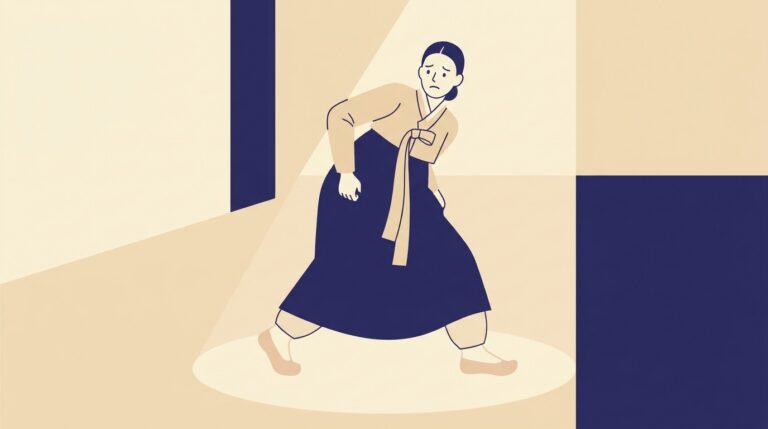
Phase 1: Why Koreans Never Need to Accuse You Out Loud
안녕하세요! 매일한글 에디터입니다. (Annyeonghaseyo! Hello, this is your Daily Hangul Editor.) Picture this: you are watching a gripping K-thriller where the detective has not accused anyone yet, yet one suspect suddenly blurts out an airtight alibi. In English, you might mutter about a guilty conscience, but Koreans drop a razor-sharp proverb: 도둑이 제 발 저린다 (dodugi je bal jeorinda). Built directly from feedback by our Level 6 learners who struggle to capture subtle psychological wit in natural speech, this guide unlocks the native humor, nunchi, and social satire behind the idiom so you can read the room—and deliver devastatingly witty comebacks—like a true local.
Phase 2: Deep Dive into 3 Core Expressions
1. A Thief’s Own Foot Goes Numb (도둑이 제 발 저린다)
- Pronunciation: do-du-gi je bal jeo-rin-da (Say doh-doo-gee jeh bahl juh-reen-dah, where jeo sounds like the “u” in “cup” with relaxed lips, and bal rhymes with “doll” ended with a light “l”).
- Meaning: Literally “a thief’s own foot goes numb.” In real life, it captures the exact moment a guilty person panics, over-explains, or acts overly defensive before anyone has even suspected them.
- K-Culture Moment: Think of tense boardroom or interrogation scenes in dramas like Vincenzo or The Glory. The villain doesn’t get caught because of a smoking gun—they slip up because someone drops a vague hint, and their overreaction exposes everything.
- Editor’s Insight: Notice the verb 저리다 (jeorida)—that pins-and-needles numbness you get from sitting cross-legged too long. Koreans associate hidden guilt with a physical, creeping discomfort that forces you to shift awkwardly until everyone notices.
- Situation Spectrum: Casual ✅ / Semi-formal ✅ / Formal ⚠️ (In high-level business settings, quote it indirectly or soften it with
-는 말이 있잖아요, since saying it bluntly can sound accusatory.)- 🤔 Think About It: English says “a guilty conscience needs no accuser”—very abstract and moral. Why do you think Korean frames guilt as a physical sensation in one’s foot, and how does your native language picture self-betrayal?
2. Drawing a Line Out of Sheer Guilt (제 발 저려서 미리 선을 긋다)
- Pronunciation: je bal jeo-ryeo-seo mi-ri seo-neul geut-da (geut-da has an unreleased “t” stop like “good” cut abruptly, and eu sounds like the “u” in “put” without rounding your lips).
- Meaning: Literally “to draw a line beforehand because one’s own foot went numb.” It describes someone preemptively distancing themselves or setting defensive boundaries so nobody links them to a mess they actually caused.
- K-Culture Moment: You will hear this constantly in K-Pop PR commentary or intense survival variety shows like The Devil’s Plan, when a player loudly announces, “Don’t look at me, I wasn’t even near that room!” before anyone asks.
- Editor’s Insight: At TOPIK Level 6, combining classical proverbs (발 저리다) with modern idiomatic predicates (선을 긋다, to draw a boundary) instantly elevates your commentary from textbook-stiff to native-level social critique.
- Situation Spectrum: Casual ✅ / Semi-formal ✅ / Formal ✅ (Works brilliantly in analytical journalism, critiques, and smart water-cooler banter.)
- 🤔 Think About It: In fast-paced Korean group dynamics, putting up a wall too early raises suspicion rather than protecting you. How does preemptive defensiveness read in your culture?
3. Having Something to Flinch About (찔리는 데가 있다)
- Pronunciation: jjil-li-neun de-ga it-da (The tense jj is like pressing “tch” firmly with zero air puff—hold your breath a split second before releasing!).
- Meaning: Literally “to have a spot that gets pricked.” It refers to having a secret fault or guilty spot that makes you flinch the second someone gets remotely close to the truth.
- K-Culture Moment: Classic K-Drama Sunday dinner scenes: a mother-in-law calmly asks how work has been lately, and the son-in-law who secretly quit his job immediately knocks over his soup spoon.
- Editor’s Insight: Think of 찔리는 데가 있다 as the internal root cause, and 도둑이 제 발 저린다 as the visible symptom. Natives often pair them together in the same breath to roast a friend gently.
- Situation Spectrum: Casual ✅ / Semi-formal ⚠️ / Formal 🚫 (Too blunt and colloquial for formal meetings; save it for friends, family, or playful teasing.)
- 🤔 Think About It: Both “numb foot” and “getting pricked” turn psychological guilt into tactile pain. Does your language use physical metaphors for guilt, or mostly legal and religious terms?
Phase 3: Textbook Korean vs. Real Korean
Situation 1: Calling out a friend who is acting suspiciously defensive
- 📖 Textbook Korean: 죄책감을 느껴서 스스로 불안해하는 것 같습니다. (Joechaekgameul neukkyeoseo seuseuro buranhaehaneun geot gatseumnida. — “It seems they feel guilt and are anxious on their own.”)
- 🗣️ Real Korean: 아무도 뭐라 안 했는데 혼자 발 저려서 난리네. (Amudo mwora an haenneunde honja bal jeoryeoseo nalline. — “Nobody even said anything, and look at them freaking out on their own.”)
- 💡 Why the difference? Textbooks lean heavily on clinical Sino-Korean nouns like 죄책감 (sense of guilt). Real Koreans compress that entire psychological diagnosis into 발 저리다 plus the vivid exclamation -네(요) and 난리(나다) to add punchy humor.
Situation 2: Defending yourself when someone accuses you of overreacting
- 📖 Textbook Korean: 저는 잘못한 일이 없기 때문에 떳떳합니다. (Jeoneun jalmothan iri eopgi ttaemune tteotteothamnida. — “I have a clear conscience because I did nothing wrong.”)
- 🗣️ Real Korean: 나 전혀 찔리는 거 없거든? 괜히 사람 몰아가지 마. (Na jeonhyeo jjillineun geo eopgeodeun? Gwaenhi saram moragaji ma. — “I have zero reason to feel guilty, okay? Stop cornering me for nothing.”)
- 💡 Why the difference? Saying 떳떳합니다 in casual banter sounds like you are testifying in court. Adding -거든? and 사람 몰아가다 (to corner/frame someone) gives your pushback natural emotional edge.
Phase 4: K-Culture Deep Dive & Non-Verbal Manners
4-1. Nunchi & Gestures
In Korea, reading whether someone’s “foot is going numb” relies heavily on 눈치 (nunchi)—social radar. Watch for three classic non-verbal tells: 시선 회피 (siseon hoepi)—darting eyes away mid-sentence—fidgeting endlessly with an iced Americano straw, and the 멋쩍은 웃음 (meotjjeogeun useum), an awkward chuckle dropped right after over-explaining a minor detail. Notice also how Koreans rarely point a finger directly when using this proverb playfully; instead, they tilt their chin subtly, raise one eyebrow, and let a knowing half-smile do the talking.
4-2. Cultural Code Analysis: K-Variety Mafia Games & K-Dramas
Want to see 도둑이 제 발 저린다 in high-definition action? Watch Korean psychological variety shows like The Devil’s Plan, Running Man, or Going Seventeen‘s legendary Mafia episodes. Because Korean communication values 체면 (chemyeon, social face) and indirect harmony, interrogators often stay eerily quiet. That silence creates unbearable social pressure, nudging the culprit to fill the void with unprompted excuses—and bam, the whole table yells, “도둑이 제 발 저리네!” (Dodugi je bal jeorine! — “The thief’s foot is going numb!”).
Phase 5: Real-Life Roleplay Scenario
Setting: It is 9:30 PM in a cozy Gangnam office pantry. The espresso machine hums softly, and an empty luxury cookie box sits on Team Leader Kang’s desk—his prized limited-edition pistachio cookie has vanished.
Characters: You (observant senior associate) and Min-ji (민지) (your sharp-tongued, caffeine-fueled colleague who usually knows every office secret).
- Min-ji: 🎭 (leaning against the fridge, swirling her iced tea) 어? 강 팀장님 책상 위에 있던 두바이 쿠키 어디 갔지? (Eo? Gang timjangnim chaeksang wie itdeon Dubai kuki eodi gatji? — “Huh? Where did the Dubai cookie on Team Leader Kang’s desk go?”)
- You: 🎭 (glancing up from your laptop) 글쎄요, 누가 먼저 먹었나 보죠. 왜요? (Geulsseyo, nuga meonjeo meogeonna bojyo. Waeyo? — “No idea, someone probably ate it first. Why?”)
- Min-ji: 🎭 (eyeing the doorway as intern Jun-ho walks past) 저기, 준호 씨! 혹시 탕비실 들렀다 갔어요? (Jeogi, Junho ssi! Hoksi tangbisil deulleotda gasseoyo? — “Hey, Jun-ho! Did you happen to stop by the pantry?”)
- Jun-ho (passing by): 🎭 (freezing instantly, hands sweating on his tumbler) 네?! 아, 아니요! 전 아까부터 계속 제 자리에만 있었는데요! 진짜로 CCTV 돌려보셔도 돼요! (Ne?! A, aniyo! Jeon akkabuteo gyesok je jarieman isseonneundeyo! Jinjjalo CCTV dollyeobosyeodo dwaeyo! — “What?! N-no! I have been at my desk the whole time! Seriously, you can even rewind the CCTV!”)
- Min-ji: 🎭 (blinking slowly as Jun-ho hurries away, then whispering to you) 와… 대박. 나 그냥 물어본 건데 왜 저렇게까지 해명하지? (Wa… daebak. Na geunyang mureobon geonde wae jeoreotgekkaji haemyeonghaji? — “Whoa… crazy. I only asked casually—why is he explaining himself that hard?”)
- You: 🎭 (smirking knowingly and taking a sip of coffee) 그러게요. 딱 보니 도둑이 제 발 저리는 격이네요. (Geureogeyo. Ttak boni dodugi je bal jeorineun gyeogineyo. — “Tell me about it. Looking at that, it is a classic case of a thief’s own foot going numb.”)
- Min-ji: 🎭 (chuckling quietly) 그러니까요. 가만히 있으면 중간이라도 갈 텐데, 혼자 찔려서 선을 긋네요. (Geureonikkayo. Gamanhi isseumyeon jungganirado gal tende, honja jjillyeoseo seoneul geunneyo. — “Right? If he stayed quiet he’d at least break even, yet he’s drawing the line all on his own out of guilt.”)
- You: 🎭 (tossing your empty cup into recycling) 우리도 괜히 엮이지 말고 모른 척합시다. (Urido gwaenhi yeokkiji malgo moreun cheokhapsida. — “Let’s not get tangled up in it either and just pretend we didn’t notice.”)
🔀 Interactive Branching Point: What would YOU say in Turn 6 if Min-ji asks for your take?
- Option A: “딱 보니 도둑이 제 발 저리는 격이네요.” (Ttak boni dodugi je bal jeorineun gyeogineyo. — “Looking at that, it’s a classic case of a thief’s foot going numb.”)
- Feedback (Best): Spot-on Level 6 polish! Using -는 격이다 (it amounts to / it is a case of) sounds effortlessly articulate, objective, and witty in a semi-formal office chat.
- Option B: “준호 씨가 도둑이에요! 잡아야 해요!” (Junho ssiga dodugieyo! Jabaya haeyo! — “Jun-ho is the thief! We must catch him!”)
- Feedback (Bad): Yikes—too literal and way too aggressive! Calling someone an actual 도둑 (thief) over a cookie kills the workplace atmosphere and misses the subtle irony of the proverb.
- Option C: “글쎄요, 설마 진짜 그랬을까요?” (Geulsseyo, seolma jinjja geuraesseulkkayo? — “Well, could he really have done that?”)
- Feedback (Risk): Safe and polite, so you avoid office gossip—but you miss a golden opportunity to bond with Min-ji using sharp native wit!
Phase 6: 10-Second Emotional Shadowing Drill
Read these out loud, pausing briefly at every / and matching the emotion tag!
- [😏 Witty & Knowing]
아무도 의심 안 했는데 / 혼자 발 저려서 / 저렇게 난리네.
(Amudo uisim an haenneunde / honja bal jeoryeoseo / jeoreotge nalline. — “Nobody even suspected them, yet look at them freaking out from guilt.”) -
[🤨 Skeptical & Sharp]
뭘 그렇게까지 해명해요? / 혹시 / 찔리는 데라도 있어요?
(Mwol geureotgekkaji haemyeonghaeyo? / Hoksi / jjillineun derado isseoyo? — “Why explain yourself that intensely? Do you perhaps have a guilty spot?”) -
[😌 Calm & Analytical]
괜히 앞질러 선을 긋다가는 / 오히려 / 도둑이 제 발 저린다는 말만 들어요.
(Gwaenhi apjilleo seoneul geutdaganeun / ohiryeo / dodugi je bal jeorindaneun malman deureoyo. — “If you draw a line too hastily, you’ll only hear people say your own foot went numb.”)
Phase 7: K-Culture Mini Dictionary
- 양심에 찔리다 (Yangsim-e jjillida) | To feel a pang of conscience | Used daily when you hesitate before sneaking the last piece of fried chicken or bending a small rule; more internal and sincere than 발 저리다.
- 자충수 (Jachungsu) | A self-defeating move (from Baduk/Go) | Heavily used in Korean business news and political commentary when someone’s panicked defense ends up sinking their own reputation.
- 방어기제 (Bangeogije) | Defense mechanism | Popular in Korean psychology podcasts and relationship chats to analyze why someone snaps defensively when their insecurities are touched.
- 적반하장 (Jeokbanhajang) | The culprit blaming the victim | A fierce four-character idiom (sajaseongeo) describing someone who goes beyond 발 저리다 and angrily attacks the innocent person who asked a simple question.
Phase 8: Traveler’s Survival Kit
Top 3 Survival Phrases (For Awkward Public Mix-ups!)
- 아, 제가 한 거 아니에요! (A, jega han geo anieyo! — “Oh, I wasn’t the one who did it!”)
- Pro Tip: Use a bright, relaxed tone with open palms if a display item falls near you in Olive Young—if you panic too loudly, locals might jokingly think your foot went numb!
- 영수증 확인해 보셔도 돼요. (Yeongsujeung hwaginhae bosyeodo dwaeyo. — “You are welcome to check my receipt.”)
- Pro Tip: At Korean unmanned convenience stores or self-checkout counters, staying calm and offering your receipt clears up accidental beep alarms smoothly.
- 제 가방인 줄 알고 착각했어요. (Je gabangin jul algo chakgakhaesseoyo. — “I mistook it for my own bag.”)
- Pro Tip: Essential at busy KTX racks or cafe bag hooks—착각하다 (to misunderstand/mistake) softens any tense moment immediately.
Editor’s Travel Note
Before hopping between hotspots in Seoul, Download Naver Map for accurate real-time Korean transit routes because global map apps frequently miss walking shortcuts, and Install Papago for context-smart Korean idiom translation whenever you encounter tricky signs. For frictionless subway rides and street-food payments, grab a T-money card or Climate Card at any convenience store (GS25, CU) right after landing—tap in and out calmly without blocking the rush-hour gates!
Phase 9: One Step Deeper
In a high-context society shaped by centuries of tight-knit village life and 눈치 (nunchi), Korean communication rarely relies on loud, direct confrontation. Instead, Koreans rely on subtle social silence—leaving just enough room for someone’s own conscience to speak louder than any accusation. That is why 도둑이 제 발 저린다 carries such enduring cultural weight: in Korea, you do not always need to interrogate a suspect when social awareness lets them expose themselves.
💬 Your Turn: Have you ever watched someone (or yourself!) panic and over-explain before anyone even asked a question? Drop your funniest “numb foot” story in the comments below!
Phase 10: FAQ & Common Mistakes
Q: Can I use “도둑이 제 발 저린다” directly toward my boss or a senior colleague?
A: Avoid aiming it straight at a superior—it implies they are hiding something shady and can seriously damage 체면 (social face). Save direct usage for close peers, friends, or lighthearted teasing, and use softened framing (“그런 말도 있잖아요”) in formal discussions.
Q: Is “발 저리다” only used for guilt, or also for actual physical numbness?
A: Both! Literally, 다리가 저리다 / 발이 저리다 (dariga jeorida / bari jeorida) is what you say after sitting cross-legged (양반다리) on a traditional Korean floor restaurant for an hour. Context makes it instantly clear whether you need a stretch or have a guilty secret.
Q: What is the difference between “도둑이 제 발 저린다” and “방귀 뀐 놈이 성낸다”?
A: Great Level 6 question! 도둑이 제 발 저린다 focuses on anxious, preemptive defensiveness or slipping up silently. 방귀 뀐 놈이 성낸다 (“the one who farted gets angry first”—similar to 적반하장) goes a step further: the guilty person actively lashes out in fake anger to deflect blame.
🚨 Common Mistakes Top 3 & Correct Action
- Mistake 1: Saying “도둑이 제 발 아파요” (“a thief’s foot hurts”).
- Correct Action: Always use 저리다 (to feel numb/tingly), never 아프다 (to hurt).
- Mistake 2: Translating “제” literally as “my” (“a thief’s my foot”).
- Correct Action: Remember that in proverbs, 제 is the archaic/colloquial contraction of 자기(의) (one’s own), not the humble pronoun 저의!
- Mistake 3: Dropping the proverb deadpan during a serious misunderstanding with a stranger.
- Correct Action: Because calling someone a “thief” metaphorically still stings, reserve it for clear irony among friends or analytical third-person commentary.
Phase 11: Action Mission & Engagement
- 🥉 Bronze Mission (Solo Practice): Stand in front of a mirror and deliver all three Phase 6 shadowing lines with matching facial expressions—keep your eyebrows sharp and your pauses crisp!
- 🥈 Silver Mission (Community Share): Post your favorite English equivalent of 도둑이 제 발 저린다 on social media or in our comments and explain why Korean’s “numb foot” metaphor hits differently.
- 🥇 Gold Mission (Real-World Use): Next time you play a deduction game (like Among Us, Mafia, or Werewolf) with Korean friends, drop “어? 혼자 발 저리신 것 같은데요?” (“Huh? Looks like someone’s foot is going numb!”) and watch their reactions.
- 🎮 K-Culture Mission: Watch one episode of The Devil’s Plan or any K-thriller tonight and spot the exact timestamp when a character preemptively clears their name (선을 긋다) before anyone accuses them!
Phase 12: Interactive Quiz Challenge
Test your Level 6 mastery! Try answering before opening each spoiler toggle.
1. Situational Judgment: You lightly ask your roommate, “Did someone move the umbrella by the door?” Before you finish, they shout, “I wasn’t even outside today! Why do you always blame me?!” Which response is the sharpest and most natural?
* A) 당신은 지금 양심에 찔려서 아픈가요?
* B) 아무도 뭐라 안 했는데 혼자 발 저려서 왜 그래?
* C) 내 발이 너무 저려서 걸을 수가 없네.
Click to check Answer & Feedback for Q1
Correct Answer: B! “아무도 뭐라 안 했는데 혼자 발 저려서 왜 그래?” (Nobody even said anything, why are you acting all guilty on your own?) hits the exact witty tone. Why not A? Mixing “양심에 찔리다” with “아프다” sounds unnatural and robotic. Why not C? Saying “내 발이 저려” means your own foot physically fell asleep!
2. Fill in the Blank: Complete this advanced sentence describing someone who draws boundaries out of guilt:
“누가 추궁하지도 않았는데 미리 ____ ____ 걸 보면 뭔가 구린 게 분명해.” (Nuga chugunghajido anneunde miri ____ ____ geol bomyeon mwonga guringe bunmyeonghae.)
Click to reveal Answer for Q2
Answer: 선을 긋는 (seoneul geunneun) or 발 저려 하는 (bal jeoryeo haneun)! “선을 긋는” (drawing a line) pairs naturally with “미리” (in advance) to describe preemptive defensiveness.
3. True or False (Culture Quiz): In the proverb “도둑이 제 발 저린다,” the word “제” means “my” (as in the speaker’s own foot). True or False?
Click to reveal Answer for Q3
False! Here, 제 is a contraction of 저의 / 자기의 meaning “one’s own” (reflexive third-person—the thief’s own foot), NOT the speaker’s foot!
🎬 Watch Our Daily Videos! (Daily Hangul Official Instagram)
Review the expressions you learned in this article with our fun daily short videos! Check out native pronunciation and real-life nuances in action.
- Instagram @dailyhangul_en







