

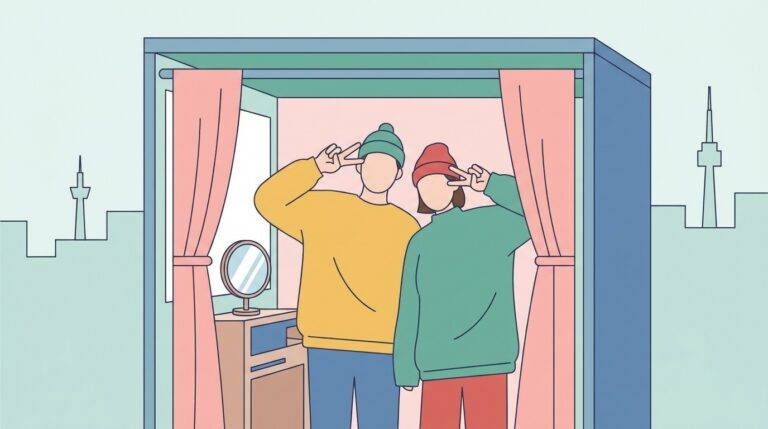
Phase 1: Stepping Into the Photo Booth
Hello! This is the Daily Hangul editor. Imagine stepping into a neon-lit Korean photo booth in Hongdae with your Korean friend. The 10-second timer starts ticking fast! You freeze, not knowing what to suggest or how to say “Shall we try the gyaru peace pose?” in Korean. Many of our beginner students told us they felt shy and just smiled awkwardly while their friends struck fun K-Pop idol poses. Based on real learner feedback, this guide solves that exact moment! By learning a few simple, trendy phrases, you will take amazing four-cut photos and bond naturally like a true local bestie.
Phase 2: Top 3 Key Expressions Deep Dive
1. 갸루피스 해 볼까요? (Gyaryupiseu hae bolkkayo?)
- Pronunciation: Gyaryupiseu hae bolkkayo? (Sounds like: Gya-ryu-pi-seu heh bol-kka-yo? — think of “gyaru” + “peace” + “hey” + “ball-kah-yo”)
- Meaning: Literally “Shall we try doing gyaru peace?” / Real nuance: “Let’s do that fun upside-down V pose together!”
- K-Culture Moment: You will see this constantly when K-Pop groups like IVE or aespa take behind-the-scenes selfies or visit four-cut photo booths on variety shows.
- Editor’s Insight: Adding 해 볼까요? (hae bolkkayo?) makes any suggestion super soft and friendly. You are not commanding your friend; you are inviting them to have fun together.
- Situation Spectrum: Casual ✅ / Semi-formal ✅ / Formal 🚫
- 🤔 Think About It: In Korea, taking photos together often requires agreeing on a matching theme or pose beforehand. How do you and your friends decide on poses in your home country—do you coordinate or just wing it?
2. 이 포즈 어때요? (I pojeu eottaeyo?)
- Pronunciation: I pojeu eottaeyo? (Sounds like: Ee po-jeu uh-tteh-yo? — “ee” as in “see”, “uh” as in “uh-oh”)
- Meaning: Literally “How is this pose?” / Real nuance: “What do you think of this pose? Should we do it?”
- K-Culture Moment: Right before the camera flash goes off in a Korean drama date scene, one character holds up a silly heart pose and asks this to get approval.
- Editor’s Insight: 어때요? (eottaeyo?) is a lifesaver for beginners! You can point at anything—a headband, a filter, or a pose—and ask this short question to sound completely natural.
- Situation Spectrum: Casual ✅ / Semi-formal ✅ / Formal ⚠️
- 🤔 Think About It: Koreans use 어때요? (eottaeyo?) constantly to check the other person’s feelings before acting. Does your native language also check in with friends this often during casual activities?
3. 완전 잘 나왔어요! (Wanjeon jal nawasseoyo!)
- Pronunciation: Wanjeon jal nawasseoyo! (Sounds like: Wan-juhn jal na-wa-ssuh-yo! — “wan” like “wand”, “juhn” like “jungle”)
- Meaning: Literally “It came out completely well!” / Real nuance: “OMG, this photo looks amazing!”
- K-Culture Moment: After stepping out of an 인생네컷 (Insaengnecut) booth, friends huddle around the printed photo strip and shout this while admiring the cutest frame.
- Editor’s Insight: Literally, Korean photos “come out” (나왔어요 / nawasseoyo) rather than just “looking good.” Adding 완전 (wanjeon) gives it that excited, trendy “totally!” energy.
- Situation Spectrum: Casual ✅ / Semi-formal ✅ / Formal 🚫
- 🤔 Think About It: Complimenting a group photo immediately builds closeness in Korea. When you look at a group selfie with friends, do you focus on how everyone looks together or how you look individually?
Phase 3: Textbook Korean vs. Real Korean
Situation 1: Suggesting a photo pose
- 📖 Textbook Korean: 우리 같이 브이 포즈를 합시다. (Uri gachi beui pojeureul hapsida.) — “Let us do the V pose together.”
- 🗣️ Real Korean: 우리 갸루피스 해 볼까요? (Uri gyaryupiseu hae bolkkayo?) — “Shall we try the gyaru peace pose?”
- 💡 Why the difference? Textbook 합시다 (hapsida) sounds like a formal military order! Real friends use ~해 볼까요? (~hae bolkkayo?) to sound cute, relaxed, and playful.
Situation 2: Reacting to a great selfie
- 📖 Textbook Korean: 사진이 매우 아름답습니다. (Sajini maeu areumdapseumnida.) — “The photograph is very beautiful.”
- 🗣️ Real Korean: 와, 완전 잘 나왔어요! (Wa, wanjeon jal nawasseoyo!) — “Whoa, it came out totally great!”
- 💡 Why the difference? Nobody says “beautiful” (아름답다 / areumdapda) for a fun booth strip in daily life. 잘 나왔어요 (jal nawasseoyo) is the #1 natural reaction Koreans use every day.
Phase 4: K-Culture Deep Dive & Non-Verbal Manners
4-1. Nunchi (눈치) & Gestures
To nail the 갸루피스 (gyaryupiseu), extend your arm slightly forward, make a peace sign (V), and flip your palm downward so your fingers point away or slightly down toward your chin. Keep a bright smile or a playful wink! In Korean photo booths, 눈치 (nunchi – social awareness) is all about timing: because the booth gives you only 5 to 10 seconds per shot, quickly look at the screen, check your friend’s pose, and match their vibe fast so nobody gets caught blinking.
4-2. Cultural Code Analysis: K-Pop & Insaengnecut Culture
In Korea, photo booths known as 인생네컷 (Insaengnecut – “Four Cuts of Your Life”) are everywhere—almost on every street corner in areas like Hongdae, Seongsu, and Gangnam! Originally popularized in Japan in the 1990s, the 갸루피스 (gyaryupiseu) exploded back into Korean mainstream culture when K-Pop stars like IVE’s Rei, aespa, and BLACKPINK members shared selfies doing it. Today, Korean friends visit photo booths after almost every meal or cafe hangout as a fun memory ritual.
Phase 5: Real-Life Roleplay Scenario
- Setting: A pastel-pink 인생네컷 (Insaengnecut) booth in Hongdae on a Saturday afternoon. K-Pop hits are playing softly in the background, and a wall of cute animal headbands hangs nearby.
- Characters: You and Minji, your cheerful Korean university buddy who loves K-Pop trends.
Minji: 여기 사람이 없어서 좋아요! 우리 빨리 들어가요! (Yeogi sarami eopseoseo joayo! Uri ppalli deureogayo!) — “It’s great there’s no line here! Let’s go inside quickly!” 🎭 Minji pulls back the pink curtain excitedly.
You: 네, 좋아요! 머리띠도 쓸까요? (Ne, joayo! Meorittido sseulkkayo?) — “Yes, sounds good! Should we wear headbands too?” 🎭 You point to a shelf full of bunny ears and sunglasses.
Minji: 당연하죠! 토끼 머리띠가 완전 귀여워요. (Dangyeonhajyo! Tokki meorittiga wanjeon gwiyeowoyo.) — “Of course! The bunny headband is totally cute.” 🎭 Minji hands you pink bunny ears and puts on a frog headband.
You: 첫 번째 사진은 갸루피스 해 볼까요? (Cheot beonjjae sajineun gyaryupiseu hae bolkkayo?) — “For the first photo, shall we try the gyaru peace pose?” 🎭 You demonstrate the upside-down V sign near your cheek.
Minji: 오, 좋아요! 요즘 유행이잖아요. 하나, 둘, 셋! (O, joayo! Yojeum yuhaengijanayo. Hana, dul, set!) — “Oh, I love it! It’s trendy these days. One, two, three!” 🎭 The camera flashes brightly.
You: 다음은 이 포즈 어때요? 볼하트! (Daeumeun i pojeu eottaeyo? Bolhateu!) — “How about this pose next? Cheek heart!” 🎭 You press a curved hand against your cheek to make half a heart.
Minji: 대박, 귀여워요! 빨리 웃어요! (Daebak, gwiyeowoyo! Ppalli useoyo!) — “Awesome, so cute! Smile quickly!” 🎭 You both lean in and make cheek hearts right before the beep.
You: 와, 사진 완전 잘 나왔어요! (Wa, sajin wanjeon jal nawasseoyo!) — “Whoa, the photos came out totally great!” 🎭 You both step outside and hold up the freshly printed four-cut strip.
🔀 Interactive Branching Point
The photo booth screen asks you to pick a frame color and offers a QR code download. Minji asks: “프레임 색깔 뭐가 좋아요?” (Peureim saekkkal mwoga joayo? – “What frame color do you like?”) How do you reply?
- A: “저는 핑크색이 좋아요! 이 프레임 어때요?” (Jeoneun pingkeusaegi joayo! I peureim eottaeyo?) — “I like pink! How about this frame?”
- Feedback (Best ✅): Natural, polite, and collaborative! You share your preference and invite Minji’s opinion.
- B: “몰라요. 아무거나 해요.” (Mollayo. Amugeona haeyo.) — “I don’t know. Just pick whatever.”
- Feedback (Bad ❌): A bit too blunt for a fun moment. Saying 아무거나 (amugeona – whatever) can make your friend feel like you are not interested.
- C: “블랙이 짱이에요!” (Beullaegi jjangieyo!) — “Black is the absolute best!”
- Feedback (Risk ⚠️): Cute slang (짱이에요 / jjangieyo), so close friends might laugh, though it sounds a little 2000s retro!
Phase 6: 10-Second Emotion Shadowing Drill
Read each line aloud with the rhythm and emotion tags. Pause briefly at each /!
[😊 Happy and excited]갸루피스 / 해 볼까요? (Gyaryupiseu / hae bolkkayo?)[🤔 Curious and playful]이 포즈 / 어때요? (I pojeu / eottaeyo?)[🤩 Thrilled and amazed]와! / 완전 잘 나왔어요! (Wa! / Wanjeon jal nawasseoyo!)[🥰 Sweet and cute]하나, 둘, 셋, / 김치! (Hana, dul, set, / gimchi!)
Phase 7: K-Culture Mini Dictionary
- 인생네컷 (Insaengnecut) | Life’s Four Cuts | The most famous Korean photo booth brand, now used as a general word for any four-cut photo booth.
- 볼하트 (Bolhateu) | Cheek Heart | Making a half-heart shape against your cheek with your fingers or palm—super popular among K-Pop idols.
- 얼짱 각도 (Eoljjang gakdo) | Best Face Angle | Holding your camera slightly above eye level (about 45 degrees) to make your face look slimmer and cuter in selfies.
- 인생샷 (Insaengsyat) | Photo of a Lifetime | A picture that came out so flattering you want to keep it as your profile photo forever.
Phase 8: Traveler’s Survival Kit
Top 3 Survival Phrases
- 사진 찍어 주세요! (Sajin jjigeo juseyo!) — Pro Tip: Say this when handing your phone to a friendly local or café staff member so they take your photo.
- 카드 돼요? (Kadeu dwaeyo?) — Pro Tip: Most Korean photo booths accept credit cards or KakaoPay, but checking with this short phrase saves time.
- 다시 찍을 수 있어요? (Dasi jjigeul su isseoyo?) — Pro Tip: Useful to ask if the booth machine glitches, though normally booths only allow one re-shoot if the screen offers it!
Editor’s Travel Note
Before heading out to Hongdae or Seongsu-dong to hunt for themed photo booths, make sure to Download the Naver Map App for Korean Directions since Google Maps does not show walking routes well in Korea. Also, bring a small portable mirror or lip balm, and keep your credit card handy—almost every 인생네컷 (Insaengnecut) machine is cashless-friendly and costs around 4,000 to 5,000 KRW (about $3–$4 USD) for two printed strips plus a QR code video download!
Phase 9: “One Step Deeper” (Thought Question)
In Korea, taking photos together is rarely just about saving an image—it is about creating shared 추억 (chueok – fond memories). That is why Korean photo booths always print two copies by default: one for you, and one for your friend. Even the tiny ritual of asking “해 볼까요?” (hae bolkkayo? – “Shall we try?”) reflects Korea’s warm 우리 (uri – “we”) culture, where agreeing on a silly pose together makes the friendship feel stronger.
💬 Your Turn: Which pose would you try first in a Korean photo booth—the upside-down 갸루피스 (gyaryupiseu) or the cute 볼하트 (bolhateu)? Share your favorite pose in the comments below!
Phase 10: FAQ & Common Mistakes
Q: Is “gyaru peace” a pure Korean word?
A: No! 갸루 (gyaru) comes from Japanese fashion culture (originally from the English word “gal”), and 피스 (pisu) comes from “peace.” Korean youth adopted the trend through K-Pop idols and made it a staple Korean selfie phrase.
Q: What do Koreans say instead of “Cheese” when taking a photo?
A: While 치즈 (chijeu – cheese) is used, Koreans very commonly say 김치 (gimchi – kimchi) or simply count 하나, 둘, 셋! (Hana, dul, set! – One, two, three!) right before pressing the shutter.
Q: Is it rude to use “~해 볼까요?” (~hae bolkkayo?) with someone older?
A: Not at all! Because it ends with ~요 (-yo), it is polite and friendly. You can comfortably use it with friends, classmates, or older siblings.
🚨 Common Mistakes Warning Board
- Saying “사진을 만들어요” (sajineul mandeureoyo – “make a photo”): In Korean, you don’t “make” photos—you 찍어요 (jjigeoyo – take/shoot). Correct Action: Always say 사진 찍어요 (sajin jjigeoyo)!
- Forgetting the “-yo” ending with new Korean acquaintances: Dropping 요 (-yo) and saying 어때? (eottae?) can sound too sudden if you just met. Correct Action: Stick to 어때요? (eottaeyo?) until you agree to speak casually.
- Pronouncing “완전” (wanjeon) like “one John”: The second syllable 전 (jeon) has an “uh” vowel sound, not “oh.” Correct Action: Practice saying wan-juhn softly!
Phase 11: Action Mission & Engagement
- 🥉 Bronze Mission: Stand in front of your mirror, hold up an upside-down peace sign, and say “갸루피스 해 볼까요?” (Gyaryupiseu hae bolkkayo?) out loud three times with a big smile.
- 🥈 Silver Mission: Take a selfie doing the gyaru peace or cheek heart pose and caption it with 완전 잘 나왔어요! (Wanjeon jal nawasseoyo!) on your Instagram story or with a study buddy.
- 🥇 Gold Mission: Visit a Korean photo booth (or a local selfie booth with a friend) and use at least two expressions from today’s lesson before the timer hits zero!
🎮 K-Culture Mission: Watch a recent K-Pop behind-the-scenes vlog or idol selfie reel on YouTube Shorts and spot how many times the members do 갸루피스 (gyaryupiseu) or 볼하트 (bolhateu)!
Phase 12: Interactive Quiz Challenge
1. Situational Judgment: Your friend holds up cute cat ears inside the photo booth and asks if you like that idea. What is the most natural thing to say to suggest trying the gyaru peace pose instead?
* A) 갸루피스 합시다. (Gyaryupiseu hapsida.)
* B) 갸루피스 해 볼까요? (Gyaryupiseu hae bolkkayo?)
* C) 갸루피스 몰라요. (Gyaryupiseu mollayo.)
Click to see Answer & Explanation for Q1
Answer: B! 갸루피스 해 볼까요? (Gyaryupiseu hae bolkkayo?) is friendly, cute, and inviting. Option A sounds like a stiff command, and Option C means “I don’t know gyaru peace.”
2. Fill in the Blank: When you love how your photo strip printed out, you cheer: “와, 완전 잘 ______!” (Wa, wanjeon jal ______!)
Click to see Answer & Explanation for Q2
Answer: 나왔어요 (nawasseoyo)! In Korean, photos “come out” well: 완전 잘 나왔어요! (Wanjeon jal nawasseoyo!)
3. True or False (Culture Quiz): Korean 인생네컷 (Insaengnecut) booths usually print only one photo strip, so friends have to cut it in half.
Click to see Answer & Explanation for Q3
Answer: False! Standard Korean four-cut booths print two identical strips by default so you and your friend can each keep a matching memory!
🎬 Watch Our Daily Videos! (Daily Hangul Official Instagram)
Review the expressions you learned in this article with our fun daily short videos! Check out native pronunciation and real-life nuances in action.
- Instagram @dailyhangul_en







