

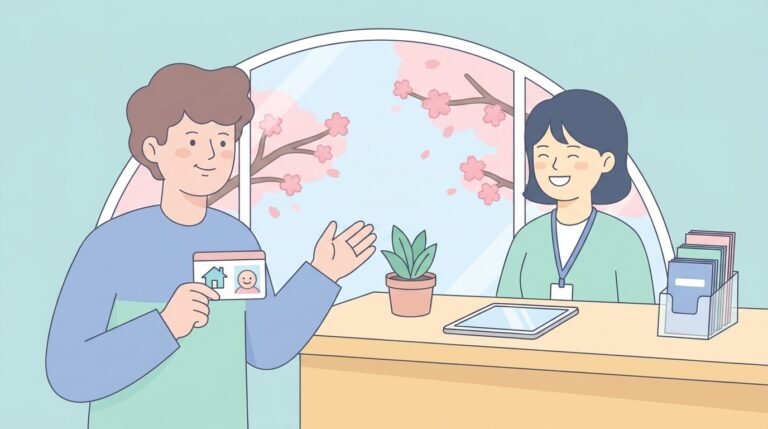
Phase 1: Empathy — Your First Moving Day Boss Level
안녕하세요! 매일한글 에디터입니다. (Annyeonghaseyo! Maeil Hangeul Editeo-imnida — Hello! I am your Daily Hangul editor.) Moving to a new studio in Seoul feels just like the start of a cozy K-drama—boxes everywhere and a bowl of hot jjajangmyeon on the floor! Wait, before celebrating, every foreigner faces one scary boss level: visiting the community center within 14 days to update your address. Last month, my student Mia froze at the counter because she did not know how to explain her move, even though they just needed to print the new address on the back of her Alien Registration Card. Based on real learner feedback, this beginner-friendly guide gives you the exact phrases to breeze through the counter and protect your visa status!
Phase 2: Deep Dive Into 3 Core Expressions
1. 체류지 변경하러 왔어요 (I came to report an address change)
- Pronunciation: Cheryuji byeongyeonghareo wasseoyo (Say “cheh-ryoo-jee byuhn-gyuhng-ha-ruh wah-ssuh-yo” — imagine “cheh” like “cherry” without the “rry”, and “wah-ssuh-yo” smoothly rolling like “was so yo”).
- Meaning: Literally “I came in order to change my place of stay.” In reality, it is the polite, official way for foreign residents to say “I am here to update my registered address.”
- K-Culture Moment: Picture a slice-of-life K-drama like Because This Is My First Life, where the main character walks up to a bright government counter carrying a folder of housing contracts, nervously rehearsing this exact line in her head.
- Editor’s Insight: Native speakers use 주소 (juso – address) in daily life, while official forms say 체류지 (cheryuji – place of stay). Saying 체류지 변경하러 왔어요 (Cheryuji byeongyeonghareo wasseoyo) immediately signals to the officer that you know the exact administrative process for foreigners!
- Situation Spectrum: Casual 🚫 / Semi-formal ✅ / Formal ✅
- 🤔 Think About It: Korean has a dedicated legal term, 체류지 (cheryuji), specifically for where foreign residents stay, separate from citizens’ 거주지 (geojuzi). How does your home country distinguish between a citizen’s address and a foreign resident’s address?
2. 외국인등록증 뒷면에 찍어 주세요 (Please print it on the back of my Alien Registration Card)
- Pronunciation: Oegugindeungnokjeung dwinmyeone jjigeo juseyo (Say “weh-goo-gin-deung-nok-jjeung dween-myuh-neh jji-guh joo-seh-yo” — “jji-guh” pops sharply like a quick stamp hitting paper!).
- Meaning: Literally “Please stamp/print it on the back side of my foreigner registration card.” Practically, it is your friendly confirmation that your updated address needs to go onto the back of your ARC.
- K-Culture Moment: Think of an indie Seoul vlog where an expat smiles proudly holding up their ARC, showing the freshly printed black ink address line on the back after completing their move.
- Editor’s Insight: The verb 찍다 (jjikda) originally means “to stamp” or “to take a photo,” and Koreans still use 찍어 주세요 (jjigeo juseyo) even though modern community center printers print the text directly onto the plastic card! It carries a cozy, analog warmth.
- Situation Spectrum: Casual 🚫 / Semi-formal ✅ / Formal ✅
- 🤔 Think About It: In Korea, your physical ID card carries your live home address right on the back so banks and delivery services can verify it instantly. In your country, do ID cards update addresses physically on the card, or only in an online database?
3. 서류 발급해 주실 수 있어요? (Could you issue this document for me?)
- Pronunciation: Seoryu balgeuphae jusil su isseoyo? (Say “suh-ryoo bahl-geup-heh joo-shil soo ee-ssuh-yo” — keep “suh-ryoo” light and quick, and rise gently at the end).
- Meaning: Literally “Do you have the ability to issue a document for me?” In practice, it is a super polite, Level-2-friendly way to ask for official certificates like a proof of residence.
- K-Culture Moment: You often hear office-worker characters in dramas like Misaeng or Hospital Playlist politely requesting paperwork at an administrative desk using ~아/어 주실 수 있어요? (~a/eo jusil su isseoyo?).
- Editor’s Insight: Adding 주실 수 있어요? (jusil su isseoyo?) softens a direct request into a respectful question. Officers hear demands all day, so adding this polite cushion almost always earns you a warm smile and extra help!
- Situation Spectrum: Casual 🚫 / Semi-formal ✅ / Formal ✅
- 🤔 Think About It: Korean relies heavily on “giving” verbs like 주다 (juda – to give) when asking for favors, framing the service as a kind gift from the listener. Does your native language use a similar “give me” structure, or does it focus more on “can I have”?
Phase 3: Textbook Korean vs. Real Korean
Situation 1: Explaining why you are at the counter
- 📖 Textbook Korean: 저는 어제 새로운 집으로 이사를 해서 주소를 변경하고 싶습니다. (Jeoneun eoje saeroun jibeuro isareul haeseo jusoreul byeongyeonghago sipseumnida. — Because I moved to a new house yesterday, I want to change my address.)
- 🗣️ Real Korean: 이사해서 주소 바꾸러 왔어요. (Isahaeseo juso bakkureo wasseoyo. — I moved, so I came to change my address.)
- 💡 Why the difference? Textbooks love long -습니다 (-seumnida) sentences with extra pronouns like 저는 (jeoneun – I). In real life, Korean community centers move fast! Dropping “I” and using 바꾸러 왔어요 (bakkureo wasseoyo – came to change) sounds natural, clear, and confident.
Situation 2: Asking where to wait or hand in your card
- 📖 Textbook Korean: 이 외국인등록증을 어디에 제출해야 합니까? (I oegugindeungnokjeungeul eodie jechulhaeya hamnikka? — Where must I submit this Alien Registration Card?)
- 🗣️ Real Korean: 이거 여기 드리면 돼요? (Igeo yeogi deurimyeon dwaeyo? — Can I just give this to you here?)
- 💡 Why the difference? Formal verbs like 제출하다 (jechulhada – submit) sound like an exam essay. Pointing gently to your card and saying 이거 여기 드리면 돼요? (Igeo yeogi deurimyeon dwaeyo?) is polite, effortless, and used by every local at the counter.
Phase 4: K-Culture Deep Dive & Non-Verbal Manners
4-1. Nunchi (눈치) & Gestures at the Community Center
Walking into a Korean 주민센터 (jumin senteo – community center) has its own unspoken rhythm! First, do not walk straight to an empty desk—look near the entrance for the 번호표 (beonhopyo – waiting number ticket machine). Press the button for 외국인 체류지 변경 (oegugin cheryuji byeongyeong – foreigner address change) or 일반 민원 (ilban minwon – general civil affairs), grab your paper slip, and wait until your number dings on the screen. When it is your turn, stand up, make brief eye contact with a slight nod, and hand over your ARC and housing contract using both hands (or your right hand supported by your left hand at the wrist). Using two hands shows respect and immediately creates good Nunchi!
4-2. Cultural Code Analysis: Palli-Palli (빨리빨리) Efficiency & Moving Day
If you watch K-Dramas or Korean lifestyle vlogs, you know two things about moving in Korea: eating jjajangmyeon on the floor and Korea’s famous 빨리빨리 (palli-palli – hurry, hurry) administrative speed! Unlike some countries where updating a residence card takes weeks of mailing forms, a Korean community center handles it right in front of you in about 5 to 10 minutes. They check your 임대차계약서 (imdaechagyeyakseo – lease contract), feed your ARC into a special printer, and hand it back with your brand-new address printed crisply on the back. Amazing, right?
Phase 5: Real-Life Roleplay Scenario
- Setting: A sunny Tuesday morning inside Seogyo-dong Community Center. The faint hum of the ticket machine fills the clean, bright hall, and Officer Kim—a kind, fast-typing civil servant in a neat blue vest—calls number 104.
- Characters: You (a cheerful Level 2 Korean learner) & Officer Kim (김 주무관 – Kim Jumugwan).
Dialogue
- Officer Kim: 104번 손님, 이쪽으로 오세요! (Baeksa-beon sonnim, ijjogeuro oseyo! — Guest number 104, please come this way!) 🎭 (Waves politely toward Desk 3 with a welcoming smile)
- You: 안녕하세요! 체류지 변경하러 왔어요. (Annyeonghaseyo! Cheryuji byeongyeonghareo wasseoyo. — Hello! I came to report an address change.) 🎭 (Gives a slight bow and places your folder neatly on the counter)
- Officer Kim: 네, 외국인등록증하고 집 계약서 보여 주세요. (Ne, oegugindeungnokjeunghago jip gyeyakseo boyeo juseyo. — Yes, please show me your Alien Registration Card and house contract.) 🎭 (Holds out both hands politely)
- You: 네, 여기 있어요. 신청서도 다 썼어요. (Ne, yeogi isseoyo. Sincheongseodo da sseosseoyo. — Yes, here they are. I filled out the application form too.) 🎭 (Hands over the ARC, lease contract, and form with both hands)
- Officer Kim: 아이고, 꼼꼼하게 잘 쓰셨네요! 잠깐만 기다려 주세요. (Aigo, kkomkkomhage jal sseushyeonne-yo! Jamkkanman gidaryeo juseyo. — Oh my, you wrote it so carefully! Please wait just a moment.) 🎭 (Types quickly on the keyboard and inserts your ARC into the back-printing machine)
- You: 저기요, 외국인등록증 뒷면에 찍어 주세요? 그리고 거주확인서 서류 발급해 주실 수 있어요? (Jeogiyo, oegugindeungnokjeung dwinmyeone jjigeo juseyo? Geurigo geojuhwaginseo seoryu balgeuphae jusil su isseoyo? — Excuse me, will you print it on the back of my ARC? And could you issue a residence certificate document for me?) 🎭 (Leans slightly forward with a polite, hopeful expression)
- Officer Kim: 네, 뒷면에 바로 찍어 드릴게요. 서류는 여기 신청하시면 무료로 나와요! (Ne, dwinmyeone baro jjigeo deurilgeyo. Seoryuneun yeogi sincheonghasimyeon muryoro nawayo! — Yes, I will print it on the back right away. If you apply here, the document comes out for free!) 🎭 (Hands back the freshly printed ARC and an extra paper certificate)
- You: 우와, 정말 빨라요! 감사합니다! (Uwa, jeongmal ppallayo! Gamsahamnida! — Wow, that was really fast! Thank you!) 🎭 (Checks the new address on the back of the ARC happily and bows)
🔀 Interactive Branching Point
Notice: Right before leaving the desk, you realize the printer missed one digit of your apartment room number (e.g., 302 instead of 305) on the back of your ARC! What do you say?
- Option A: “저기요, 여기 호수가 조금 다른 것 같아요. 확인해 주실 수 있어요?” (Jeogiyo, yeogi hosuga jogeum dareun geot gatayo. Hwaginhae jusil su isseoyo? — Excuse me, I think the room number here is a little different. Could you check it?)
- Option B: “야! 이거 틀렸잖아! 다시 찍어!” (Ya! Igeo teullyeotjana! Dasi jjigeo! — Hey! This is wrong! Print it again!)
- Option C: Say nothing, smile awkwardly, and leave because you feel shy.
Feedback:
* Option A (Best! ✅): Polite, calm, and clear! Using 것 같아요 (geot gatayo – I think/it seems) softens the correction so the officer does not feel blamed and fixes it immediately.
* Option B (Bad! 🚫): Way too rude! Using banmal (casual speech) like 야 (ya) and 다시 찍어 (dasi jjigeo) to a public official is considered very disrespectful.
* Option C (Risk! ⚠️): Never leave with a typo on your ARC! A wrong room number can block bank accounts, phone verification, and visa extensions later. Always double-check before leaving the counter!
Phase 6: 10-Second Emotional Shadowing Drill
Read aloud with feeling! Pause briefly at each / mark.
- [😊 Happy and polite] 안녕하세요! / 체류지 변경하러 / 왔어요. (Annyeonghaseyo! / Cheryuji byeongyeonghareo / wasseoyo. — Hello! / I came to / report an address change.)
- [🥺 Polite and slightly careful] 외국인등록증 뒷면에 / 찍어 주세요. (Oegugindeungnokjeung dwinmyeone / jjigeo juseyo. — On the back of my ARC / please print it.)
- [😌 Grateful and relieved] 서류 발급해 주셔서 / 정말 감사합니다! (Seoryu balgeuphae jusyeoseo / jeongmal gamsahamnida! — For issuing the document / thank you so much!)
Phase 7: K-Culture Mini Dictionary
- 주민센터 (Jumin senteo) | Community Center | Also called 행정복지센터 (Haengjeong bokji senteo). Your local neighborhood office for address updates, official documents, and local trash bags.
- 외국인등록증 (Oegugindeungnokjeung) | Alien Registration Card (ARC) | Your essential ID card in Korea for banking, mobile plans, and online shopping—don’t forget the back carries your live address!
- 번호표 (Beonhopyo) | Waiting Number Ticket | The little paper slip you pull at banks, post offices, and community centers so nobody cuts in line.
- 임대차계약서 (Imdaechagyeyakseo) | Lease / Housing Contract | The official paper you sign with your landlord; always bring the original copy when reporting an address change.
Phase 8: Survival Kit for Residents & Travelers
Survival Phrases TOP 3
- 번호표 어디에서 뽑아요? (Beonhopyo eodieseo ppobayo? — Where do I pull a waiting ticket?) — Pro Tip: Look for a small kiosk with glowing red or green buttons right inside the door!
- 이거 어디에 써요? (Igeo eodie sseoyo? — Where do I write this?) — Pro Tip: Point to the blank box on your 체류지 변경 신고서 (address change form) and the staff will guide your pen.
- 수수료 얼마예요? (Susuryo eolmayeyo? — How much is the fee?) — Pro Tip: Address changes are free, though extra official certificates like 외국인등록사실증명서 (Certificate of Alien Registration) may cost around 2,000 KRW.
Editor’s Travel Note
Before heading out, search your neighborhood’s nearest center by using the Naver Map App Download for Accurate Community Center Directions rather than Google Maps, since Naver Map shows exact walking entrances and office hours (usually Mon–Fri, 9:00 AM to 6:00 PM, and avoid 12:00–1:00 PM lunch rush if you want shorter lines!). Keep a Korean debit card or small cash (2,000–5,000 KRW) in your pocket in case you need extra stamped documents, and remember: you must report your move within 14 days to avoid a fine!
Phase 9: One Step Deeper — Why Korea Tracks Every Address So Fast
In Korea, your local community center is more than just a boring paperwork office—it reflects Korea’s deep-rooted neighborhood culture (동네 문화 – dongne munhwa) and digital efficiency. Traditionally, Korean villages looked out for every household, and today that spirit lives on in hyper-connected local centers that link your address instantly to hospitals, schools, and delivery networks. Once your address is printed on the back of your ARC, it feels like your official “welcome stamp” into your new neighborhood. That tiny line of ink connects you to everyday life in Korea!
💬 Your Turn: Have you ever visited a government office in Korea or another country? Tell us in the comments what surprised you the most—or which phrase you want to practice first!
Phase 10: FAQ & Common Mistakes
Q: Can I report my address change at ANY community center in Korea?
A: No! You must visit the community center (주민센터) that oversees your new home address, or use the official HiKorea website online if you have an electronic certificate. Checking your neighborhood on Naver Map saves you a wasted trip!
Q: Do I need to bring a passport photo when updating my address?
A: Usually no! Because they only print the new address on the back of your existing Alien Registration Card, you only need your ARC, your passport, your signed housing contract (임대차계약서), and the short application form provided at the center.
Q: Is it okay if the back of my ARC runs out of empty lines for new addresses?
A: Yes, don’t worry! If your ARC back is completely full from moving several times, the officer will attach an official address sticker or guide you on getting a replacement card through Immigration.
🚨 Common Mistakes Warning Board
- Mistake: Waiting 1 month after moving to visit the center. -> Correct Action: Always go within 14 days of your move-in date to avoid late fines!
- Mistake: Bringing only a photo of your housing contract on your phone. -> Correct Action: Bring the physical original contract (and if you live in someone else’s place, bring their ID copy and a signed 거주숙소제공확인서 / confirmation of residence).
- Mistake: Leaving the counter without reading the printed back of your ARC. -> Correct Action: Check your Korean address spelling and apartment room number (호수) on the spot!
Phase 11: Action Mission & Engagement
- 🥉 Bronze Mission (Solo Practice): Stand in front of your mirror and say all 3 core expressions from Phase 2 aloud three times while pretending to hand over an ID card with both hands!
- 🥈 Silver Mission (Share & Connect): Share your favorite phrase from today’s guide on Instagram or with a study buddy, tagging #DailyHangul so we can cheer you on!
- 🥇 Gold Mission (Real-Life Action): Next time you visit a Korean community center, bank, or cafe counter, challenge yourself to hand over your card with two hands and use a polite ~주실 수 있어요? (~jusil su isseoyo?) request!
- 🎮 K-Culture Mission: Watch an episode of a slice-of-life K-Drama (like Because This Is My First Life or Extraordinary Attorney Woo) or a Seoul expat vlog on YouTube, and spot how characters hand over cards or documents with two hands!
Phase 12: Interactive Quiz Challenge
Test your skills! Click each toggle below to reveal the answer and explanation.
Quiz 1 (Situational Judgment): You arrive at your new neighborhood’s community center with your lease contract and ARC. What is the BEST thing to do first?
A) Walk up to any empty desk and say “주소 바꿔!”
B) Pull a waiting ticket (번호표) and wait for your number, then say “체류지 변경하러 왔어요.”
C) Ask them to mail your new ARC to your home in 3 weeks.
👉 Click to check Quiz 1 Answer & Feedback
Correct Answer: B! Pulling a 번호표 (waiting ticket) shows great Korean Nunchi, and saying “체류지 변경하러 왔어요” politely tells the officer exactly what you need. (Option A is rude and skips the line; Option C isn’t needed because they print it on the spot!)
Quiz 2 (Fill in the Blank): Complete the polite request: “외국인등록증 ____ 찍어 주세요.” (Please print it on the back of my Alien Registration Card.)
A) 앞면에 (apmyeone)
B) 뒷면에 (dwinmyeone)
C) 옆면에 (yeopmyeone)
👉 Click to check Quiz 2 Answer & Feedback
Correct Answer: B (뒷면에)! 앞면 means front, 옆면 means side, and 뒷면 means back—where Korean ARCs display your updated home address!
Quiz 3 (True / False Cultural Quiz): True or False? In Korea, you have 60 days after moving to report your new address to the community center.
👉 Click to check Quiz 3 Answer & Feedback
Correct Answer: False! Foreign residents must report a change of residence within 14 days of moving to avoid penalties. Mark your calendar right after moving day!
🎬 Watch Our Daily Videos! (Daily Hangul Official Instagram)
Review the expressions you learned in this article with our fun daily short videos! Check out native pronunciation and real-life nuances in action.
- Instagram @dailyhangul_en







