

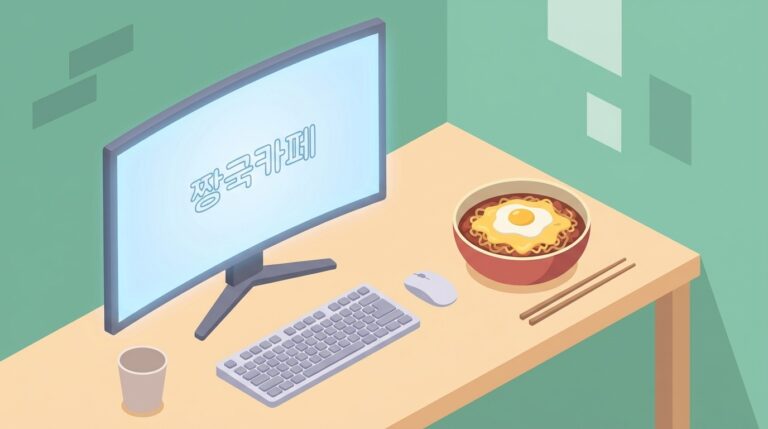
Phase 1: Empathy
안녕하세요! 매일한글 에디터입니다.
Imagine this scene: You step into a trendy Korean PC bang in Sinchon after an exhilarating day exploring Seoul. You expect rows of sleek monitors, glowing mechanical keyboards, and maybe the faint hum of computer fans. But the moment the sliding glass door opens, your senses are completely hijacked. Instead of stale snack-aisle air, you are greeted by the mouthwatering aroma of caramelized pork belly, sizzling garlic butter, and simmering rich broths.
You sit down in an ultra-plush gaming chair, power on the massive curved monitor, and spot a glowing button labeled “먹거리 주문” (Food & Drink Order). You click it, expecting basic microwave chips and canned sodas. Instead, a digital restaurant menu with over 80 items pops up: gourmet Jjagyechi (truffle black-bean noodles with sunny-side-up egg and cheese), spicy pork rice bowls, handmade dumplings, and iced Americanos in giant 1-liter cups. In modern Korea, the PC bang part-timer—affectionately known as the 알바생 (albaseang)—is widely considered an undercover culinary master!
Many of our Daily Hangul learners have told us: “I wanted to order that amazing food I saw on YouTube mukbangs, but I had no idea how to navigate the desktop menu, ask custom questions, or speak naturally to the staff!” Don’t let language barriers keep you from enjoying one of Korea’s greatest hybrid cultural wonders: the “PCttorang” (PC bang + Restaurant). Based on real feedback from international learners living in Seoul, this guide gives you the exact phrases, cultural etiquette, and confidence to feast like a local gaming pro.
Phase 2: Core Expressions Breakdown
1. 여기 라면 맛집인데요? (Yeogi ramyeon matjib-inde-yo?)
- Pronunciation: Yeo-gi rah-myeon maht-jeeb-in-deh-yo? (Think of “maht-jeeb” like “mart” + “jeep” spoken quickly, with a slight rising intonation at the end).
- Meaning: Literal: “Is this place a ramyeon restaurant?” | Actual Nuance: “Wow, this ramyeon is unbelievably good—are you sure this is just a PC bang and not a gourmet eatery?”
- K-Culture Moment: You will hear this exact witty compliment on popular Korean YouTube variety shows like Workman or celebrity game streams when an idol tastes a PC bang dish that outperforms a street food cart.
- Editor’s Insight: The ending pattern -인데요? expresses pleasant surprise while gently nudging the listener into a friendly conversation. It softens your statement into an affectionate compliment rather than a dry observation.
- Situation Spectrum: Casual: ✅ | Semi-formal: ✅ | Formal: ⚠️
- 🤔 Think About It: In Korean culture, dubbing any casual venue a “맛집” (mat-jip / gourmet house) is the highest compliment you can pay. Does your culture have a special word for unexpected culinary gems in everyday hangout spots?
2. 짜계치 하나 추가해 주세요 (Jjagyechi hana chugahae juseyo)
- Pronunciation: Jjah-gyeh-chi ha-na choo-gah-hae joo-seh-yo (Pronounce “Jjah” with sharp tension like the ‘zz’ in “pizza”, followed by “gyeh” like “get” without the ‘t’).
- Meaning: Literal: “Please add one Jjagyechi.” | Actual Nuance: “I’d like to order that iconic combo of Jjapaghetti topped with a fried egg and melted cheddar cheese!”
- K-Culture Moment: Seen across college drama scenes and webtoons where characters pull all-nighters studying or gaming. Jjagyechi is the undisputed king of PC bang soul food.
- Editor’s Insight: This word is a portmanteau (짜파게티 + 계란 + 치즈). Korean food culture loves creative abbreviations. Using the real compound name instantly proves you aren’t just an outsider—you know the authentic menu secrets.
- Situation Spectrum: Casual: ✅ | Semi-formal: ✅ | Formal: 🚫
- 🤔 Think About It: Koreans love blending multiple comfort foods into single acronyms (like Chimaek for chicken and beer). What are your native language’s most beloved food slang mashups?
3. 자리로 갖다 주시나요? (Jari-ro gatda jusinayo?)
- Pronunciation: Jah-ree-ro gaht-dah joo-shee-nah-yo? (Notice the double-t in “gatda”—snap your tongue back against your teeth like in “cat door”).
- Meaning: Literal: “Do you bring it to the seat?” | Actual Nuance: “Will this be served directly to my computer desk, or should I come pick it up at the kitchen counter?”
- K-Culture Moment: The moment a newcomer orders on screen and hovers awkwardly near the counter, only for an experienced Korean friend to say, “Just sit down; they deliver right to your keyboard!”
- Editor’s Insight: The honorific infix -시- (-si-) shows genuine respect to the hard-working part-time worker without sounding stiff or overly bureaucratic.
- Situation Spectrum: Casual: ⚠️ | Semi-formal: ✅ | Formal: ✅
- 🤔 Think About It: In many Western internet cafes, self-service is mandatory. Why do you think Korean urban spaces emphasize direct desk-side delivery even in high-tech digital environments?
Phase 3: Textbook Korean vs. Real Korean
Situation 1: Asking if your desk order went through successfully
- 📖 Textbook Korean:
음식 주문이 잘 접수되었습니까?
(Eumsik jumun-i jal jeopsu-doeeosseumnikka?)
“Has the food order been properly processed?” - 🗣️ Real Korean:
자리에서 주문 넣었는데, 잘 들어갔나요?
(Jari-eseo jumun neoeonneunde, jal deureogatnayo?)
“I submitted the order from my seat—did it go through all right?” - 💡 Why the Difference?: Textbooks often rely on administrative vocabulary like “접수” (jeopsu / formal registration). Native speakers in casual environments prefer dynamic physical metaphors like “주문을 넣다” (to insert an order) and “들어가다” (to go into the system).
Situation 2: Complimenting the worker on their cooking skills
- 📖 Textbook Korean:
이 요리는 매우 훌륭합니다.
(I yori-neun maeu hullyunghamnida.)
“This dish is exceedingly magnificent.” - 🗣️ Real Korean:
알바생분 완전 요리사인데요? 손맛 대박이에요!
(Alba-saeng-bun wanjeon yorisa-inde-yo? Sonmat daebak-ieyo!)
“Are you a professional chef? Your seasoning skills are insane!” - 💡 Why the Difference?: No native Korean under age 60 says “매우 훌륭합니다” for a bowl of noodles. Using “완전” (wanjeon / totally) combined with “손맛” (sonmat / magical hand touch in cooking) brings instant warmth and genuine emotion.
Phase 4: K-Culture Deep Dive & Non-verbal Manners
4-1. 눈치 (Nunchi) & Gaming Cafe Body Language
When you are inside a Korean PC bang, space management is an art form:
* The Headset Tilt: When food is delivered, never keep both headphone cups sealed over your ears. Slip one cup behind your ear so the part-timer knows you are listening.
* The Desk Shuffle: When the staff approaches with a steaming tray, gently slide your keyboard backward toward the monitor with both hands to clear a clear landing pad for your tray.
* The 15-Degree Nod: Say “감사합니다!” (Gamsahamnida) with a crisp 15-degree head bow. Never walk inside the staff cooking booth or kitchen window—PC bang kitchens are compact, high-heat speed zones with fryers and boiling water.
4-2. Cultural Code Analysis: The Birth of the “PCttorang”
Two decades ago, PC bangs were dimly lit, smoke-filled basements where players survived on cold triangle kimbap and cup noodles. Today, PC bang franchises compete in a fierce commercial battleground. With lightning-fast home internet everywhere in Korea, cafes evolved into luxury social lounges featuring commercial deep fryers, vacuum sealers, sous-vide meats, and dedicated extraction hoods.
This gave birth to the portmanteau PC또랑 (PC-ttorang = PC bang + 레스토랑). Young Koreans now frequently visit PC cafes primarily to eat dinner with friends while watching Netflix or playing team games. The part-timer (알바생) isn’t just resetting timers; they are line cooks balancing egg frying timers with high-speed customer orders.
Phase 5: Real-World Roleplay Scenario
Setting: CyberNest PC Lounge in Hongdae. LED backlights glow quietly across 120 gaming stations.
Characters:
* Liam (리아姆): A foreign exchange student who just finished a 2-hour gaming session.
* Min-jun (민준): The 23-year-old part-timer wearing an apron, balancing three sizzling food trays.
- Turn 1 (Liam):
🎭 Liam clicks the on-screen order popup and selects the Jjagyechi menu item with extra cheese.
저기요, 화면에서 결제 수단을 카드로 선택하면 되나요?
(Jeogiyo, hwamyeon-eseo gyeolje sudan-eul kadeu-ro seontaekhamyeon doenayo?)
“Excuse me, do I just select ‘credit card’ as the payment method on screen?” -
Turn 2 (Min-jun):
🎭 Min-jun steps over to Liam’s station holding a portable card reader with a bright smile.
네, 손님! 자리에서 바로 긁으셔도 되고, 음식 나올 때 결제하셔도 돼요.
(Ne, sonnim! Jari-eseo baro geulgeusyeodo doego, eumsik naol ttae gyeoljehasyeodo dwaeyo.)
“Yes, customer! You can swipe right at your desk card reader, or pay me when the food arrives.” -
Turn 3 (Liam):
🎭 Liam inserts his card into the desk terminal with curiosity.
자리에서 바로 결제되네요! 신기하다. 혹시 짜계치에 계란은 반숙인가요?
(Jari-eseo baro gyeoljedoeneyo! Singihada. Hoksi jjagyechi-e gyeran-eun bansuk-ingayo?)
“It pays right here at the desk! Amazing. By any chance, is the egg on the Jjagyechi soft-boiled?” -
Turn 4 (Min-jun):
🎭 Min-jun proudly nods with expert confidence.
그럼요! 저희 매장은 무조건 노른자 터지는 완벽한 반숙으로 나갑니다.
(Geureomyo! Jeohui maejang-eun mujogeon noreunja teojineun wanbyeokhan bansuk-euro nagamnida.)
“Of course! In our store, we unconditionally serve it sunny-side up with a perfectly runny yolk.” -
Turn 5 (Liam):
🎭 Liam’s eyes widen with joy.
대박! 그러면 공깃밥도 하나 같이 추가해 주세요.
(Daebak! Geureomyeon gonggitbap-do hana gachi chugahae juseyo.)
“Awesome! In that case, please add a bowl of steamed rice as well.” -
Turn 6 (Min-jun):
🎭 Min-jun taps his PDA terminal efficiently.
주문 확인했습니다. 5분 안에 자리로 갖다 드릴게요!
(Jumun hwaginhaesseumnida. O-bun an-e jari-ro gatda deurilgeyo!)
“Order confirmed. I’ll bring it right to your seat within 5 minutes!” -
Turn 7 (Liam):
🎭 5 minutes later, Liam takes his first bite and pauses in sheer admiration.
와… 알바생분 요리 실력 장난 아니네요. 여기 라면 맛집인데요?
(Wa… alba-saeng-bun yori sillyeok jangnan anineyyo. Yeogi ramyeon matjib-inde-yo?)
“Whoa… your cooking skills are no joke. Is this a gourmet noodle spot in disguise?” -
Turn 8 (Min-jun):
🎭 Min-jun chuckles happily while wiping down the tray.
하하, 맛있게 드셔주셔서 감사해요! 더 필요한 반찬 있으면 메신저로 불러주세요.
(Haha, masitge deusyeojusyeoseo gamsahaeyo! Deo piryohan banchan isseumyeon mesinjeo-ro bulleojuseyo.)
“Haha, thank you so much for enjoying it! If you need more pickled radish, just message me via the desktop chat!”
🔀 Interactive Choice Point
You just finished your delicious bowl of noodles and beverage. Empty bowls and napkins sit on the desk tray. What should you do next?
- Choice A: Carry the tray back to the main service counter and say, “잘 먹었습니다! 쟁반 여기 둘게요!” (Jal meogeosseumnida! Jaengban yeogi dulgeyo!)
- Choice B: Walk straight through the staff swinging doors into the hot kitchen to wash your own bowl in the sink.
- Choice C: Push the greasy bowl next to the mousepad, log out of your PC, and walk out without cleaning or notifying anyone.
💡 Choice Feedback:
- Choice A (Best): 🌟 Excellent! While some premium PC bangs clear trays after you log off, returning the tray to the return window (퇴식구 / Toesikgu) is universally appreciated and shows considerate nunchi.
- Choice B (Bad): 🚫 Dangerous! Entering commercial kitchen quarters violates hygiene codes and disrupts workers operating hot deep fryers.
- Choice C (Risk): ⚠️ Sub-optimal. While staff will eventually clear it during station cleanup, leaving sauce dripping near sensitive optical gaming gear creates unnecessary inconvenience.
Phase 6: 10-Second Emotion Shadowing Drill
Read each phrase aloud. Mimic the emotional state and pause at each slash mark (/)!
- [😋 Hungry and full of eager anticipation]
“짜계치에 / 계란 반숙으로 / 부탁드려요!”
(Jjagyechi-e / gyeran bansuk-euro / butak-deuryeoyo!)
→ “With the Jjagyechi / soft-boiled egg please / I kindly request!” -
[😲 Blown away after the first delicious bite]
“와, / 여기 PC방 맞아요? / 알바생분 요리 실력 대박!”
(Wa, / yeogi PC-bang majayo? / Alba-saeng-bun yori sillyeok daebak!)
→ “Whoa, / is this really a PC bang? / The part-timer’s cooking is incredible!” -
[😊 Warm, respectful, and leaving on a happy note]
“쟁반 / 카운터에 둘게요, / 정말 잘 먹었습니다!”
(Jaengban / kaunteo-e dulgeyo, / jeongmal jal meogeosseumnida!)
→ “The tray / I will leave on the counter, / that was truly a delicious meal!”
Phase 7: K-Culture Mini Dictionary
-
PC또랑 (PC-ttorang)
- Translation: PC Cafe-Restaurant Hybrid.
- Real Usage: Slang coined by younger Koreans to describe modern gaming centers equipped with full restaurant menus, fryers, and specialty beverage counters.
- 알바생 (Alba-saeng)
- Translation: Part-time worker (derived from the German word Arbeit).
- Real Usage: Refers to high school or college students working hourly jobs. In PC bangs, they are legendary for juggling technical PC support and speed-cooking.
- 먹거리 주문 (Meokgeori Jumun)
- Translation: Food & Refreshment Ordering System.
- Real Usage: The prominent on-screen desktop icon or software dock in every Korean PC bang used to browse menus and send orders directly to the kitchen.
- 반숙 (Bansuk)
- Translation: Soft-boiled or runny yolk egg.
- Real Usage: Essential culinary vocabulary. The runny yolk acts as a creamy sauce when mixed into spicy Korean ramyeon or savory black bean noodles.
Phase 8: Traveler’s Survival Kit
Top 3 Survival Phrases for PC Cafe Foodies:
- 튀김 바삭하게 튀겨 주세요.
(Twigim basakhage twigyeo juseyo.)
Pro Tip: “Please fry the snacks extra crispy.” Perfect for sausage skewers and fried dumplings. - 단무지 좀 더 주실 수 있나요?
(Danmuji jom deo jusil su innayo?)
Pro Tip: “Could I have a little more yellow pickled radish?” Cuts through rich, greasy noodle sauces. - 다 먹은 그릇은 어디에 두면 돼요?
(Da meogeun geureut-eun eodie dumyeon dwaeyo?)
Pro Tip: “Where should I place empty dishes after eating?” Keeps you respectful regardless of specific cafe layout rules.
Editor’s Travel Note: Real-World Navigation & Payment
- Finding Top-Tier PC Cafes: Avoid tiny run-down basements. Use the [Naver Map app navigation for top-rated PC cafes] and search for major premium franchise names like 아이센스리그 PC방 (iSens League), 긱스타 PC방 (Geekstar), or 쓰리팝 PC방 (3POP).
- Smart Seat Payments: Most modern PC bangs have credit card IC chip readers attached directly beside your keyboard or monitor. If your foreign travel card doesn’t process through the desktop terminal, simply choose “현장 결제” (pay on-site) or “카운터 결제” (pay at counter), and you can settle in cash or physical card when the part-timer brings your food.
Phase 9: A Step Deeper (Cultural Thought)
In Korean society, the PC bang represents far more than just a room filled with high-end graphic cards. It is an urban sanctuary—a cultural safe harbor where young Koreans, who often live in tight quarters with family until marriage, can experience complete autonomy, comfort, and affordable culinary pampering.
When you understand that the PC bang is designed as an all-inclusive “micro-resort” for busy urbanites, the incredible cooking skills of the part-timers make total sense: hospitality in Korea is defined by making the guest feel completely taken care of without ever forcing them to leave their zone of comfort.
💬 Your Turn: Does your country have a unique hangout space where an unrelated service (like gaming, studying, or laundry) evolved into an unexpected gourmet food experience? Tell us in the comments below!
Phase 10: FAQ & Common Mistakes
Q: Can I pay with an international foreign credit card at the PC bang seat?
A: Most automated seat-order terminals are programmed for Korean domestic payment gateways. If your foreign Visa or Mastercard gets rejected on the computer screen, simply select “카운터 결제” (Counter Payment) or “현장 현금 결제” (On-site Cash Payment) so you can pay the staff member directly.
Q: Is it considered rude to order food right before my computer time runs out?
A: Not at all! However, if your computer time hits zero, the screen will automatically shut down and log off, leaving you in the dark. It is best practice to add at least 30 minutes of PC time if you plan to enjoy a warm meal.
Q: Do I need to clean up my own tray, or does the staff do it?
A: In modern franchises, there is usually a designated return shelf near the counter labeled 퇴식구 (Toesikgu). Returning your tray there is considered polite etiquette, although leaving it neatly pushed back at your desk is also accepted if the cafe specifically advertises full cleanup service.
🚨 Common Mistakes Alert (Top 3)
- Mistake 1: Standing up and trying to order verbally at the busy kitchen counter during peak hours.
Correct Action: Sit at your computer terminal and use the on-screen digital ordering program—it keeps kitchen tickets organized and fast. - Mistake 2: Spilling ramen soup on mechanical keyboards and quietly switching seats without notifying staff.
Correct Action: Accidents happen! Immediately notify the counter with “죄송한데 국물을 조금 쏟았어요!” (I’m so sorry, I spilled some broth!) so they can sanitize the equipment before switches break. - Mistake 3: Forgetting to formally log out of your session on the screen.
Correct Action: Always click the “사용 종료” (End Session) button on top of your screen so your remaining prepaid credit stays safely saved to your user ID.
Phase 11: Action Mission & Engagement
- 🥉 Bronze Level: Stand in front of your mirror and practice saying: “여기 라면 맛집인데요?” three times with an enthusiastic, admiring facial expression.
- 🥈 Silver Level: Snap a photo of a delicious casual meal you cooked or ordered, share it to your Instagram story, and caption it: “PC방 알바생 손맛 인정!” (Acknowledging true PC bang part-timer culinary skill!).
- 🥇 Gold Level: On your next trip to Korea, visit a major franchise PC bang, order a bowl of Jjagyechi directly from the seat screen, and thank the part-timer using natural Korean!
🎮 K-Culture Mission: Watch an episode of a Korean variety show or gaming mukbang (such as Workman at a PC Cafe). Listen closely to identify how many times the cast mentions the words 알바생 and 맛집!
Phase 12: Interactive Quiz Challenge
Question 1: Situation Judgment
You want to order Jjapaghetti with cheese and an egg, but you don’t know if the staff delivers to your computer seat. Which phrase is the most natural and polite to ask the staff?
* A) 라면 빨리 가져와! (Ramyeon ppalli gajyeowa!)
* B) 자리로 갖다 주시나요? (Jari-ro gatda jusinayo?)
* C) 식당 어디에 있습니까? (Sikdang eodie isseumnikka?)
👉 Click to Reveal Answer & Explanation
Correct Answer: B
Explanation: Option B is polite and natural (semi-formal with honorific -si-). Option A is rude informal speech (Banmal), and Option C asks “Where is the restaurant?” which makes no sense inside an internet cafe!
Question 2: Fill in the Blanks
Fill in the missing Korean syllables for the iconic noodle combination:
짜파게티 + [ ]란 + [ ]즈 = 짜계치
👉 Click to Reveal Answer & Explanation
Correct Answer: 계, 치
Explanation: 계란 (Gyeran = Egg) and 치즈 (Chijeu = Cheese). Combined together with 짜파게티, it creates the famous portmanteau 짜계치 (Jjagyechi)!
Question 3: True or False Cultural Quiz
True or False? In modern Korean PC bangs, food is always pre-packaged instant snacks heated up in basic microwaves, and custom cooking with fryers or stoves is prohibited.
👉 Click to Reveal Answer & Explanation
Correct Answer: False
Explanation: False! Modern Korean “PCttorang” venues operate licensed commercial kitchens featuring fryers, stovetops, and griddles, preparing restaurant-quality meals on demand.







