

Phase 1: Empathy (Story-driven Opening)
안녕하세요! 매일한글 에디터입니다.
Imagine this: You have just walked out of a bustling subway car at Hongdae Station on Line 2. The sounds of indie street buskers echo through Exit 9, the tempting smell of freshly fried tteokbokki fills the air, and you reach down to grab your favorite crossbody bag—only to realize your hands are empty. That bag had your passport, your transit card, and that one-of-a-kind autographed K-pop photo card you waited three hours in line to buy. Your heart drops straight to your sneakers.
In a K-drama, a romantic stranger might sprint through the ticket gates to hand it back to you in slow motion. But in real life, standing amid thousands of commuters during Seoul’s rush hour, the immediate feeling is sheer panic. You see a subway staff member in uniform, but your mind goes completely blank: How on earth do I ask where the lost and found is in Korean?
Take a deep breath! South Korea is globally famous for its astonishingly high rate of returned property and its hyper-organized lost-and-found systems. You are in very safe hands. However, knowing how to clearly locate that office turns an hour of panicked wandering into a smooth, ten-minute resolution. Based on real-world classroom sessions with hundreds of beginner travelers who faced this exact scare, I have distilled the most natural, polite, and stress-free ways to ask for the lost and found. Let’s make sure you never feel helpless when you misplace something in Korea!
Phase 2: Key Expressions in Depth
Here are three indispensable expressions you need to know when hunting down your missing belongings.
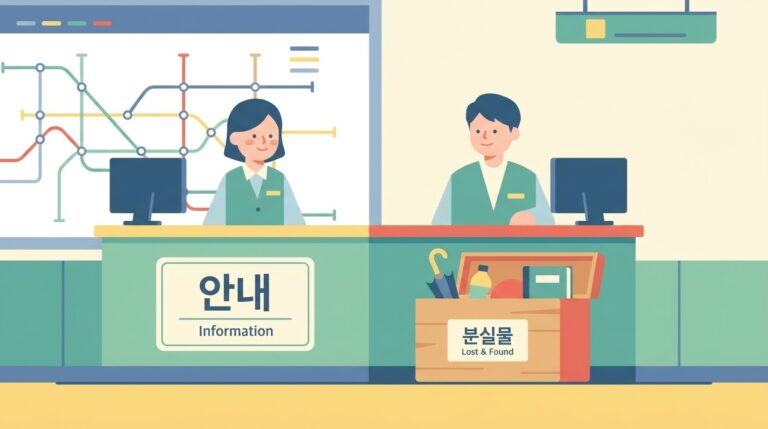
1. 분실물 보관소가 어디에 있어요? (Bunsilmul bogwanso-ga eodi-e isseoyo?)
- Pronunciation: Boon-sheel-mool bo-gwan-so-ga uh-dee-eh ee-ssuh-yo? (Think of “boon” as in windfall, “sheel”, “mool” like water, “bo-gwan” like guarding, and “so” like a place).
- Meaning: Literal: “Where is the lost item storage place?” | Nuance: “Where is the lost and found office?”
- K-Culture Moment: This is the phrase frequently used by characters in slice-of-life dramas like Hospital Playlist or travel variety shows when an idol accidentally leaves their bag behind in a train station.
- Editor’s Insight: ‘분실물’ (bunsilmul) refers to lost property, while ‘보관소’ (bogwanso) means a safekeeping room or depot. It is the most standardized, clear term printed on navigational signs across Korea’s public transit.
- Situation Spectrum: Casual ⚠️ | Semi-formal ✅ | Formal ✅
- 🤔 Think About It: Notice how Korean builds compound nouns using Chinese character roots (Hanja: 紛失物 保管所). Does your native language compress complex civic services into compound words like this?
2. 유실물 센터를 찾고 있어요. (Yusilmul senteo-reul chatgo isseoyo.)
- Pronunciation: Yoo-sheel-mool sen-tuh-reul chat-go ee-ssuh-yo? (“Yoo” like youth, “sheel”, “mool”, “sen-tuh”).
- Meaning: Literal: “I am searching for the lost property center.” | Nuance: “I am looking for the lost and found center.”
- K-Culture Moment: You will hear this exact announcement over subway station speakers: “유실물 센터로 문의해 주시기 바랍니다” (Please make inquiries at the Lost and Found Center).
- Editor’s Insight: ‘유실물’ (yusilmul) is an exact synonym of ‘분실물’. Seoul Metro and major railway networks commonly use the English loanword ‘센터’ (Center) combined with ‘유실물’ on their official directory maps.
- Situation Spectrum: Casual 🚫 | Semi-formal ✅ | Formal ✅
- 🤔 Think About It: In English, we use two opposite verbs turned into a noun phrase (“Lost and Found”), whereas Korean focuses purely on the condition of safekeeping (“property left behind”). What does this tell you about Korean institutional trust?
3. 혹시 이 근처에 안내 데스크가 있나요? (Hoksi i geuncheo-e annae deseukeu-ga innayo?)
- Pronunciation: Hohk-shee ee geun-chuh-eh ahn-nae deh-seu-keu-ga een-nah-yo? (Emphasize the gentle lift on “Hohk-shee”).
- Meaning: Literal: “By any chance, is there an information desk around this neighborhood?” | Nuance: “Excuse me, is there an information desk nearby?”
- K-Culture Moment: A must-use line when stepping inside massive complex spaces like The Hyundai Seoul, Incheon Airport, or COEX Mall.
- Editor’s Insight: Dedicated lost-and-found offices can be tucked away in basement administrative corridors. When you cannot spot signs for them, heading to an ‘안내 데스크’ (Information Desk) is your quickest stepping stone.
- Situation Spectrum: Casual 🚫 | Semi-formal ✅ | Formal ✅
- 🤔 Think About It: Why do Koreans sprinkle ‘혹시’ (by chance) into questions even when they know an information desk probably exists? It acts as a polite verbal cushion to avoid putting social pressure on the listener!
Phase 3: Textbook Korean vs Real Korean
Let’s see how standard textbook dialogues contrast with how real Seoulites speak on the street.
Situation 1: Asking Station Staff for Directions
- 📖 교과서 한국어: 분실물 센터의 위치를 가르쳐 주십시오. (Bunsilmul senteo-ui wichi-reul gareuchyeo jusipsio.) — “Please teach me the location of the lost and found center.”
- 🗣️ 진짜 한국어: 저기요, 분실물 센터 어디인지 알 수 있을까요? (Jeogiyo, bunsilmul senteo eodiinji al su isseulkkayo?) — “Excuse me, could you tell me where the lost and found center is?”
- 💡 왜 다를까? Textbook imperatives like
~주십시오sound overly rigid and authoritative, like military commands. Real speakers cushion their request with~알 수 있을까요?(“Could I possibly know?”), creating a softer, friendlier rapport.
Situation 2: Explaining What Happened
- 📖 교과서 한국어: 저는 지하철에서 제 가방을 잃어버렸습니다. (Jeoneun jihacheore-seo je gabang-eul ireobeoryeotseumnida.) — “I lost my bag inside the subway.”
- 🗣️ 진짜 한국어: 지하철에 가방을 깜빡 두고 내렸어요. (Jihacheore gabang-eul kkamppak dugo naeryeosseoyo.) — “I accidentally left my bag behind on the subway when I got off.”
- 💡 왜 다를까? Koreans rarely say they just “lost” an item if they left it on a seat. Instead, using the onomatopoeia
깜빡(kkamppak, reflecting a sudden memory lapse or blink) instantly sounds native and explains the exact circumstance.
Phase 4: K-Culture Deep Dive & Non-Verbal Manners
4-1. 눈치 (Nunchi) & Polite Gestures
When approaching someone in a public booth or subway counter to ask for the lost-and-found office:
* The Soft Approach: Do not barge in shouting “Excuse me!” Instead, make calm eye contact, bow your head slightly (about 15 degrees), and say a gentle “저기요…” (Jeogiyo…).
* Two-Hand Phone Display: If you have photos of what you lost, receipts, or your transit card number, present your phone using both hands or support your right forearm with your left hand. This subtle gesture signals high respect and immediately triggers the staff’s protective instincts to help you.
4-2. Cultural Code Analysis: The Legend of Seoul Transit Honesty
Foreign visitors often marvel at videos of Koreans leaving laptops on cafe tables to use the restroom. But what happens in transit? Seoul Metro alone recovers over 100,000 lost items annually, with an impressive return rate exceeding 80%. When an item is found on a seat or overhead rack, conductors bring it to the terminal station’s ‘역무실’ (Station Office). If unclaimed after a few days, it moves to a major transfer hub’s ‘유실물 센터’ (Lost and Found Center). Asking for the location isn’t just about finding a room; it connects you into one of the most honest civic retrieval pipelines in the world.
Phase 5: Real Role-play Scenario
- Location: Express Bus Terminal Station (고속터미널역), a labyrinth-like transfer point between Lines 3, 7, and 9.
- Characters:
- Alex (알렉스): An exchange student looking frantic holding an umbrella.
- Station Master Park (역무원 박 씨): A veteran subway staff member wearing a neat navy uniform.
Dialogue:
- Alex: 🎭 (Approaches the glass ticket booth, bowing slightly with hands together) 저기요, 죄송한데요. (Jeogiyo, joesonghandeyo.) — “Excuse me, I’m sorry to bother you.”
- Station Master Park: 🎭 (Puts down his clipboard and smiles warmly) 네, 무슨 일이세요? (Ne, museun iriseyo?) — “Yes, what can I do for you?”
- Alex: 🎭 (Looking nervous, pointing back toward the train platforms) 제가 7호선에 가방을 깜빡 두고 내렸어요. (Jega chil-ho-seone gabang-eul kkamppak dugo naeryeosseoyo.) — “I accidentally left my bag behind on Line 7.”
- Station Master Park: 🎭 (Nods reassuringly and leans forward) 아이고, 그러셨어요? 많이 놀라셨겠네요. (Aigo, geureosyeosseoyo? Mani nollasyeotgenneyo.) — “Oh dear, really? You must have been so surprised.”
- Alex: 🎭 (Showing his phone notepad) 혹시 이 역에 분실물 보관소가 어디에 있어요? (Hoksi i yeoge bunsilmul bogwanso-ga eodi-e isseoyo?) — “By any chance, where is the lost and found office in this station?”
- Station Master Park: 🎭 (Points down the hallway toward Exit 8) 7호선 지하 1층 고객안내센터 옆에 있어요. 여기서 직진하시면 돼요. (Chil-ho-seon jiha il-cheung gogaek-annae-senteo yeope isseoyo. Yeogiseo jikjinhasimyeon dwaeyo.) — “It is next to the Customer Info Center on Basement Level 1 for Line 7. Just go straight from here.”
- Alex: 🎭 (Relieved, bowing deeply) 정말 감사합니다! 금방 다녀올게요. (Jeongmal gamsahamnida! Geumbang danyeoolgeyo.) — “Thank you so much! I will go right away.”
- Station Master Park: 🎭 (Giving a gentle wave) 네, 서두르지 말고 조심히 가세요! (Ne, seodureuji malgo josimhi gaseyo!) — “Yes, don’t rush, walk safely!”
🔀 Interactive Decision Point
You reach the junction described by Station Master Park, but there are two hallways and no English sign. What do you say to the convenience store clerk standing nearby?
- Choice A: “야! 분실물 센터 어디야?” (Ya! Bunsilmul senteo eodiya?)
- Choice B: “실례지만, 분실물 보관소가 이쪽인가요?” (Sillyejiman, bunsilmul bogwanso-ga ijjokingayo?)
- Choice C: “가방! 내 가방 어디 있어요?” (Gabang! Nae gabang eodi isseoyo?)
Feedback:
* Choice A (Bad): Using banmal (casual informal Korean 야 and 어디야) with a stranger is considered extremely rude. They will likely be startled or offended.
* Choice B (Best): Starting with 실례지만 (“Excuse me, but…”) and asking 이쪽인가요? (“Is it this way?”) is textbook polite, calm, and gets immediate, friendly assistance.
* Choice C (Risk): Demanding “Where is my bag?” sounds like you are accusing the store clerk of having stolen it! Stick to asking for the office location.
Phase 6: 10-Second Emotion Shadowing Drill
Practice these lines with rhythm, breath, and emotion. The slashes / indicate brief pauses.
[😰 당황스럽고 다급하게 / Flustered & Urgent]
저기요, / 제가 지하철에 / 가방을 두고 내렸어요! / (Jeogiyo, / jega jihacheore / gabang-eul dugo naeryeosseoyo!)-
[🙏 정중하고 간절하게 / Polite & Earnest]
혹시 / 분실물 보관소가 / 어디에 있는지 / 알 수 있을까요? / (Hoksi / bunsilmul bogwanso-ga / eodi-e inneunji / al su isseulkkayo?) -
[😮💨 안도하며 감사하게 / Relieved & Grateful]
아, 저쪽이군요! / 알려주셔서 / 정말 감사합니다. / (A, jeojjog-igunyo! / allyeojusyeoseo / jeongmal gamsahamnida.)
Phase 7: K-Culture Mini Dictionary
- 분실물 / 유실물 (Bunsilmul / Yusilmul) | Lost Property
- Meaning: Both words mean items that have slipped away from their owners. You will see ‘유실물’ predominantly on railway signage and ‘분실물’ in general stores, museums, and schools.
- 역무실 (Yeongmusil) | Station Control Office
- Meaning: The central control room at any Korean metro station. If the station has no separate large lost-and-found hub, this is where recovered items are stored during the first 24 to 72 hours.
- 유실물 센터 (Yusilmul Senteo) | Lost and Found Center
- Meaning: Larger transit hub centers that gather lost items from multiple connected subway lines. City Hall (시청역) and Express Bus Terminal (고속터미널역) are famous hub centers in Seoul.
- 접수증 (Jeopsujeung) | Claim Receipt / Registration Slip
- Meaning: The verification paper or digital record you sign when identifying and claiming your item back. You will be asked to present an ID (신분증).
Phase 8: Survival Kit for Travelers
TOP 3 Survival Phrases
- 유실물 센터가 몇 층에 있어요? (Yusilmul senteo-ga myeot cheung-e isseoyo?)
- Pro Tip: Use this when navigating multi-level underground mega-stations like Gangnam or Seoul Station.
- 가방을 찾으러 왔어요. (Gabang-eul chajeureo wasseoyo.)
- Pro Tip: Say this when you arrive at the lost-and-found window (“I came to pick up my bag”).
- 사진 보여드릴게요. (Sajin boyeodeurilgeyo.)
- Pro Tip: Visuals speak louder than words! Pull up a photo of your lost item and use this phrase (“I’ll show you a photo”).
Editor’s Travel Note
- Track your train details: Whenever you take the subway, take a quick peek at the subway car number printed on the doors (a 4-to-6 digit number, like 2045) or the boarding gate number (e.g., 3-4). If you leave something, telling the staff that exact number allows them to call the next station and intercept your bag within minutes!
- Digital Lost & Found: Check the official Korean National Police Agency lost item portal via 경찰청 유실물 포털 LOST112 웹사이트 확인하기, where photos of every recovered item in Korea are uploaded daily. Also, navigate metro stations with precision using the 네이버 지도 앱 다운로드.
Phase 9: “한 발 더 깊이” (One Step Deeper)
In Korean society, leaving someone else’s dropped item alone or turning it into an official center is tied to the concept of ‘양심’ (Yangsim – Conscience). Taking an unattended phone or wallet is not just socially condemned; it carries legal penalties under embezzlement of lost property laws. When you approach a Korean worker to ask for the lost and found, you are tapping into a strong civic culture that takes pride in public honesty. They will often treat your missing possession with the exact same urgency as if it were their own.
💬 Your Turn: Have you ever lost an item while traveling abroad? What is the first place you went looking for it? Share your story in the comments below!
Phase 10: FAQ & Common Mistakes
Q: Can I speak English at the Seoul Metro Lost and Found center?
A: Most major transit hubs have staff with basic English proficiency, but using simple Korean phrases like “분실물 센터 어디예요?” immediately clarifies your need and earns instant goodwill.
Q: What should I bring when I go to pick up my lost belongings?
A: Always bring an official form of identification (your passport or Alien Registration Card) to match your identity against the claim paperwork.
Q: How long do subway stations keep items before moving them?
A: Local station offices usually hold items for about 3 to 7 days before transferring them to the regional police department storage facility.
🚨 Common Mistakes Alert!
| Mistake | Why It Causes Trouble | Correct Action |
|---|---|---|
| Asking “내 물건 어디 있어요?” (Where is my stuff?) | Sounds aggressive or demanding, as if the worker took it. | Ask for the facility: “분실물 센터가 어디에 있어요?” |
| Forgetting which subway car/line you rode | Subway networks have thousands of cars; staff cannot search without details. | Note down the line color, boarding time, and car number immediately. |
| Pronouncing ‘분실물’ as boon-seel-mool with flat English rhythm | Lack of correct syllable flow might make it hard for staff to catch the word. | Emphasize Boon-shil-mul smoothly together as one vocabulary unit. |
Phase 11: Action Mission & Engagement
- 🥉 Bronze Mission (Solo Practice): Stand in front of your mirror and practice saying: “분실물 보관소가 어디에 있어요?” three times with a clear voice and a polite bow.
- 🥈 Silver Mission (Social Learning): Open your voice memo app or social media, record yourself doing the Emotion Shadowing drill from Phase 6, and tag our community.
- 🥇 Gold Mission (Real-World Application): The next time you visit a Korean metro station, department store, or airport, spot the physical ‘분실물 센터’ or ‘안내 데스크’ sign and read it aloud!
- 🎮 K-Culture Mission: Watch any episode of a subway-based Korean drama (like Catch the Ghost) and spot whether the characters use ‘분실물’ or ‘유실물’ when talking about belongings.
Phase 12: Interactive Quiz Challenge
Test your knowledge before you hit the Seoul streets!
Q1. Situation Judgment
You lost your scarf on Line 3. You see an information booth. Which sentence is the most polite and natural for an A2 learner?
1. 야, 내 목도리 내놔. (Ya, nae mokdori naenwa.)
2. 저기요, 유실물 센터가 어디에 있어요? (Jeogiyo, yusilmul senteo-ga eodi-e isseoyo?)
3. 목도리를 교과서에 두었습니다. (Mokdorireul gyogwaseo-e dueotseumnida.)
👉 Click for Answer & Explanation
Correct Answer: 2
Explanation: Sentence 2 combines the gentle call-out ‘저기요’ with the standard polite question form. Sentence 1 is impolite banmal, and Sentence 3 nonsensically says you left your scarf inside a textbook!
Q2. Fill in the Blank
지하철에 가방을 _______ 두고 내렸어요. (I accidentally / in a flash left my bag behind.)
* Hint: Think of the sound of a blinking eye!
👉 Click for Answer & Explanation
Correct Answer: 깜빡 (kkamppak)
Explanation: ‘깜빡’ is the quintessential Korean adverb for suddenly forgetting or leaving something behind without realizing it.
Q3. True or False?
In Korea, ‘분실물’ and ‘유실물’ have completely opposite meanings.
👉 Click for Answer & Explanation
Correct Answer: False (F)
Explanation: Both terms refer to lost and found items. ‘분실물’ is widely used in everyday settings, while ‘유실물’ is common in official transit terminology.







