

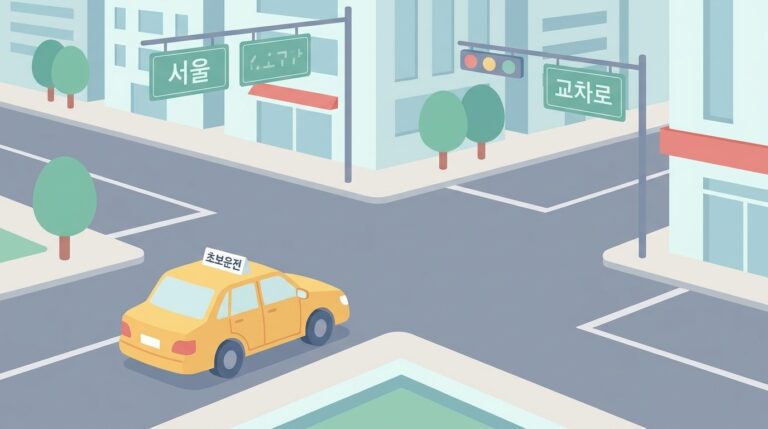
Conquering the Korean Road Test Without Panicking Behind the Wheel
Phase 1: 공감 (Story-Driven Opening)
안녕하세요! 매일한글 에디터입니다.
Imagine this: You are sitting in the driver’s seat of a bright canary-yellow subcompact car (노란 학원차). Right next to you sits an expressionless test examiner wearing dark sunglasses, holding an ominous digital tablet that beeps every time you breathe too loudly. Outside, the bustling traffic of Mapo or Gangnam zooms past, delivery scooters weave through blind spots like caffeinated ninjas, and suddenly, the automated GPS system blares: “300미터 앞, 비보호 좌회전입니다” (300 meters ahead, unprotected left turn). Your palms turn slick with sweat. What was that rule about oncoming traffic again? Did you remember to cancel your blinker?
Tackling the Korean driver’s license (운전면허) and the dreaded road test (도로주행) is notorious even among native Koreans. For foreign residents and expats, navigating complex urban traffic while processing rapid-fire instructions in Korean can feel like defusing a bomb while riding a rollercoaster. But do not worry! Having coached hundreds of intermediate learners through their test anxieties, I have distilled the exact communicative cues, road slang, and non-verbal nuances you need to pass your road test with flying colors. By the end of this guide, you won’t just pass the road test—you will navigate Korean traffic with the poise of an experienced Seoul cab driver.
Phase 2: 핵심 표현 3선 심층 분석 (Core Expressions)
1. 깜빡이 먼저 켜고 들어가세요 (Kkamppagi meonjeo kyeogo deureogaseyo)
- Pronunciation: [Kkam-ppa-gi meon-jeo kyeo-go deu-reo-ga-se-yo] (Think of ‘kkam-ppak’ as the sound of an eyelid blinking rapidly or a light flashing).
- Meaning: Literal: “Turn on the blinker first and enter.” | Nuance: “Signal your turn/lane change before merging!”
- K-Culture Moment: You will hear this barked in virtually every Korean driving academy YouTube channel or during variety shows like I Live Alone (나 혼자 산다), where celebrities inevitably forget their turn signal during nervous driving lessons.
- Editor’s Insight: While the formal term is 방향지시등 (direction indicator), nobody in the car will say that under pressure. Everyone uses the onomatopoeic word 깜빡이 (blinker). In the Korean road test, failing to indicate at least 30 meters before lane merging results in an automatic deduction of points.
- Situation Spectrum: Casual ✅ | Semi-formal ✅ | Formal ⚠️
- 🤔 Think About It: Why does Korean road culture use a playful sound-symbolic word (깜빡이) even in stern instructional contexts? How does your native language contrast official road terms with colloquial driving terms?
2. 비보호 좌회전 조심하세요 (Bibohu jwahoejeon josimhaseyo)
- Pronunciation: [Bi-bo-ho jwa-hoe-jeon jo-sim-ha-se-yo] (Break it down: ‘Bi’ [non-] + ‘boho’ [protection] + ‘jwahoejeon’ [left turn]).
- Meaning: Literal: “Be careful with the unprotected left turn.” | Nuance: “Yield to oncoming traffic before taking the left on green.”
- K-Culture Moment: Seen frequently in K-drama thrillers when characters are tailing someone through tight commercial alleys or suburban intersections in Gyeonggi-do, sweating over whether oncoming delivery trucks will yield.
- Editor’s Insight: 비보호 literally means “unprotected.” Many foreigners mistakenly turn on a red signal because there is no left arrow. In Korea, you can only make an unprotected left turn on a green light when oncoming traffic is clear. Turning on red is a severe traffic violation (신호위반) that results in immediate disqualification on the driving test.
- Situation Spectrum: Casual ✅ | Semi-formal ✅ | Formal ✅
- 🤔 Think About It: How does the linguistic framing of “unprotected” (비보호) influence driver vigilance compared to terms like “permissive left turn” or “filter turn”?
3. 양보해 주셔서 감사합니다 (Yangbohae jusyeoseo gamsahamnida)
- Pronunciation: [Yang-bo-hae ju-syeo-seo gam-sa-ham-ni-da] (Pronounce ‘yang-bo’ smoothly, like ‘yung-bo’).
- Meaning: Literal: “Thank you for yielding.” | Nuance: “Thanks for letting me merge / cut in!”
- K-Culture Moment: Often accompanied by a quick wave of the hand inside the car or a double-flash of hazard lights (비상등) when a polite driver lets an anxious learner change lanes during morning gridlock.
- Editor’s Insight: 양보 (yielding/concession) is considered the supreme virtue on fast-paced Korean roads. Saying this to your instructor or practicing passenger demonstrates social maturity and situational awareness (눈치).
- Situation Spectrum: Casual ⚠️ (use 양보해 줘서 고마워) | Semi-formal ✅ | Formal ✅
- 🤔 Think About It: In many Western driving cultures, a brief wave of the hand suffices. Why is verbalizing appreciation or flashing hazard lights an essential courtesy in urban Korean driving?
Phase 3: 교과서 한국어 vs 진짜 한국어 (Textbook vs. Real-World Korean)
Situation 1: Changing lanes in heavy traffic
- 📖 교과서 한국어: 지금 차선을 변경해도 되겠습니까? (Jigeum chaseoneul byeong-gyeonghaedo doegesseumnikka? – “May I change lanes right now?”)
- 🗣️ 진짜 한국어: 지금 슬쩍 들어가도 돼요? (Jigeum seuljjeok deureogado dwaeyo? – “Can I gently slide/merge in right now?”)
- 💡 왜 다를까? Real drivers rarely use rigid Sino-Korean nouns like 차선 변경 (lane change) in spoken chatter; instead, they use vivid adverbs like 슬쩍 (smoothly, stealthily) and the natural verb 들어가다 (to enter/go in).
Situation 2: Alerting about an impatient tailgater
- 📖 교과서 한국어: 후방 차량이 안전거리를 유지하지 않습니다. (Hubang charyangi anjeon-georireul yujihaji anseumnida. – “The rear vehicle is not maintaining a safe following distance.”)
- 🗣️ 진짜 한국어: 뒤차가 너무 바짝 붙었어요. (Dwichaga neomu bajjak buteosseoyo. – “The car behind is riding right on our bumper!”)
- 💡 왜 다를까? Koreans replace clinical terms like 후방 차량 with everyday compound words like 뒤차 (rear car), and use sensory adverbs like 바짝 (tightly/closely) to convey immediate urgency.
Phase 4: K-Culture 딥다이브 & 비언어적 매너 (Deep Dive & Non-Verbal Manners)
4-1. 눈치 (Nunchi) & Road Gestures
On the Korean road, communication happens without saying a single word. When merging into a tight lane during your road test practice, turning on your 비상깜빡이 (hazard warning flashers) for exactly 2 to 3 blinks is the universal Korean gesture for “죄송합니다 & 감사합니다” (I’m sorry & Thank you). If you fail to turn on hazard lights after a tight merge, other drivers may perceive you as rude (배려가 없다). Additionally, when pedestrian crossings do not have traffic lights, make direct eye contact with waiting pedestrians and extend your open right palm above the dashboard to signal that they may cross.
4-2. Culture Code: The “Pali-Pali” (빨리빨리) Dilemma on the Road
Korea’s legendary speed culture (빨리빨리) manifests visibly at intersections. The millisecond the light turns green, drivers behind you might expect instant acceleration. However, during the road test (도로주행 시험), rapid acceleration (급가속) or sudden braking (급제동) results in automated deductions via the tablet sensor. Surviving the road test requires a high degree of emotional regulation: you must resist the unspoken pressure from impatient commercial drivers behind you while strictly obeying the 50 km/h urban speed limit under the 안전속도 5030 (Safety Speed 5030) policy.
Phase 5: 실전 롤플레이 시나리오 (Real-Life Roleplay Scenario)
Setting: Inside the yellow driving school vehicle. Rain begins to drizzle on the windshield. Instructor Park, a veteran tester with gray hair and a stern face, taps his tablet.
- Instructor Park: 안전벨트 매시고, 준비되면 시동 거세요. (Anjeonbelteu maesigo, junbidoemyeon sidong geoseyo.)
🎭 Taps his tablet impatiently and glances at your posture.
“Fasten your seatbelt, and start the engine when you are ready.” - You: 네, 확인했습니다. 출발 준비 끝났습니다! (Ne, hwaginhaesseumnida. Chulbal junbi kkeutnasseumnida!)
🎭 Adjusts mirrors deliberately and turns the ignition key.
“Yes, confirmed. I am ready to depart!” - Instructor Park: 좌측 깜빡이 켜고 서서히 출발하세요. (Jwachuk kkamppagi kyeogo seoseohi chulbalhaseyo.)
🎭 Watches the rear-view mirror.
“Turn on the left indicator and depart slowly.” - You: 좌회전 깜빡이 켜고 합류하겠습니다. (Jwahoejeon kkamppagi kyeogo hamnyuhagesseumnida.)
🎭 Turns head over the shoulder to check the blind spot.
“Indicating left, merging onto the main road now.” - Instructor Park: 저기 앞 교차로에서 비보호 좌회전해야 합니다. (Jeogi ap gyocharo-eseo bibohu jwahoejeonhaeya hamnida.)
🎭 Points ahead at an intersection with oncoming cars.
“You need to make an unprotected left turn at that intersection ahead.” - You: 맞은편 직진 차량 먼저 보내고 가겠습니다. (Majeunpyeon jikjin charyang meonjeo bonaego gagesseumnida.)
🎭 Decelerates smoothly and waits behind the stop line on green.
“I will let the oncoming straight traffic pass first.” - Instructor Park: 잘하네요. 무리하게 들이밀지 마세요. (Jalhaneyo. Murihage deurimilji maseyo.)
🎭 Nods with a subtle, approving smirk.
“Well done. Don’t force your way in recklessly.” - You: 안전거리 확보하고 회전하겠습니다. (Anjeon-geori hwakbohago hoejeonhagesseumnida.)
🎭 Turns smoothly after the last oncoming car passes.
“Securing safe distance and turning now.”
🔀 Interactive Decision Point: Yellow Light Dilemma
As you approach the crosswalk line at 45 km/h, the green traffic light suddenly turns yellow (황색 불). You are about 10 meters away from the stop line. What do you do?
- Option A: Slam on the brakes instantly (급브레이크를 밟는다) to stop before the white line.
👉 Feedback [Risk]: High risk of automatic point deduction for 급제동 (abrupt stop), and potential rear-end collision risk. If your vehicle halts over the crosswalk, you lose points for line violation. - Option B: Smoothly continue through the intersection (신속하게 통과한다) since you are already past the safe stopping dilemma zone.
👉 Feedback [Best]: In Korean driving tests, if stopping abruptly would cause a dangerous halt inside the dilemma zone, passing through safely is evaluated favorably, provided you clear it before red. - Option C: Hesitate, take your foot off the gas, and coast halfway into the crosswalk.
👉 Feedback [Bad]: Automatic failure (실격)! Stopping inside an intersection or over a pedestrian crossing on a changing light will terminate your test immediately.
Phase 6: 10초 감정 섀도잉 드릴 (Emotional Shadowing Drill)
Practice these lines with exaggerated intonation and pauses at the slashes (/):
[😰 긴장되고 조심스럽게 - Tense & Cautious]
“앞차가 / 갑자기 멈출 수도 있으니까 / 안전거리 / 유지할게요.”
(Apchaga / gapjagi meomchul sudo isseunikka / anjeon-geori / yujihalgeyo. – “Since the car ahead / might stop abruptly / I will keep / a safe distance.”)-
[😮💨 안도하고 차분하게 - Relieved & Calm]
“휴, / 깜빡이 끄는 거 / 깜빡할 뻔했네요. / 차분하게 가겠습니다.”
(Hyu, / kkamppagi kkeuneun geo / kkamppakhal ppeonhaenneyo. / Chabunhage gagesseumnida. – “Phew, / I almost forgot / to turn off the blinker. / I will proceed calmly.”) -
[🫡 당당하고 자신감 있게 - Confident & Professional]
“주행 시험 / 종료 지점에 도착했습니다. / 기어 P단에 놓고 / 주차 브레이크 채우겠습니다!”
(Juhaeng siheom / jongnyo jijeome dochakhaesseumnida. / Gieo P-dane noko / jucha beureikeu chaeugesseumnida! – “I have arrived / at the test finish point. / Putting gear in Park / and engaging the parking brake!”)
Phase 7: K-Culture 미니 사전 (Core Vocab)
- 도로주행 (Doro-juhaeng) | On-road driving test | The final, practical stage of obtaining a Korean driver’s license, conducted on real public roads covering roughly 5 km.
- 비보호 (Bibohu) | Unprotected (turn) | Road sign indicating permissible turns without dedicated arrows; turning is legal solely on green when oncoming traffic is clear.
- 비상등 (Bisangdeung) | Hazard lights | Dual amber flashing lights used not only for breakdowns, but crucially as an automotive social handshake to express “thank you” or “excuse my abrupt maneuver.”
- 초보운전 (Chobo-unjeon) | Beginner driver | Sign attached to rear windows. In Korea, creative stickers like “어제 면허 땄어요” (Got my license yesterday) or “밥값도 못하는 초보” (Novice who can’t even earn his keep) are popular road humor.
Phase 8: 여행자를 위한 생존 키트 (Survival Kit for Expats & Travelers)
Top 3 Survival Phrases
- 1. 내비게이션 소리 좀 키워도 될까요? (Naebigeisyeon sori jom kiwodo doelkkayo?)
Pro Tip: Test examiners use standardized Korean GPS tablets. If you struggle with Korean listening comprehension, politely request higher GPS volume before rolling out. - 2. 여기서 유턴 가능한가요? (Yeogiseo yuteon ganeunghangayo?)
Pro Tip: U-turns in Korea are conditional (조건부 유턴). Check the sub-plate underneath the U-turn sign (e.g., 보행신호시 = during pedestrian green; 좌회전시 = during left-turn arrow). - 3. 먼저 지나가세요! (Meonjeo jinagaseyo!)
Pro Tip: Use this when meeting oncoming vehicles in narrow residential villas (골목길). Pair it with a polite double head nod.
Editor’s Travel Note: Apps & License Exchange
If you hold a valid foreign license, you can frequently exchange it for a Korean Class 2 license at an official Driver’s License Examination Center by submitting an apostilled license translation and embassy certificate. When driving in Korea, foreign map apps often fall short due to local security regulations. Download the Naver Map Navigation App or KakaoMap Road Guide for real-time lane alerts and overspeed camera chimes.
Phase 9: “한 발 더 깊이” (Cultural Reflection)
Driving in South Korea offers a profound mirror into the country’s hyper-dense, community-oriented social fabric. The road is not an individualistic open frontier; it is a shared, high-stakes communal living room on wheels. Every vehicle is armed with two-channel black boxes (블랙박스), and millions tune into popular YouTube dashcam channels like Han Moon-chul TV (한문철 TV) to dissect everyday traffic etiquette and liability percentages. This intense mutual scrutiny means that driving requires constant, active 눈치 (situational perceptiveness) and swift accountability.
💬 Your Turn: In your home country, how do drivers say “thank you” or apologize for cutting into a lane? Do you think flashing hazard lights is an effective communication tool? Share your thoughts in the comments below!
Phase 10: FAQ & 오해 방지 (FAQ Schema)
Q: Can I take the Korean driver’s license written and road test in English?
A: Yes! The computer-based academic test (학과시험) is available in English, Chinese, and Vietnamese. However, during the on-road test (도로주행), while the GPS navigation voice can be set to English at some major testing centers (like Western Seoul/Gangnam), your examiner will communicate almost exclusively in Korean. Learning core commands like 우회전 (right turn), 차선 변경 (lane change), and 정지 (stop) is mandatory.
Q: What is the most common reason for immediate disqualification during the road test?
A: Running a red light (신호위반) or failing to stop completely before turning right at a red signal crosswalk is the number one cause of immediate failure (실격). Under recent Korean pedestrian protection laws, you must come to a complete stop if any pedestrian is standing on or stepping toward the crosswalk.
Q: Can I turn right on a red light in South Korea?
A: Only after coming to a complete stop first! Under updated traffic laws, if the vehicle-facing signal is red, you must bring the wheels to a complete halt before the stop line, look left and right for crossing pedestrians, and only then proceed slowly if the path is entirely clear.
🚨 흔한 실수 (Common Mistakes) Warning Board
- Mistake: Turning off the engine before disengaging the gear or pulling the handbrake.
Correct Action: Stop $\rightarrow$ Shift to Park (P) $\rightarrow$ Pull Parking Brake $\rightarrow$ Turn Off Engine (시동 끄기). Doing this out of sequence docks points. - Mistake: Leaving the turn signal on after completing a lane merge.
Correct Action: Manually click off the blinker if the steering wheel return mechanism doesn’t snap it back within 3-5 seconds. - Mistake: Creeping forward while waiting at a red traffic light.
Correct Action: Keep your foot firmly pressed on the brake; or shift to Neutral (N) if stopped for more than 10 seconds (standard Korean academy test procedure).
Phase 11: 액션 미션 & 참여 유도 (Action Mission)
- 🥉 Bronze Mission (Self-Practice): Sit in a chair and simulate a road test: say “깜빡이 켜고 차선 변경하겠습니다” while pantomiming checking your left blind spot over your shoulder.
- 🥈 Silver Mission (Social Sharing): Screenshot a quirky Korean 초보운전 (beginner driver) sticker meme from social media and write a one-sentence Korean caption explaining what it means.
- 🥇 Gold Mission (Real-world Application): The next time you take a taxi in Korea, listen carefully to the GPS voice prompts and count how many times you hear words like 과속 방지턱 (speed bump) or 단속 구간 (speed camera zone).
- 🎮 K-Culture Mission: Watch an episode of a Korean variety show featuring someone taking a driving test (e.g., Omniscient Interfering View or Hangout with Yoo) and spot at least two driving expressions covered in this guide.
Phase 12: 인터랙티브 퀴즈 챌린지 (Interactive Quiz)
Test your real-world Korean road competency!
1. Situational Judgment: You are waiting at an intersection for an unprotected left turn (비보호 좌회전). The traffic signal in front of you is a solid RED circle, and there are zero oncoming cars. What should you do?
(A) Turn left quickly before cars arrive.
(B) Wait at the stop line until the signal turns GREEN, then yield to oncoming cars before turning.
(C) Honk your horn and creep across the intersection slowly.
2. Fill-in-the-Blank: Lane change courtesy phrase:
“끼어들게 해 주셔서 감사합니다. 고마움의 표시로 _________를 두세 번 깜빡였습니다.”
(Hint: Hazard warning lights)
3. True or False: In Korea, double-flashing your hazard lights (비상등) is considered an aggressive gesture that provokes road rage.
👉 Click to reveal answers & explanations!
- Answer: (B)
Explanation: In South Korea, 비보호 좌회전 is only permissible on a GREEN light. Turning on red is classified as 신호위반 (running a red light) and will cause instant failure in a driving test. - Answer: 비상등 (Bisangdeung) or 비상깜빡이 (Bisang-kkamppagi)
Explanation: Flashing hazard lights 2–3 times is the universal Korean gesture for “thank you for letting me in.” - Answer: False
Explanation: It is the exact opposite! Flashing your hazard lights briefly is the hallmark of polite driving and defuses road tension instantly.







