

Mastering the Art of Terrarium Crafting: Advanced Korean for Green Living
안녕하세요! 매일한글 에디터입니다.
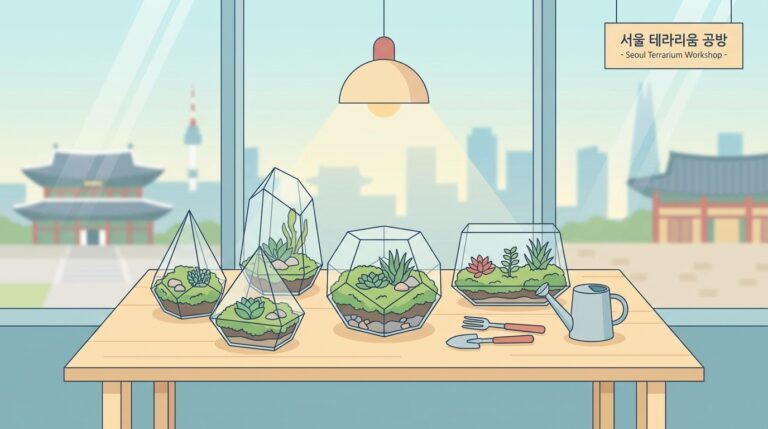
Have you ever stepped into a sun-dappled botanical studio tucked away in the trendy alleys of Seongsu-dong or Yeonnam-dong, captivated by the miniature glass worlds resting on wooden workbenches? In fast-paced urban Korea, the rise of the sik-jipsa (식집사, plant butler) subculture has turned terrarium DIY workshops into the ultimate form of weekend emotional healing, widely celebrated as pul-meong (풀멍, zoning out while gazing at lush greenery).
However, when you sit down with an artisan florist in Seoul, standard beginner phrases like “이거 예뻐요” (This is pretty) simply won’t capture the subtle artistry of your vision. Advanced learners often struggle to discuss spatial layering, soil drainage, and delicate moss placement without sounding overly academic or clumsily hesitant. Based on real feedback from seasoned learners attending one-day workshops across Korea, this C1-level masterclass will elevate your botanical Korean from basic transactional exchanges to eloquent, native-level design discourse.
Phase 2: Core Expressions for Terrarium Crafting
1. 배수층을 신경 써서 깔아주세요 (Baesucheung-eul singyeong sseoseo kkarajuseyo)
- Pronunciation: [Bae-su-cheung-eul sin-gyeong sseo-seo kka-ra-ju-se-yo] (Think: “Bae-soo-chung” like “bay soup chew-ng” with a crisp, rolling finish)
- Meaning: Literally: “Please lay down the drainage layer with care.” / Actual Nuance: “Make sure to establish a well-ventilated, thoroughly balanced drainage base.”
- K-Culture Moment: Frequently heard on lifestyle variety shows like I Live Alone (나 혼자 산다) whenever celebrities build closed biosystems or repot exotic houseplants.
- Editor’s Insight: The phrase 신경 쓰다 (to pay close attention / take care) paired with 깔다 (to lay/spread) demonstrates technical awareness of root rot prevention without sounding pedantic.
- Situation Spectrum: Casual ✅ | Semi-formal ✅ | Formal ⚠️
- 🤔 Think About It: How does Korean prioritize process-oriented verbs like 신경 써서 깔다 over merely stating “Add stones for drainage”?
2. 단차를 줘서 입체감을 살려볼게요 (Danchareul jwoseo ipchegameul sallyeobolgeyo)
- Pronunciation: [Dan-cha-reul jwo-seo ip-che-gam-eul sal-lyeo-bol-ge-yo] (Sounds like “Dahn-cha” followed by “ip-che-gahm”)
- Meaning: Literally: “I will give height differences to revive 3D feeling.” / Actual Nuance: “I’m going to create varied elevation to bring out depth and dimension.”
- K-Culture Moment: Used by interior designers and landscape architects on architectural YouTube channels such as Space Spack.
- Editor’s Insight: 단차 (step difference/elevation) is an advanced design term borrowed from architecture. Using it in gardening shows sophisticated spatial understanding.
- Situation Spectrum: Casual ✅ | Semi-formal ✅ | Formal ✅
- 🤔 Think About It: In your native tongue, do you describe plant styling in terms of “height variation” or dynamic architectural “elevation”?
3. 과습되지 않게 습도를 머금도록 조절해주세요 (Gwasupdoeji anke seupdoreul meogeumdorok jojeolhaejuseyo)
- Pronunciation: [Gwa-seup-doe-ji an-ke seup-do-reul meo-geum-do-rok jo-jeol-hae-ju-se-yo] (The “meo-geum” feels like gently holding water inside your mouth)
- Meaning: Literally: “Adjust so it holds humidity without becoming overwatered.” / Actual Nuance: “Balance the moisture retention so the terrarium stays humid without waterlogging the roots.”
- K-Culture Moment: Spoken during professional botanical masterclasses and floristry certification courses in Gangnam.
- Editor’s Insight: The poetic verb 머금다 (to gently hold/contain within) elevates the dialogue instantly from basic care instructions to mindful cultivation.
- Situation Spectrum: Casual ⚠️ | Semi-formal ✅ | Formal ✅
- 🤔 Think About It: Why does Korean botanical terminology often use poetic verbs of containment (머금다) to describe ecological balances?
Phase 3: Textbook Korean vs. Real Korean
Scenario 1: Discussing Aesthetic Spacing of Stones and Moss
- 📖 Textbook Korean: 식물과 돌을 균형 있게 배치하세요. (Sikmulgwa doreul gyunhyeong itge baechihaseyo. / Place the plants and stones in balance.)
- 🗣️ Real Korean: 여백의 미를 살려서 뒤쪽으로 갈수록 완만하게 경사를 줘보세요. (Yeobaegui mireul sallyeoseo dwijjogeuro galsurok wanmanhage gyeongsareul jwoboseyo. / Emphasize negative space and build a gentle slope toward the back.)
- 💡 Why the Difference? Native Korean designers emphasize traditional concepts like 여백의 미 (the beauty of empty space) and natural topography over rigid geometric symmetry.
Scenario 2: Asking About Terrarium Plant Acclimation
- 📖 Textbook Korean: 이 식물이 여기서 잘 자랄 수 있습니까? (I sikmuri yeogiseo jal jaral su itseumnikka? / Can this plant grow well here?)
- 🗣️ Real Korean: 밀폐형 용기인데 이끼랑 피토니아가 무르지 않고 잘 활착할까요? (Milpyehyeong yonggi-inde ikkirang pitoniaga mureuji anko jal hwalchakhalkkayo? / Since this is a closed container, will the moss and Fittonia establish roots well without rotting?)
- 💡 Why the Difference? Advanced plant hobbyists (식집사) specifically refer to container types (밀폐형 vs 개방형) and technical milestones like 활착 (root establishment/adaptation).
Phase 4: K-Culture Deep Dive & Non-Verbal Manners
4-1. Workshop Nunchi & Delicate Handling
When attending a Korean terrarium atelier, tweezers (핀셋) and long spatulas are your primary extensions of etiquette. Hold your tools lightly near the middle, and when asking an instructor for feedback, tilt your glass jar slightly toward them while supporting the base with both hands. Never plunge tools aggressively into the substrate; Korean instructors value slow, meditative movements, mirroring the calm ethos of pul-meong.
4-2. The “Planterior” Phenomenon in Korea
Living in high-rise apartments (아파트) has inspired generations of Koreans to bring nature indoors, coining the portmanteau 플랜테리어 (Plant + Interior). A terrarium is considered a self-sustaining microcosm reflecting the owner’s inner equilibrium. Crafting one isn’t just DIY—it is a serene form of self-care amidst the bustle of Seoul.
Phase 5: Real-Life Roleplay Scenario
Setting: Green Atelier, a sunlit botanical studio in Seongsu-dong filled with glass vessels and lush bryophytes.
Characters:
* Min-seo (민서): Experienced Terrarium Master & Florist
* You (학습자): A passionate plant enthusiast attending an advanced workshop
민서: “자, 먼저 유리 볼 바닥에 마사토랑 훈탄을 섞어서 배수층부터 잡아볼게요.”
(Ja, meonjeo yuri bol badage masatorang huntaneul seokkeoseo baesucheungbuteo jababolgeyo.)
“Alright, let’s start by mixing coarse sand and biochar at the bottom of the glass bowl to establish the drainage layer.”
🎭 Gently tilts a bag of volcanic grit toward you with an inviting smile.
You: “배수층은 대략 용기 높이의 몇 퍼센트 정도로 올리는 게 안정적인가요?”
(Baesucheungeun daeryak yonggi nopiui myeot peosenteu jeongdoro ollineun ge anjeongjeoingayo?)
“Roughly what percentage of the container’s height should the drainage layer occupy for stability?”
🎭 Holding the glass vessel up to eye level to assess the proportions.
민서: “보통 20% 정도가 적당해요. 그 위에 수태를 얇게 깔아 흙이 밑으로 쏟아지지 않게 막아주세요.”
(Botong isip-peosenteu jeongdoga jeokdanghaeyo. Geu wie suthaereul yalgge kkara heulgi miteuro ssodajiji anke magajuseyo.)
“About 20% is ideal. Place a thin layer of sphagnum moss over it to prevent the soil from falling through.”
🎭 Demonstrating the delicate pressing motion with wooden tweezers.
You: “네, 수태로 층 분리를 확실히 한 다음에 소일로 언덕 지형을 만들어볼게요.”
(Ne, suthero cheung bunrireul hwaksilhi han daeume so-illo eondeok jihyeongeul mandeureobolgeyo.)
“Understood. After cleanly separating the layers with moss, I’ll create a sloped mound using planting soil.”
🎭 Carefully layering the soil with a small stainless steel scoop.
민서: “좋아요! 뒷부분을 도톰하게 올려서 단차를 주면 훨씬 깊이감이 생겨요.”
(Joayo! Dwitbubu-neul dotomhage ollyeoseo danchareul jumyeon hwolssin gip-igami saenggyeoyo.)
“Great! Elevating the back section creates a far richer sense of depth.”
🎭 Nodding approvingly while examining your mound angle.
You: “피토니아는 포인트로 중앙에 배치하고, 주변은 비단이끼로 꼼꼼하게 식재해볼게요.”
(Pitoni-aneun pointeuro jung-ange baechihago, jubyeoneun bidan-ikkiro kkomkkomhage sikjaehaebolgeyo.)
“I’ll place the Fittonia in the center as a focal point and meticulously plant cushion moss around it.”
🎭 Gently tucking moss edges beneath decorative stones using fine-tipped tweezers.
민서: “손끝이 아주 섬세하시네요! 물뿌리개로 벽면을 타고 흐르듯 분무해주면 완성입니다.”
(Sonkkeuchi aju seomsehasi-neyo! Mulp 뿌ri-gaero byeongmyeoneul tago heureudeut bunmuhaejumyeon wanseong-imnida.)
“You have such a delicate touch! Spray water so it trickles down the inner glass wall, and you’re all set.”
🎭 Handing over a vintage brass mister.
You: “유리벽에 맺히는 결로 현상을 보면서 환기 주기를 맞추면 되겠죠?”
(Yuribyeoge maetchineun gyeollo hyeonsangeul bomyeonseo hwanggi jugireul matchumyeon doegetjyo?)
“I can time the ventilation cycles by observing the condensation on the glass walls, right?”
🎭 Spritzing gently while checking the seal of the cork lid.
🔀 Interactive Decision Point
How do you respond when the instructor asks if you want to add decorative miniature figurines (피규어) inside your terrarium?
- Option A: “자연스러운 돌과 이끼의 조화가 좋아서 피규어 없이 여백을 살려보고 싶어요.” (Best: Demonstrates aesthetic maturity and native-level design lexicon.)
- Option B: “안 넣어요. 싫어요.” (Bad: Abrupt and overly blunt, lacking polite nuance.)
- Option C: “피규어는 자연 파괴니까 절대 넣으면 안 되는 거 아닌가요?” (Risk: Offensively critical and misinterprets personal creative preferences.)
Phase 6: 10-Second Emotional Shadowing Drill
Practice these lines using the emotional markers and rhythm breaks (/):
[🌿 차분하고 집중된 어조 / Calm & Focused]
“배수층을 탄탄하게 깔아야 / 식물 뿌리가 썩지 않고 / 건강하게 자리 잡아요.”
(Baesucheungeul tantanhage kkaraya / sikmul ppuriga sseokji anko / geonganghage jari jabayo.)
“Only when the drainage base is solid / can the roots settle healthily / without rotting.”-
[✨ 감탄하며 섬세하게 / Delighted & Observant]
“뒤쪽에 완만하게 단차를 두니까 / 작은 유리병 안에서도 / 숲속 같은 입체감이 느껴지네요!”
(Dwitjjoge wanmanhage danchareul dunikka / jageun yuribyeong aneseodo / supsok gateun ipchegami neukkyeojineyo!)
“Because we created a gentle elevation in the back / even inside this tiny glass jar / it feels like a dimensional forest!”
Phase 7: K-Culture Mini Dictionary
-
식집사 (Sik-jipsa) | Noun
A portmanteau of 식물 (plant) and 집사 (butler/guardian). It playfully describes modern plant lovers who dedicate time and affection to caring for indoor foliage as if serving royalty. -
풀멍 (Pul-meong) | Noun / Slang
Derived from 풀 (grass/plants) and 멍때리다 (to zone out). Refers to the meditative, restorative act of clearing one’s mind while gazing silently at vibrant green botanicals. -
플랜테리어 (Planterior) | Noun
Combining Plant and Interior. A major design trend across urban Korean households and commercial spaces aimed at maximizing aesthetic greenery inside micro-apartments. -
활착 (Hwal-chak) | Noun (Technical / Gardening)
The biological process of transplanted flora successfully embedding roots and adapting stably to new soil conditions. Essential vocabulary for C1 terrarium and bonsai hobbyists.
Phase 8: Survival Kit for Travelers
Top 3 Workshop Survival Phrases
-
“테라리움 전용 흙이랑 수태 비율을 어떻게 맞출까요?”
(Terarium jeonyong heulg-irang suthae biyureul eotteoke matchulkkayo?)
Pro Tip: Use this to verify soil mixing ratios when handling specialized ferns or mosses. -
“유리병 안쪽에 습기가 너무 차면 뚜껑을 얼마나 열어둬야 하나요?”
(Yuribyeong anjjoge seupgiga neomu chamyeon ttukkeongeul eolmana yeoreodwoya hanayo?)
Pro Tip: Perfect for clarifying closed-terrarium maintenance protocols. -
“완성된 작품을 비행기나 대중교통으로 흔들림 없이 가져갈 포장이 가능할까요?”
(Wanseongdoen jakpumeul bihaenggina daejunggyotongeuro heundeullim eopsi gajyeogal pojangi ganeunghalkkayo?)
Pro Tip: Essential for ensuring fragile glass containers receive shock-absorbent packaging.
Editor’s Travel Note
- Planning to book an atelier workshop in Seoul? Use local platforms like Somssidang or search for classes on Naver using the phrase “원데이 클래스 테라리움”. Download the Naver Map App to easily navigate narrow workshop alleys in Yeonnam-dong and Seongsu-dong.
- If you want to purchase raw materials such as premium volcanic scoria, live mountain moss, or vintage glassware at wholesale rates, visit the underground botanical market at Yangjae Flower Market (양재꽃시장) near Yangjae Citizen’s Forest Station (Shinbundang Line).
Phase 9: Going One Step Deeper
In Korean traditional aesthetics, there is a profound admiration for 순리 (the natural order) and 무위자연 (uncontrived nature). Unlike Western formal gardens with razor-sharp geometric hedges, Korean garden philosophy strives to make human interventions look effortless—as if nature flourished that way on its own. Crafting a terrarium in Korea carries this same cultural legacy: rather than forcing moss into rigid patterns, one respects the contour of stones and the natural curvature of leaves.
💬 Your Turn: Have you ever attended a plant workshop or built a terrarium? What aspect of green interior design resonates most with your lifestyle? Share your thoughts below in Korean!
Phase 10: FAQ & Avoiding Misunderstandings
Q: Can I use everyday conversational Korean like “흙 좀 더 줘” in a workshop?
A: No. Even in casual one-day workshops, instructors appreciate polite semi-formal verb endings (해요체). Use “소일(흙) 조금만 더 주실 수 있나요?” to remain gracious and respectful.
Q: What is the difference between 이끼를 심다 and 이끼를 식재하다?
A: 심다 is the everyday general verb for planting. 식재하다 (植栽하다) is a Sino-Korean technical term meaning “to plant and landscape systematically.” Using 식재하다 immediately marks you as a knowledgeable C1 speaker.
Q: Why do Korean florists emphasize 훈탄 (carbonized rice hulls) in terrariums?
A: 훈탄 acts as an organic antimicrobial filter in closed glass biospheres, preventing foul odors and root rot in Korea’s humid summers.
🚨 Common Mistakes Warning Board
- Calling all moss 풀 (Grass): Moss is strictly 이끼 (Ikki). Calling cushion moss 풀 sounds unrefined.
- Saying 물을 많이 줘요 for closed jars: Closed terrariums recycle moisture via condensation. Use 과습을 방지하다 (prevent overwatering) rather than asking about frequent watering schedules.
- Confusing 배수 (Drainage) with 환기 (Ventilation): 배수 refers to liquid flow in the substrate; 환기 refers to air exchange through the lid.
Phase 11: Action Missions & Engagement
- 🥉 Bronze Mission (Self-Practice): Look at a houseplant or garden photo and record a 15-second voice memo describing its elevation using 단차 and 여백의 미.
- 🥈 Silver Mission (Social Connection): Post a photo of your favorite greenery on Instagram with the hashtag
#식집사and write one caption sentence using 머금다. - 🥇 Gold Mission (Real Life Execution): Visit a local flower shop or atelier in Korea and ask the master: “밀폐형 테라리움에 가장 잘 활착하는 이끼 종류가 무엇인가요?”
- 🎮 K-Culture Mission: Watch an episode of a Korean lifestyle vlog (like Kikyo or Onda) and note down three sensory adjectives used to describe home gardening.
Phase 12: Interactive Quiz Challenge
Test your mastery of advanced botanical Korean with these practical questions.
1. Fill-in-the-Blank:
“유리병 뒤쪽 흙을 높여서 ( )를 주면 훨씬 깊이감 있는 풍경이 연출됩니다.”
* A) 환기 (Hwanggi)
* B) 단차 (Dancha)
* C) 결로 (Gyeollo)
2. Situational Judgment:
Which phrase is the most natural and polite way to explain that you prefer an uncrowded, minimalist terrarium layout?
* A) “저는 복잡한 것보다 여백의 미를 살려서 심플하게 가고 싶어요.”
* B) “식물이 너무 많으면 못생겼으니까 다 빼주세요.”
* C) “흙만 넣고 아무것도 안 심는 게 제 취향입니다.”
3. True or False:
In Korean botanical terminology, 활착 refers to the artificial dyeing of moss for preservation purposes. (True / False)
🔍 Click here for answers and explanations
-
Answer: B) 단차 (Dancha)
Explanation: 단차 refers to step elevation or grade difference, creating visual depth in landscaping and terrarium design. -
Answer: A) “저는 복잡한 것보다 여백의 미를 살려서 심플하게 가고 싶어요.”
Explanation: Invoking 여백의 미 (beauty of empty space) conveys aesthetic elegance with native-level cultural nuance. -
Answer: False
Explanation: 활착 (Hwal-chak) refers to biological root establishment and stable acclimatization after planting, not artificial coloration.







