

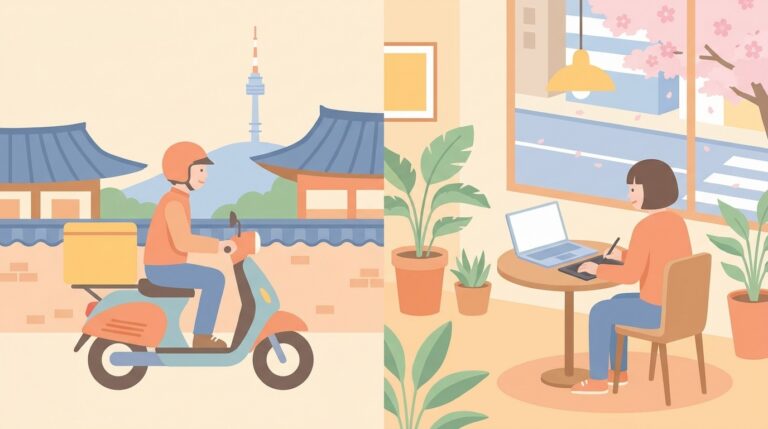
Phase 1: Empathy — Behind the Screen of Korea’s 24/7 Convenience
안녕하세요! 매일한글 에디터입니다. (Annyeonghaseyo! Hello, I’m your Daily Hangul Editor.)
Have you ever watched a late-night K-Drama scene where a tired delivery rider zooms past neon-lit Seoul streets, or read a hit K-Webtoon wondering how the artist survives brutal weekly deadlines? Today, millions of platform and gig workers—from delivery riders and couriers to designated drivers and IT freelancers—power South Korea’s hyper-fast economy. Yet many intermediate learners struggle to discuss their rights, contracts, and social safety nets beyond basic textbook vocabulary. Built from real learner feedback, this guide equips you with nuanced TOPIK Level 4 expressions to navigate Korea’s gig economy like a local!
Phase 2: Deep Dive Into 3 Core Expressions
1. 산재보험 적용을 받다 (Sanjaeboheom jeogyongeul batda — To be covered by industrial accident insurance)
- Pronunciation: San-jae-bo-heom jeo-gyong-eul bat-da (Think: Sahn-jeh-boh-hum juh-gyong-eul baht-dah, where eo sounds like the “u” in cup and bat ends softly without popping the “t”.)
- Meaning: Literally “to receive the application of industrial disaster insurance.” In practice, it means being legally eligible for medical and financial compensation if injured while working a gig.
- K-Culture Moment: In realistic Korean documentaries and news dramas covering delivery riders (baedal raideo) riding through monsoon rain, reporters frequently highlight whether injured riders can 산재보험 적용을 받다 (Sanjaeboheom jeogyongeul batda).
- Editor’s Insight: Intermediate learners often say boheomeul batda (to get insurance), which sounds like receiving a private payout. Using 적용을 받다 (jeogyongeul batda — to have a policy/law apply to you) immediately elevates your Korean to a sharp, news-literate Level 4 register, showing you understand institutional rights.
- Situation Spectrum: Casual (⚠️ slightly stiff among close friends) / Semi-formal (✅ natural in serious talks) / Formal (✅ ideal for news, workplaces, and legal consultations)
- 🤔 Think About It: In Korean, the word sanjae compresses “industrial” and “accident” into one urgent civic term. How does your native language distinguish between a traditional employee’s workplace injury and a gig worker’s accident on the road?
2. 표준계약서를 작성하다 (Pyojun-gyeyakseo-reul jakseonghada — To draw up a standard contract)
- Pronunciation: Pyo-jun-gye-yak-seo-reul jak-seong-ha-da (Think: Pyoh-joon-gyeh-yahk-suh-reul jahk-sung-hah-dah, keeping pyo smooth like “pure” without the “r”.)
- Meaning: Literally “to write a standard contract form.” It refers to signing a government-recommended fair contract that protects freelancers, webtoon artists, and IT contractors from unpaid work or sudden cancellations.
- K-Culture Moment: Behind-the-scenes stories of K-Webtoon creators and indie K-Pop producers often mention the relief of finally getting to 표준계약서를 작성하다 (Pyojun-gyeyakseo-reul jakseonghada) instead of relying on vague verbal promises.
- Editor’s Insight: Beginners use sseuda (to write) for everything, while Level 4 speakers choose 작성하다 (jakseonghada — to draft/fill out an official document). Knowing the synonym pair gyeyakeul maetda (to conclude a contract) alongside this phrase lets you talk smoothly about fair freelance negotiations.
- Situation Spectrum: Casual (⚠️ use gyeyakseo sseuda with buddies) / Semi-formal (✅ great with clients or fellow creators) / Formal (✅ standard in business and agencies)
- 🤔 Think About It: In Korea’s fast-paced creative and IT sectors, people used to trust verbal uiri (loyalty/good faith) over paperwork. Why do you think moving toward written standard contracts is transforming modern Korean work culture?
3. 정당한 대가를 요구하다 (Jeongdanghan daegareul yoguhada — To demand fair compensation)
- Pronunciation: Jeong-dang-han dae-ga-reul yo-gu-ha-da (Think: Jung-dahng-hahn deh-gah-reul yoh-goo-hah-dah, where ae sounds like the “e” in bed.)
- Meaning: Literally “to demand a rightful price/return.” In real life, it expresses standing up for fair pay, reasonable platform commission rates, or overtime compensation without sounding aggressive.
- K-Culture Moment: Just like the determined office and contract workers in classic workplace dramas such as Misaeng or Agency, platform workers and freelancers use this phrase in interviews and online communities when pushing back against unfair pay cuts.
- Editor’s Insight: Notice the difference between don (money) and 대가 (daega — compensation/due reward for effort). Daega carries moral weight—it implies you earned it through sweat and skill. Pairing it with 정당한 (jeongdanghan — rightful/just) makes your argument sound composed and persuasive rather than angry.
- Situation Spectrum: Casual (⚠️ a bit dramatic for splitting a dinner bill) / Semi-formal (✅ strong for serious career chats) / Formal (✅ powerful in negotiations, essays, and debates)
- 🤔 Think About It: Saying “give me more money” can feel awkward in both English and Korean, yet jeongdanghan daega frames pay as a matter of dignity and fairness. How do cultural norms in your country shape how freelancers ask for fair pay?
Phase 3: Textbook Korean vs. Real Korean
Situation 1: Explaining that you work as a freelancer or gig worker
- 📖 교과서 한국어 (Textbook Korean): “저는 플랫폼을 통해 자유롭게 일하는 프리랜서입니다.” (Jeoneun peullaetpomeul tonghae jayurobge ilhaneun peuriraenseoimnida. — “I am a freelancer who works freely through a platform.”)
- 🗣️ 진짜 한국어 (Real Korean): “요즘 플랫폼 쪽으로 프리 뛰고 있어요.” (Yojeum peullaetpom jjogeuro peuri ttwigo isseoyo. — “These days I’m hustling freelance gigs through platforms.”) OR “퇴근하고 투잡으로 배달 알바 뛰어요.” (Toegeunhago tujabeuro baedal alba ttwieoyo. — “After work, I run delivery gigs as a side hustle.”)
- 💡 왜 다를까? (Why is it different?): In everyday Korean, people shorten peuriraenseo to 프리 (peuri) and use the dynamic verb 뛰다 (ttwida — literally “to run”) to capture the hustle of jumping between gigs or working a tujab (two-job side hustle).
Situation 2: Complaining about high platform commission fees
- 📖 교과서 한국어 (Textbook Korean): “플랫폼 회사의 수수료가 너무 높아서 수익이 적습니다.” (Peullaetpom hoesaui susuryoga neomu nopaseo suigi jeokseumnida. — “Because the platform company’s fee is too high, my profit is small.”)
- 🗣️ 진짜 한국어 (Real Korean): “플랫폼 수수료 떼고 나면 남는 게 별로 없어요.” (Peullaetpom susuryo ttego namyeon namneun ge byeollo eopseoyo. — “Once the platform takes its cut, there’s barely anything left.”)
- 💡 왜 다를까? (Why is it different?): Natives use 떼다 (tteda — to detach/take a cut) rather than abstract nouns like suik (profit). Saying namneun ge eopda (nothing remains) feels vivid, relatable, and emotionally honest.
Phase 4: K-Culture Deep Dive & Non-Verbal Manners
4-1. Nunchi (눈치) & Gestures in the Gig Economy
Korea’s platform workers operate at lightning speed, and showing 눈치 (nunchi — social awareness) goes a long way:
* With Delivery Riders & Couriers (Baedal Gisa / Taekbae Gisa): Most deliveries happen contactless with the note “문 앞에 놓아주세요” (Mun ape nohajuseyo — “Please leave it by the door”). If you do meet them face-to-face, offer a quick head nod and say “수고하세요!” (Sugohaseyo! — “Thank you for your hard work!”) or leave a cold bottle of bottled water by the door in summer—a beloved small gesture of Korean jeong.
* With Designated Drivers (Daeri-unjeon Gisa): After a hoesik (company dinner), Koreans call a daeri driver to drive their own car home safely. Always hand over your car keys with two hands or a polite slight bow, and confirm the route calmly without backseat driving.
* With Freelance Clients: At café meetings in places like Gangnam or Pangyo (Korea’s Silicon Valley), freelancers bring a clean tablet or laptop, listen attentively before pitching rates, and follow up via KakaoTalk with a structured summary.
4-2. Cultural Code Analysis: K-Webtoons & Korea’s Ppalli-ppalli Speed
Have you ever wondered how Korea became the global capital of K-Webtoons (inspiring hit K-Dramas like Itaewon Class, All of Us Are Dead, and Solo Leveling) and 30-minute food delivery? Both are powered by Korea’s 빨리빨리 (ppalli-ppalli — hurry-hurry) culture. While audiences love seamless midnight chimaek (fried chicken and beer) deliveries and punctual weekly webtoon episodes, behind the scenes, creators and riders often shoulder intense physical and mental pressure. That is why recent Korean media, public debates, and labor movements increasingly spotlight mental health breaks, minimum-fee guarantees, and social safety nets for gig workers—turning invisible digital labor into a respected pillar of society.
Phase 5: Real-Life Roleplay Scenario
Setting: A cozy indie café near Hongdae, Seoul. Soft lo-fi music plays while rain taps against the window. Min-jun (민준), a veteran IT freelancer who used to do food delivery during college, is chatting over iced Americanos with Alex (알렉스), a foreign webtoon assistant navigating a new platform contract.
- Alex: 민준 씨, 이번에 새로 계약한 웹툰 플랫폼 조건이 좀 애매한 것 같아요. (Min-jun ssi, ibeone saero gyeyakhan weptun peullaetpom jogeoni jom aemaehan geot gatayo.) — “Min-jun, the terms for this new webtoon platform contract I signed seem a bit vague.”
🎭 Shows the contract PDF on a tablet with a worried frown. - Min-jun: 어, 잠깐만요. 혹시 표준계약서를 작성했어요? (Eo, jamkkanmanyo. Hoksi pyojun-gyeyakseo-reul jakseonghaesseoyo?) — “Oh, hold on. By any chance, did you draw up a standard contract?”
🎭 Leans forward and adjusts his glasses. - Alex: 아니요, 그냥 메신저로 원고료만 정하고 바로 시작했어요. (Aniyo, geunyang mesinjyeoro wongoryoman jeonghago baro sijakhaesseoyo.) — “No, we just decided the per-episode fee over messenger and started right away.”
🎭 Scratches the back of his neck awkwardly. - Min-jun: 아이고, 그러면 수정 요청이 계속 들어와도 추가 비용을 못 받을 수 있어요. (Aigo, geureomyeon sujeong yocheongi gyesok deureowado chuga biyongeul mot badeul su isseoyo.) — “Oh no, if you do that, even if revision requests keep coming in, you might not get paid extra.”
- Alex: 맞아요! 그리고 만약 일하다가 손목 터널 증후군 같은 게 생기면 산재보험 적용을 받을 수 있나요? (Majayo! Geurigo manyak ilhadaga sonmok teoneol jeunghugun gateun ge saenggimyeon sanjaeboheom jeogyongeul badeul su innayo?) — “Right! And if I develop something like carpal tunnel syndrome while working, can I be covered by industrial accident insurance?”
🎭 Gently rotates a sore wrist. - Min-jun: 요즘은 프리랜서나 플랫폼 노동자도 일정 요건을 갖추면 산재 가입이 가능해졌어요. (Yojeumeun peuriraenseona peullaetpom nodongjado iljeong yogeoneul gatchumyeon sanjae gaibi ganeunghaejyeosseoyo.) — “These days, even freelancers and platform workers can enroll in industrial accident insurance if they meet certain criteria.”
🎭 Nods reassuringly. - Alex: 다행이네요. 저도 눈치 보지 말고 정당한 대가를 요구해야겠어요. (Dahaengineyo. Jeodo nunchi boji malgo jeongdanghan daegareul yoguhaeyagesseoyo.) — “That’s a relief. I need to stop worrying about what others think and demand fair compensation.”
🎭 Sits up straight with newfound confidence. - Min-jun: 당연하죠! 계약 조건부터 다시 꼼꼼히 정리해서 정중하게 요청해 보세요. (Dangyeonhajyo! Gyeyak jogeonbuteo dasi kkomkkomhi jeongnihaeseo jeongjunghage yocheonghae boseyo.) — “Of course! Start by carefully organizing the contract terms and politely put in your request.”
🎭 Raises his iced coffee cup in a supportive cheers.
🔀 Interactive Branching Point: What should Alex send the platform PD next?
- Option A: “PD님, 원활한 연재를 위해 표준계약서 작성과 수정 횟수 명시를 정중히 요청드립니다.” (PD-nim, wonhwalhan yeonjaereul wihae pyojun-gyeyakseo jakseonggwa sujeong hoetsu myeongsireul jeongjunghi yocheongdeurimnida.) — “PD, for a smooth serialization, I politely request drafting a standard contract and specifying the number of revisions.”
- Feedback (Best ✅): Brilliant! Framing it around wonhwalhan yeonjae (smooth serialization) shows teamwork while firmly securing your legal protection.
- Option B: “이 조건 불공정하니까 당장 돈 더 안 주면 연재 중단할게요.” (I jogeon bulgongjeonghanikka dangjang don deo an jumyeon yeonjae jungdanhalgeyo.) — “These terms are unfair, so if you don’t pay more right away, I’ll stop the series.”
- Feedback (Bad 🚫): Way too confrontational for Korean business etiquette! Even when you are right, abrupt ultimatums burn bridges quickly.
- Option C: “그냥 주시는 대로 감사히 받겠습니다. 제가 더 열심히 할게요.” (Geunyang jusineun daero gamsahi batgetseumnida. Jega deo yeolsimhi halgeyo.) — “I’ll just gratefully take whatever you give me. I’ll work harder.”
- Feedback (Risk ⚠️): Polite, yes, but dangerous! In the gig economy, staying silent about vague terms often leads to burnout and unpaid revisions.
Phase 6: 10-Second Emotion Shadowing Drill
Read aloud at natural speed, pausing briefly at / and matching the emotion cue!
- [😤 Frustrated & Venting]
플랫폼 수수료 떼고 나면 / 솔직히 남는 게 / 하나도 없어요.
(Peullaetpom susuryo ttego namyeon / soljikhi namneun ge / hanado eopseoyo.)
“Once the platform takes its cut, / honestly there’s / nothing left at all.” -
[🤔 Serious & Curious]
혹시 / 플랫폼 노동자도 / 산재보험 적용을 / 받을 수 있나요?
(Hoksi / peullaetpom nodongjado / sanjaeboheom jeogyongeul / badeul su innayo?)
“By any chance, / can platform workers too / be covered by / industrial accident insurance?” -
[😊 Confident & Firm]
이제는 / 눈치 보지 말고 / 정당한 대가를 / 요구해야죠!
(Ijeneun / nunchi boji malgo / jeongdanghan daegareul / yoguhaeyajyo!)
“From now on, / without shrinking back, / we have to demand / fair compensation!”
Phase 7: K-Culture Mini Dictionary
- 대리운전 (Daeri-unjeon) | Designated driving service | When Koreans drink alcohol at dinner, they call a daeri driver via an app to drive their own car home safely. It is one of Korea’s largest night-time platform labor sectors.
- 특수고용직 (Teuksugoyongjik) | Special-type worker / Dependent contractor | Often shortened to teukgo in Korean news. It describes workers legally treated like independent business owners (couriers, delivery riders, golf caddies) who still depend heavily on one company or app.
- 플랫폼 수수료 (Peullaetpom susuryo) | Platform commission / service fee | The percentage or fee an app charges workers or small restaurants for matching orders. A hot topic in Korean business and labor news!
- 안전망 (Anjeongmang) | Safety net | Originally meaning a circus net, 사회적 안전망 (sahoejeok anjeongmang) refers to unemployment benefits, industrial accident insurance, and legal protections for gig workers.
Phase 8: Survival Kit for Travelers & Expats
Top 3 Survival Phrases
- 문 앞에 두고 벨 눌러주세요. (Mun ape dugo bel nulleojuseyo.) — “Please leave it at the door and ring the bell.”
- Pro Tip: Almost all delivery apps let you select this as a preset note so you don’t even have to answer the phone!
- 여기 안전하게 주차 부탁드립니다. (Yeogi anjeonhage jucha butakdeurimnida.) — “Please park safely right here.”
- Pro Tip: Essential when wrapping up a ride with a designated (daeri) driver late at night.
- 계약서 사본 하나 보내주실 수 있나요? (Gyeyakseo sabon hana bonaejusil su innayo?) — “Could you send me a copy of the contract?”
- Pro Tip: Never feel shy asking this when taking on freelance tutoring, translation, or design gigs in Korea.
Editor’s Travel & Living Note
- Mobility & Designated Drivers: When traveling or living in Korea, Download the Kakao T App for Taxis and Designated Drivers before you head out for dinner—you can pay smoothly via registered cards and track routes transparently.
- Labor Rights Help: If you work legally as a freelancer or platform worker in Korea and ever have questions about contracts or insurance, Check the Ministry of Employment and Labor Official Information or call the 1350 hotline (multilingual support available!).
- Payment Tip: Korea is virtually cashless for gig services. Setting up KakaoPay or Toss with your Korean bank account makes tipping, splitting rides, and paying couriers effortless.
Phase 9: “One Step Deeper” — From Pyeongsaeng Jikjang to the Gig Safety Net
For decades, South Korea’s economic miracle was built on the ideal of 평생직장 (pyeongsaeng jikjang)—a lifetime job at one company that acted like a second family, providing meals, bonuses, and stability. As millions of Koreans now shift toward digital platforms as riders, couriers, webtoon creators, and IT freelancers, the old company-centered model no longer fits everyone. Today, Korean society is actively wrestling with a profound question: how do we preserve the warmth of communal solidarity (상생 — sangsaeng, mutual thriving) inside an algorithm-driven economy? Expanding insurance and standard contracts for gig workers isn’t just legal reform—it’s Korea building a new kind of digital 안전망 (anjeongmang).
💬 Your Turn: How are delivery riders and freelancers treated in your home country—do they get health or accident insurance, or are they strictly on their own? Share your thoughts in the comments!
Phase 10: FAQ & Myth-Busting
Q: Are platform delivery riders in Korea considered regular company employees?
A: Usually no—many are classified as independent contractors or 특수고용직 (teuksugoyongjik) rather than salaried jeonggyujik (full-time regular employees). However, Korea has steadily expanded 고용보험 (goyongboheom — employment insurance) and 산재보험 (sanjaeboheom — industrial accident insurance) coverage so platform workers still receive key protections.
Q: Is it rude to ask a Korean client for a written contract when doing freelance work?
A: Not at all! While older generations sometimes relied on informal trust, modern Korean creators, developers, and agencies expect you to 표준계약서를 작성하다 (pyojun-gyeyakseo-reul jakseonghada). Asking politely shows professionalism, not distrust.
Q: Should I tip delivery riders or couriers in Korea?
A: Tipping is not mandatory in Korea because delivery fees are built into the app checkout. Instead, leaving a friendly five-star review, writing a warm thank-you note, or offering a cold drink on scorching summer days is the most appreciated gesture!
🚨 Common Mistakes Warning Board
- Mistake: Saying “돈 더 주세요” (Don deo juseyo — “Give me more money”) during a freelance rate negotiation.
- Correct Action: Use “정당한 대가” (jeongdanghan daega) or “단가 조정” (danga jojeong — rate adjustment) politely, e.g., “작업 범위에 맞춰 단가 조정이 가능할까요?” (“Could we adjust the rate to match the scope of work?”).
- Mistake: Confusing 배달 (baedal) (food/quick delivery) with 택배 (taekbae) (parcel courier delivery).
- Correct Action: Remember baedal is hot food or same-hour groceries via scooter, while taekbae is boxed online shopping deliveries arriving by truck.
- Mistake: Thinking “수고하세요” (Sugohaseyo) works for everyone, including elders or bosses.
- Correct Action: While widely said to delivery riders and couriers of similar or younger age, to older drivers or superiors use “고생 많으셨습니다” (Gosaeng maneusyeotseumnida — “Thank you for your hard work”) or “감사합니다” (Gamsahamnida).
Phase 11: Action Mission & Engagement
- 🥉 Bronze Mission (Solo Practice): Record yourself reading the 3 sentences in Phase 6’s 10-Second Emotion Shadowing Drill on your phone. Listen back—did you pause naturally at the
/marks? - 🥈 Silver Mission (Community Share): Post one phrase you learned today (like 정당한 대가를 요구하다) on your social media or study journal with an English sentence explaining why gig worker rights matter to you.
- 🥇 Gold Mission (Real-World Use): Next time you receive a package or order food in Korea (or at a Korean restaurant abroad), greet the courier warmly with a smile and “수고 많으셨습니다!” (Sugo maneusyeotseumnida!)—or practice negotiating a mock freelance term in Korean with your language partner!
- 🎮 K-Culture Mission: Watch an episode of a modern Korean workplace or slice-of-life K-Drama (or browse a popular Korean webtoon about daily life) and spot how characters talk about alba (part-time gigs), baedal, or gyeyakseo (contracts). Note down one new collocation you hear!
Phase 12: Interactive Quiz Challenge
Quiz 1 (Situational Judgment): You just finished illustrating a freelance banner for a Korean start-up, and the manager keeps asking for five extra unpaid edits. Which response is best?
A) 아무 말도 안 하고 밤새 수정한다.
B) “계약서에 명시된 수정 횟수를 넘어서 추가 비용 협의가 필요합니다.”
C) “진짜 너무하시네요. 다신 연락하지 마세요.”
Click to reveal Answer & Explanation for Quiz 1
Correct Answer: B
* Why B works: Saying “계약서에 명시된 수정 횟수를 넘어서 추가 비용 협의가 필요합니다” (“Since this exceeds the revision count stated in the contract, we need to discuss an additional fee”) is calm, professional, and protects your rights.
* Why A & C fail: A leads to unpaid burnout, while C burns your professional reputation.
Quiz 2 (Fill in the Blank): Complete the natural Korean sentence:
“플랫폼 ____ 떼고 나면 남는 게 별로 없어요.” (Once the platform takes its commission fee, there’s barely anything left.)
Click to reveal Answer & Explanation for Quiz 2
Correct Answer: 수수료 (susuryo)
* Explanation: 수수료 (susuryo) means “commission” or “service fee,” and pairing it with 떼다 (tteda — to take a cut) is how native Koreans talk naturally about platform fees.
Quiz 3 (True / False Cultural Quiz):
In Korea, 대리운전 (daeri-unjeon) means hiring a taxi driver to take your friends home while you drive your own car.
Click to reveal Answer & Explanation for Quiz 3
Correct Answer: False!
* Explanation: Daeri-unjeon means a licensed designated driver comes to you and drives your own car home safely—usually when you’ve had a drink at a hoesik (company dinner) or gathering!
🎬 Watch Our Daily Videos! (Daily Hangul Official Instagram)
Review the expressions you learned in this article with our fun daily short videos! Check out native pronunciation and real-life nuances in action.
- Instagram @dailyhangul_en







