

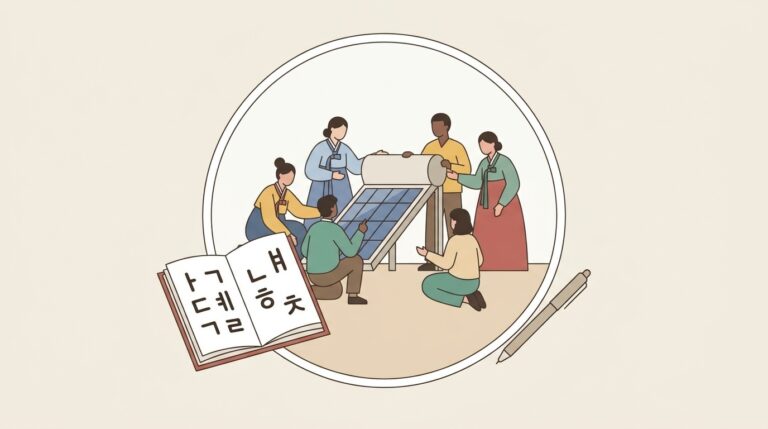
Mastering Advanced Korean in International Development (ODA): The Art of Localizing Appropriate Technology
Phase 1: Empathy & Immersion (The Field Reality of K-ODA)
안녕하세요! 매일한글 에디터입니다! (Hello! It’s your Daily Hangul editor!)
Picture this: You are sitting in an airy conference room in Seongnam at the KOICA (Korea International Cooperation Agency) headquarters, or perhaps inside a field research tent in Southeast Asia surrounded by prototype solar-powered water filtration kits and local ceramic kilns. You are tasked with presenting a breakthrough in 적정 기술(Appropriate Technology). You have spent weeks analyzing soil conditions, supply chains, and community habits.
However, when pitching your localization framework to senior Korean directors and international stakeholders, you find yourself stumbling over overly textbook terms like “기술을 바꿉니다” (We change the technology) or textbook-stiff phrases that fail to capture the delicate socio-technical nuances of sustainable community empowerment. In high-stakes international cooperation (ODA), language is not just a tool for sharing data—it is a diplomatic bridge that demonstrates deep cultural respect, sustainability ethos, and collaborative humility.
Today, we are diving into advanced C2-level Korean for International Development Cooperation & Appropriate Technology Localization. Whether you are drafting project proposals, negotiating technology transfers, or discussing field-tested innovations on a K-Development podcast, this masterclass will elevate your discourse from mere fluency to refined executive-level eloquence. Let’s make your Korean as resilient, adaptive, and impactful as the appropriate technologies you champion!
Phase 2: Core Expressions Deep Dive (C2 Level)
Here are three indispensable, highly sophisticated expressions used by top-tier Korean development practitioners, policy analysts, and social innovators.
1. 현장의 목소리를 수렴하여 맞춤형 기술로 안착시키다 (Hyeonjang-ui moksorireul suryeomhayeo matchumhyeong gisullo anchaksikida)
- Pronunciation: Hyeon-jang-ui mok-so-ri-reul su-ryeom-ha-yeo mat-chum-hyeong gi-sul-lo an-chak-si-ki-da (Think of the rhythm as flowing like a river: Hyeon-jang sounds like ‘hyon-jahng’, and an-chak hits firmly like landing a spacecraft smoothly onto ground).
- Meaning:
- Literal: To gather the voice of the field and settle it as a customized technology.
- Nuanced C2 Context: “To actively assimilate grassroots community feedback, ensuring the indigenization and sustainable integration of tailored technology.”
- K-Culture Moment: Frequently heard in high-level investigative documentaries (such as KBS Sisa Window or EBS DocuPrime) when evaluating why a water-purifying pump project succeeded by respecting traditional village pottery methods rather than imposing foreign machinery.
- Editor’s Insight: The verb 안착시키다 (anchaksikida) originates from aerospace/aviation (soft-landing), but in business and ODA, it signifies seamless, conflict-free adoption into a local socio-economic fabric.
- Situation Spectrum:
- Casual: 🚫 (Too heavy for ordering coffee)
- Semi-formal: ⚠️ (Use when discussing serious project ideas with colleagues)
- Formal / Diplomatic: ✅ (The golden standard for debriefings, papers, and executive pitches)
- 🤔 Think About It: In English development discourse, we often say “stakeholder engagement.” How does the Korean metaphor of gathering voices (목소리를 수렴하다) convey a more attentive, humble listening stance?
2. 탁상공론을 지양하고 자생적 생태계를 조성하다 (Taksanggongroneul jiyanghago jasaengjeok saengtaegyereul joseonghada)
- Pronunciation: Tak-sang-gong-ro-neul ji-yang-ha-go ja-saeng-jeok saeng-tae-gye-reul jo-seong-ha-da (Be careful with ji-yang [avoid/eschew] vs ji-hyang [aim toward]—a classic trap even for advanced learners!).
- Meaning:
- Literal: To eschew desk-bound hollow debates and construct a self-sustaining ecosystem.
- Nuanced C2 Context: “To steer clear of armchair policymaking in favor of fostering a self-reliant, sustainable local ecosystem.”
- K-Culture Moment: Echoed in corporate-diplomatic dramas like Misaeng (Incomplete Life) or Search: WWW when visionary leaders reject detached headquarter directives to build enduring field operations.
- Editor’s Insight: 자생적 (Jasaengjeok) implies that the community can maintain, repair, and reproduce the appropriate technology on its own long after foreign aid specialists depart.
- Situation Spectrum:
- Casual: 🚫
- Semi-formal: ⚠️
- Formal / Diplomatic: ✅
- 🤔 Think About It: Why does Korean ODA philosophy place immense weight on “자립 (self-reliance)” and “자생 (self-generation)”? Consider Korea’s own post-war transition from an aid recipient to an OECD DAC donor.
3. 공여국과 수혜국의 경계를 허무는 상생의 패러다임 (Gong-yeoguk-gwa suhyeguk-ui gyeong-gyereul heomuneun sangsaeng-ui paereodaim)
- Pronunciation: Gong-yeo-guk-gwa su-hye-guk-ui gyeong-gye-reul heo-mu-neun sang-saeng-ui pae-reo-da-im (Gong-yeo sounds like ‘gong-yaw’, smoothly blending into su-hye).
- Meaning:
- Literal: A paradigm of co-prosperity that breaks down the boundaries between donor and recipient nations.
- Nuanced C2 Context: “A reciprocal paradigm shift that transcends the paternalistic donor-recipient dichotomy, pursuing genuine mutual empowerment.”
- K-Culture Moment: A keynote staple at the World NGO Forum or Seoul ODA International Conference speeches.
- Editor’s Insight: The Sino-Korean word 상생 (Sangsaeng – 相生) embodies living together in synergistic balance. It strips away top-down condescension.
- Situation Spectrum:
- Casual: 🚫
- Semi-formal: ⚠️
- Formal / Diplomatic: ✅
- 🤔 Think About It: How does framing international assistance as 상생 (mutual thriving) rather than 원조 (unilateral aid) transform negotiation power dynamics?
Phase 3: Textbook Korean vs. Real Korean (C2 Level Polish)
At the C2 level, natural speech is not about using street slang, but knowing how top professionals fluidly distill complex diplomatic concepts without sounding robotic.
Situation 1: Explaining why an imported technology must be altered for local resources
- 📖 교과서 한국어 (Textbook Korean):
- 현지 재료를 사용해서 기술을 다시 고쳐야 성공할 수 있습니다.
(Hyeonji jaeryoreul sayonghaeseo gisureul dasi gochyeoya seonggonghal su itseumnida. – “We must fix the technology again using local materials to succeed.”)
- 현지 재료를 사용해서 기술을 다시 고쳐야 성공할 수 있습니다.
- 🗣️ 진짜 한국어 (Real C2 Professional Korean):
- 현지 조달 가능한 자재를 기반으로 기술의 토착화를 이뤄내야 지속 가능성이 담보됩니다.
(Hyeonji jodal ganeunghan jajaereul gibaneuro gisului tochakhwareul irwonaeya jisok ganeungseongi dambodoemnida. – “True sustainability is guaranteed only when we achieve the indigenization of technology grounded in locally procurable materials.”)
- 현지 조달 가능한 자재를 기반으로 기술의 토착화를 이뤄내야 지속 가능성이 담보됩니다.
- 💡 왜 다를까? (Why the difference?):
Textbook Korean uses basic verbs like ‘고치다 (to fix)’. Sophisticated Korean utilizes conceptually precise terms like 토착화 (indigenization) and 담보되다 (to be secured/guaranteed), which project project-management authority.
Situation 2: Criticizing a failed project that ignored community habits
- 📖 교과서 한국어 (Textbook Korean):
- 주민들의 생활 습관을 생각하지 않고 기술만 주어서 실패했습니다.
(Jumindeului saenghwal seupgwaneul saenggakhaji anko gisulman jueoseo silpaehaetseumnida. – “It failed because they gave only technology without thinking of the residents’ habits.”)
- 주민들의 생활 습관을 생각하지 않고 기술만 주어서 실패했습니다.
- 🗣️ 진짜 한국어 (Real C2 Professional Korean):
- 주민들의 생활 양식과 괴리된 일방적 기술 보급이 초래한 구조적 한계였습니다.
(Jumindeului saenghwal yangsikgwa goeridoen ilbangjeok gisul bogeubi choraehan gujojeok hangyeyeosseumnida. – “It was a structural limitation brought about by unilateral technological dissemination alienated from the residents’ cultural lifestyle.”)
- 주민들의 생활 양식과 괴리된 일방적 기술 보급이 초래한 구조적 한계였습니다.
- 💡 왜 다를까? (Why the difference?):
The phrase 괴리되다 (to be divorced/estranged from) and 초래하다 (to bring about/cause a systemic issue) articulate causality with intellectual precision.
Phase 4: K-Culture Deep Dive & Non-Verbal Manners
4-1. Nunchi & Professional Demeanor in ODA Consultations
When presenting technical innovations to Korean ODA executives or community elders in field offices:
* 경청(Active Attentive Listening) with Both Hands: When holding project blueprints or passing tablets displaying field telemetry, always hold them with both hands (두 손으로 공손히).
* The Head-Nodding Cadence (고개 끄덕임과 추임새): Avoid flat silences. Use subdued, respectful vocal nods such as “네, 말씀하신 맥락을 십분 공감합니다” (Yes, I fully empathize with the context you mentioned) rather than an abrupt “알겠습니다”.
* Eye Contact & Modesty: In Korean professional culture, fierce unblinking eye contact during critique can be interpreted as confrontational. Soften your gaze toward the upper lapel/collarbone area when receiving rigorous field performance critiques.
4-2. Cultural Code Analysis: The Spirit of ‘Pumasi’ (품앗이) in Modern Appropriate Tech
Traditional Korean agrarian society thrived on 품앗이 (Pumasi)—communal labor exchange where mutual aid was not charity, but a cyclical social contract. Modern Korean appropriate technology initiatives (such as G-Saver heat-retaining stoves or water filtration bikes) succeed globally because they mirror this exact cultural DNA: empowering local artisans to lead maintenance and assembly rather than turning them into dependent recipients.
Phase 5: Live Roleplay Scenario (High-Level Policy Debrief)
Setting: The Strategic Evaluation Boardroom at an ODA Center in Gwanghwamun, Seoul.
Characters:
– 박민우 부장 (Director Park Min-woo): Veteran KOICA project director, sharp analytical mind, deeply dedicated to field viability.
– You (Senior Development Specialist): Leading the localization pilot of an off-grid solar biosensor unit.
Turn 1
* 박민우 부장: 🎭 (안경을 고쳐 쓰며 보고서를 응시한다 / Adjusting his glasses, peering closely at the report)
이번 동남아 농촌 지역 정수 모듈 사업, 현지 부품 조달률이 85%까지 올라왔군요. 하지만 여전히 초기 보급 단계에서 주민들의 거부감이 감지된다는 평가가 있습니다. 원인이 뭡니까?
(Ibeon dongnama nongchon jiyeok jeongsu modyul saeop, hyeonji bupum jodalryuri palsipsipopeosenteukkaji ollawatgunyo. Hajiman yeojeonhi chogi bogeup dangyeseo jumindeului geobugami gamjidoendaneun pyeong-gaga itseumnida. Wonini mwomnikka?)
“The local component procurement rate for this Southeast Asian rural water purification module reached 85%. However, evaluations indicate there is still community resistance during early deployment. What is the root cause?”
Turn 2
* You: 🎭 (차분하게 태블릿의 현장 인터뷰 자료를 화면에 띄우며 / Calmly displaying field interview footage on the monitor)
기계적 성능의 문제가 아니라, 현지 주민들의 수로 이용 관습과 충돌했기 때문입니다. 기술의 일방적 주입보다는 그들의 전통적 물 관리 질서를 포용하는 미세 조정이 필요했습니다.
(Ggyejeok seongneungui munjega anira, hyeonji jumindeului suro iyong gwanseupgwa chungdolhaetgi ttaemunimnida. Gisului ilbangjeok ju-ipbodaneun geodeului jeontongjeok mul gwanri jilsoreul poyonghaneun mise jojeongi piryohaetseumnida.)
“It was not a mechanical failure, but a friction with the traditional canal usage customs of the villagers. Rather than a unilateral imposition of tech, we needed micro-calibrations embracing their traditional water management ethos.”
Turn 3
* 박민우 부장: 🎭 (흥미를 보이며 펜을 내려놓는다 / Showing genuine interest, setting down his pen)
전통적 관습의 포용이라… 구체적으로 어떤 방식으로 접근했습니까? 단순한 설득만으로는 한계가 있었을 텐데요.
(Jeontongjeok gwanseupui poyong-ira… Guchejeoguro eotteon bangsigeuro jeopgeunhaetseumnikka? Dansunhan seoldeukmaneuroneun hangyega isseosseul tendeyo.)
“Embracing traditional customs… How did you approach this concretely? Mere persuasion wouldn’t have sufficed.”
Turn 4
* You: 🎭 (현지 목공 장인들과의 협업 사진을 가리키며 / Pointing to photos of collaboration with local carpenters)
마을 원로들과 목공 장인들을 기술 개발 초기 공정에 파트너로 참여시켰습니다. 외형을 현지 대나무 바구니 공예 구조와 결합하여 심리적 진입 장벽을 대폭 낮췄습니다.
(Maeul weonrodeulgwa mokgong jangingdeureul gisul gaebal chogi gongjeonge pateuneoro cham-yeosikyeotseumnida. Oehyeong-eul hyeonji daenamu baguni gong-ye gujowa gyeolhapayeo simrijeok jin-ip jangbyeog-eul daepok natchwotseumnida.)
“We invited village elders and master carpenters as co-design partners early in the development cycle. By fusing the exterior casing with local bamboo weaving crafts, we dramatically lowered psychological barriers.”
Turn 5
* 박민우 부장: 🎭 (고개를 끄덕이며 엷은 미소를 짓는다 / Nodding with a subtle, impressed smile)
탁상공론을 탈피한 훌륭한 접근이군요. 그렇다면 사후 유지보수(O&M)를 위한 자생적 수익 모델은 어떻게 설계되었습니까?
(Taksanggongroneul talpihan hullyunghan jeopgeun-igunyo. Geureotdamyeon sahu yujibosu-reul wihan jasaengjeok su-ik modyeoreun eotteoke seolgyedoeeotseumnikka?)
“An excellent approach that breaks away from armchair theories. In that case, how did you design the self-sustaining revenue model for ongoing Operations & Maintenance (O&M)?”
Turn 6
* You: 🎭 (수익 순환 도표를 명확하게 짚으며 / Firmly tracing the economic circular diagram)
청년 자치 조직에 수리 기술을 전수하고, 잉여 정수 판매 수익이 마을 공동 기금으로 환원되는 선순환 생태계를 구축했습니다.
(Cheongnyeon jachi jojige suri gisureul jeonsuhago, ing-yeo jeongsu panmae su-igi maeul gongdong gigeumeuro hwanwondoeneun seonsunhwan saengtae-gyereul guchukhaetseumnida.)
“We transferred repair expertise to the youth cooperative and established a virtuous cycle where surplus clean water sales are reinvested directly into the community fund.”
Turn 7
* 박민우 부장: 🎭 (서류에 결재 사인을 하며 / Signing his approval on the project dossier)
단순 원조를 넘어선 진정한 상생의 롤모델이 될 수 있겠군요. 이 프레임워크를 다른 거점 프로젝트에도 표준 매뉴얼로 확장 적용합시다.
(Dansun wonjoreul neomeoseon jinjeonghan sangsaeng-ui rolmodyeri doel su itgetgunyo. I peureim-wokeureul dareun geojeom peurojekteuedo pyojun maenyueollo hwakjang jeok-yonghapsida.)
“This has the potential to become a true benchmark of mutual coexistence that transcends simple aid. Let’s scale and standardize this framework across our other hub projects.”
Turn 8
* You: 🎭 (정중하게 목례하며 / Bowing respectfully with confidence)
감사합니다. 현장 실무진들과 긴밀히 공조하여 기술의 완전한 현지 안착을 끝까지 책임지겠습니다.
(Gamsahamnida. Hyeonjang silmujindeulgwa ginmilhi gongjohayeo gisului wanjeonhan hyeonji anchageul kkeutkkaji chaegimjigetseumnida.)
“Thank you, Director. Working in close coordination with the field teams, I will ensure complete, enduring indigenization through to the end.”
🔀 Interactive Decision Point
How would you answer if Director Park asks: “현지 협력 기관과의 소통 과정에서 갈등이 생기면 어떻게 대처하시겠습니까?” (How will you handle conflict if communication stalls with local partner institutions?)
- Choice A (Best Action):
“일방적 중재보다는 현지 거버넌스의 자율성을 존중하며, 공동 문제 해결 워크숍을 통해 접점을 도출하겠습니다.”
(Feedback: 🌟 Outstanding C2 response! Emphasizes mutual governance and cooperative problem-solving without patronizing). - Choice B (Bad Action):
“우리가 자금을 지원하는 입장이니 KOICA 규정대로 따르라고 강하게 요구하겠습니다.”
(Feedback: ❌ Fatal mistake! Reflects paternalistic, archaic donor mentalities that destroy collaborative ODA relations). - Choice C (Risk Action):
“시간이 지나면 자연스럽게 해결될 테니 현장 매니저의 판단에 전적으로 맡기겠습니다.”
(Feedback: ⚠️ Too passive. Signals a lack of accountability and strategic mediation).
Phase 6: 10-Second Emotion Shadowing Drill
Imitate the exact intonation, pauses (/), and emotional depth of an international cooperation strategist.
[🌱 진정성 있고 설득력 있게 - With sincere conviction]
현지 조달 자재를 활용하여 / 기술의 토착화를 달성할 때, / 진정한 지속 가능성이 / 확보됩니다.
(Hyeonji jodal jajaereul hwalyonghayeo / gisului tochakhwareul dalseonghal ttae, / jinjeonghan jisok ganeungseongi / hwakbodoemnida.)-
[🤝 상생의 철학을 담아 격조 높게 - With noble collaborative dignity]
우리의 목표는 단순 원조가 아니라, / 수혜국과 함께 성장하는 / 자생적 경제 생태계의 / 완성입니다.
(Uriui mokpyoneun dansun wonjoga anira, / suhyegukgwa hamkke seongjanghaneun / jasaengjeok gyeongje saengtaegyeui / wanseong-imnida.) -
[💼 프로페셔널하고 단호하게 - Professional, measured, and decisive]
탁상공론식 설계를 지양하고 / 현장 거버넌스와의 긴밀한 공조를 통해 / 리스크를 선제적으로 통제하겠습니다.
(Taksanggongronsik seolgyereul jiyanghago / hyeonjang geobeoneonseuwaui ginmilhan gongjoreul tonghae / riseukeureul seonjejeogeuro tongjehagetsuumnida.)
Phase 7: K-Culture Mini Dictionary
| Term (한글 + Romanization) | Diplomatic & ODA Meaning | Real-World Context Insight |
|---|---|---|
| 1. 적정기술 (Jeokjeong gisul) | Appropriate Technology | Technology tailored to the environmental, cultural, and economic conditions of a specific community without exorbitant maintenance costs. |
| 2. 공적개발원조 (Gongjeok gaebal wonjo) | Official Development Assistance (ODA) | Government-backed developmental grants, loans, and technical transfers aimed at sustainable welfare and economic growth. |
| 3. 상생협력 (Sangsaeng hyeomnyeok) | Mutual Co-prosperity & Cooperation | Partnership where both sides learn, co-create value, and benefit symmetrically rather than hierarchically. |
| 4. 토착화 (Tochakhwa) | Indigenization / Rooting | The comprehensive process of transplanting an innovation until it thrives independently using native knowledge and resources. |
Phase 8: Field Practitioner’s Survival Kit
Top 3 Executive Communication Lines
- “현장 실사를 거쳐 타당성 조사를 재검토하겠습니다.”
(Hyeonjang silsareul geocheo tadangseong josareul jaegeomtohagetsuumnida.)
Pro Tip: Use this when you want to pause hasty project approvals and demand empirical ground-truthing. - “이해관계자 간의 다각적 이해관계를 조율하는 협의체를 구성합시다.”
(Ihaegwangyeja ganui dagakjeok ihaegwangyereul joyulhaneun hyeob-uichereul guseonghapsida.)
Pro Tip: Essential for bringing diverse NGOs, local governments, and engineers to one round table. - “사후 모니터링 체계를 제도화하여 기술의 자생력을 담보해야 합니다.”
(Sahu moniteoring chegyereul jedohwahayeo gisului jasaengryeog-eul dambohaeya hamnida.)
Pro Tip: Demonstrates that you are planning 5–10 years ahead, not just until the grant end-date.
Editor’s Field Note for Korea-Based Research & Travel
- Essential App Reference: When conducting research or field benchmarking trips across Korean regional eco-parks and green tech hubs, install the 네이버 지도 앱 다운로드 to navigate intercity express bus terminals and eco-innovative rural trial zones.
- Meeting Protocol: When visiting development institutions like the KOICA Development Cooperation History Museum or Global Green Growth Institute (GGGI) in Seoul, business cards (명함) should always be received with both hands and placed neatly on the table in front of you throughout the meeting—never shoved directly into a pocket.
Phase 9: “One Step Deeper” (인문학적 사색: From Aid Recipient to Global Partner)
In 1953, in the ashes of the Korean War, South Korea was one of the most impoverished, aid-dependent societies in the world, receiving emergency relief flour, cement, and medical supplies under international ODA programs. Within six decades, Korea became the first nation to transition from a recipient country (수혜국) to a prominent member of the OECD Development Assistance Committee (공여국).
Because of this collective historical memory, Korean development cooperation is infused with a deep cultural concept: 동병상련 (Dongbyeongsangryeon – mutual empathy born of shared suffering). When Korean engineers and social entrepreneurs design appropriate technologies today, the underlying philosophical impulse is not condescending charity, but solidarity—believing that local communities carry their own latent genius for self-transformation.
💬 Your Turn: How does your home country approach international development and appropriate technology? Does your language have a concept comparable to 상생 (Sangsaeng)? Let me know in the comments below!
Phase 10: FAQ & Common Mistakes
Q: What is the crucial difference between ‘지양하다’ (Jiyanghada) and ‘지향하다’ (Jihyanghada)?
A: These two words sound almost identical to non-native ears but mean exact opposites!
* 지양하다 (止揚하다 – Jiyanghada): To avoid, reject, or transcend a negative practice (e.g., 탁상공론을 지양하다 = avoid armchair talk).
* 지향하다 (志向하다 – Jihyanghada): To pursue, aim toward, or aspire to an ideal (e.g., 친환경 가치를 지향하다 = pursue eco-friendly values). Mixing these up in an executive presentation completely inverts your strategy!
Q: Can I use ‘원조’ (Wonjo) casually when talking with partner communities?
A: While ‘원조 (Aid/Assistance)’ is a legitimate technical term in ODA, using it repeatedly in interpersonal field meetings can sound paternalistic. Advanced practitioners prefer 협력 (Cooperation), 상생 파트너십 (Win-win Partnership), or 기술 나눔 (Technology Sharing).
Q: How do I politely push back against a Korean director’s top-down proposal?
A: Use the high-level consultative buffer pattern: “부장님의 혜안에 깊이 공감합니다만, 현장 수용성을 극대화하기 위해 [대안]을 병행 검토하는 것은 어떻겠습니까?” (I deeply understand your strategic vision; however, to maximize local receptivity, could we concurrently examine [alternative]?).
🚨 흔한 실수 (Common Mistakes) TOP 3
- Mistake: Saying “기술을 가르쳐 주다” (To teach technology to them).
- Correct Action: Use “기술을 전수하다” (To transfer/share expertise) or “역량을 강화하다” (To build capacity).
- Mistake: Mixing up 수혜자 (Beneficiary) with 기부자 (Donor) in reports.
- Correct Action: Clearly distinguish 공여 주체 (Donor entity), 수행 기관 (Implementing agency), and 현지 주민/협력 주체 (Local community/Cooperative entity).
- Mistake: Pronouncing 효과성 (Effectiveness) as flat hyo-gwa-seong.
- Correct Action: Pronounce with fortified tensification: [효꽈성 / Hyo-kkwa-seong] for authentic executive diction.
Phase 11: Action Mission & Engagement
- 🥉 Bronze Mission (Solo Practice): Record yourself reading the 3 Shadowing Drill sentences in Phase 6. Listen closely to your pauses and ensure crisp distinction between 지양 and 지향.
- 🥈 Silver Mission (Community Sharing): Write a 3-sentence summary on social media or in our comment section below explaining an appropriate technology case using the words 토착화, 자생력, and 상생.
- 🥇 Gold Mission (Live Application): In your next academic seminar, professional webinar, or Korean conversation exchange, pitch a project idea using the phrase: “탁상공론을 지양하고 현장 밀착형 솔루션을 도출해야 합니다.”
- 🎮 K-Culture Mission: Watch an episode of a Korean documentary covering global social enterprises or KOICA world volunteers, and spot at least two instances where they talk about 주민 자립 (community independence).
Phase 12: Interactive Quiz Challenge
Test your mastery of C2-level development vocabulary and professional situational judgment!
1. Situation Judgment Quiz
During a formal symposium on appropriate technology, you want to state that a solar stove project failed because the organizers did not listen to the women who actually cook in the village. Which phrase is the most sophisticated?
* (A) 여자들이 요리하는 것을 안 봐서 망했습니다.
* (B) 실사용자의 생활 패턴을 간과한 공급자 중심의 설계가 실패의 주원인이었습니다.
* (C) 밥 짓는 법을 다시 가르치지 않아서 효과가 없었습니다.
2. Fill-in-the-Blank Quiz
Complete the sentence with the appropriate Sino-Korean idiom pair:
원조 기관의 일방적 지원을 ( _______ )하고, 지역사회의 지속 가능한 ( _______ ) 생태계를 구축해야 한다.
(We must eschew unilateral donor aid and construct a self-sustaining local ecosystem.)
3. True / False Cultural Insight
True or False: In advanced Korean ODA diplomacy, the term 상생 (Sangsaeng) refers strictly to financial profit distribution between two private corporations.
👉 Click to reveal answers & explanations!
Quiz Explanations
- Answer: (B)
- Explanation: (B) utilizes immaculate C2 terminology—실사용자 (end-user), 간과하다 (to overlook), and 공급자 중심 (supplier-centric)—delivering a razor-sharp, professional diagnostic critique without sounding crude.
- Answer: 지양(止揚) / 자생적(自生的)
- Explanation: 지양하다 means to eschew/avoid, and 자생적 means self-generating/self-reliant.
- Answer: False
- Explanation: 상생 is a deep philosophical term rooted in co-prosperity, mutual elevation, and harmonious coexistence, widely utilized across civic, environmental, and international development spheres.
- Explanation: 상생 is a deep philosophical term rooted in co-prosperity, mutual elevation, and harmonious coexistence, widely utilized across civic, environmental, and international development spheres.
Keep pushing the boundaries of your Korean language journey. Remember, when you master the language of international cooperation, you are not just learning vocabulary—you are learning how to build global empathy and lasting change! 오늘도 매일한글과 함께 한 걸음 더 성장하셨습니다! 다음 유닛에서 만나요!







