

안녕하세요! 매일한글 에디터입니다.
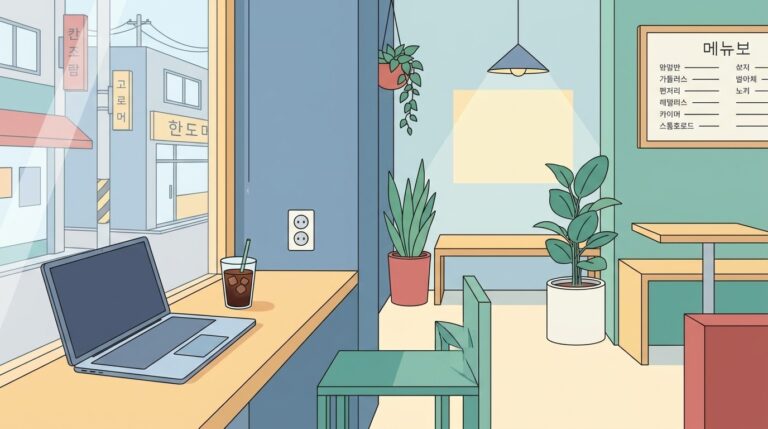
Imagine this classic Seoul scenario: You walk into a sunlit, aesthetic cafe in Seongsu-dong after walking all morning. Your phone battery is flashing a critical 4%, and you have 30 minutes before your online meeting. You spot a pristine two-person table near the wall, but another customer is sitting at the adjacent table with their laptop spread out, their charger cable dangling close to the only available wall socket. You freeze. Can I plug in here? Is this seat considered taken? Will the staff glare at me if I stay for two hours?
If you have ever felt that wave of panic in a trendy Korean cafe, you are not alone. Cafe culture in Korea is world-renowned—from sleek minimalist aesthetics to high-speed Wi-Fi and the unbelievable safety of leaving a laptop unattended to visit the restroom. However, navigating the unspoken social contract—power outlets, table etiquette, the Kagong-jok (cafe study) debate, and polite indirect phrasing—requires genuine cultural navigation skills. At the B2 intermediate level, you are moving beyond simple robotic orders and mastering the delicate art of smooth, natural communication. Let’s make sure you never second-guess yourself in a Korean cafe again!
Phase 2: Core Expressions Deep Dive
1. 혹시 콘센트 있는 자리 있을까요? (Hoksi kon-sen-teu inneun jari isseulkkayo?)
- Pronunciation: [Hok-shi kon-sen-teu in-neun ja-ri ee-sseul-kka-yo?] (Think: ‘Hok-she’ whispered gently, then ‘con-cent’ like an electrical socket).
- Meaning: Literal: “By any chance, is there a seat with an electrical outlet?” | Nuanced: “Could you let me know if there’s an outlet seat available?”
- K-Culture Moment: Heard constantly in modern youth hubs like Hongdae, Sinchon, or Gangnam when university students and remote workers ask busy baristas during peak laptop hours.
- Editor’s Insight: The magic word here is 혹시 (hoksi) (“by any chance”). Koreans rarely ask blunt direct questions like “Where is an outlet?” adding 혹시 softens the tone and demonstrates peak consideration.
- Situation Spectrum: Casual: ⚠️ | Semi-formal: ✅ | Formal: ✅
- 🤔 Think About It: Notice how English often uses direct questions (“Do you have outlets?”), while Korean defaults to indirect possibility (“Would there happen to be…?”). How does this reflect collective harmony in public spaces?
2. 여기 혹시 자리 비어 있나요? (Yeogi hoksi jari bieo innayo?)
- Pronunciation: [Yeo-gi hok-shi ja-ri bee-eo in-na-yo?] (Imagine asking politely: ‘Yuh-gi hawk-she jah-ree bee-uh in-nah-yo?’).
- Meaning: Literal: “Is this seat empty by any chance?” | Nuanced: “Excuse me, is anyone sitting here / may I take this seat?”
- K-Culture Moment: You see a vacant chair at a 4-person table where someone is working solo, or a jacket is nearby and you want to verify if a companion is returning.
- Editor’s Insight: Pair this phrase with a subtle open-palm gesture toward the chair and a slight 15-degree head bow. It disarms the other person instantly.
- Situation Spectrum: Casual: ⚠️ | Semi-formal: ✅ | Formal: ✅
- 🤔 Think About It: In your home country, do people comfortably share multi-seat communal tables with strangers, or is it customary to leave empty buffer chairs?
3. 다 마신 음료는 반납대에 두면 될까요? (Da masin eumryoneun bannapdaee dumyeon doelkkayo?)
- Pronunciation: [Da ma-sin eum-ryo-neun ban-nap-dae-eh doo-myeon doel-kka-yo?]
- Meaning: Literal: “Should I place finished drinks at the return counter?” | Nuanced: “Where should I return my empty tray when I’m done?”
- K-Culture Moment: In boutique indie cafes or multi-floor roasteries where it is unclear whether staff clear tables or you return trays yourself.
- Editor’s Insight: Using the grammar pattern -(으)면 될까요? (“Would it be okay if I do…?”) showcases B2-level politeness rather than demanding instructions.
- Situation Spectrum: Casual: 🚫 | Semi-formal: ✅ | Formal: ✅
- 🤔 Think About It: Why does Korean hospitality place clear responsibility on both the server and the guest to maintain shared cafe order?
Phase 3: Textbook Korean vs. Real Korean
Situation 1: Asking a stranger if a seat is taken
- 📖 교과서 한국어 (Textbook): 이 자리에 앉아도 됩니까? (I jarie anjato doepnikka? – “May I sit in this seat?”)
- 🗣️ 진짜 한국어 (Real-world): 저기요, 혹시 여기 자리 있나요? (Jeogiyo, hoksi yeogi jari innayo? – “Excuse me, is someone sitting here by any chance?”)
- 💡 왜 다를까? (Why the difference?): The textbook version sounds like an interrogation or a military briefing. Native speakers soften public inquiries by asking about the state of the seat rather than their own intention to sit.
Situation 2: Asking the barista to charge your phone
- 📖 교과서 한국어 (Textbook): 제 핸드폰을 충전해 주십시오. (Je haendeuponeul chungjeonhae jusipsio. – “Please charge my cellular phone.”)
- 🗣️ 진짜 한국어 (Real-world): 저, 죄송한데 핸드폰 충전 좀 부탁드려도 될까요? (Jeo, joesonghande haendeupon chungjeon jom butakdeuryeodo doelkkayo? – “Excuse me, I’m sorry to bother you, but could I possibly ask for a quick phone charge?”)
- 💡 왜 다를까? (Why the difference?): Asking a cafe worker to charge your personal electronics is a favor, not an entitled right. Layering 죄송한데 (I’m sorry to trouble you) with 부탁드려도 될까요? makes you sound warm, respectful, and sophisticated.
Phase 4: K-Culture Deep Dive & Non-Verbal Manners
4-1. 눈치 (Nunchi) & Table Gestures
Korean cafe culture operates on subtle radar signals known as 눈치 (Nunchi):
* The Laptop Boundary: It is perfectly acceptable to study or work on your laptop in large franchise cafes (like Twosome Place, Starbucks, or Hollys). However, taking up a 4-person table with laptops, tablets, and extension cords during lunch rush (12:00 PM – 1:30 PM) will earn you serious side-eye. Always choose 1-2 person tables or designated community study desks.
* Belonging Safety vs. Table Hogging: While you can safely leave your MacBook, wallet, and bag on a table while visiting the restroom or ordering at the counter, leaving your items for more than 20–30 minutes to grab food outside is considered poor etiquette.
* Plug Sharing Etiquette: If someone is using a two-socket wall outlet, never unplug their adapter without asking! Make soft eye contact, point gently, and ask: “혹시 옆에 꽂아도 될까요?” (Hoksi yeope kkojado doelkkayo? – “May I plug in next to yours?”).
4-2. Culture Code: The ‘Kagong-jok’ (카공족) Phenomenon
In Korean dramas like Twenty-Five Twenty-One or modern office series, cafes are portrayed as vibrant social hubs and study havens. Due to high-density living and small studio apartments (one-rooms), cafes serve as Korea’s communal living room. However, this has spurred debates between cafe owners and 카공족 (Kagong-jok – Cafe Study Tribe). As a golden rule:
1. Follow the 1인 1음료 (One drink per person) rule.
2. If you plan to stay longer than 2.5 to 3 hours, order a second drink or dessert as a respectful courtesy to the owner.
Phase 5: Real-Life Role-Play Scenario
Setting: Cafe Loup, an aesthetic indie cafe in Yeonnam-dong. You need to charge your laptop to finish a project, but the place is moderately crowded.
Characters: You (B2 Learner) & Min-jun (Friendly Barista)
- You: 안녕하세요! 아이스 아메리카노 한 잔이랑 바스크 치즈케이크 하나 부탁드려요.
(Annyeonghaseyo! Aiseu amerikano han jan-irang baseukeu chijeukeikeu hana butakdeuryeoyo.)
🎭 [Smiling gently, handing over payment card with both hands]
“Hello! One iced Americano and one Basque cheesecake, please.” -
Min-jun: 네, 주문 도와드렸습니다. 결제 완료되셨고요, 진동벨 챙겨드릴게요.
(Ne, jumun dowadeuryeotseumnida. Gyeolje wanryodoesyeotgoyo, jindongbel chaenggyeodeurilgeyo.)
🎭 [Hands over a pager with a polite nod]
“Yes, your order is placed. Payment is complete, and here is your buzzer.” -
You: 저, 혹시 노트북 쓰려고 하는데 콘센트 있는 자리가 남아 있을까요?
(Jeo, hoksi noteubuk sseuryeogo haneunde kon-sen-teu inneun jariga nama isseulkkayo?)
🎭 [Scanning the cafe room respectfully]
“Excuse me, I’m hoping to use my laptop. Would there happen to be any seats left with an outlet?” -
Min-jun: 아, 안쪽 창가 바(Bar) 테이블 아래쪽에 콘센트가 다 설치되어 있어요!
(A, anjjok changga ba teibeul araejjoge kon-sen-teuga da seolchidoeeo isseoyo!)
🎭 [Pointing towards the window counter with an open hand]
“Ah, there are outlets installed under the window bar counter toward the back!” -
You: 감사합니다! 그리고 혹시 와이파이 비밀번호는 영수증에 나와 있나요?
(Gamsahamnida! Geurigo hoksi waipai bimilbeonhoneun yeongsujeunge nawa innayo?)
🎭 [Glancing down at the receipt]
“Thank you! And by any chance, is the Wi-Fi password printed on the receipt?” -
Min-jun: 네, 영수증 하단이랑 저기 픽업대 앞 안내판에도 적혀 있습니다.
(Ne, yeongsujeung hadan-irang jeogi pigeopdae ap annaepannedo jeokhyeo itseumnida.)
“Yes, it’s at the bottom of the receipt and also written on the board in front of the pick-up counter.” -
You: 친절하게 알려주셔서 감사해요. 편하게 작업하고 갈게요!
(Chinjeolhage allyeojusyeoseo gamsahaeyo. Pyeonhage jageophago galgeyo!)
🎭 [Giving a pleasant bow and taking the pager]
“Thank you for your kind help. I’ll enjoy my work session here!” -
Min-jun: 네, 좋은 시간 보내세요!
(Ne, joeun sigan bonaeseyo!)
“Thank you, have a wonderful time!”
🔀 Interactive Branching Point
You head to the window bar table. There is one free outlet, but the cord from the laptop next to you is stretched across the socket opening. What do you do?
- Choice A: 저기요, 이거 제 콘센트인데 줄 좀 치워주실래요? (Jeogiyo, igeo je kon-sen-teu-inde jul jom chiwojusillaeyo? – “Excuse me, this is my outlet, can you move your cord?”)
- Choice B: 실례지만, 혹시 옆에 콘센트 꽂아도 괜찮을까요? (Sillyejiman, hoksi yeope kon-sen-teu kkojado gwaenchaneulkkayo? – “Pardon me, would it be alright if I plug in next to yours?”)
- Choice C: Say nothing, squeeze your adapter in forcefully, bumping their cord out of the way.
Decision Feedback:
* Choice A (Bad): Too confrontational! Claiming public cafe sockets as “mine” violates mutual consideration and creates awkward tension.
* Choice B (Best! ⭐): Exemplary B2 etiquette! It uses 실례지만 (Excuse me) and seeks gentle permission, guaranteeing a friendly “네, 쓰세요!” response.
* Choice C (Risk): Unplugging or tangling someone else’s cord without warning can corrupt their work file and violates silent Korean cafe harmony.
Phase 6: 10-Second Emotion Shadowing Drill
Read these lines aloud using the emotion markers and slash (/) pause breaks:
[😊 Polished & Inquiring]
저기요, / 혹시 여기 / 콘센트 자리 / 남아 있을까요?
(Jeogiyo, / hoksi yeogi / kon-sen-teu jari / nama isseulkkayo?)-
[🤝 Soft & Considerate]
실례지만, / 혹시 옆에 / 같이 꽂아도 / 괜찮을까요?
(Sillyejiman, / hoksi yeope / gachi kkojado / gwaenchaneulkkayo?) -
[🙏 Grateful & Polite]
다 마신 트레이는 / 저기 반납대에 / 두면 될까요?
(Da masin teureineun / jeogi bannapdaee / dumyeon doelkkayo?)
Phase 7: K-Culture Mini Dictionary
- 카공족 (Kagong-jok) | N. Cafe Study Tribe
A portmanteau of 카페 (Cafe) + 공부 (Study) + 족 (Tribe). Refers to students or professionals who turn cafes into their primary study and work stations. - 1인 1음료 (Irin Il-eumnyo) | N. One Drink Per Person Policy
The standard cafe baseline across Korea requiring every seated guest to order at least one beverage item. - 콘센트 (Kon-sen-teu) | N. Electrical Wall Outlet
Derived from ‘concentric plug’. Essential vocabulary when scouting study cafes or remote-work friendly spots. - 반납대 / 픽업대 (Bannapdae / Pigeopdae) | N. Return Counter / Pick-up Counter
Crucial directional signage in self-service cafes indicating where to collect orders and return finished trays.
Phase 8: Survival Kit for Travelers
Top 3 Survival Phrases
- 충전기 빌릴 수 있을까요? (Chungjeongi billil su isseulkkayo? – “Could I borrow a phone charger?”)
Pro Tip: Many Korean cafe counters keep backup USB-C, Lightning, and wireless chargers available for guests behind the register. - 와이파이 비밀번호가 어떻게 돼요? (Waipai bimilbeonhoga eotteoke dwaeyo? – “What is the Wi-Fi password?”)
Pro Tip: In 90% of cases, the password is either the cafe’s phone number or printed at the very bottom of your physical receipt. - 물 좀 마실 수 있을까요? / 셀프 바 어디 있나요? (Mul jom masil su isseulkkayo? / Selpeu ba eodi innayo? – “May I have water? / Where is the self-service water bar?”)
Editor’s Travel Note
- When hunting for cafe spots with ample seating and fast Wi-Fi, download and search via the 네이버 지도 (Naver Map) 앱 다운로드. Filter reviews using keywords like “콘센트” (Outlets) or “작업하기 좋은 카페” (Great cafe for laptop work).
- Korean sockets use Type C and F plugs with a 220V standard at 60Hz. Pack a snug multi-adapter so your charger doesn’t wobble loose from wall sockets!
Phase 9: One Step Deeper (Reflective Essay)
In modern Korean urban society, the cafe is much more than a commercial beverage outlet—it is the quintessential “제3의 공간” (The Third Place) between home and work. In densely populated cities where personal space is scarce, cafes offer an affordable sanctuary of independence and focus. This unique dynamic creates a fascinating duality: an extraordinary level of communal trust where unattended laptops remain untouched for hours, paired with an unspoken expectation of hyper-awareness (Nunchi) regarding outlet sharing, volume control, and time spent.
💬 Your Turn: How does cafe workspace etiquette in your home country compare to Korea’s Kagong-jok culture? Have you ever shared an outlet with a stranger? Share your thoughts below!
Phase 10: FAQ & Avoiding Misunderstandings
Q: Is it really safe to leave my laptop and bag on the table when going to the bathroom?
A: Yes! In Korea, public security and social trust are exceptionally high; people regularly leave laptops, iPads, and jackets at their tables while visiting the restroom or ordering. However, keep your passport and critical valuables (cash/phone) on your person just in case.
Q: Can I bring outside snacks or bakery goods into a Korean cafe?
A: Generally, no. Bringing outside food (외부 음식 반입 금지) is strictly frowned upon unless it is baby food or special medical items. Always finish outside snacks before entering.
Q: How long can I stay on one drink if I am working or studying?
A: Standard social etiquette suggests a limit of around 2 to 3 hours per drink. If you plan to settle in for a 5-hour work marathon, ordering a second coffee or a slice of cake halfway through shows great courtesy to the business.
🚨 Common Mistakes TOP 3
- Mistake: Unplugging an existing charger or cafe lamp to plug in your phone without asking.
Correct Action: Always ask the staff or adjacent patron: “여기 꽂아도 될까요?” - Mistake: Ordering 1 drink for a group of 3 people because two of you aren’t thirsty.
Correct Action: Respect the 1인 1음료 policy by ordering small tea, bottled water, or a dessert for non-coffee drinkers. - Mistake: Leaving empty cups on the table when walking out of a self-service cafe.
Correct Action: Carry your tray back to the designated 반납대 (Return Counter) or counter area.
Phase 11: Action Missions & Engagement
- 🥉 Bronze Mission (Solo): Practice saying the outlet request phrase (“혹시 콘센트 있는 자리 있을까요?”) 5 times using the Emotion Shadowing rhythm.
- 🥈 Silver Mission (Social): Leave a comment below sharing your favorite Korean beverage order using the intermediate structure ~한 잔이랑 ~하나 부탁드려요.
- 🥇 Gold Mission (Real-life): Visit a Korean cafe (or local Korean-owned cafe) and successfully locate an outlet or ask for the Wi-Fi using polite Korean!
🎮 K-Culture Mission: In the next K-Drama you watch, look out for cafe scenes! Notice whether characters return their trays to the counter or spot the 1인 1음료 sign on the wall.
Phase 12: Interactive Quiz Challenge
Test your knowledge before your next cafe run!
- Situational Judgment: You arrive at a packed cafe and see a jacket draped on a chair at a 2-person table, with nobody seated. What is the best phrase to check the seat?
- A) 이 자리 내 거야! (This seat is mine!)
- B) 저기요, 혹시 일행 있으신가요? (Excuse me, is there someone with you by any chance?)
- C) 비키세요. (Please move away.)
- Fill in the blank: When asking to return your empty tray, you say: “다 마신 컵은 (________)에 두면 될까요?”
-
True / False: In Korea, it is polite to occupy a 4-person booth alone with your laptop for 6 hours as long as you ordered one Americano.
👉 Click to reveal answers & explanations
- Answer: B – Asking about a potential companion (혹시 일행 있으신가요? or 여기 자리 있나요?) is courteous and polite.
- Answer: 반납대 (Bannapdae / Return counter) – You can also say 퇴식구 (Toesikgu) in some food-court style establishments.
- Answer: FALSE – Solo laptop users should use 1-2 person tables or bar desks, and staying beyond 3 hours requires ordering additional items to respect the business.







