

Phase 1: 공감 (Story-Immersive Opening)
안녕하세요! 매일한글 에디터입니다. (Hello! This is your Daily Hangul editor.)
Picture this: It is 11:45 PM on a crisp Friday night in Seoul. You are comfortably tucked into bed at your cozy Hongdae Airbnb, munching on convenience store snacks and binge-watching a thrilling K-Drama. Suddenly, a deafening siren pierces through the room: WHEEE-WOOO! WHEEE-WOOO! A robotic voice crackles through the wall speaker mounted above your front door: “화재 경보가 작동 중입니다. 비상구를 확인하세요…”
Your heart instantly drops into your stomach. Is there a real fire? Did someone burn samgyeopsal on the floor below? Or is this just a routine test? You peek into the hallway, but everyone is murmuring in rapid Korean, pointing at staircases, and checking their phones. In high-stress moments like this, textbook phrases like “안녕” (Hello) vanish from memory. Navigating an emergency in a foreign country is genuinely terrifying, especially when language barriers stand between you and your safety.
That is why we built this survival guide based on feedback from hundreds of real international residents in Korea. Today, you will master the exact B1-level emergency phrases, cultural reflexes, and practical vocabulary needed to handle fire alarms and apartment emergencies with absolute confidence. Let’s make sure you always stay safe and sound in Korea!
Phase 2: 핵심 표현 3선 심층 분석 (Top 3 Core Expressions)
1. 불이 났어요! / 불이야! (Buri nasseoyo! / Buriya!)
- Pronunciation: [Boo-ree nah-ssuh-yo / Boo-ree-yah] (Sound analogy: Rhymes with “Booty” replaced with an ‘R’ + “nah-saw-yo”)
- Meaning: “A fire broke out!” / “Fire!”
- K-Culture Moment: You will hear this shouted at the top of someone’s lungs in disaster K-Dramas like The First Responders (소방서 옆 경찰서) whenever a character spots smoke billowing from a kitchen.
- Editor’s Insight:
불means fire, and나다means to happen or break out.불이 났어요is polite and informative (Semi-formal/Polite), while shouting불이야!is the universal, immediate panic cry reserved for shouting down hallways or out windows.- Situation Spectrum: Casual: ✅ (불이야!) | Semi-formal: ✅ (불이 났어요!) | Formal: ✅ (화재가 발생했습니다.)
- 🤔 Think About It: In English, we shout a single noun (“Fire!”), whereas everyday spoken Korean frequently relies on a complete verb structure (“A fire has happened!”). How does specifying the sudden occurrence change the urgency?
2. 화재 경보기 오작동이에요? (Hwajae gyeongbogi ojakdong-ieyo?)
- Pronunciation: [Hwa-jae gyeong-boh-gee oh-jak-dong-ee-ae-yo?]
- Meaning: Literal: “Is the fire alarm a malfunction?” ➔ Actual Nuance: “Is it a false alarm?”
- K-Culture Moment: In modern high-rise apartments (아파트) or officetels (오피스텔), hyper-sensitive smoke detectors often trigger from heavy cooking steam. Neighbors will step into the hallway, asking the building manager this exact sentence.
- Editor’s Insight:
오작동(malfunction/false trigger) combines오(mis-/error) and작동(operation). Using this phrase immediately signals to Koreans that you understand modern apartment quirks.- Situation Spectrum: Casual: ⚠️ (오작동이야?) | Semi-formal: ✅ | Formal: ✅ (오작동입니까?)
- 🤔 Think About It: Notice how polite inquiry softens emergency tension in Korean communities. Asking before panicking reflects collective calmness.
3. 비상계단으로 대피하세요. (Bisang-gyedaneuro daepihaseyo.)
- Pronunciation: [Bee-sang-gye-dahn-eu-roh dae-pee-ha-se-yo]
- Meaning: Literal: “Please evacuate toward the emergency staircase.” ➔ Actual Nuance: “Take the stairs to evacuate now.”
- K-Culture Moment: When security guards or police officers direct building crowds during fire drills or real alerts in films like Exit (엑시트).
- Editor’s Insight: Never use the elevator (엘리베이터) during a fire.
비상계단(emergency stairs) +(으)로(direction particle: towards) +대피하세요(please evacuate) is the standard life-saving directive.- Situation Spectrum: Casual: 🚫 | Semi-formal: ✅ | Formal: ✅
- 🤔 Think About It: Korean emergency instructions make extensive use of Sino-Korean root words (
비상= emergency,대피= evacuation). Why do you think public safety phrases favor these concise roots?
Phase 3: 교과서 한국어 vs 진짜 한국어 (Textbook vs. Real Korean)
Situation 1: Warning people in the hallway to evacuate immediately
- 📖 교과서 한국어 (Textbook): 화재가 발생하였으니 신속하게 대피하십시오. (Hwajaega balsaenghayeosseuni sinsokhage daepihasipsio. / Since a fire has occurred, evacuate swiftly.)
- 🗣️ 진짜 한국어 (Real Spoken): 지금 불났대요! 빨리 계단으로 나가요! (Jigeum bulnatdaeyo! Ppal-li gyedaneuro nagayo! / They say there’s a fire right now! Let’s get out via the stairs quickly!)
- 💡 왜 다를까? (Why the difference?): Official broadcast speakers use ultra-formal Sino-Korean vocabulary, but real people in the corridor use hearsay contractions (
~대요) and urgent spoken verbs (빨리 나가요).
Situation 2: Asking your building security guard if everything is okay
- 📖 교과서 한국어 (Textbook): 경보 장치가 잘못 작동된 것입니까? (Gyeongbo jangchiga jalmot jakdongdoen geosimnikka? / Was the alarm apparatus operated incorrectly?)
- 🗣️ 진짜 한국어 (Real Spoken): 경비 아저씨, 이거 진짜 불난 거 아니죠? (Gyeongbi ajeossi, igeo jinjja bulnan geo anijyo? / Security mister, this isn’t a real fire, right?)
- 💡 왜 다를까? (Why the difference?): Addressing the guard respectfully as
경비 아저씨(Security Uncle/Mister) and using tag questions (~아니죠?) builds instant rapport and seeks immediate reassurance.
Phase 4: K-Culture 딥다이브 & 비언어적 매너 (Deep Dive & Non-Verbal Manners)
4-1. 눈치 (Nunchi) & Hallway Etiquette During Alarms
- The Peek-and-Smell (빼꼼 확인): When an alarm goes off in a Korean officetel, don’t rush blindly into the hall without your shoes, but also don’t ignore it. Koreans cracked open their front doors slightly (빼꼼) to check for burning smells (탄내) or white smoke (연기).
- Wet Cloth Coverage (젖은 수건): In Korean safety drills, everyone is taught to immediately cover their nose and mouth with a wet towel or their sleeve while staying low. Mimicking this posture demonstrates serious safety awareness.
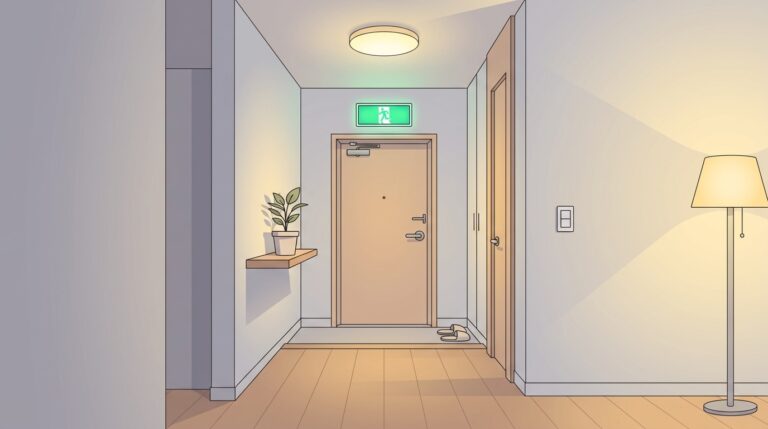
- No Elevator Rule: Korean residents will actively stop you with open palms if you press the elevator button during a chime. Always head directly toward the green emergency exit sign (비상구).
4-2. Culture Code: The Wallpad (월패드) & Building Broadcast System
In almost every modern Korean residence, your apartment is equipped with an interactive home-automation screen called a Wallpad (월패드). Fire alarms are synced to building-wide broadcasts. The resident security committee or maintenance office (관리사무소) will usually make an announcement within 60 to 90 seconds in Korean saying either: “금일 소방 점검 중입니다” (Today is fire inspection) or “실제 화재 상황입니다. 즉시 대피하십시오” (This is an actual fire situation. Evacuate immediately).
Phase 5: 실전 롤플레이 시나리오 (Interactive Roleplay)
- Setting: The 8th-floor hallway of an officetel in Mapo-gu, Seoul. The alarm is chiming loudly.
- Characters:
- You: An exchange student staying in room 804.
- Min-ho (민호): The friendly 20-something neighbor from room 805 holding his phone flashlight.
[1] You: 🎭 (Frantically opening your door and looking around)
    저기요! 지금 무슨 일이에요?
    (Jeogiyo! Jigeum museun irieyo? / Excuse me! What is going on right now?)

[2] Min-ho: 🎭 (Sniffing the air with a furrowed brow)
    경보기가 울리는데, 탄 냄새는 안 나는 것 같아요.
    (Gyeongbogiga ullineunde, tan naemsaeneun an naneun geot gatayo. / The alarm is ringing, but I don't smell anything burning.)

[3] You: 🎭 (Checking your phone with a trembling voice)
    진짜 불난 거 아니에요? 119에 전화해야 할까요?
    (Jinjja bulnan geo anieyo? Il-il-gu-e jeonhwahaeya halkkayo? / Isn't it a real fire? Should we call 119?)

[4] Min-ho: 🎭 (Checking the wallpad announcement speaker above)
    잠시만요, 관리실 방송 들어봐요. 안내가 나올 거예요.
    (Jamsimanyo, gwallisil bangsong deureobwayo. Annaega naol geoyeyo. / Hold on, listen to the management announcement. A notice will come out.)

[5] Speaker Broadcast: 🎭 (Loud static followed by a guard's calm voice)
    "아- 아- 안내 말씀 드립니다. 3층 조리 중 연기로 인한 오작동입니다."
    (Ah- ah- Annae malsseum deurimnida. Sam-cheung jori jung yeon-giro inan ojakdong-imnida. / "Mic check. Announcement: It is a false alarm due to cooking smoke on the 3rd floor.")

[6] Min-ho: 🎭 (Sighing in relief and smiling warmly)
    휴, 다행이네요! 단순 오작동이에요. 걱정 안 하셔도 돼요.
    (Hyu, dahaeng-ineyeyo! Dansun ojakdong-ieyo. Geokjeong an hasyeodo dwaeyo. / Phew, what a relief! It's just a simple false alarm. You don't need to worry.)

[7] You: 🎭 (Patting your chest with a relieved smile)
    정말 다행이에요. 깜짝 놀랐어요!
    (Jeongmal dahaeng-ieyo. Kkamjjak nollasseoyo! / What a huge relief. I was so startled!)

[8] Min-ho: 🎭 (Waving gently before heading back inside)
    놀라셨죠? 이제 편하게 쉬세요!
    (Nollasyeotjyo? Ije pyeonhage swiseyo! / You must have been scared, right? Rest comfortably now!)
🔀 Interactive Choice Point
What would you say if the smoke was real and Min-ho had not noticed yet?
- Option A: “불이야! 빨리 비상계단으로 뛰어요!” (Buriya! Ppal-li bisang-gyedaneuro ttwieoyo!)
- 👉 Feedback [BEST]: Perfect! Clear, urgent, and immediately points toward the safe escape route.
- Option B: “엘리베이터를 타고 1층으로 갈까요?” (Ellibeiteoreul tago il-cheung-euro galkkayo?)
- 👉 Feedback [RISK]: Dangerous! Never suggest riding the elevator during a fire event.
- Option C: “화재 상황인 것 같은데 어떡하죠?” (Hwajae sanghwang-in geot gateunde eotteokhajyo?)
- 👉 Feedback [BAD]: Too passive for an active smoke emergency. Prioritize action over questioning.
Phase 6: 10초 감정 섀도잉 드릴 (10-Second Emotion Shadowing Drill)
Repeat these lines out loud with the designated rhythm (/ marks a short breath pause) and emotional intention!
[🚨 긴박하고 다급하게 - Urgent & Frantic]
불이 났어요! / 빨리 / 밖으로 대피하세요!
(Buri nasseoyo! / Ppal-li / bakkeuro daepihaseyo!)-
[😰 혼란스럽고 다급하게 - Confused & Anxious]
저기요, / 연기가 나는데 / 이거 오작동 맞아요?
(Jeogiyo, / yeon-giga naneunde / igeo ojakdong majayo?) -
[🗣️ 침착하고 단호하게 - Calm & Authoritative]
엘리베이터 타지 마시고 / 비상계단으로 / 내려가세요!
(Ellibeiteo taji masigo / bisang-gyedaneuro / naeryeogaseyo!)
Phase 7: K-Culture 미니 사전 (Core Vocabulary)
- 소방서 (Sobangseo) / 소방관 (Sobanggwan) | Fire Station / Firefighter
- Usage: Korea’s emergency number for fire and medical emergencies is 119. Say: “소방관님, 도와주세요!” (Firefighter, please help!).
- 비상구 (Bisang-gu) | Emergency Exit
- Usage: Look for the glowing green icon showing a running figure on walls or floor indicators.
- 소화기 (Sohwagi) | Fire Extinguisher
- Usage: Present in every Korean hallway. Often marked with red signage: “소화기 사용법” (Fire extinguisher instructions).
- 관리사무소 (Gwalli-samuso) | Building Management Office
- Usage: The hub responsible for turning off false alarms and issuing announcements over the intercom.
Phase 8: 여행자를 위한 생존 키트 (Traveler’s Survival Kit)
Survival Expressions TOP 3
- 119에 신고해 주세요! (Il-il-gu-e singohae juseyo!)
- Pro Tip: Use this when you need a bystander to call the emergency dispatch line for you.
- 연기가 너무 심해요. (Yeon-giga neomu simhaeyo.)
- Pro Tip: Tell dispatchers or neighbors that the smoke is heavy so they prioritize oxygen masks.
- 도와주세요, 안에 사람이 있어요! (Dowajuseyo, ane sarami isseoyo!)
- Pro Tip: Crucial if someone is trapped inside a room or bathroom.
Editor’s Travel Note
- Emergency Call Support: In South Korea, dialing
119gives you access to a real-time three-way foreign language interpretation service (English, Chinese, Japanese, etc.). Just say “English please”. - Essential App Setup: Download the official Emergency Ready App on Google Play / App Store provided by the Korean Ministry of the Interior and Safety for real-time English civil defense and fire push alerts.
Phase 9: “한 발 더 깊이” (A Step Deeper)
South Korea has one of the highest densities of multi-family apartment complexes in the world. Because millions live stacked above and beside one another, fire preparedness is viewed not merely as personal safety, but as an act of communal solidarity (공동체 의식). When alarms chime, neighbors frequently look out for adjacent elderly residents or university students living alone. Calling out to your hallway neighbor isn’t seen as nosy; it is considered basic civic warmth (정, Jeong).
💬 Your Turn: Have you ever experienced a sudden false alarm or emergency siren while traveling abroad? How did you react, and what Korean phrase would you use first today? Share your story in the comments below!
Phase 10: FAQ & 오해 방지 (FAQ & Common Mistakes)
Q: What is the difference between calling 112 and 119 in Korea?
A: 119 is strictly for fire, rescue, ambulance, and medical emergencies (Fire Department / 소방서). 112 is exclusively for crime reporting and police assistance (Police Department / 경찰서). For a fire alarm or smoke, always call 119.
Q: Why do fire alarms in Korean studios (One-rooms) ring so frequently?
A: Many Korean studio apartments feature sensitive kitchen heat/smoke detectors placed near gas or induction burners. Frying Korean pork belly (삼겹살) or boiling spicy stew (찌개) with closed windows easily triggers the sensor.
Q: Can I speak English when calling 119 for a fire emergency?
A: Yes! The 119 emergency headquarters connects you immediately to translation interpretation services provided by the Korea Tourism Organization (1330) or emergency translation desks within seconds.
🚨 흔한 실수 (Common Mistakes) Top 3
- ❌ Mistake 1: Shouting “도둑이야!” (Thief!) during a fire.
- 👉 Correct Action: Shout “불이야!” (Buriya! / Fire!).
- ❌ Mistake 2: Using the elevator to get downstairs quickly during an alarm.
- 👉 Correct Action: Always push through the fire doors into the 비상계단 (Emergency stairs).
- ❌ Mistake 3: Ignoring the intercom announcement because it’s in Korean.
- 👉 Correct Action: Listen for key words like 오작동 (false alarm) or 대피 (evacuate), or immediately ask a neighbor.
Phase 11: 액션 미션 & 참여 유도 (Action Missions)
- 🥉 Bronze Mission (Self Practice): Stand in front of your room door and practice shouting “불이 났어요! 대피하세요!” 3 times with full projection.
- 🥈 Silver Mission (Social Connection): Screenshot your favorite survival phrase from Phase 2, post it to your Instagram story, and tag
@DailyHangulwith your pronunciation voice note! - 🥇 Gold Mission (Real Life): Check your current accommodation or hotel room: locate the nearest 비상구 (Emergency Exit) and 소화기 (Fire Extinguisher) on your floor.
- 🎮 K-Culture Mission: Watch Episode 1 of the disaster drama Exit and spot how the characters yell emergency instructions to the crowd.
Phase 12: 인터랙티브 퀴즈 챌린지 (Interactive Quiz)
Q1. You hear an alarm and smell smoke in your hallway. Which phrase should you shout to alert your neighbors?
* (A) 불이야! 빨리 대피하세요!
* (B) 실례지만 화장실이 어디예요?
* (C) 경찰관님, 도둑을 잡아주세요!
Q2. Fill in the blank with the appropriate Sino-Korean term for “false alarm/malfunction”:
* “연기 때문에 경보기가 ______________(으)로 울렸어요.”
Q3. True or False: During a fire alarm in a 20-story Korean apartment, it is safest to take the central elevator to reach the 1st floor ground level faster.
🔍 Click here to reveal answers & explanations!
- Answer: (A) 불이야! 빨리 대피하세요! (Fire! Please evacuate quickly!). (B means “Where is the restroom?” and C means “Officer, please catch the thief!”).
- Answer: 오작동 (Ojakdong / Malfunction). Full sentence: 연기 때문에 경보기가 오작동으로 울렸어요. (The alarm rang as a malfunction due to smoke).
- Answer: False. Never take the elevator during an active fire alarm, as power failure can trap you in the shaft. Always use the emergency stairs (비상계단).







