

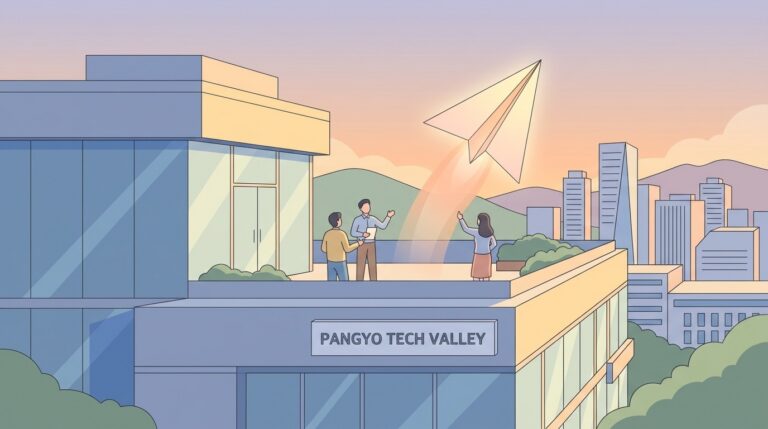
Phase 1: Empathy — Welcome to the Pangyo Boardroom
Hello! I’m your Daily Hangul editor. (안녕하세요! 매일한글 에디터입니다.) Picture a tense conference room in Pangyo, Korea’s Silicon Valley, straight out of the K-Drama Start-Up. You’ve spent months crafting a bold new service, only to face skeptical executives asking why the company should gamble on something outside its core cash cow. Saying ‘we want to try something new’ sounds dangerously naive at an executive level. That is why advanced learners often tell us they freeze when defending innovation in Korean! Based on real coaching feedback from global professionals in Seoul, today’s guide equips you with C1-level Korean to champion in-house ventures (CICs), justify pivots, and pitch spin-offs like a seasoned strategist.
Phase 2: Deep Dive into 3 Core Expressions
1. 본업에 안주하지 않다 (Boneobe anjuhaji anta)
- Pronunciation: bo-neo-be an-ju-ha-ji an-ta (Imagine saying “bo-nuh-beh” softly, then “ahn-joo” like “Andrew” without the ‘dr’, followed by “ha-jee ahn-tah” with a crisp, decisive ending.)
- Meaning: Literally “to not settle comfortably in one’s main job.” In corporate Korean, it carries the high-level strategic nuance of refusing to rest on one’s laurels or cash-cow business model.
- K-Culture Moment: Think of the intense boardroom monologues in Reborn Rich or Agency, where an ambitious protagonist warns the chairman that clinging to past success guarantees future obsolescence.
- Editor’s Insight: Native executives love the verb 안주하다 (anjuhada) because it implies passive complacency rather than simple stability. Pairing it with 본업 (boneop — core business) immediately signals C1-level business acumen and strategic urgency.
- Situation Spectrum: Casual 🚫 | Semi-formal ⚠️ | Formal ✅
- 🤔 Think About It: In English, “resting on our laurels” uses an ancient Greek victory wreath metaphor, whereas Korean 안주하다 (anjuhada) uses Hanja meaning “to reside peacefully.” Why do you think Korean corporate culture frames complacency as “getting too comfortable at home”?
2. 파괴적 혁신을 실험하다 (Pagoejeok hyeoksineul silheomhada)
- Pronunciation: pa-goe-jeok hyeok-si-neul sil-heom-ha-da (Think “pah-gweh-juck” + “hyuck-she-neul” with a quick breathy ‘h’, ending in “shil-hum-ha-da” where ‘sil’ sounds like ‘shill’.)
- Meaning: Literally “to experiment with destructive innovation.” Practically, it refers to testing disruptive innovation that may even challenge existing company norms.
- K-Culture Moment: In K-Drama Start-Up, when characters present AI or autonomous driving prototypes at Hackathon demo days, commentators and venture capitalists constantly throw around 파괴적 혁신 (pagoejeok hyeoksin) to separate true game-changers from minor feature updates.
- Editor’s Insight: Notice the pairing with 실험하다 (silheomhada — to experiment) instead of 도입하다 (doiphada — to adopt). Using “experiment” lowers executive fear by framing the risky venture as a controlled, data-driven test rather than reckless spending.
- Situation Spectrum: Casual ⚠️ | Semi-formal ✅ | Formal ✅
- 🤔 Think About It: How does your native language soften the word “destructive” in business? In Korean, 파괴적 (pagoejeok) sounds dramatic in daily life, yet inside a Pangyo tech office, it is considered a badge of visionary honor.
3. 사내벤처(CIC) 인큐베이팅 제도를 운영하다 (Sanaebencheo inkyubeiting jedoreul unyeonghada)
- Pronunciation: sa-nae-ben-cheo in-kyu-be-i-ting je-do-reul u-nyeong-ha-da (“Sa-neh-ben-chuh” flows smoothly into the Konglish “in-kyu-bay-ting”, followed by “jeh-do-reul oo-nyung-ha-da”.)
- Meaning: Literally “to operate an in-house venture (Company-in-Company) incubating system.” It describes running an internal startup program with independent decision-making to nurture spin-off candidates.
- K-Culture Moment: Picture a sleek corporate recruitment video from Korean tech giants like Naver or Kakao—often parodied in office comedies like Gaus Electronics—highlighting how employees can pitch wild ideas, build an independent CIC, and eventually spin off as CEOs.
- Editor’s Insight: Using 제도 (jedo — formal system/policy) rather than just 프로그램 (peurogeuraem) tells your Korean counterpart that innovation isn’t a one-off event here—it is institutionalized in the company’s DNA.
- Situation Spectrum: Casual 🚫 | Semi-formal ✅ | Formal ✅
- 🤔 Think About It: Why do Korean conglomerates favor structured terms like 제도 (jedo — system) even when talking about rebellious startup culture? Compare that with Silicon Valley’s informal “skunkworks” vibe.
Phase 3: Textbook Korean vs Real Korean
Situation 1: Explaining why your team is building a risky side project
- 📖 Textbook Korean: 우리 회사는 원래 하던 일만 하지 않고 새로운 기술을 시험하기 위해 작은 팀을 만들었습니다. (Uri hoesaneun wollae hadeon ilman haji anko saeroun gisureul siheomhagi wihae jageun timeul mandeureotseumnida. — Our company didn’t just do what it originally did and made a small team to test new technology.)
- 🗣️ Real Korean: 본업에 안주하지 않고 파괴적 혁신을 실험하려고 별도 CIC 형태로 사내벤처를 인큐베이팅하고 있습니다. (Boneobe anjuhaji anko pagoejeok hyeoksineul silheomharyeogo byeoldo CIC hyeongtaero sanaebencheoreul inkyubeitinghago itseumnida. — Rather than resting on our core business, we’re incubating an in-house venture as a separate CIC to test disruptive innovation.)
- 💡 Why the difference? Textbook Korean sounds descriptive and hesitant, like a student report. In real Korean boardrooms, using concise Sino-Korean concepts like 본업 (boneop) and industry loanwords like CIC immediately establishes authority and aligns you with executive strategy.
Situation 2: Deciding whether to pivot or spin off an incubated team
- 📖 Textbook Korean: 이 계획은 성공할 것 같지 않아서 방향을 바꾸거나 회사를 따로 나눌지 생각하고 있습니다. (I gyehoegeun seonggonghal geot gatji anaseo banghyangeul bakkuguna hoesareul ttaro nanulji saenggakhago itseumnida. — Since this plan doesn’t seem likely to succeed, we are thinking about changing direction or splitting the company separately.)
- 🗣️ Real Korean: 시장 반응을 보고 과감히 피벗을 단행할지, 아니면 사업성을 보고 분사(스핀오프)를 추진할지 의사결정 단계에 있습니다. (Sijang baneungeul bogo gwagamhi pibeoseul danhaenghalji, animyeon saeopseongeul bogo bunsareul chujinhalji uisagyeoljeong dangyee itseumnida. — We are at the decision-making stage of whether to boldly execute a pivot based on market feedback or push for a spin-off based on business viability.)
- 💡 Why the difference? Saying “it doesn’t seem likely to succeed” sounds defeated and amateurish. Real Korean business pros frame change proactively with 과감히 단행하다 (gwagamhi danhaenghada — boldly execute) and 사업성 (saeopseong — business viability), showing disciplined leadership rather than failure.
Phase 4: K-Culture Deep Dive & Non-Verbal Manners
4-1. Nunchi (눈치) & Executive Boardroom Gestures
When pitching a disruptive CIC or spin-off in Korea, what you say is only half the battle—your 눈치 (nunchi — social situational awareness) seals the deal. First, respect the legacy before proposing disruption: nod gently toward senior executives who built the core business when saying 본업에 안주하지 않고 (boneobe anjuhaji anko), signaling gratitude for the cash cow funding your experiment. Second, control your hand gestures: avoid overly theatrical pointing; instead, hold your clicker or tablet firmly with relaxed, open-palm gestures at chest level. Finally, watch the room’s temperature—if an executive clears their throat or furrows their brow over cannibalization risks, pause immediately and invite their concern with calm eye contact.
4-2. Cultural Code Analysis: K-Drama & Korea’s Chaebol-Startup Hybrid
If you’ve watched Start-Up or Misaeng, you know Korean work culture traditionally prized stability, hierarchy, and loyalty to one massive conglomerate. Yet over the past decade, Korean giants like Samsung (C-Lab), Hyundai (ZER01NE), and Naver (CICs) realized that slow hierarchy kills innovation. That is why Korea pioneered a unique hybrid culture: 사내벤처 인큐베이팅 (in-house venture incubating). Employees keep their corporate safety net while working in hoodie-wearing, English-nickname teams inside Pangyo or Gangnam labs—combining Silicon Valley agility with Korean collective backing.
Phase 5: Real-Life Roleplay Scenario
Setting: A sleek, glass-walled 18th-floor conference room overlooking Pangyo Techno Valley at 4:00 PM. Iced Americanos line the mahogany table. Team Lead Min-jun (민준) is pitching his CIC team’s quarterly review to Managing Director Seo (서 상무), a sharp 25-year veteran of the core business.
- 서 상무 (MD Seo): 🎭 (tapping a pen thoughtfully on the financial report) 민준 팀장, 이번 분기 사내벤처 지표가 예상보다 더딘데, 그냥 본업 지원 부서로 복귀하는 게 낫지 않겠나? (Minjun timjang, ibeon bungi sanaebencheo jipyoga yesangboda deodinde, geunyang boneop jiwon buseoro bokgwihaneun ge natji ankenna? — Team Lead Min-jun, this quarter’s in-house venture metrics are slower than expected. Wouldn’t it be better to just return to a core-business support role?)
- 민준 (Min-jun): 🎭 (leaning forward calmly, maintaining steady eye contact) 상무님, 우려하시는 부분은 충분히 공감합니다. 다만 저희가 본업에 안주하지 않고 파괴적 혁신을 실험하기 위해 이 CIC 인큐베이팅 제도를 운영하고 있는 만큼, 지금 접기엔 이릅니다. (Sangmunim, uryeohasineun bubuneun chungbunhi gonggamhamnida. Daman jeohuiga boneobe anjuhaji anko pagoejeok hyeoksineul silheomhagi wihae i CIC inkyubeiting jedoreul unyeonghago inneun mankeum, jigeum jeopgien ireumnida. — Managing Director, I completely empathize with your concern. However, since we operate this CIC incubating system precisely to experiment with disruptive innovation rather than resting on our core business, it’s too early to fold now.)
- 서 상무 (MD Seo): 🎭 (raising an eyebrow slightly) 말은 좋지. 그런데 기존 고객층을 뺏어 먹는 제 살 깎아먹기가 될 수도 있잖아. (Mareun jochi. Geureonde gijon gogaekcheungeul ppaeseo meongneun je sal kkakgameokgiga doel sudo itjana. — Sounds nice in theory. But it could turn into cannibalization that steals our existing customer base.)
- 민준 (Min-jun): 🎭 (clicking to a clean data slide with a confident smile) 맞습니다. 그래서 초기 모델에서 과감히 피벗을 단행해 B2B 타깃으로 선회했습니다. 지난 2주간 파일럿 전환율이 3배 뛰었습니다. (Matseumnida. Geuraeseo chogi modereseo gwagamhi pibeoseul danhaenghae B2B tagiseuro seonhoehaetseumnida. Jinan ijugan paillot jeonhwanyuri sebae ttwieotseumnida. — You’re right. That’s why we boldly executed a pivot from our initial model and shifted toward a B2B target. Over the past two weeks, pilot conversion tripled.)
- 서 상무 (MD Seo): 🎭 (leaning in to examine the chart closely) 오, B2B로 피벗했다고? 그건 본업과 부딪치지 않겠군. (O, B2Bro pibeothaetdago? Geugeon boneopgwa buditchiji anketgun. — Oh, you pivoted to B2B? That wouldn’t clash with the core business.)
- 민준 (Min-jun): 🎭 (nodding respectfully) 네, 상무님. 이 성장세를 유지해 올해 하반기에는 독립적인 분사(스핀오프) 가능성까지 타진해 볼 계획입니다. (Ne, sangmunim. I seongjangsereul yujihae olhae habangieneun dongnipjeogin bunsa ganeungseongkkaji tajinhae bol gyehoegimnida. — Yes, sir. If we maintain this momentum, we plan to explore the possibility of an independent spin-off in the second half of this year.)
- 서 상무 (MD Seo): 🎭 (closing the folder with a faint, approving smile) 좋아. 분사 여부는 다음 분기 실적을 보고 다시 논의하자고. 계속 밀어붙여 봐. (Joa. Bunsa yeobuneun daeum bungi siljeogeul bogo dasi nonuihajago. Gyesok mireobutyeo bwa. — Good. Let’s revisit the spin-off decision after seeing next quarter’s results. Keep pushing forward.)
- 민준 (Min-jun): 🎭 (bowing slightly at 15 degrees) 감사합니다, 상무님! 데이터로 증명하겠습니다. (Gamsahamnida, sangmunim! Deiteoro jeungmyeonghagetseumnida. — Thank you, Managing Director! We will prove it with data.)
🔀 Interactive Branching Point: What if MD Seo pushes back harder on the budget?
Imagine MD Seo snaps: “예산이 너무 많이 들어. 왜 굳이 외부 스타트업처럼 돈을 태우지? (Yesani neomu mani deureo. Wae guji oebu seutateueopcheoreom doneul taeuji? — It costs too much. Why burn cash like an external startup?)” How do you respond?
* A) “상무님, 요즘 트렌드를 모르셔서 그러시는데, 원래 스타트업은 다 이렇게 돈을 태웁니다.” (Sangmunim, yojeum teurendeureul moreusyeoseo geureosineunde, wollae seutateueobeun da ireoke doneul taeumnida. — Sir, you don’t know current trends; all startups burn money like this.)
* B) “단기 비용보다 본업에 안주했을 때의 기회비용이 훨씬 큽니다. 다음 마일스톤 미달 시 즉시 자진 철수하겠습니다.” (Dangi biyongboda boneobe anjuhaesseul ttaeui gihoebiyongi hwolssin keumnida. Daeum maileuseuton midal si jeuksi jajin cheolsuhagetseumnida. — The opportunity cost of resting on our core business is far higher than short-term costs. If we miss the next milestone, we will voluntarily pull the plug immediately.)
* C) “알겠습니다. 그럼 당장 다음 주부터 팀원 절반을 줄이고 기능도 대폭 축소하겠습니다.” (Algetseumnida. Geureom dangjang daeum jubuteo timwon jeolbaneul jurigo gineungdo daepok chuksohagetseumnida. — Understood. Starting next week, we’ll cut half the team and slash features.)
Feedback:
* Choice A (🚫 Bad): Criticizing an executive’s trend awareness is a fatal nunchi blunder in Korea. Even in a flat CIC culture, disrespectful phrasing destroys trust instantly.
* Choice B (✅ Best): Brilliant! You reframe spending as avoiding 기회비용 (gihoebiyong — opportunity cost) and offer a clear exit criterion (milestone accountability), turning risk into calculated discipline.
* Choice C (⚠️ Risk): Surrendering immediately without defending your data makes executives question your conviction as a venture leader. Always negotiate with metrics first!
Phase 6: 10-Second Emotional Shadowing Drill
Read these lines aloud using the / marks for natural breath pauses and lean into the emotion tags!
[🔥 Passionate & Visionary]
본업에 안주하지 않고 / 파괴적 혁신을 실험하기 위해 / 사내벤처 인큐베이팅 제도를 / 과감히 운영하고 있습니다. (Boneobe anjuhaji anko / pagoejeok hyeoksineul silheomhagi wihae / sanaebencheo inkyubeiting jedoreul / gwagamhi unyeonghago itseumnida.)[🧐 Calm & Analytical]
초기 시장의 냉정한 피드백을 수용해 / B2B 모델로 / 전격 피벗을 단행했습니다. (Chogi sijangui naengjeonghan pideubaegeul suyeonghae / B2B modero / jeongyeok pibeoseul danhaenghaetseumnida.)[😤 Determined against pushback]
단기적인 적자보다 / 혁신의 골든타임을 놓치는 것이 / 훨씬 더 큰 리스크입니다. (Dangijeogin jeokjaboda / hyeoksinui goldeuntaimeul nochineun geosi / hwolssin deo keun riseukeuimnida.)
Phase 7: K-Culture Mini Dictionary
- 사내독립기업 / CIC (Sanaedongnipgieop) | Company-in-Company | Used when a large Korean firm grants an internal unit its own budget, hiring power, and brand autonomy to move like a nimble startup.
- 피벗 (Pibeot) | Pivot | Widely used across Pangyo tech offices and investor decks to mean shifting a business model or target audience after testing market fit.
- 분사 / 스핀오프 (Bunsa / Seupinopeu) | Spin-off | 분사 (bunsa) is the standard formal/legal Korean term in boardrooms and news articles, while 스핀오프 (seupinopeu) is common in casual tech conversations.
- 제 살 깎아먹기 (Je sal kkakgameokgi) | Cannibalization (lit. “carving one’s own flesh”) | A vivid native Korean idiom frequently heard in strategy meetings when a new venture threatens to steal revenue from the parent company’s flagship product.
Phase 8: Survival Kit for Business Travelers
Top 3 Survival Phrases for Networking in Pangyo & Gangnam
- 요즘 어떤 신사업 인큐베이팅하고 계세요? (Yojeum eotteon sinsaeop inkyubeitinghago gyeseyo?) — Pro Tip: Great icebreaker at Seoul startup mixers; it flatters the listener by assuming they are forward-thinking.
- 사업성을 타진해 보는 단계입니다. (Saeopseongeul tajinhae boneun dangyeimnida.) — Pro Tip: Use this classy C1 phrase when you aren’t ready to reveal revenue numbers yet—it means “we’re currently testing business viability.”
- 명함 한 장 주실 수 있을까요? (Myeongham han jang jusil su isseulkkayo?) — Pro Tip: Always offer and receive business cards with both hands and read their title carefully before putting it away.
Editor’s Travel Note
Visiting Korea’s innovation hubs like Pangyo Techno Valley or Teheran-ro in Gangnam? Do not rely on Google Maps for walking directions. Before landing, [Download Naver Map for seamless Pangyo transit directions] and [Download Kakao T for instant business taxi hailing]. For networking, Korean tech pros heavily use digital business cards—[Install Remember business card scanner app] to scan paper cards automatically. Ride the sleek red-line Shinbundang Line (신분당선) subway from Gangnam Station straight to Pangyo Station in just 14 minutes using a T-money card or contactless corporate transit card!
Phase 9: “One Step Deeper” (Thought Question)
For decades, Korean corporate success was built on 공동체 의식 (gongdongche uisik — collective solidarity) and respect for seniority, where rocking the boat was discouraged. Yet today, Korea’s top companies actively sponsor internal rebels through CICs, encouraging them to challenge the core business. This fascinating paradox shows that Korean society isn’t abandoning collectivism—it is redesigning it into a protective launchpad where individual innovators can take bold risks without standing completely alone. True disruption in Korea rarely means burning bridges; it means building a faster bridge while honoring the foundation.
💬 Your Turn: In your country’s workplace culture, is it easier to launch an innovative project inside a large corporation or start from scratch outside? Share your thoughts in the comments!
Phase 10: FAQ & Myth-Busting
Q: Is “CIC” understood by every Korean businessperson, or should I use “사내벤처”?
A: In tech, finance, and conglomerate strategy teams, both CIC and 사내벤처 (sanaebencheo) are universally understood. However, when speaking to more traditional manufacturing partners or government grant officers, using 사내벤처 (sanaebencheo) or 사내독립기업 (sanaedongnipgieop) is much clearer and safer.
Q: What is the subtle difference between “분사 (bunsa)” and “스핀오프 (seupinopeu)”?
A: They describe the same corporate action, but 분사 (bunsa) carries a formal, legal, and HR-focused tone used in official announcements and contracts, whereas 스핀오프 (seupinopeu) feels trendier and is favored by venture capitalists, startup media, and Pangyo developers.
Q: When should I use “안주하다 (anjuhada)” vs “만족하다 (manjokhada)”?
A: 만족하다 (manjokhada) is positive or neutral (“to be satisfied”), while 안주하다 (anjuhada) almost always carries a critical nuance of “becoming complacent and stopping growth.” Never tell a boss “우리 팀은 현재 성과에 안주하고 있습니다” unless you want to criticize your own team!
🚨 Common Mistakes Warning Board
- Mistake: Saying “우리 회사의 본업을 파괴할 겁니다” (We will destroy our company’s core business) to translate “disruptive innovation.” ➡️ Correct Action: Always attach 혁신 (hyeoksin — innovation) to form 파괴적 혁신 (pagoejeok hyeoksin), or executives will think you’re planning corporate sabotage!
- Mistake: Using casual Konglish like “피벗팅해요” in an official executive report. ➡️ Correct Action: Use the crisp C1 collocation 피벗을 단행하다 (pibeoseul danhaenghada) or 사업 방향을 선회하다 (saeop banghyangeul seonhoehada).
- Mistake: Dropping honorifics completely just because you work in a “flat” CIC team. ➡️ Correct Action: Even when calling someone by an English nickname (like Kevin or Joy), Korean CIC employees still keep the polite -요 (-yo) ending to maintain mutual respect!
Phase 11: Action Mission & Engagement
- 🥉 Bronze Mission (Solo Practice): Record a 30-second voice memo on your phone pitching a fictional K-Pop or AI food-tech CIC inside your dream Korean company, using all 3 core expressions from Phase 2.
- 🥈 Silver Mission (Community Share): Post one sentence on LinkedIn or Instagram using #DailyHangul explaining what 제 살 깎아먹기 (je sal kkakgameokgi) means in business strategy.
- 🥇 Gold Mission (Real-World Use): Next time you speak with a Korean colleague, tutor, or language partner, ask them their opinion on whether big companies should run a 사내벤처 인큐베이팅 제도 or acquire outside startups instead!
- 🎮 K-Culture Mission: Rewatch Episode 1 or 5 of Start-Up (or check out Korean business YouTube channels like EO or 삼프로TV) and count how many times you hear 피벗 (pivot), 사업성 (business viability), or 혁신 (innovation)!
Phase 12: Interactive Quiz Challenge
1. Situational Judgment: Your Korean team lead worries that your new CIC app might steal customers from your company’s main legacy service. Which idiom best names this concern, and how should you frame your solution?
* A) 배보다 배꼽이 더 크다 (The belly button is bigger than the belly) — Just ignore legacy users.
* B) 제 살 깎아먹기 (Cannibalization) — Show data on pivoting to an untapped segment.
* C) 누워서 떡 먹기 (Piece of cake) — Promise both apps will magically double revenue.
Click to reveal Answer & Feedback for Q1
Correct Answer: B! 제 살 깎아먹기 (je sal kkakgameokgi) accurately describes cannibalization. Option A means “the minor cost exceeds the main benefit,” and Option C means “very easy”—neither addresses market overlap professionally.
2. Fill-in-the-Blank: Complete this C1 executive statement:
“우리 회사는 현재의 매출에 ( ______ ) 않고, 미래 먹거리를 찾기 위해 별도 사내벤처를 육성하고 있습니다.”
(Rather than resting on current sales, our company is nurturing a separate in-house venture to find future growth engines.)
* A) 만족하지 (manjokhaji)
* B) 안주하지 (anjuhaji)
* C) 포기하지 (pogihaji)
Click to reveal Answer & Feedback for Q2
Correct Answer: B (안주하지)! 매출에 안주하지 않고 captures the exact C1 nuance of refusing to grow complacent with existing revenue.
3. True or False (Culture Check): In Korean conglomerates that run flat-hierarchy CIC incubators with English nicknames, employees immediately switch to Banmal (casual speech) with everyone regardless of age.
Click to reveal Answer & Feedback for Q3
Answer: False! Even in progressive Pangyo tech companies and CICs that use English nicknames (like “Jaden” or “Mina”), colleagues almost always use polite 존댓말 (-요 / Jondaetmal) to preserve mutual respect across generations.
🎬 Watch Our Daily Videos! (Daily Hangul Official Instagram)
Review the expressions you learned in this article with our fun daily short videos! Check out native pronunciation and real-life nuances in action.
- Instagram @dailyhangul_en







