

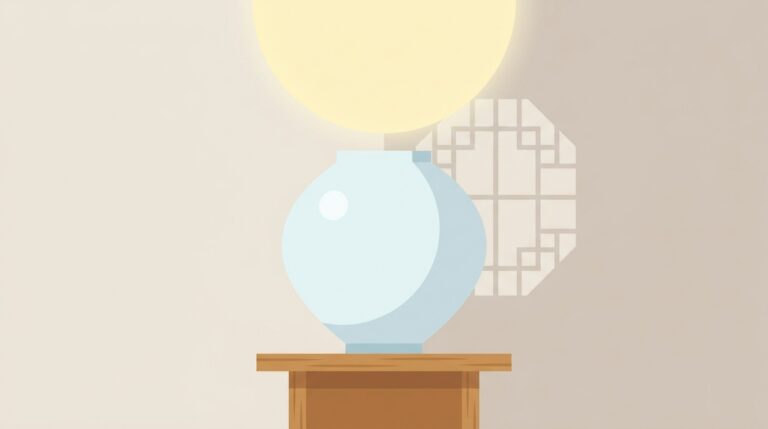
Phase 1: Empathy — When “Pretty” Just Isn’t Enough
안녕하세요! 매일한글 에디터입니다. (Annyeonghaseyo! Hello from your Daily Hangul Editor!) Imagine standing inside a quiet, sun-drenched gallery in Samcheong-dong, gazing at a milky-white Joseon Moon Jar (달항아리, Dalhangari) that you first spotted in a BTS RM art post. Your Korean friend remarks how its lopsided curves feel comforting, and your advanced vocabulary suddenly freezes. Saying “It is pretty” (예뻐요, yeppeoyo) feels way too flat! Many Level 5 learners share that their hardest hurdle is articulating subtle Korean aesthetics like humility and warmth. Built from real learner feedback, this guide gives you nuanced Korean to talk about K-Heritage effortlessly.
Phase 2: Deep Dive Into 3 Essential Expressions
1. 비움의 미학 (Bium-ui mihak)
- Pronunciation: Bium-ui mihak (Sounds like “Bee-oom-eh mee-hahk” — remember that possessive 의 is smoothly pronounced like “eh” in natural speech!)
- Meaning: Literal: “The aesthetics of emptying” / Actual Nuance: The intentional beauty found in restraint, negative space (여백의 미, yeobaek-ui mi), and letting go of excess ego or greed.
- K-Culture Moment: Picture an architectural documentary or an exhibition tour where a curator pauses before an unadorned white porcelain jar and explains how its lack of ornate patterns creates emotional breathing room.
- Editor’s Insight: Unlike Western minimalism, which often feels sleek, geometric, or cold, 비움의 미학 (bium-ui mihak) carries a warm, spiritual warmth—emptying oneself not to look trendy, but to make room for others and nature.
- Situation Spectrum: Casual ⚠️ (Slightly poetic for everyday banter) / Semi-formal ✅ / Formal ✅
- 🤔 Think About It: In English, “empty” often implies something missing or lonely. Why do you think Korean aesthetics treat “emptying” (비움, bium) as a state of fullness and comfort?
2. 인위적이지 않고 자연스럽다 (Inwijeogiji anko jayeonseureopda)
- Pronunciation: Inwijeogiji anko jayeonseureopda (Sounds like “Een-wee-juh-gee-jee ahn-ko jah-yuhn-suh-ruhp-dah” — let the ㄱ and ㅎ blend into a crisp “k” sound in 않고!)
- Meaning: Literal: “Not artificial and natural” / Actual Nuance: Effortlessly organic, unpretentious, and free from forced perfection—celebrating gentle asymmetry.
- K-Culture Moment: Frequently heard on K-Variety shows like You Quiz on the Block when master artisans or modern ceramicists describe why a slightly warped Moon Jar feels more alive than a machine-made sphere.
- Editor’s Insight: At Level 5, simply saying 자연스럽다 (jayeonseureopda) isn’t enough when praising craftsmanship. Pairing it with 인위적이지 않다 (inwijeogiji anta, not contrived) shows you truly grasp the artist’s restraint.
- Situation Spectrum: Casual ✅ (Great in thoughtful chats) / Semi-formal ✅ / Formal ✅
- 🤔 Think About It: When admiring art or even someone’s style in your native culture, do people praise symmetry and precision more, or deliberate imperfection?
3. 넉넉하게 품어 주다 (Neongneokage pumeo juda)
- Pronunciation: Neongneokage pumeo juda (Sounds like “Nuhng-nuh-kah-geh poo-muh joo-dah” — the double ㄱ/ㅎ softens into a clear “kah” sound!)
- Meaning: Literal: “To hold generously in one’s embrace” / Actual Nuance: To radiate warm, non-judgmental inclusivity and maternal comfort—just like the round, milky belly of a Moon Jar.
- K-Culture Moment: Think of heartfelt K-Drama scenes (like My Mister or Our Blues) where someone silently accepts another person’s flaws, or art critics describing why the Moon Jar feels like a gentle hug.
- Editor’s Insight: 넉넉하다 (neongneokada) means “generous/ample,” while 품다 (pumda) means “to embrace in one’s bosom.” Together, they turn a ceramic vessel into a living metaphor for Korean empathy (정, jeong).
- Situation Spectrum: Casual ✅ / Semi-formal ✅ / Formal ✅
- 🤔 Think About It: Can an inanimate object “embrace” someone in your language? How does personifying pottery reveal Korean views on warmth and community?
Phase 3: Textbook Korean vs. Real Korean
Situation 1: Describing the Imperfect Shape of a Moon Jar
- 📖 교과서 한국어 (Textbook Korean): 이 도자기는 좌우 대칭이 완벽하지 않아서 조금 특이해요. (I dojagineun jwau daechingi wanbyeokaji anaseo jogeum teugihaeyo. — “This ceramic isn’t symmetrically perfect, so it’s a bit unique.”)
- 🗣️ 진짜 한국어 (Real Korean): 완벽한 대칭이 아니라서 오히려 더 정감 가고 멋스럽네요. (Wanbyeokan daechingi aniraseo ohiryeo deo jeonggam gago meotseureomneyo. — “Precisely because it isn’t perfectly symmetrical, it feels even more endearing and tasteful.”)
- 💡 왜 다를까? (Why the Difference?): Calling asymmetry “unique” (특이하다, teugihada) can sound subtly critical in Korean. Native speakers use 오히려 (ohiryeo, on the contrary/rather) and 정감 가다 (jeonggam gada, to feel warm and approachable) to frame imperfection as the ultimate charm.
Situation 2: Reacting to the Milky-White Glaze
- 📖 교과서 한국어 (Textbook Korean): 하얀색이 아주 깨끗하고 화려하지 않아서 좋아요. (Hayansaegi aju kkaekkeutago hwaryeohaji anaseo joayo. — “The white color is very clean and not flashy, so I like it.”)
- 🗣️ 진짜 한국어 (Real Korean): 눈이 시릴 만큼 새하얀 게 아니라, 은은한 유백색이라서 마음이 편안해져요. (Nuni siril mankeum saehayan ge anira, euneunhan yubaeksaegiraso maeumi pyeonanhaejyeoyo. — “It isn’t blindingly snow-white; it’s a subtle milky white, so it puts my mind at ease.”)
- 💡 왜 다를까? (Why the Difference?): Joseon white porcelain isn’t sterile white—it has soft, warm undertones. Using 은은하다 (euneunhada, subtle/delicate) and 유백색 (yubaeksaek, milky white) immediately signals cultural fluency and refined taste.
Phase 4: K-Culture Deep Dive & Non-Verbal Manners
4-1. Nunchi (눈치) & Gallery Etiquette
When Koreans admire traditional ceramics at spaces like the National Museum of Korea or Leeum Museum, their body language reflects the very humility of the Moon Jar. Avoid pointing directly at artworks with a single extended finger—instead, gesture gently with an open palm turned slightly upward, as if cradling the curve in the air. Keep your voice softly modulated, pause for a few seconds of shared silence before speaking, and never lean too close to unglassed pedestals. That quiet pause shows deep respect (예의, yeui) both for the artifact and for fellow viewers.
4-2. Cultural Code Analysis: From Joseon Kilns to K-Heritage Minimalism
The Moon Jar (달항아리, Dalhangari) was never meant to flaunt royal extravagance; because two separate halves had to be thrown on the wheel and joined together, gravity naturally pulled each jar into a slightly asymmetrical orb during firing. Today, this 17th-to-18th-century philosophy drives modern K-Heritage across K-Pop and K-Travel. You can see it in the earthy, unvarnished interiors of contemporary Bukchon tea houses, in minimalist Korean skincare packaging (think Sulwhasoo’s Moon Jar-inspired bottles), and in global stars like BTS’s RM sharing quiet photos of Kwon Dae-sup’s modern Moon Jars—bridging centuries-old humble grace with contemporary healing.
Phase 5: Real-Life Roleplay Scenario
Setting: A tranquil afternoon at a contemporary craft gallery in Samcheong-dong, Seoul. Sunlight filters through traditional paper blinds onto a large modern Moon Jar.
Characters: 지연 (Ji-yeon), a warm, knowledgeable gallery curator in her 30s, and You, an art-loving Korean learner.
- 지연 (Ji-yeon): 🎭 (Smiling gently with hands clasped) 어서 오세요. 오늘 전시된 달항아리가 유독 눈길을 끌죠? (Eoseo oseyo. Oneul jeonsidoen dalhangariga yudok nungireul kkeuljyo? — “Welcome. The Moon Jar on display today really catches the eye, doesn’t it?”)
- You: 🎭 (Nodding slowly while admiring the curves) 네, 맞아요. 완벽한 원형이 아닌데도 묘하게 안정감이 느껴지네요. (Ne, majayo. Wanbyeokan wonhyeongi anindedo myohage anjeonggami neukkyeojineyo. — “Yes, it does. Even though it isn’t a perfect circle, it gives a strangely grounding sense of stability.”)
- 지연 (Ji-yeon): 🎭 (Eyes lighting up with appreciation) 와, 정말 예리하시네요! 위아래를 따로 만들어 붙이다 보니 자연스럽게 비대칭이 생기거든요. (Wa, jeongmal yerihasineyo! Wiaraereul ttaro mandeureo buchida boni jayeonseureopge bidaechingi saenggigeodeunyo. — “Wow, you’re so perceptive! Because the top and bottom are made separately and joined, asymmetry forms naturally.”)
- You: 🎭 (Tracing the soft curve gently in the air) 인위적이지 않고 자연스러워서 더 따뜻한 느낌이 드는 것 같아요. (Inwijeogiji anko jayeonseureowoseo deo ttatteutan neukkimi deuneun geot gatayo. — “Because it’s uncontrived and natural, I think it gives off an even warmer feeling.”)
- 지연 (Ji-yeon): 🎭 (Gesturing toward the glaze) 맞아요. 이 은은한 유백색도 욕심을 비운 겸허한 미학을 보여 주죠. (Majayo. I euneunhan yubaeksaekdo yoksimeul biun gyeomheohan mihageul boyeo jujyo. — “Exactly. This subtle milky glaze also reveals a humble aesthetic emptied of greed.”)
- You: 🎭 (Looking thoughtfully at the empty gallery wall around it) 주변의 여백까지 작품의 일부처럼 보여요. 넉넉하게 품어 주는 느낌이에요. (Jubyeon-ui yeobaekkkaji jakpum-ui ilbucheoreom boyeoyo. Neongneokage pumeo juneun neukkimieyo. — “Even the empty space around it looks like part of the artwork. It feels like it’s warmly embracing everything.”)
- 지연 (Ji-yeon): 🎭 (Chuckling warmly) 한국 미학의 핵심을 정확히 짚으셨어요. 요즘 K-헤리티지가 사랑받는 이유이기도 하죠. (Hanguk mihag-ui haeksimeul jeonghwaki jipeusyeosseoyo. Yojeum K-heritijiga sarangbanneun iyugido hajyo. — “You nailed the core of Korean aesthetics. That’s also why K-Heritage is so loved these days.”)
- You: 🎭 (Bowing slightly with a smile) 설명 덕분에 작품을 훨씬 깊이 있게 감상할 수 있었어요. 감사합니다. (Seolmyeong deokbune jakpumeul hwolssin gipi ikke gamsanghal su isseosseoyo. Gamsahamnida. — “Thanks to your explanation, I was able to appreciate the piece much more deeply. Thank you.”)
🔀 Interactive Branching Point: What Would You Say Next?
Ji-yeon offers you a catalog and asks if you’ve seen other Korean traditional ceramics before.
- Option A: “아직 낯설지만, 오늘 달항아리를 보면서 비움의 미학에 큰 매력을 느꼈어요.” (Ajik natseoljiman, oneul dalhangarireul bomyeonseo bium-ui mihage keun maeryeogeul neukkyeosseoyo. — “I’m still new to it, but seeing the Moon Jar today made me deeply drawn to the aesthetics of emptiness.”) -> [BEST!] Humble, culturally resonant, and uses advanced aesthetics vocabulary naturally.
- Option B: “네, 박물관에서 똑같이 하얀 그릇을 많이 봤는데 다 비슷해 보였어요.” (Ne, bangmulgwan-eseo ttokgachi hayan geureuseul mani bwanneunde da biseutae boyeosseoyo. — “Yes, I saw lots of identical white bowls at museums, and they all looked the same.”) -> [BAD!] Referring to a Moon Jar as a generic “bowl” (그릇) and saying they all look the same misses the subtlety and dampens the curator’s enthusiasm.
- Option C: “비대칭이라서 처음엔 불량품인 줄 알았는데, 생각보다 비싸서 놀랐어요.” (Bidaechingiraso cheoeumen bullyangpumin jul aranneunde, saenggakboda bissaseo nollasseoyo. — “Because it’s asymmetrical, I thought it was defective at first, and I was surprised it’s pricier than expected.”) -> [RISK!] While honest humor can sometimes work among close friends, calling an artwork a “defective product” (불량품) to a curator sounds jarring and overly blunt.
Phase 6: 10-Second Emotion Shadowing Drill
Read aloud while matching the pauses (/) and emotional cues!
- [😌 Reverently and calmly]
욕심을 비운 / 겸허한 곡선이 / 마음을 참 편안하게 해 주네요.
(Yoksimeul biun / gyeomheohan gokseoni / maeumeul cham pyeonanhage hae juneyo. — “The humble curves emptied of greed really put the mind at ease.”) -
[✨ In quiet awe of subtle beauty]
완벽하지 않아서 / 오히려 더 / 넉넉하게 품어 주는 느낌이에요.
(Wanbyeokaji anaseo / ohiryeo deo / neongneokage pumeo juneun neukkimieyo. — “Because it isn’t perfect, it feels like it embraces us even more generously.”) -
[🌿 Thoughtfully appreciative]
인위적이지 않고 / 자연스러운 멋이 / 바로 한국 미학의 핵심이죠.
(Inwijeogiji anko / jayeonseureoun meosi / baro hanguk mihag-ui haeksimijyo. — “An uncontrived, natural charm is truly the heart of Korean aesthetics.”)
Phase 7: K-Culture Mini Dictionary
| Word (Hangul & Romanization) | Translation | Real-Life & Business Usage |
|---|---|---|
| 여백의 미 (Yeobaek-ui mi) | Beauty of empty space | Used not only for traditional ink paintings and ceramics, but also in modern UX design, minimalist branding, and interior architecture. |
| 겸허하다 (Gyeomheohada) | Humble, modest | Higher-register synonym of 겸손하다; often used in formal speeches, art reviews, and leadership essays to praise quiet dignity. |
| 포용력 (Poyongnyeok) | Capacity to embrace, inclusivity | Frequently heard in both cultural commentary and Korean workplace evaluations when praising an empathetic leader or welcoming space. |
| 유백색 (Yubaeksaek) | Milky white | A refined color descriptor used in ceramics, luxury skincare marketing, lighting design, and fashion editorials. |
Phase 8: Survival Kit for Travelers
Top 3 Gallery & Heritage Survival Phrases
- 작품 설명을 들을 수 있을까요? (Jakpum seolmyeongeul deureul su isseulkka-yo?) — “Could I hear an explanation of the artwork?” (Pro Tip: Ask this politely at smaller Samcheong-dong or Insadong galleries—many curators love sharing stories behind contemporary K-Heritage pieces!)
- 사진 촬영이 가능한가요? (Sajin chwaryeongi ganeunghangayo?) — “Is photography allowed?” (Pro Tip: Even if a museum allows photos, always turn off your flash and mute your shutter sound out of nunchi!)
- 오디오 가이드는 어디서 빌려요? (Odio gaideuneun eodiseo billyeoyo?) — “Where can I rent an audio guide?” (Pro Tip: Major museums like the National Museum of Korea offer rich English audio guides and free daily docent tours.)
Editor’s Travel Note
- Essential Apps: Before heading to Bukchon or Yongsan, be sure to complete your Naver Map App download for accurate Korean walking routes and check the National Museum of Korea official exhibition schedule to see whether the special Moon Jar rooms are open.
- Transit & Payment Tips: Permanent exhibitions at national museums in Seoul are usually free, while special exhibitions require tickets (easily paid via T-money, Wowpass, or international Visa/Mastercard). Take Subway Line 4 to Ichon Station (Exit 2) for the National Museum, or Line 3 to Anguk Station for Bukchon’s modern ceramic boutiques.
Phase 9: One Step Deeper — Aesthetics of Warm Imperfection
In a hyper-competitive society where people constantly feel pressured to be flawless, Koreans’ enduring love for the Joseon Moon Jar offers a quiet rebellion. A Moon Jar never pretends to be perfectly round; its slight tilt reminds us that beauty doesn’t come from rigid control, but from accepting human limits with grace. Perhaps that is why traditional concepts like 여백의 미 (yeobaek-ui mi) and 포용 (poyong) continue to resonate so deeply in modern Korea—they give tired hearts permission to breathe, pause, and simply exist as they are.
💬 Your Turn: Think of a traditional object, craft, or cultural symbol from your own country. Does it celebrate flawless symmetry or warm imperfection? Share your thoughts in the comments below!
Phase 10: FAQ & Myth-Busting
Q: Why are Joseon Moon Jars always slightly lopsided? Was it a mistake by the potters?
A: Not at all! Because these jars were remarkably large (often over 40cm tall), Joseon potters had to shape the upper and lower hemispheres separately on the wheel and join them together. During high-temperature kiln firing, the clay naturally settled and tilted slightly—an organic result potters embraced rather than forcing into rigid symmetry.
Q: What is the difference between 겸손하다 (gyeomsonhada) and 겸허하다 (gyeomheohada) at Level 5?
A: 겸손하다 is the everyday word for being modest about yourself in social interactions (e.g., deflecting a compliment). 겸허하다 carries a deeper, philosophical nuance of humbling oneself before nature, life, art, or fate—making it ideal when discussing Moon Jars and K-Heritage.
Q: How is the Moon Jar reinterpreted in modern K-Heritage today?
A: Contemporary ceramic artists, architects, and luxury K-Beauty brands reinterpret the Moon Jar’s proportions, soft milky texture, and uncluttered silhouette into modern sculptural furniture, ceramic lighting, and minimalist packaging.
🚨 Common Mistakes Top 3
- Mistake: Saying “달항아리가 불량품 같아요” (It looks defective) to describe asymmetry. -> Correct Action: Use 비대칭의 조화 (bidaeching-ui johwa, harmony of asymmetry) or 자연스러운 곡선 (jayeonseureoun gokseon, natural curves).
- Mistake: Calling the color simply “하얀색” (plain white) or “새하얀색” (blinding snow-white). -> Correct Action: Describe its warmth with 은은한 유백색 (euneunhan yubaeksaek, subtle milky white).
- Mistake: Pronouncing 의 in 비움의 미학 strictly as “ui.” -> Correct Action: As a possessive particle, pronounce it smoothly as “e” (bium-e mihak) so your Level 5 Korean sounds effortlessly native.
Phase 11: Action Mission & Engagement
- 🥉 Bronze (Solo Practice): Stand in front of a mirror and recite the 3 shadowing lines in Phase 6 while practicing a gentle open-palm gesture.
- 🥈 Silver (SNS Share): Post a photo of a serene minimalist object or ceramic cup in your daily life with the caption: “오늘의 소소한 비움의 미학 (Oneul-ui sosohan bium-ui mihak — Today’s small aesthetic of emptying).”
- 🥇 Gold (Real-Life Use): Next time you visit a museum, cafe, or art exhibition with a Korean friend, weave “인위적이지 않고 자연스럽다” or “여백의 미” into your conversation!
🎮 K-Culture Mission: Search Korean YouTube or Instagram for #달항아리 (Dalhangari) or watch an exhibition vlog by RM or a Korean craft artisan. Spot how many times they use words like 여백 (yeobaek), 은은하다 (euneunhada), or 편안하다 (pyeonanhada)!
Phase 12: Interactive Quiz Challenge
Quiz 1 (Situational Judgment): You are admiring a modern Moon Jar with your Korean professor, who asks what impresses you most. Which response sounds the most culturally nuanced and appropriate?
A) 완전 하얗고 대칭이 완벽해서 비싸 보이네요.
B) 인위적이지 않은 비대칭 곡선이 마음을 참 편안하게 해 주네요.
C) 그냥 깔끔하고 예뻐서 집에 하나 놓고 싶어요.
Quiz 2 (Fill-in-the-Blank): Complete the sentence with the most fitting Level 5 expression:
“화려한 장식을 덜어낸 달항아리는 욕심을 비운 ( )의 미학을 잘 보여 줍니다.”
(Options: 1. 겸허 / 2. 사치 / 3. 과시)
Quiz 3 (True / False): In Korean aesthetics, 여백의 미 (yeobaek-ui mi) means leaving space empty purely because the artist ran out of time or materials.
Click here to reveal the answers and detailed explanations!
- Quiz 1 Answer: B — “인위적이지 않은 비대칭 곡선이 마음을 참 편안하게 해 주네요.” (The uncontrived asymmetrical curves really put the mind at ease.) Option A is factually off (Moon Jars aren’t starkly white or perfectly symmetrical), and Option C is too casual/simple for Level 5 with a professor.
- Quiz 2 Answer: 1. 겸허 (gyeomheo, humility) — 사치 (luxury) and 과시 (ostentation/showing off) express the exact opposite of a Moon Jar’s spirit.
- Quiz 3 Answer: False — 여백의 미 is an intentional aesthetic choice designed to create breathing room, reflection, and warm inclusivity for the viewer.
🎬 Watch Our Daily Videos! (Daily Hangul Official Instagram)
Review the expressions you learned in this article with our fun daily short videos! Check out native pronunciation and real-life nuances in action.
- Instagram @dailyhangul_en







