

How to Cancel a Payment in Korea Without Breaking a Sweat: Your Ultimate Guide to Smooth Refunds
Phase 1: Empathy (Story-Driven Opening)
안녕하세요! (Annyeonghaseyo!) I’m your Daily Hangul editor and Korean culture navigator. Have you ever stood at a trendy boutique in Seongsu-dong or a bustling makeup store in Myeongdong, holding a stylish jacket or skincare set, only to realize minutes later that you were double-charged, picked the wrong shade, or simply changed your mind?
Suddenly, your heart starts pounding. You want to cancel the transaction or ask for a refund, but your mind goes completely blank. You know the textbook word for refund (hwanbul), but you hesitate: What if I sound rude? How do I ask how long the card cancellation takes? Do they need my physical receipt and card?
Take a deep breath! You are definitely not alone. Over the years, countless international learners have told us that inquiring about payment cancellations (gyeolje chwiso) is one of the most nerve-wracking shopping hurdles in Korea. But when you master the right natural phrases, polite phrasing, and non-verbal cues, Korean staff are amazingly swift and helpful. Let’s make sure you never lose your hard-earned money or your confidence while shopping in Korea!
Phase 2: Core Expressions Deep Dive (Top 3)
1. 결제 취소하고 싶은데 어떻게 해야 돼요? (Gyeolje chwisohago sipeunde eotteoke haeya dwaeyo?)
- Pronunciation: [Gyeol-je chwi-so-ha-go shi-peun-de eo-tteo-ke hae-ya dwae-yo?] (Sounds like: ‘Gyul-jeh chwee-so ha-go sheep-un-deh uh-ttuh-keh hae-ya dweh-yo?’)
- Meaning: Literal: “I want to cancel payment, so how should I do it?” / Nuance: “I’d like to cancel this transaction. Could you guide me through the procedure?”
- K-Culture Moment: Seen frequently in K-Dramas when the flustered protagonist accidentally buys matching couple items and sheepishly walks back to the counter to reverse the card charge.
- Editor’s Insight: Ending with
-n-de eotteoke haeya dwaeyo?creates a soft, polite tone of asking for guidance rather than making a demanding complaint.- Situation Spectrum: Casual 🚫 / Semi-formal ✅ / Formal ✅
- 🤔 Think About It: Notice how Korean speakers rarely say direct imperative commands like “Cancel this now.” Why does framing a request as a question feel more cooperative in Korean service culture?
2. 카드 승인 취소는 언제쯤 처리되나요? (Kadeu seung-in chwisoneun eonjejjeum cheoridoenayo?)
- Pronunciation: [Ka-deu seung-in chwi-so-neun eon-je-jjeum cheo-ri-doe-na-yo?] (Sounds like: ‘Kah-deu sung-in chwee-so-noon un-jeh-jjoom chuh-ree-dweh-nah-yo?’)
- Meaning: Literal: “When around will the card approval cancellation be processed?” / Nuance: “Roughly when will the refund reflect on my card statement?”
- K-Culture Moment: Used by savvy shoppers at pop-up stores when returning pre-ordered K-Pop merchandise to ensure their foreign credit card release date.
- Editor’s Insight: Adding
-jjeum(roughly/around) softens your inquiry, showing understanding that bank processing times can vary.- Situation Spectrum: Casual ⚠️ / Semi-formal ✅ / Formal ✅
- 🤔 Think About It: In your home country, do customers ask the store clerk or call the credit card company directly to track transaction rollbacks?
3. 결제했던 실물 카드랑 영수증 여기 있어요. (Gyeoljehaetdeon silmul kadeurang yeongsujeung yeogi isseoyo.)
- Pronunciation: [Gyeol-je-haet-deon sil-mul ka-deu-rang yeong-su-jeung yeo-gi i-sseo-yo.] (Sounds like: ‘Gyul-jeh-haet-dun sheel-mool kah-deu-rang yung-soo-joong yuh-gee ee-ssuh-yo.’)
- Meaning: Literal: “Here is the physical card paid with and the receipt.” / Nuance: “I have both the original card used and the purchase receipt right here.”
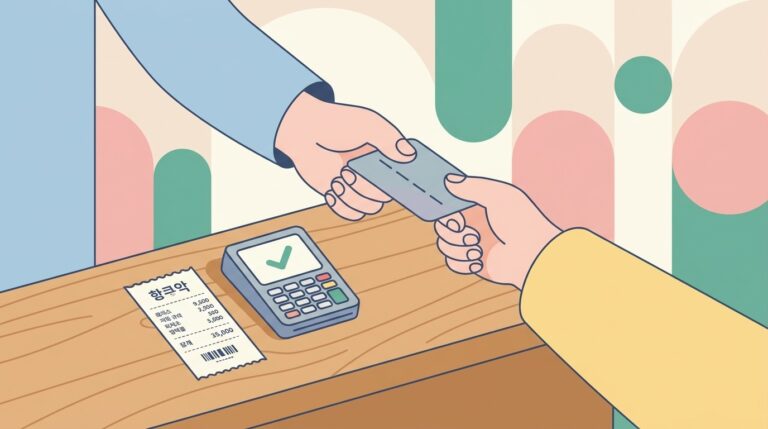
- K-Culture Moment: The signature gesture when shopping in Korea: handing over both items using two hands across the counter.
- Editor’s Insight: Silmul kadeu (physical plastic card) is essential to mention if you used Apple Pay or a physical card, as Korean POS terminals require the original payment method for instant reversal.
- Situation Spectrum: Casual 🚫 / Semi-formal ✅ / Formal ✅
- 🤔 Think About It: Why is presenting both the original payment method and paper receipt strictly enforced across East Asian retail systems?
Phase 3: Textbook Korean vs. Real-world Korean
Situation 1: Asking if a refund/cancellation is possible
- 📖 Textbook Korean: 환불을 요구합니다. (Hwanbuleul yoguhamnida. – “I demand a refund.”)
- 🗣️ Real-World Korean: 이거 혹시 결제 취소 가능할까요? (Igeo hoksi gyeolje chwiso ganeunghalkkayo? – “By any chance, would it be possible to cancel this purchase?”)
- 💡 Why is it different? The textbook phrase sounds like an aggressive legal notice! Using hoksi (by any chance) and -lkkayo? makes your tone respectful and collaborative.
Situation 2: Asking if you can exchange for a different color instead
- 📖 Textbook Korean: 다른 색상으로 변경하십시오. (Dareun saeksangeuro byeongyeonghasipsio. – “Change it to another color.”)
- 🗣️ Real-World Korean: 취소 대신 다른 색으로 교환해도 될까요? (Chwiso daesin dareun saegeuro gyohwanhaedo doelkkayo? – “Could I perhaps exchange it for another color instead of cancelling?”)
- 💡 Why is it different? Native speakers soften everyday store transactions with
-haedo doelkkayo?(May I…?) to maintain friendly rapport with staff.
Phase 4: K-Culture Deep Dive & Non-Verbal Etiquette
4-1. Nunchi (눈치) & Body Language at the Counter
When approaching the counter for a payment cancellation in Korea:
1. Two-Hand Rule: Hand over your receipt and credit card with both hands (or your right hand supported lightly by your left forearm). This immediately demonstrates good manners.
2. The Polite Nod: A slight 15-degree head bow as you approach the cashier signals respect and prepares the staff to assist you gladly.
3. Receipt Readiness: Korean retail POS machines require the original barcode or approval number printed on the receipt. Having the receipt already pulled out saves precious time.
4-2. Cultural Code: The ‘Ppallli-Ppalli’ (빨리빨리) Card Culture
Korea is virtually a cashless society. Over 90% of retail transactions occur via cards or mobile quick-pay (Samsung Pay, Apple Pay, KakaoPay). Because transactions process in milliseconds, card cancellations are treated as reverse-authorization rather than cash paybacks. Korean clerks will usually print a minus-receipt (chwiso yeongsujeung) showing -₩25,000 immediately so you can leave with absolute peace of mind.
Phase 5: Real-World Roleplay Scenario
- Setting: An olive-toned flagship cosmetics store in Hongdae on a rainy Saturday afternoon.
- Characters: You (Curious Traveler) & Min-ji (Friendly Store Staff, NPC).
- You: 저기요, 죄송한데 결제 취소 좀 도와주실 수 있나요? (Jeogiyo, joesonghande gyeolje chwiso jom dowajusil su innayo?)
🎭 Action: [Holding your shopping bag gently, making polite eye contact]
(Excuse me, sorry to bother you, could you please help me cancel a payment?) -
Min-ji: 네, 고객님! 구매하신 영수증이랑 결제 카드 있으신가요? (Ne, gogaeknim! Gumaehasin yeongsujeung-irang gyeolje kadeu isseusingayo?)
🎭 Action: [Smiling brightly and preparing the scanner terminal]
(Yes, valued customer! Do you have your receipt and the card you used to pay?) -
You: 네, 영수증이랑 실물 카드 여기 있어요. (Ne, yeongsujeung-irang silmul kadeu yeogi isseoyo.)
🎭 Action: [Presenting the paper receipt and credit card with both hands]
(Yes, here are the receipt and the physical card.) -
Min-ji: 결제 취소 도와드릴게요. 상품에 이상이 있으셨나요? (Gyeolje chwiso dowadeurilgeyo. Sangpume isangi isseosyeonnayo?)
🎭 Action: [Scanning the receipt barcode and tapping buttons on the POS]
(I’ll assist with the cancellation. Was there any issue with the product?) -
You: 아뇨, 친구 선물인데 색상을 잘못 골라서요. (Anyo, chingu seonmul-inde saeksangeul jalmot gollaseoyo.)
🎭 Action: [Chuckling lightly with a sheepish grin]
(No, it’s a gift for a friend, but I picked the wrong shade.) -
Min-ji: 아, 그러셨군요! 카드 승인 취소 완료되었습니다. (A, geureosyeotgunyo! Kadeu seung-in chwiso wanryodoeeotseumnida.)
🎭 Action: [Handing back the card along with a minus-receipt]
(Ah, I see! The card transaction cancellation has been completed.) -
You: 혹시 카드 승인 취소는 언제쯤 계좌에 반영되나요? (Hoksi kadeu seung-in chwisoneun eonjejjeum gyejwa-e banyeongdoenayo?)
🎭 Action: [Receiving the card carefully with both hands]
(By the way, roughly when will the cancellation reflect in my account?) -
Min-ji: 해외 카드라서 영업일 기준 3일에서 5일 정도 걸릴 거예요! (Hae-oe kadeuraseo yeongeobil gijun sam-il-eseo o-il jeongdo geollil geoyeyo!)
🎭 Action: [Nodding reassuringly]
(Since it’s an overseas card, it will take about 3 to 5 business days!)
🔀 Interactive Decision Branch
What if the clerk says: “Tag-i eopseoseo hwanburi eoryeowoyo” (The tag is missing, so a refund is difficult)? How do you respond?
- Option A: “아, 몰라요! 그냥 환불해 줘요!” (A, mollayo! Geunyang hwanbulhae jwoyo! – I don’t care! Just refund me!)
- 👉 Feedback (Bad): Extremely rude and confrontational in Korea; staff may call store security.
- Option B: “죄송하지만 뜯지 않은 새 상품인데, 다른 제품으로 교환은 가능할까요?” (Joesonghajiman tteutji aneun sae sangpum-inde, dareun jepumeuro gyohwaneun ganeunghalkkayo? – I’m sorry, but it’s an unopened brand-new item. Could I perhaps exchange it for another product?)
- 👉 Feedback (Best!): Polite, flexible, and shows empathy. Most Korean retail managers will readily approve an even exchange.
- Option C: (Walk out in silence without taking your receipt or item)
- 👉 Feedback (Risk): You lose both your money and the item unnecessarily without negotiating an exchange.
Phase 6: 10-Second Emotional Shadowing Drill
Practice out loud with emotional rhythm pauses marked by /:
[🥺 Slightly apologetic & humble]
저기요… / 결제 취소하고 싶은데 / 어떻게 해야 돼요?
(Jeogiyo… / gyeolje chwisohago sipeunde / eotteoke haeya dwaeyo?)-
[💳 Clear & cooperative]
영수증이랑 / 결제했던 카드 / 여기 같이 드릴게요.
(Yeongsujeung-irang / gyeoljehaetdeon kadeu / yeogi gachi deurilgeyo.) -
[😊 Relieved & grateful]
친절하게 안내해 주셔서 / 정말 감사합니다!
(Chinjeolhage annaehae jusyeoseo / jeongmal gamsahamnida!)
Phase 7: K-Culture Mini Dictionary
- 결제 취소 (Gyeolje Chwiso): Payment Cancellation. Used at point-of-sale to reverse credit card authorizations or digital wallet payments before settlement.
- 영수증 (Yeongsujeung): Receipt. Vital document in Korea; holds the unique transaction approval number (seung-in beonho) required for POS returns.
- 승인 취소 (Seung-in Chwiso): Approval Cancellation / Card Authorization Void. The formal term clerks use when voiding a swipe or chip charge.
- 영업일 기준 (Yeongeobil Gijun): Based on Business Days. Excludes weekends and Korean public holidays (gonghyuil) when calculating international bank wire returns.
Phase 8: Traveler’s Survival Kit
Top 3 Survival Phrases
- 이거 환불 가능한가요? (Igeo hwanbul ganeunghangayo?) – Is a refund possible for this? (Pro Tip: Say this within 7 days of purchase for most cosmetic and fashion outlets.)
- 영수증 재발급 되나요? (Yeongsujeung jaebalgeup doenayo?) – Can my receipt be reissued? (Pro Tip: If you lost your receipt, stores can look up the purchase using your exact credit card number and purchase timestamp.)
- 취소 영수증도 같이 주세요. (Chwiso yeongsujeungdo gachi juseyo.) – Please give me the cancellation receipt as well. (Pro Tip: Always snap a quick photo of the minus-receipt for your records.)
Editor’s Travel Note
Always make sure you have reliable mobile data and navigation apps ready. Before heading back to a store, check store operating hours using Naver Map App Download. Keep all tax-free shopping receipts organized in a separate pouch; canceling a tax-free purchase requires re-scanning your passport alongside the original receipt!
Phase 9: A Step Deeper (Reflection)
In Korean customer service culture, canceling a transaction isn’t seen as a conflict, but as a mutual courtesy procedure (sangho ye-ui). Notice how phrases in Korean naturally embed humility words like joesonghande (I’m sorry to trouble you) and hoksi (by any chance) even when you are exercising your clear right as a paying consumer. By cushioning your request with soft grammar, you invite the staff member into a cooperative problem-solving partnership.
💬 Your Turn: Have you ever experienced an awkward refund moment while traveling abroad? How would using these polite Korean phrases have changed that experience? Share your stories in the comments below!
Phase 10: FAQ & Common Mistakes
Q: Can I get a refund in cash if I paid with a foreign credit card?
A: No. Under Korean financial regulations, payment cancellations must strictly be returned through the original payment method (the exact same card or digital wallet).
Q: How long does an overseas credit card cancellation take to show up?
A: While local Korean cards void instantly, international credit/debit cards take approximately 3 to 7 business days (yeongeobil gijun) depending on your home country’s issuing bank.
Q: Can I return an item if I lost the physical price tag?
A: Most Korean retail stores require original tags attached (taek michimson) and unopened packaging for full refunds. However, polite negotiation often allows an exchange for another item of equal value.
🚨 Common Mistakes Alert
- Bringing only a photo of the card: POS terminals must physically swipe, insert, or tap the chip of the original card to process a refund.
- Using informal speech (Banmal): Never say “Chwisohae” or “Hwanbulhae”. Always use polite ending -yo (Chwisohae juseyo).
- Demanding immediate banking updates: Yelling that your banking app hasn’t updated on the spot will only cause stress; international card gateways process transactions overnight.
Phase 11: Action Mission
- 🥉 Bronze Mission (Solo Drill): Practice reading the 3 Core Expressions aloud 5 times in front of your mirror while holding your payment card with both hands.
- 🥈 Silver Mission (Social Share): Write your favorite sentence from today’s guide on Instagram Stories or Threads and tag
@DailyHangulwith the hashtag#KoreanShoppingSkills. - 🥇 Gold Mission (Real Life): Next time you shop in Korea or a Korean supermarket, politely ask the cashier for a receipt using “Yeongsujeung juseyo!” with a confident smile.
- 🎮 K-Culture Mission: Watch an episode of a slice-of-life K-drama (like Hospital Playlist or Welcome to Samdal-ri) and spot how characters hand over cards at convenience stores or coffee shops!
Phase 12: Interactive Quiz Challenge
1. [Situational Judgment] You bought a sweater in Myeongdong, but want to cancel the charge right away. What is the most natural, polite Korean sentence to say to the cashier?
* A) 결제 취소하십시오. (Gyeolje chwisohasipsio.)
* B) 결제 취소하고 싶은데 어떻게 해야 돼요? (Gyeolje chwisohago sipeunde eotteoke haeya dwaeyo?)
* C) 환불을 빨리 처리해라. (Hwanbuleul ppalli cheorihaera.)
👉 Click to reveal Answer & Explanation
Correct Answer: B
Explanation: Option B is polite, natural, and frames the situation cooperatively. Option A sounds like a military command, and Option C is rude informal speech.
2. [Fill in the Blank] Fill in the missing word for physical card: “결제했던 ______ 카드랑 영수증 여기 있어요.”
* A) 가상 (Gasang – Virtual)
* B) 실물 (Silmul – Physical)
* C) 선물 (Seonmul – Gift)
👉 Click to reveal Answer & Explanation
Correct Answer: B (실물 – Silmul)
Explanation: ‘Silmul kadeu’ refers to the actual physical card required by the card reader to cancel the swipe.
3. [True or False] Korean retail shops will gladly issue a cash refund for purchases made on a Visa or MasterCard.
* True / False
👉 Click to reveal Answer & Explanation
Correct Answer: False
Explanation: Korean financial regulations require transactions to be refunded back to the original payment method.







