

Phase 1: Empathy & Story Opening
안녕하세요! 매일한글 에디터입니다. (Hello! I’m your Daily Hangul editor.)
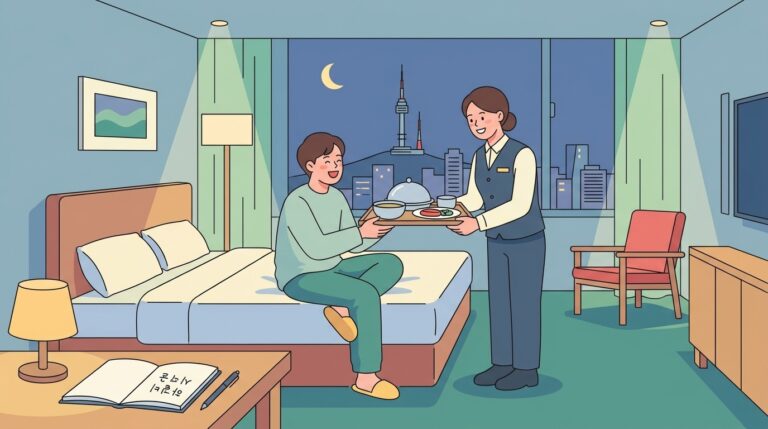
Picture this: After a thrilling 10-hour flight landing at Incheon and exploring the vibrant streets of Myeongdong, you finally check into your cozy hotel in Seoul. It is 10:30 PM. Your legs are aching, your stomach is growling, and all you want is a warm bowl of Kimchi stew or crispy fried chicken delivered straight to your door. You pick up the in-room telephone, press the ‘Room Service’ button, hear the polite chime, and suddenly… panic sets in!
“What if they speak only fast Korean? How do I say my room number naturally? What if I accidentally order three bowls instead of one?”
If you have ever hesitated before picking up the phone in a Korean hotel, you are definitely not alone. Many A2-level Korean learners find phone conversations intimidating because you cannot rely on hand gestures or facial expressions. But don’t worry! Ordering room service in Korea is actually one of the easiest, most rewarding micro-adventures you can have during your trip. With just three core patterns and our secret cultural etiquette tips, you will order like a seasoned K-Drama chaebol heir in under two minutes. Let’s dive in!
Phase 2: Core Expressions Deep Dive
1. 룸서비스 주문하고 싶어요 (Rumseobiseu jumunhago sipeoyo)
- Pronunciation: [Room-suh-bee-seu joo-moon-ha-go she-paw-yo] (Think of ‘room service’ with a soft Korean beat, followed by ‘joo-moon’ like ‘June moon’ + ‘she-paw-yo’)
- Meaning: Literal: “I want to order room service.” / Nuance: “Hello, I’d like to place a room service order, please.”
- K-Culture Moment: Seen in classic luxury K-Dramas like Business Proposal or King the Land, when the protagonist relaxes in a high-end suite after a long day.
- Editor’s Insight: The ending
~고 싶어요 (~go sipeoyo)is your friendly, polite magic wand for expressing any wish at the A2 level. It immediately signals your intent gently.- Situation Spectrum: Casual: ⚠️ (Sounds too formal with friends) | Semi-formal: ✅ | Formal: ✅
- 🤔 Think About It: In English, we often say “Can I get…?” framed as asking permission. Why do you think Korean directly states the desire politely using
~고 싶어요instead?2. 702호인데요, 치킨 하나 주세요 (Chilbaegi-ho-indeyo, chikin hana juseyo)
- Pronunciation: [Cheel-baek-ee ho-in-deh-yo, chee-keen ha-na joo-seh-yo] (Sounds like ‘Chill-back-ee-ho’ + ‘chicken ha-na joo-say-yo’)
- Meaning: Literal: “It’s room 702, please give me one chicken.” / Nuance: “This is room 702; I would like to order one serving of chicken, please.”
- K-Culture Moment: Whenever travelers crave late-night chimaek (chicken and beer) inside their hotel room while watching late-night variety shows.
- Editor’s Insight: The connector
~인데요 (~indeyo)provides background context (“I’m in room 702, and so…”). Remember to use Sino-Korean numbers for room digits (칠백이호= 702) and Native Korean numbers for counting items (하나= one).- Situation Spectrum: Casual: ⚠️ | Semi-formal: ✅ | Formal: ✅
- 🤔 Think About It: Notice how Korean introduces the room context first before making the request. How does providing context first reflect Korean conversational courtesy?
3. 얼마나 걸려요? (Eolmana geollyeoyo?)
- Pronunciation: [Uhl-mah-nah gull-lyuh-yo?] (Think of ‘All-mana’ + ‘gull’ like the bird + ‘yuh-yo’)
- Meaning: Literal: “How much does it catch/take?” / Nuance: “How long will it take?”
- K-Culture Moment: In fast-paced K-Dramas, busy characters ask this before running to an urgent business meeting or date.
- Editor’s Insight:
얼마나 (eolmana)means ‘how much/long’, and걸려요 (geollyeoyo)is the standard verb for time duration. It’s concise, polite, and essential for planning your shower while waiting for food!- Situation Spectrum: Casual: ⚠️ (
얼마나 걸려?) | Semi-formal: ✅ | Formal: ✅- 🤔 Think About It: In your native tongue, do you ask about “time length” or “cost/amount of time”? Korean uses
얼마나for both price and time duration!
Phase 3: Textbook Korean vs. Real-world Korean
Situation 1: Giving your room number on the phone
- 📖 Textbook Korean: 제 방 번호는 501호입니다. (Je bang beonhoneun obaegil-ho-imnida. – “My room number is 501.”)
- 🗣️ Real Korean: 501호인데요! (Obaegil-ho-indeyo! – “I’m in room 501!”)
- 💡 Why is it different? While the textbook version is grammatically flawless, real Koreans use
~인데요to smoothly set up the conversation without sounding like a robotic press release.
Situation 2: Asking for extra napkins or water when the cart arrives
- 📖 Textbook Korean: 저에게 물을 더 주시겠습니까? (Jeo-ege muleul deo jusigesseumnikka? – “Would you give more water to me?”)
- 🗣️ Real Korean: 물 하나만 더 부탁드려요. (Mul hanaman deo butakdeuryeoyo. – “Just one more bottle of water, please.”)
- 💡 Why is it different? Native speakers avoid heavy passive/conditional questions. Adding
부탁드려요 (butakdeuryeoyo - I kindly request)sounds warmer, extremely polite, and concise.
Phase 4: K-Culture Deep Dive & Non-Verbal Manners
4-1. 눈치 (Nunchi) & Phone Etiquette
- The Vocal Smile (목소리 미소): In Korean service culture, a soft, slightly higher-pitched tone over the phone conveys friendliness and respect. When speaking, aim for a calm, cheerful rhythm.
- Receiving the Delivery: When hotel staff deliver your tray, receive the receipt or clipboard with two hands (양손) or place your left hand gently supporting your right forearm. A light 15-degree bow with “감사합니다 (Gamsahamnida)” shows wonderful etiquette.
4-2. Cultural Code: The Midnight Yasik (야식) Culture
South Korea has an unmatched late-night food culture called Yasik (야식). Even in luxury hotels, room service menus often feature upscale twists on beloved comfort foods: Abalone porridge (Jeonbok-juk), Korean fried chicken, and handmade ramyeon. Ordering room service is not just dining; it is a cozy, quintessential K-travel relaxation ritual!
Phase 5: Real-World Roleplay Scenario
Setting: Room 1204 at a boutique hotel overlooking the Han River in Seoul. 11:00 PM.
Characters: You (Hungry Traveler) & Min-su (Polite Hotel Service Concierge).
- Turn 1 (Min-su): 네, 룸서비스입니다. 무엇을 도와드릴까요? 🎭 [Polite, bright phone voice]
(Ne, rumseobiseu-imnida. Mueoseul dowadeurilkkayo? / Yes, this is room service. How may I help you?) - Turn 2 (You): 안녕하세요! 룸서비스 주문하고 싶어요. 🎭 [Friendly, confident]
(Annyeonghaseyo! Rumseobiseu jumunhago sipeoyo. / Hello! I would like to order room service.) - Turn 3 (Min-su): 네, 고객님. 객실 번호와 메뉴 말씀해 주세요. 🎭 [Ready to write down order]
(Ne, gogaeknim. Gaeksil beonhowa menyu malsseumhae juseyo. / Yes, valued guest. Please tell me your room number and menu items.) - Turn 4 (You): 1204호인데요, 불고기 덮밥 하나 주세요. 🎭 [Clear pronunciation]
(Cheon-ibaeksa-ho-indeyo, bulgogi deopbap hana juseyo. / It’s room 1204; please give me one Bulgogi rice bowl.) - Turn 5 (Min-su): 네, 불고기 덮밥 하나 맞으실까요? 음료는 필요 없으세요? 🎭 [Checking details]
(Ne, bulgogi deopbap hana majeuseilkkayo? Eumryoneun piryo eopseuseyo? / Yes, one Bulgogi bowl. Would you like any drinks?) - Turn 6 (You): 콜라 하나도 같이 주세요. 얼마나 걸려요? 🎭 [Asking smoothly]
(Kolla hanado gachi juseyo. Eolmana geollyeoyo? / Please include one Coke too. How long will it take?) - Turn 7 (Min-su): 약 25분 정도 걸립니다. 맛있게 준비해 드리겠습니다. 🎭 [Reassuring tone]
(Yak isibo-bun jeongdo geollimnida. Mas-itge junbihae deurigesseumnida. / It takes about 25 minutes. We will prepare it deliciously for you.) - Turn 8 (You): 네, 감사합니다! 🎭 [Happy tone before hanging up]
(Ne, gamsahamnida! / Great, thank you!)
🔀 Interactive Decision Fork
When Min-su asks if you need drinks in Turn 5, what will you say?
* Choice A: “불고기 싫어요, 피자 줘.” (Bulgogi sileoyo, pija jwo.)
Feedback (Bad): ❌ Too blunt and uses informal speech (banmal) to staff! This can feel rude.
* Choice B: “콜라 하나도 같이 주세요.” (Kolla hanado gachi juseyo.)
Feedback (Best): 🌟 Perfect! Polite, clear, and uses the natural ~도 같이 (also together) structure.
* Choice C: “음료수 아무거나 가져와요.” (Eumryosu amugeona gajyeowayo.)
Feedback (Risk): ⚠️ Means “Bring whatever drink.” Staff won’t know your preference and might be confused.
Phase 6: 10-Second Emotion Shadowing Drill
Practice matching the exact rhythm and intonation with these emotion markers:
[😊 Cheerful & Courteous]
안녕하세요! / 룸서비스 / 주문하고 싶어요.
(An-nyeong-ha-se-yo! / Rum-seo-bi-seu / ju-mun-ha-go si-peo-yo.)-
[🎯 Clear & Precise]
1204호인데요, / 불고기 덮밥 하나 / 주세요.
(Cheon-i-baek-sa-ho-in-de-yo, / bul-go-gi deop-bap ha-na / ju-se-yo.) -
[⏳ Curious & Anticipating]
음식 나오는 데 / 얼마나 / 걸려요?
(Eum-sik na-o-neun de / eol-ma-na / geol-lyeo-yo?)
Phase 7: K-Culture Mini Dictionary
- 객실 (Gaeksil) | Hotel guest room | Used formally by hotel staff instead of the casual word
방 (bang). Example: “객실 번호 (Room number)”. - 야식 (Yasik) | Late-night meal/snack | The beloved Korean culture of eating tasty meals between 10 PM and 2 AM.
- 치맥 (Chimaek) | Chicken & Beer combo | The ultimate pairing often ordered to hotel rooms after sightseeing.
- 포장/배달 (Pojang / Baedal) | Takeout / Delivery | Delivery culture in Korea is world-class. Hotels often have specific pickup spots in the lobby for app deliveries.
Phase 8: Traveler’s Survival Kit
Top 3 Survival Phrases
- 수저 하나 더 주세요 (Sujeo hana deo juseyo) (Please give me one more set of spoon and chopsticks)
👉 Pro Tip: In case you share a meal with your travel buddy. - 체크아웃 할 때 계산할게요 (Chekeu-aut hal ttae gyesanhalgeyo) (I will pay when checking out)
👉 Pro Tip: Most hotel room service charges can be billed directly to your room folio. - 다 먹은 그릇은 문 밖에 둘게요 (Da meogeun geureuseun mun bakke dulgeyo) (I will leave the finished dishes outside the door)
👉 Pro Tip: Keeps your room clean and fresh overnight!
Editor’s Travel Note
If your accommodation does not offer 24-hour room service, you can easily use delivery services. Check our guide on Naver Map and Baemin Delivery setup for foreign travelers to pick up food right at your hotel lobby with zero language barrier!
Phase 9: A Step Deeper (Reflection)
In Korea, phone interactions with service providers are deeply rooted in mutual consideration (Baeryeo, 배려). Notice how phrases like ~인데요 soften the conversation by introducing background first, rather than demanding an action upfront. This linguistic buffer reflects an egalitarian respect between customer and service provider.
💬 Your Turn: In your home country, do people state their room number first or their order first when calling hotel room service? Share your experience in the comments below!
Phase 10: FAQ & Common Mistakes
Q: Do I need to tip the room service delivery staff in Korea?
A: No! South Korea does not have a tipping culture. All service fees and taxes (VAT) are already included in the bill. A warm verbal thank you with a slight bow is the best etiquette.
Q: Can I order regular delivery apps (like Baemin) to my hotel room door?
A: Most Korean hotels do not allow delivery couriers into guest elevators for security reasons. You should meet the delivery rider in the 1st-floor lobby or main entrance.
Q: How do I read hotel room numbers in Korean?
A: Use Sino-Korean numbers: 305 is Sam-baek-o-ho (305호), 1402 is Cheon-sa-baek-i-ho (1402호).
🚨 Common Mistakes Alert
- Mistake: Using pure English numbers like “Room seven zero two” when speaking slow Korean.
Correct Action: Learn your Sino-Korean numbers: 칠백이호 (Chil-baek-i-ho). - Mistake: Forgetting counter words and saying “치킨 일 주세요”.
Correct Action: Use Native Korean counters for food: 치킨 하나 (hana) 주세요. - Mistake: Giving a cash tip directly to the staff.
Correct Action: Simply say “감사합니다, 맛있게 먹을게요! (Thank you, I’ll enjoy the meal!)” with both hands clasped.
Phase 11: Action Missions
- 🥉 Bronze Mission (Solo Practice): Stand in front of your mirror, hold a phone to your ear, and recite: “안녕하세요! 501호인데요, 룸서비스 주문하고 싶어요.” smoothly three times.
- 🥈 Silver Mission (Social/Study Share): Write your favorite midnight snack in Korean in our comments section using the pattern:
[Food name] + 하나 주세요! - 🥇 Gold Mission (Real Action): On your next trip to Korea (or during your next hotel stay), order a meal or extra towel via telephone in 100% Korean!
🎮 K-Culture Mission: Watch any hotel scene in your favorite K-Drama this week and spot whether characters use ~인데요 when introducing their situation!
Phase 12: Interactive Quiz Challenge
Q1. Fill in the blank:
“803호________, 김치찌개 하나 주세요.” (It’s room 803; please give me one Kimchi stew.)
(1) 예요 (2) 인데요 (3) 하고 (4) 에서
Q2. True or False:
In South Korea, you must prepare a 15% cash tip for the hotel room service staff. (True / False)
🔍 Click here to reveal Answers & Explanations!
- Q1 Answer: (2) 인데요 (indeyo)
Explanation:~인데요is the natural connector used to introduce background context politely when starting a phone request. - Q2 Answer: False
Explanation: Korea is a strictly non-tipping country. Polite words and two-handed manners are all you need!







