

Phase 1: Empathy (Story-Driven Opening)
안녕하세요! 매일한글 에디터입니다. (Hello! I’m your Daily Hangul editor.)
Picture this: You just landed in Seoul and headed straight to the bustling COEX Mall or the futuristic Dongdaemun Design Plaza (DDP). Your hands are full of shopping bags filled with K-beauty skincare and limited-edition K-Pop photocards. Your feet are aching from hitting 15,000 steps, and you are staring at an endless maze of underground corridors, desperately looking for a way up to the next floor. You spot an information desk or a friendly store clerk, but your mind goes blank. Should you take the stairs? Is there a lift?
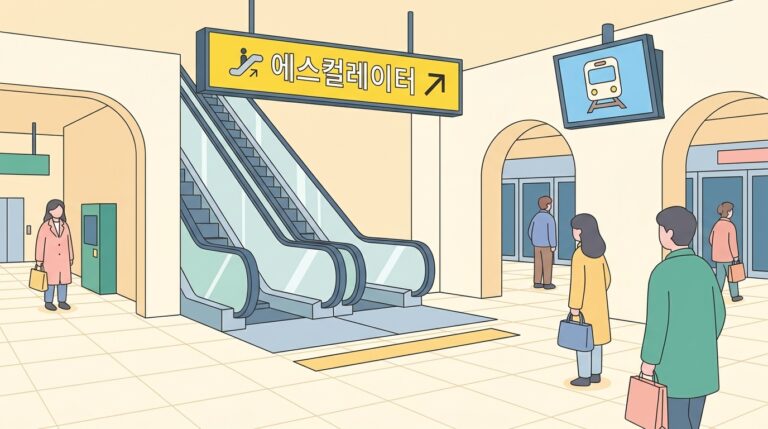
Suddenly, the smiling clerk notices your confusion, points gently with an open palm toward the corner, and says warmly: “에스컬레이터 타세요! (Eseukeolleiteo taseyo! / Take the escalator!)”
Navigating multi-level department stores, massive subway transfer stations like Express Bus Terminal, and sprawling shopping complexes is an everyday adventure in South Korea. Based on real feedback from hundreds of beginner learners in our Daily Hangul community, asking for and following directions to basic facilities like escalators is one of the most immediate confidence-boosters you can master. In this guide tailored for absolute beginners (A1), you will master how to spot, ask for, and follow escalator directions naturally—just like a Seoul local!
Phase 2: Top 3 Core Expressions In-Depth
1. 에스컬레이터 타세요 (Eseukeolleiteo taseyo)
- Pronunciation: [E-seu-keol-le-i-teo ta-se-yo] (Sounds like “Ess-cur-lay-ee-tor tah-say-yo”)
- Meaning: Literal: “Ride the escalator” / Practical: “Please take the escalator.”
- K-Culture Moment: You’ll hear this constantly in K-Dramas whenever a character is guiding a friend through a busy department store (like in Queen of Tears) or inside a modern high-rise office building.
- Editor’s Insight: In Korean, the verb 타다 (tada) means “to ride” or “to take” any form of wheeled or moving transport (buses, subways, taxis, and yes, escalators and elevators!). Adding -세요 (-seyo) makes it a gentle, polite suggestion.
- Situation Spectrum:
- Casual (with close friends): ⚠️ 에스컬레이터 타 (Eseukeolleiteo ta)
- Semi-formal / Polite everyday: ✅ 에스컬레이터 타세요 (Eseukeolleiteo taseyo)
- Formal announcements: ✅ 에스컬레이터를 이용해 주시기 바랍니다 (Eseukeolleiteoreul i-yong-hae ju-si-gi ba-ram-ni-da)
- 🤔 Think About It: Why does Korean use the verb “to ride” (타다) for stationary moving stairs? Because Korean focuses on the passive motion of being carried by the machine!
2. 저쪽에 있어요 (Jeojjoge isseoyo)
- Pronunciation: [Jeo-jjo-ge it-sseo-yo] (Sounds like “Judge-choke-eh ee-so-yo”)
- Meaning: Literal: “It exists in that direction” / Practical: “It is over that way / over there.”
- K-Culture Moment: When retail workers or subway staff guide travelers, they will pair this exact sentence with a polite two-handed or open-palm directional gesture.
- Editor’s Insight: 저쪽 (jeojjok) refers to a place away from both the speaker and the listener. It’s the most common directional pointer in daily Korean life.
- Situation Spectrum:
- Casual: ⚠️ 저쪽에 있어 (Jeojjoge isseo)
- Semi-formal: ✅ 저쪽에 있어요 (Jeojjoge isseoyo)
- Formal: ✅ 저쪽에 있습니다 (Jeojjoge itsseumnida)
- 🤔 Think About It: Notice how Korean distinguishes between “here” (이쪽), “there near you” (그쪽), and “way over there” (저쪽). How does this compare to your language?
3. 어디에 있어요? (Eodie isseoyo?)
- Pronunciation: [Eo-di-e it-sseo-yo?] (Sounds like “Uh-dee-eh ee-so-yo?”)
- Meaning: Literal: “At where does it exist?” / Practical: “Where is it located?”
- K-Culture Moment: The ultimate survival phrase! Whether hunting for the nearest subway exit or the escalator up to the K-Pop pop-up event, this phrase unlocks every door.
- Editor’s Insight: At the A1 level, simply attach any noun in front: [Noun] + 어디에 있어요? (e.g., 에스컬레이터 어디에 있어요? = Where is the escalator?).
- Situation Spectrum:
- Casual: ⚠️ 어디 있어? (Eodi isseo?)
- Semi-formal: ✅ 어디에 있어요? (Eodie isseoyo?)
- Formal: ✅ 어디에 있습니까? (Eodie itsseumnikka?)
- 🤔 Think About It: Asking “Where is X?” in Korean puts the place first and the question word next. Why do you think Korean establishes the topic before asking the question?
Phase 3: Textbook Korean vs. Real Korean
Situation 1: Asking where the escalator is
- 📖 교과서 한국어 (Textbook): “실례지만, 에스컬레이터는 어디에 위치합니까?” (Sil-lye-ji-man, eseukeolleiteoneun eodie wichi-hamnikka? / Excuse me, where is the escalator situated?)
- 🗣️ 진짜 한국어 (Real Life): “저기요, 에스컬레이터 어디 있어요?” (Jeogiyo, eseukeolleiteo eodi isseoyo? / Excuse me, where’s the escalator?)
- 💡 왜 다를까? (Why is it different?): Textbook Korean often overuses heavy Hanja words like 위치 (wichi – location). Real Koreans use the light, versatile verb 있어요 (isseoyo – to be/exist) with a casual attention-grabber 저기요 (jeogiyo).
Situation 2: Telling someone to take the escalator
- 📖 교과서 한국어 (Textbook): “에스컬레이터에 탑승하십시오.” (Eseukeolleiteoe tapseung-hasipsio. / Please board the escalator.)
- 🗣️ 진짜 한국어 (Real Life): “저쪽 에스컬레이터 타시면 돼요!” (Jeojjok eseukeolleiteo tasimyeon dwaeyo! / You can just take that escalator over there!)
- 💡 왜 다를까? (Why is it different?): -(으)시면 돼요 (-simyeon dwaeyo) translates naturally to “You can simply do…” and gives a much friendlier, cooperative vibe than the stiff command -하십시오.
Phase 4: K-Culture Deep Dive & Non-Verbal Manners
4-1. 눈치 (Nunchi) & Escalator Etiquette in Korea
When taking an escalator in Korean subway stations or malls, notice where people stand!
* Stand on the Right, Walk on the Left: Although official safety campaigns promote standing on both sides, peak commuter hours in Seoul subway stations follow an unspoken rule: stand on the right side if you want to ride passively, and leave the left side open for busy commuters rushing to catch their train.
* The Open-Hand Gesture: When pointing out facilities to strangers, pointing with a single index finger can sometimes feel blunt. Polite Koreans will gesture in the direction using a relaxed, open hand with the palm slightly tilted upward.
4-2. Culture Code: Mega-Malls & Subways
Korea’s underground world is vast. Stations like Gangnam, Jamsil, and Express Bus Terminal are multi-level cities with shopping underground malls (지하상가 – jihasangga). Knowing how to navigate escalators (에스컬레이터) versus elevators (엘리베이터) saves you from dragging luggage up endless stairs!
Phase 5: Real-World Roleplay Scenario
Setting: Alex is inside a huge department store in Seongsu-dong, trying to find the 2nd-floor fashion pop-up store, holding two heavy tote bags. Minji, a helpful store staff member wearing a neat apron, notices Alex looking at the floor map.
Alex: 저기요, 실례합니다!
      (Jeogiyo, sillyehamnida! / [🎭 Politely waving hand slightly] Excuse me!)

Minji: 네, 고객님! 무엇을 도와드릴까요?
       (Ne, gogaengnim! Mueoseul dowadeurilkkayo? / [🎭 Smiling warmly] Yes, customer! How can I help you?)

Alex: 2층에 가고 싶어요. 에스컬레이터 어디에 있어요?
      (I-cheunge gago sipeoyo. Eseukeolleiteo eodie isseoyo? / [🎭 Pointing upwards with curiosity] I want to go to the 2nd floor. Where is the escalator?)

Minji: 아, 에스컬레이터요?
       (A, eseukeolleiteoyo? / [🎭 Nodding understandingly] Ah, the escalator?)

Minji: 저쪽에 있어요. 화장품 매장 옆이에요.
       (Jeojjoge isseoyo. Hwajangpum maejang yeopieyo. / [🎭 Gesturing with open palm toward the right] It is over there. Right next to the cosmetics store.)

Alex: 아, 저쪽이요?
      (A, jeojjogiyo? / [🎭 Looking toward the cosmetics store] Ah, that way?)

Minji: 네! 저쪽 에스컬레이터 타세요. 바로 2층 나와요.
       (Ne! Jeojjok eseukeolleiteo taseyo. Baro i-cheung nawayo. / [🎭 Cheerful nod] Yes! Please take that escalator over there. It leads straight to the 2nd floor.)

Alex: 감사합니다! 좋은 하루 보내세요!
      (Gamsahamnida! Joeun haru bonaeseyo! / [🎭 Slight bow] Thank you! Have a great day!)
🔀 Interactive Choice Point
You want to ask if the escalator goes going UP or DOWN. What do you say?
* Option A: “위로 가요?” (Wiro gayo? / Does it go up?)
* 👉 Feedback [Best]: Natural, clear, and perfectly polite for A1 level! The staff will instantly understand.
* Option B: “올라가십시오.” (Ollagasipsio. / Please go up.)
* 👉 Feedback [Risk]: This is an imperative command to the staff! You are telling them to go up instead of asking if the escalator goes up.
* Option C: “에스컬레이터 업?” (Eseukeolleiteo eop? / Escalator up?)
* 👉 Feedback [Bad]: Konglish that might confuse older staff. Stick to full Korean phrasing with 위 (wi – up) or 올라가다 (ollagada – to go up).
Phase 6: 10-Second Emotion Shadowing Drill
Practice reading these lines aloud with the emotional cues and rhythm breaks (/)!
[🙋♂️ Polite & Inquiring]
저기요, / 에스컬레이터 / 어디에 있어요?
(Jeogiyo, / eseukeolleiteo / eodie isseoyo?)-
[😊 Bright & Helpful]
저쪽에 있어요! / 에스컬레이터 / 타세요.
(Jeojjoge isseoyo! / Eseukeolleiteo / taseyo.) -
[✨ Relieved & Grateful]
아, 저쪽이군요! / 정말 감사합니다!
(A, jeojjogigunyo! / Jeongmal gamsahamnida!)
Phase 7: K-Culture Mini Dictionary
| # | Word (Hangul + Romanization) | English Meaning | Real-Life / Daily Usage |
|---|---|---|---|
| 1 | 에스컬레이터 (Eseukeolleiteo) | Escalator | Look for yellow overhead signs in subway stations with this text. |
| 2 | 엘리베이터 (Ellibeiteo) | Elevator / Lift | Crucial when you have heavy luggage or baby strollers. |
| 3 | 층 (Cheung) | Floor / Level | Attached to numbers: 1층 (First floor), 지하 1층 (Basement 1 / B1). |
| 4 | 출구 (Chulgu) | Exit | Follow this word combined with numbers (e.g., 3번 출구) to leave subway stations. |
Phase 8: Traveler’s Survival Kit
Top 3 Survival Phrases
- 에스컬레이터 어디 있어요? (Eseukeolleiteo eodi isseoyo?)
- Pro Tip: Swap 에스컬레이터 with 화장실 (Hwajangsil – Restroom) or 엘리베이터 (Ellibeiteo – Elevator) anytime.
- 몇 층에 있어요? (Myeot cheunge isseoyo?)
- Pro Tip: Use this when you can’t find a specific store inside a tall department store.
- 저쪽으로 가세요. (Jeojjogeuro gaseyo.)
- Pro Tip: When locals say this to you, look at where their hand is pointing and walk that way!
Editor’s Travel Note
- App Navigation: Don’t rely on Google Maps inside Korea! Check out the Naver Map App Guide to find exact indoor transit exits and step-free escalator routes in Seoul subway stations.
- Luggage Tip: If an escalator is out of service or crowded, look for the sign saying 승강기 / 엘리베이터 (Elevator), usually located near the center of the platform.
Phase 9: “One Step Deeper” (Reflective Prompt)
Korean culture places high value on communal speed and efficiency (often known as the 빨리빨리 / ppallippalli spirit). When using transit facilities, verbal instructions like “타세요” (Please ride) are short, helpful, and designed to keep foot traffic flowing smoothly without causing bottlenecks.
💬 Your Turn: In your home country, do people stand on a specific side of the escalator, or is it free-for-all? Drop your answer in the comments below!
Phase 10: FAQ & Common Mistakes
Q: Can I use “타세요” for elevators as well?
A: Yes, absolutely! You can say “엘리베이터 타세요” (Ellibeiteo taseyo) when suggesting someone take the elevator.
Q: What is the difference between “이쪽” and “저쪽”?
A: 이쪽 (Ijjok) means “this way” (close to the speaker), while 저쪽 (Jeojjok) means “that way over there” (far from both people).
Q: How do I ask if the escalator is going down?
A: You can simply ask: **”내려가요?” (Naeryeogayo? / Does it go down?)
🚨 Common Mistakes Alert
- Mistake: Saying “에스컬레이터 걸으세요” (Walk the escalator).
- Correct Action: Use 타세요 (taseyo) instead of walk.
- Mistake: Pointing aggressively with your index finger at someone’s face while asking.
- Correct Action: Use an open palm when indicating direction.
- Mistake: Forgetting to add 요 (yo) at the end (saying just 어디 있어? to older locals).
- Correct Action: Always keep -어요 / -세요 attached for politeness.
Phase 11: Action Missions
- 🥉 Bronze Mission (Solo): Stand in front of your mirror and say “저기요, 에스컬레이터 어디 있어요?” with a polite smile 3 times.
- 🥈 Silver Mission (Social): Write a comment on our latest Instagram post using the phrase “에스컬레이터 타세요!”.
- 🥇 Gold Mission (Real-world): Next time you visit a Korean supermarket (H-Mart) or travel to Korea, spot the escalator and ask/confirm the direction in Korean!
- 🎮 K-Culture Mission: Watch an episode of a slice-of-life K-Drama (like Hospital Playlist or Business Proposal) and spot a scene where characters ride or mention an escalator!
Phase 12: Interactive Quiz Challenge
1. Situation Quiz: You are at Hongik University Station carrying heavy luggage. You want to ask where the escalator is. Which sentence is best?
* A) 에스컬레이터 어디에 있어요?
* B) 에스컬레이터 타!
* C) 에스컬레이터 안녕?
2. Fill-in-the-Blank: Complete the polite sentence meaning “Please take the escalator over there.”
* “저쪽 ___________ 타세요.” (Hint: Escalator in Korean)
3. True or False: In Korea, the verb 타다 (tada) is only used for cars and buses, never for escalators.
* (True / False)
👉 Click to reveal answers & explanations!
- Answer: A (에스컬레이터 어디에 있어요? is polite and accurate! B is too casual/rude to strangers, and C means “Hello escalator”).
- Answer: 에스컬레이터 (Eseukeolleiteo).
- Answer: False (타다 is widely used for escalators, elevators, bikes, trains, and planes!).







